.jpg)

Global transaction value from embedded payments will grow 134% between 2024 and 2028, reaching $2.5 trillion, according to Juniper Research.
Gigapay is the mass creator payout platform that operates as Merchant of Record, sitting between platforms and creators as the legal counterparty for every deliverable.
For influencer marketing platforms, affiliate networks, and creator economy products, embedding payouts directly inside the product turns a slow operational handoff into a native feature creators actually use.
This article walks through what integrated creator payouts are, the benefits they produce, the step-by-step process for embedding Gigapay inside your platform, and how to get started in 2026.
Key Takeaways
- Integrated creator payouts let platforms pay creators natively, with KYC and tax handled in the background.
- Gigapay's REST API embeds creator payouts directly inside platforms, agencies, and affiliate networks.
- Most full integrations take two to five days of engineering time end-to-end.
- As a Merchant of Record, Gigapay absorbs tax and compliance liability for every payout.
- Creators get paid instantly across 65+ countries and 50+ currencies through one platform.
What are Integrated Creator Payouts
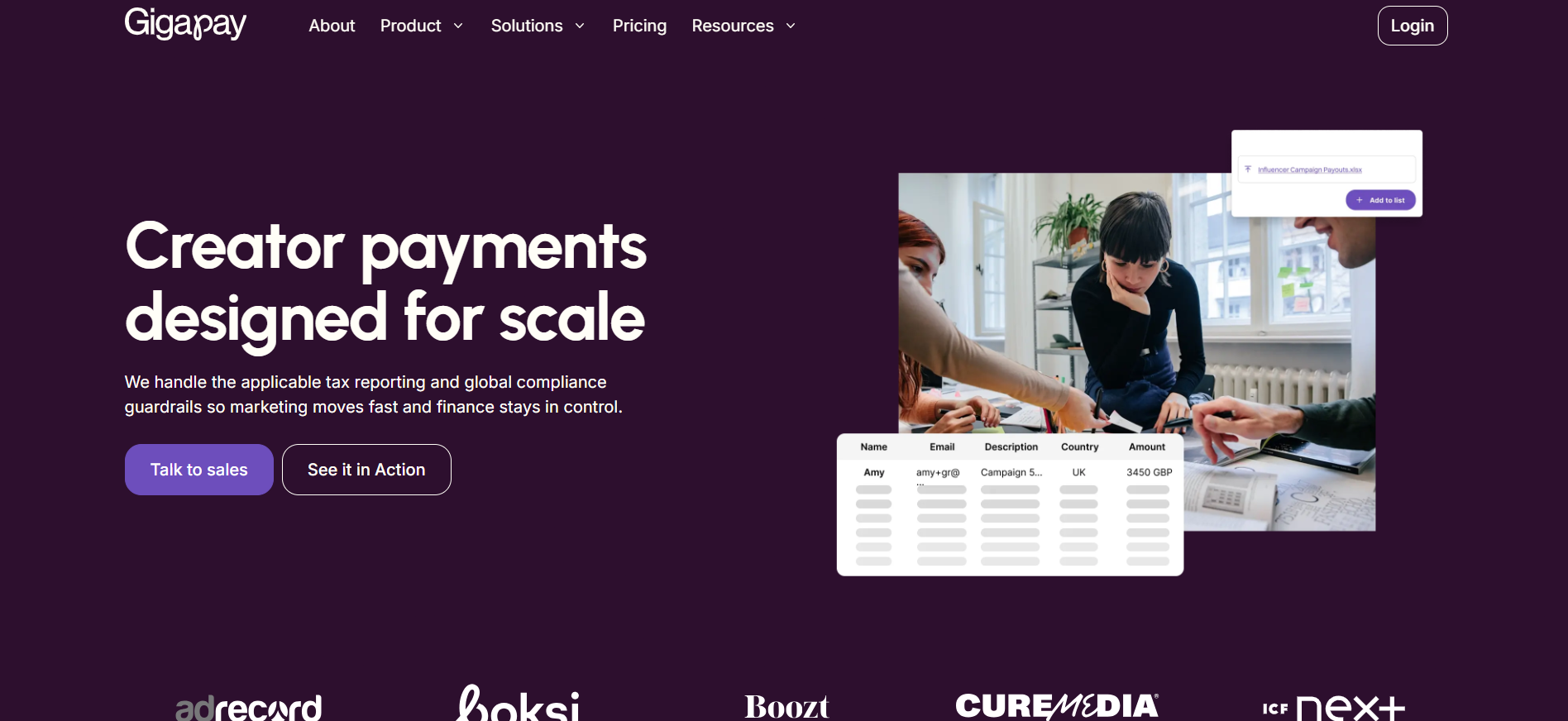
Integrated creator payouts are the ability to pay creators (onboarding, identity verification, money movement, tax reporting, and invoicing) directly inside the platform a brand, agency, or network already uses to manage its creator program.
Instead of running a campaign in one tool and then leaving that tool to settle with creators elsewhere, the payment is native to the workflow.
In a typical non-integrated setup, a brand discovers a creator on an influencer marketing platform, briefs them in that platform, gets the deliverable approved in the same place, and then exports everything to a finance tool (or a spreadsheet) to actually settle the payment. Every step outside the platform is friction, and every piece of creator data that has to be re-entered elsewhere creates compliance and error risk.
An integrated payout means the platform exposes a "Pay creator" action that runs the full flow inside the product.
- Creator onboarding (KYC, tax forms, entity type selection, bank details) happens once.
- Money moves on local payment rails.
- Multi-currency handling, invoice generation, and tax reporting all run in the background.
For platforms that embed this layer through an API like Gigapay's, the model also shifts who carries the legal weight. Gigapay becomes the Merchant of Record for every payout, which means the platform is not the tax counterparty, and the embedded experience inside the platform is a finished payout product, not just a money-movement connector.
Embedded payout APIs are developer tools that let SaaS companies send money to contractors, sellers, and users through a few lines of code, turning disbursements into a product feature instead of a back-office headache.
What are the Benefits of Integrated Creator Payouts in 2026
The benefits of integrated creator payouts in 2026 land at three levels: the platform doing the embedding, the brands and agencies using the platform, and the creators on the receiving end.
1. For platforms embedding the payout layer
The most important benefit is that payouts become a sticky native feature inside the product, which lifts retention. Users who pay creators inside the platform have a harder time switching to a competitor that requires them to leave the product to settle with the same creator base.
Platforms also gain a new monetizable surface, because Gigapay's pricing structure (a SaaS subscription plus a percentage transaction fee) supports partner economics that the platform can layer its own margin on top of. And the platform skips the longest part of its own roadmap, since building a global creator payout product from scratch is a multi-year program of legal counsel in every market, KYC infrastructure, payment partner contracts, and tax reporting pipelines.
2. For brands and agencies using the platform
The benefit is a single tool instead of three. Approval, payment, invoicing, and compliance live in the same screen. Cross-border tax reporting (DAC7 in the EU, KU14 in Sweden, KSK in Germany) is handled in the background, which means finance does not need to chase tax documentation for every collaboration.
Procurement constraints that used to block nano and micro creators from getting paid disappear, because Gigapay accepts creators who do not have a registered business or VAT number. 74 percent of brands are moving budget into creator programs in 2026, making payout infrastructure a decision that affects both spend and retention.
3. For creators
The benefit is the experience itself. Onboarding happens once and applies to every brand or agency they work with through the same Gigapay-powered platform. Payouts arrive instantly on local rails.
EarlyPay gives creators access to scheduled funds before the official payout date when they need liquidity. And creator support is handled by Gigapay's dedicated team, which is the reason Gigapay's creator NPS sits at 88, a number that is unusual for a payments product.
How Platforms Embed Gigapay Inside Their Product (Step-By-Step Guide)
The full integration takes two to five days for most teams. Most developers are up and running in Gigapay's sandbox environment within an hour, and a full production integration including project syncing, automated payout triggers, and webhook listeners typically takes two to five days of development time.
Below is the sequence we recommend, with the API objects and decisions called out at each step.
Step 1: Decide what to embed and where to draw the line
Before any code, the product team needs to decide what part of the payout experience lives inside the platform and what part redirects to Gigapay-hosted screens.
The standard split: the platform owns the campaign workflow (briefing, creator selection, deliverable approval, performance reporting) and triggers the payout from inside that workflow. Creator onboarding (the KYC flow, entity type selection, bank details) happens on a Gigapay-hosted link that the platform embeds or links to from its UI. Payout status updates flow back into the product through webhooks.
Lock down three things at this stage:
- First, whether the platform will use the full API or start with CSV uploads via the Gigapay dashboard. Most teams scale from CSV to API once volume justifies the engineering time.
- Second, whether the platform will white-label the experience or keep the Gigapay brand visible at the onboarding link.
- Third, whether customers (brands, agencies) need their own Gigapay accounts or pay through the platform as the single counterparty.
Step 2: Get sandbox credentials and explore the API
The Gigapay sandbox is identical to the production environment, except no real money moves through it. It serves as a sandbox for developers and uses regular API keys.
The platform receives two credentials during sandbox setup: an API token used for authentication on every request, and an Integration ID that scopes the request to your specific integration.
Both belong in environment variables from the start, because production uses separate credentials and the platform should be able to switch environments with a single config change.
Gigapay's API is also browsable, meaning every endpoint renders a human-friendly view in a browser. Before writing any code, walk through the projects, employees, payouts, and registrations endpoints in the browser to understand how the resources are shaped and how they relate to each other.
Step 3: Map Gigapay's data model to your platform
Five objects need to be mapped to your existing schema.
- The Project scopes a campaign, brand, or program, and acts as the container for the payouts that belong together.
- The Employee is the API term for the creator being paid, and each creator becomes an Employee object once onboarded.
- The Payout is the actual payment to a creator inside a project.
- The Invoice is the consolidated billing artifact Gigapay generates for the brand or agency funding the project.
- The Registration is the onboarding state of a company joining Gigapay as a new integration, used during initial setup.
A Gigapay Project usually maps to the platform's Campaign or Program. An Employee maps to the platform's Creator. A Payout maps to the Earning, Payment, or Settlement record. Decide which IDs are the source of truth and whether the platform stores the Gigapay IDs alongside its own.
Step 4: Create your first project
A Project is the first object to create for any campaign, and it scopes both the payouts and the invoice that will follow.
The platform calls the project's endpoint with a name for the project and an ID of its choosing. Pass your own internal campaign ID as the resource ID. Gigapay accepts it, which means later lookups can happen using the platform's own identifiers without having to store a separate Gigapay ID.
A useful convention is to make the project name human-readable for the brand-side view (for example, "Spring 2026 Nordic Campaign") and the ID a stable internal reference that maps one-to-one to a record in the platform's own database.
Step 5: Fund the project with a prepayment
Gigapay requires a prepayment to enable real-time payouts, with no limit on how many payouts are pre-registered, since Gigapay does not process them until payment is received. The prepayment endpoint creates the funding instruction tied to the project.
The platform calls the prepayments endpoint with the project ID, the amount being funded, and the currency. Once the prepayment is settled (confirmed via a webhook event), every payout triggered against the project goes out instantly. If your customers fund Gigapay through your platform rather than directly, this is the layer where your commercial model lives.
Decide whether the platform pre-funds projects on behalf of customers, invoices customers in advance, or settles after the campaign closes.
Step 6: Surface the creator onboarding link inside your UI
Creators onboard on Gigapay-hosted screens. The platform's job is to generate the onboarding link and place it where it makes sense in the product, typically right after the deliverable is approved or the contract is signed.
To generate the link, the platform creates an Employee object with the creator's name, email, country, and the project they belong to. The API returns the onboarding URL in the response. Surface that URL inside the platform: as a button next to the creator's name, in an email automation, or as part of the campaign's status panel.
When the creator clicks the link, they land on a Gigapay-hosted flow where they complete identity verification, choose an entity type (individual, sole trader, or company), and submit bank details. No registered business or VAT number is required. The full flow is handled by Gigapay's web app, including the creator support touchpoints if the creator hits a question during onboarding.
Step 7: Dispatch the payouts
Once a creator is onboarded, or in parallel (Gigapay accepts payouts to unverified creators using the invoiced amount field, which holds the payout until the creator completes verification), the platform calls the payouts endpoint with the amount, the currency, the Employee ID of the creator, the project ID, and a description.
The description field deserves attention because it is visible to the creator inside their Gigapay account. Write it as a human-readable line that explains why this payout is being made, for example "Q2 collaboration fee, deliverable 2 of 3".
Avoid machine IDs or internal codes that look like random strings to the creator.
Once the creator claims the payout and is verified, funds settle on local payment rails: SEPA Instant in the EU, Faster Payments in the UK, ACH in the US. Settlement is instant from the moment the creator claims it.
Step 8: Wire up webhooks for real-time status
Webhooks are optional but the preferred way of monitoring the status of objects. Gigapay can send callbacks on events including EmployeeClaimed, EmployeeCreated, EmployeeVerified, InvoiceCreated, InvoicePaid, PayoutAccepted, and PayoutNotified.
Two important distinctions to handle in your webhook configuration. Integration-scoped webhooks (Employee, Payout, and Payrun events) require the Integration ID header on every request. User-scoped webhooks (Registration events) do not. Build your webhook receiver with both cases in mind.
Each webhook payload also contains the full object that triggered the event, along with HTTP headers carrying a timestamp and a signature. Verify the signature on every incoming request before acting on it.
Map each webhook to a status visible inside your product. A typical mapping turns EmployeeCreated into "Onboarding sent", EmployeeVerified into "Ready to pay", PayoutNotified into "Payout pending", PayoutAccepted into "Paid", and InvoicePaid into "Settlement complete" for the brand-side view.
Step 9: Run the full flow in sandbox
In the sandbox, walk through the complete happy path: create a project, fund the prepayment, onboard a test creator, dispatch a payout, verify the webhook chain, and confirm the invoice generated correctly.
Then test the edge cases. Confirm what the UI shows when a creator fails KYC. See what happens when a payout is sent before the prepayment has settled. Check how multi-currency display (for example, a EUR project funded but a USD creator paid) reconciles in your reports. Decide how your support team sees Gigapay-side issues so they can hand off cleanly to Gigapay's creator support team.
This step usually surfaces two or three UX decisions the product team did not make in Step 1. That is expected. Adjust the in-product flow before going live, not after.
Step 10: Plan the in-product creator experience
Before production rollout, lock down four UX surfaces.
The "Pay creator" trigger. Where it sits in the campaign flow, who can press it, and what permission model gates it.
The status display. How payout status surfaces to the user who triggered it, and what label maps to which webhook event. Avoid technical state names like "PayoutAccepted" in user-facing copy, since they read as system jargon to a brand or campaign manager.
The creator-facing view. If the platform exposes anything to creators (a dashboard, a notification, an email), decide what to show about the payout itself and what to defer to Gigapay's own creator support and dashboard.
The support handoff. Gigapay's creator support team handles payment-related questions directly with creators. The platform's support team needs a clear escalation path for the few cases where the question crosses both products, so neither side leaves the creator without an answer.
Step 11: Move to production and roll out
Production runs on the live API endpoint, which your Gigapay account manager confirms during onboarding. Swap the environment variables, regenerate credentials in production, and re-test the happy path with a single real creator and a small real amount before opening the flow to all users.
For larger platforms, roll out by segment rather than turning it on globally. Start with one customer, one region, or one campaign type. Watch the webhook event volume and the support ticket pattern for the first two weeks, then expand from there based on what the data shows.

Integration Patterns by Platform Type
The eleven steps above are the same regardless of platform type, but the way the integration shows up to users differs.
1. Influencer marketing platforms
Influencer marketing platforms typically embed Gigapay as the payment layer of an existing campaign workflow. Kolsquare did this so creators inside Kolsquare can invoice and get paid directly inside the product, with no external invoicing tool and no bounce out to a separate dashboard. The brand approves the deliverable, and the payout fires from the same screen.
This is the pattern that produces the biggest UX shift, because it consolidates an entire workflow that used to span three tools.
2. Affiliate networks
Affiliate networks push high-volume, low-ticket payments to thousands of partners every cycle. The integration leans heavily on the batch payout endpoint and on webhooks.
AdRecord's CEO put it directly: "Simplicity, responsibility, and seamless API integration make this a no-brainer." For affiliate platforms, the payoff is the time the finance team gets back from no longer chasing creator tax forms across borders.
3. eSports and streaming networks
eSports and streaming networks use the same primitives for prize pools, sponsorship payouts, and tournament winnings paid across many jurisdictions. The volume pattern is bursty (a tournament finishes and 200 payouts go out within minutes), which makes the instant rails and the prepayment model especially useful.
What Changes Commercially Once the Integration Ships
Once the integration ships, three commercial effects show up at the same time.
- Payouts become a sticky native feature, which lifts retention. Users who pay creators inside the platform have a harder time switching to a competitor that forces them to leave the product to settle with the same creator base.
- The platform monetizes the payout flow without building a payments business. Gigapay's pricing structure of a SaaS subscription plus a percentage transaction fee supports partner economics, and the platform can layer its own margin on top inside its commercial model.
- The platform skips the longest part of its roadmap. Building a global creator payout product from scratch means hiring legal counsel in every market, building KYC infrastructure, signing payment partner contracts, and standing up tax reporting pipelines.
Embedding Gigapay collapses that program into a two-to-five-day integration and shifts the legal counterparty role off the platform's balance sheet.
How to Get Started with Gigapay in 2026
Getting started with Gigapay in 2026 follows a clear path that begins before any code is written. Each of the steps below builds on the last, and most platforms move from first conversation to live production in a few weeks.
1. Book the planning meeting with Gigapay's engineering team
The first move is a planning meeting with Gigapay's engineering team. Before the integration begins, one of Gigapay's engineers sets up an initial planning meeting to make sure there are no misunderstandings about what the platform is trying to achieve, and a shared Slack channel is set up for any questions during the integration.
The meeting clarifies whether the platform's use case fits the API directly or whether a CSV-first phase makes more sense as a starting point. It also surfaces any non-obvious constraints, such as how your customers handle invoicing, which currencies you need at launch, and whether any of your target markets have specific compliance requirements (KSK in Germany is the most common one that comes up).
2. Get sandbox access and your dedicated Slack channel
After the planning meeting, the platform receives a sandbox API token and Integration ID, and the shared Slack channel goes live. Most engineering teams reach a working test flow against the sandbox within the first hour.
Product and design teams use this same sandbox period to validate the UX decisions covered in Step 1 and Step 10 of the technical guide above. The Slack channel remains open throughout the integration, so questions about edge cases (multi-currency settlement, KYC failures, webhook signature verification, batch sizes) get answered directly by Gigapay's engineers without waiting on a support ticket.
3. Run the technical integration
This is the eleven-step process covered in the previous section, from project creation through webhook configuration to production rollout. Most platforms complete it in two to five days of focused engineering time.
The work splits roughly into one to two days on the core API flow, half a day on webhook handling, half a day on UX polish, and the remainder on edge-case testing in sandbox.
Larger platforms with more complex internal data models can spend additional time on schema mapping in Step 3, but the API surface itself does not get larger.
4. Confirm the commercial setup
The Base plan starts at €279 per month with a 4.9% admin fee per payout. The Enterprise plan applies once annual payout volume exceeds €1.8M and includes EarlyPay, a dedicated customer success manager, and unlimited users and API rate limits.
Most platforms run creator programs at the volume that justifies an embedded integration land in Enterprise territory within the first six to twelve months. The commercial conversation usually happens in parallel with the sandbox phase, so the contract is signed by the time the platform is ready to switch to production credentials.
5. Plan the rollout to your customers
The final step is deciding how the new payout experience reaches your customers. Most platforms roll out by segment rather than turning the integration on globally.
Pick a first segment based on which customers will see the biggest improvement (typically the ones running the most creator collaborations or hitting the most cross-border friction today), brief them on what changes from their side (usually nothing visible except faster creator payment and one consolidated invoice from Gigapay), and then expand based on the support and webhook data from the first two weeks of live use.
By the end of the first month, most platforms have enough data to roll out to the full customer base with confidence.
Conclusion
Gigapay is the mass creator payout platform that lets influencer marketing software, affiliate networks, and creator economy products embed instant global payouts and Merchant of Record compliance directly inside their own UI.
Integrated creator payouts in 2026 mean a native "Pay creator" action inside the product, two to five days of engineering work to ship it, and a legal counterparty role that shifts off the platform's balance sheet.
Book a demo to walk through what the integration looks like for your specific product and which steps your team can compress.
Read Next:
- Best Way to Pay Instagram Influencers Internationally in Bulk (2026 Guide)
- Gigapay Merchant of Record: Full Product Overview
- Self-Billing for Creators: How Gigapay Turns 500 Invoices Into One
FAQs:
1. What are integrated creator payouts?
Integrated creator payouts are the ability to pay creators (onboarding, KYC, money movement, tax reporting, and invoicing) directly inside the platform a brand or agency already uses to manage its campaigns, instead of exporting data to a separate finance tool.
2. How long does it take to integrate Gigapay's creator payout API into a platform?
It takes two to five days of engineering time to integrate Gigapay's creator payout API into a platform, with most teams reaching a working sandbox flow within the first hour. The full timeline depends on the complexity of the platform's internal data model and webhook handling.
3. Does the embedding platform take on tax liability for creator payouts?
The embedding platform does not take on tax liability for creator payouts, because Gigapay acts as Merchant of Record and becomes the legal counterparty for every creator deliverable, handling DAC7, KU14, and KSK reporting in the background.
4. How does the creator onboarding flow work inside an embedded Gigapay integration?
The creator onboarding flow inside an embedded Gigapay integration runs on Gigapay-hosted screens that the platform links to from its own UI, where the creator completes KYC, chooses an entity type, and submits bank details without needing a registered business or VAT number.
5. What is the difference between embedding Gigapay and embedding Stripe Connect for creator payouts?
The difference between embedding Gigapay and embedding Stripe Connect for creator payouts is that Gigapay assumes the Merchant of Record role for every deliverable, automates EU and country-specific tax reporting, and onboards creators without requiring a registered business, none of which is part of the Stripe Connect model.
.jpg)
.jpg)
.jpg)