
36.8% of European brands and agencies now work with 100 or more creators a year, double the 2024 share, according to Kolsquare's The Future of Influencer Marketing: The 2026/2027 Outlook (September 2026).
Paying them across 10 European markets on one invoice means contracting one Merchant of Record that buys their services and invoices you per batch.
Gigapay is the Merchant of Record for creator payments. Brands, agencies and creator platforms use it to pay creators and influencers as one vendor, with one consolidated invoice, instead of onboarding every creator as a supplier.
Below is the 2026 cost by country and how to move all 10 markets onto one invoice.
Key Takeaways
- One consolidated invoice can replace one supplier invoice per creator across 10 markets.
- Standard VAT in these 10 markets runs from 19% in Germany to 25.5% in Finland.
- Ardent Partners puts the 2026 average cost of processing one invoice at $9.90.
- Four of the 10 markets use SEK, NOK, DKK or GBP, adding conversion costs.
- KSK stays with German clients, and the 2026 rate is 4.9% of artistic fees.
How Much Are European Brands Spending On Creators In 2026?
European influencer budgets are growing faster than the finance processes that pay creators. Kolsquare's 2026/2027 study, run by B2B International in May and June 2026 among 1,123 marketing decision-makers, found that 89% expect to raise influencer spend in the next 12 months. That share was 75% in 2025 and 54% in 2024.
Median annual spend is €144,000 across the sample and €367,000 at companies with 1,000 or more employees. Rosters grew with budgets: 85% of organisations worked with more creators than the year before, and 70.9% use micro creators.
.For your team, every new creator in a new market becomes another supplier record, invoice and bank transfer unless the payment model changes.
Why Does Paying Creators Across European Markets Cost So Much?
The cost sits in the invoice count. Ardent Partners' AP Metrics that Matter in 2026, as summarised by sponsor Medius, puts the average cost of processing one invoice at $9.90. Best-in-class teams pay $2.67, and 19.9% of invoices hit an exception on average.
Creator fees are small next to that overhead. Kolect's 2026 benchmark of 120,000+ collaborations (October 2026) puts the median creator fee at $616 in Western and Northern Europe, $600 in the UK and Ireland and $460 in Southern Europe.
Processing alone takes about 1.6% of a $616 fee, before onboarding, conversion and follow-up.
Each market then adds its own layer:
- Currency: Sweden, Norway, Denmark and the UK do not use the euro.
- VAT: rates and registration thresholds differ in every country.
- Invoice format: France and Germany are phasing in e-invoicing rules.
- Supplier status: many nano and micro creators have no registered company or VAT number for procurement to check.
For finance, the bill grows with the number of creators and countries, so a 10-market programme multiplies admin even when fees stay flat.
What Does It Cost To Pay Creators In Each European Market In 2026?
The cost of paying a creator in 2026 changes with each market's currency, VAT rate and VAT registration threshold. The table below compares the 10 markets this guide covers, with the median creator fee for each market's region.
Sources: standard rates from the European Commission VAT rates list, GOV.UK and the Norwegian Tax Administration (Skatteetaten); thresholds as compiled by Taxually (October 2026); fees from Kolect (October 2026).
Three patterns matter for budgeting. Standard VAT on services runs from 19% in Germany to 25.5% in Finland, so the VAT line on a creator invoice changes by market. Creators below their country's threshold are often not VAT-registered, so procurement may have no VAT number to check. Four markets pay in SEK, NOK, DKK or GBP, so a euro-funded programme carries conversion margins on 40% of its markets.
For your budget, treat currency and creator legal form as cost drivers alongside the fee itself.
How Much Does It Cost To Pay 150 Creators One By One Versus On One Invoice?
Paying 150 creators a month one by one costs about $17,820 a year in invoice processing alone, at Ardent Partners' 2026 average of $9.90 per invoice. The example below assumes 15 creators in each of the 10 markets, paid monthly.
This is a calculation from published averages, not a measured customer result. Creator fees stay the same in both columns: at the regional medians above, 150 creators cost roughly $90,000 a month in fees. The consolidated column also excludes the Merchant of Record's own fees, which for Gigapay are on the live pricing page.
Gigapay's estimate for a brand running 600 collaborations a year compares €139,590 and 840 hours handled one by one with €46,350 and 60 hours on Gigapay.
For your business case, count invoices, exceptions and supplier records, because those are the lines that shrink.
How To Pay Creators In 10 European Markets On One Invoice, Step By Step
Moving 10 markets onto one invoice takes eight steps, and most of the work happens before the first campaign.
- Map every creator by market, currency and legal form: individual, sole trader or company.
- Agree with finance and procurement which records they will keep: the vendor's invoice, the contract and proof of payment.
- Sign one agreement with one Merchant of Record and set it up as a single vendor.
- Upload creators and amounts per campaign by spreadsheet, app or API.
- Ask creators to onboard and complete identity and tax-ID checks before work starts.
- Approve the delivered work, then receive one consolidated invoice per batch or campaign.
- Pay that one invoice and reconcile it at month-end against the batch.
- List the obligations that stay with you in each market, such as KSK for German clients, with your tax adviser.
Run steps 1 and 2 first, because they decide whether finance will sign off on the new process.
How Does Gigapay Pay Creators In 10 Markets On One Invoice?
Gigapay turns one supplier relationship per creator into one Service Agreement and one consolidated invoice per batch or campaign.
How the model works
- The client signs one Service Agreement with Gigapay and adds creators and amounts by spreadsheet upload, the app or the API.
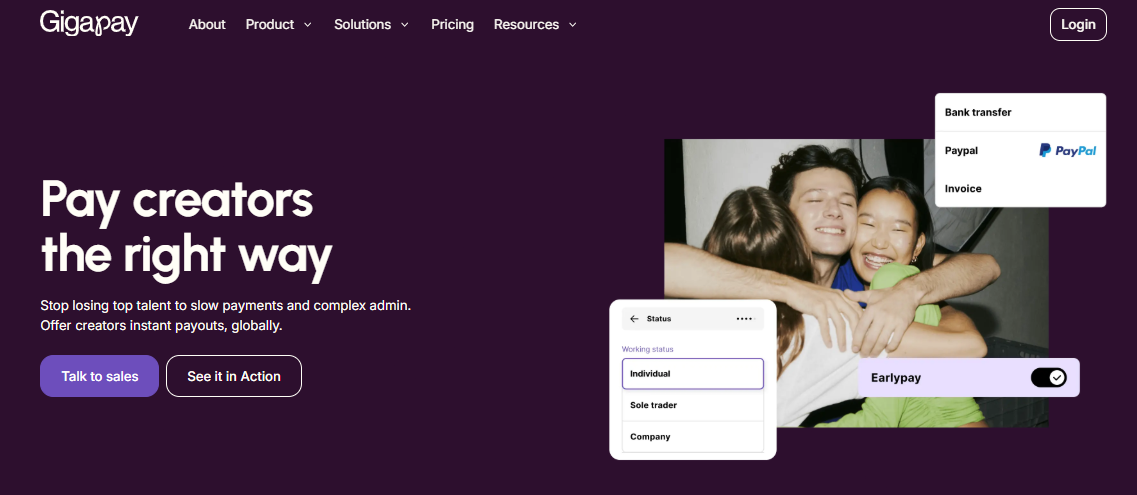
- Creators onboard with Gigapay as an individual, a sole trader or a company. Gigapay runs identity and tax-ID checks at onboarding.
- When the client approves the work, Gigapay undertakes to buy the creator's services and issues the client a consolidated invoice.
- The creator claims the payout in Gigapay. At the claim, Gigapay buys the services and resells them to the client.
- The payout is executed by a licensed third-party payment provider.
- Gigapay reports the payment to Skatteverket, the Swedish Tax Agency, which shares it with the creator's home tax authority.
What it covers across 10 markets
- One vendor, one invoice: the client has one vendor record and receives one consolidated invoice per batch or campaign. The client keeps Gigapay's invoice, the contract and proof of payment.
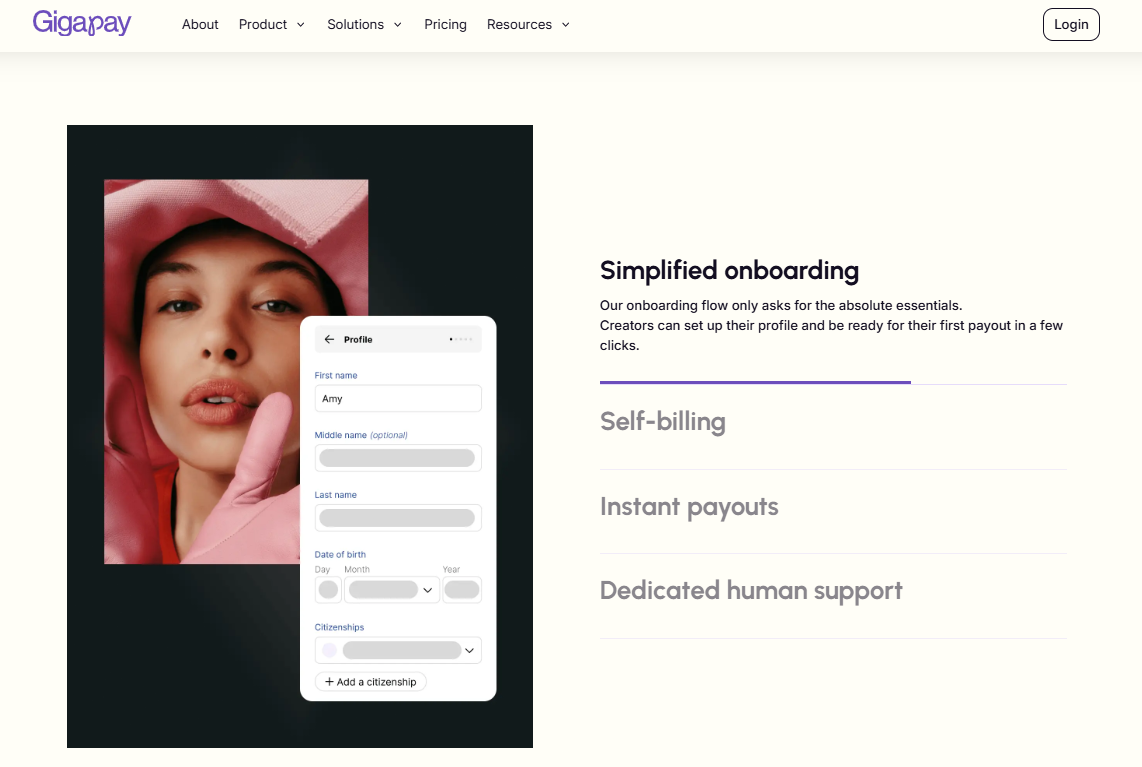
- Creator onboarding: creators onboard as individuals, sole traders or companies, and no registered company or VAT number is needed. Gigapay puts creator onboarding at about 10 minutes.
- Creator paperwork: Gigapay handles the paperwork for every payout. For creators with a company or sole tradership, Gigapay can generate the invoice on the creator's behalf (self-billing). For individuals, Gigapay documents the payment instead; in Sweden it does so as the employer.
- Currencies and speed: Gigapay pays in 50+ currencies. Payouts arrive in seconds to a few banking days, depending on country and payout method; instant payouts apply only in Sweden at Nordea, Swedbank, SEB, Handelsbanken and Danske Bank.
- Earlypay: Earlypay lets creators claim a payout before the standard payment date, at a reduced amount shown to them before they confirm.
- Sweden: Gigapay can employ the creator for the assignment, deduct preliminary tax, pay employer contributions and file the employer return.
- Germany: for German clients, Gigapay collects and shares the creator data needed to handle KSK obligations correctly.
- DAC7: Gigapay files DAC7 as the platform operator with Skatteverket.
- API and partners: clients and platforms can integrate payouts through the Gigapay API, with integration in a week. Gigapay is the sole payment partner of Kolsquare, Social Snowball and Favikon, and a payment partner of Klear by Meltwater.
Check that all 10 markets are live for your programme on the Supported Markets page.
What clients report
WPP Media reports 80% fewer invoices, Once Upon reports 25% admin time saved and Boozt reports 3x collaborations without growing the team.
For your team, that means one vendor to onboard, one invoice to approve per batch and one set of records to keep.
Who Handles Tax, VAT, DAC7 And KSK When One Vendor Pays Your Creators?
For the creator's fee, Gigapay is the payer: Gigapay pays the creator and reports the payment. Outside Sweden nothing is deducted at source and the creator handles their own tax and contributions; in Sweden Gigapay employs them and deducts as an employer.
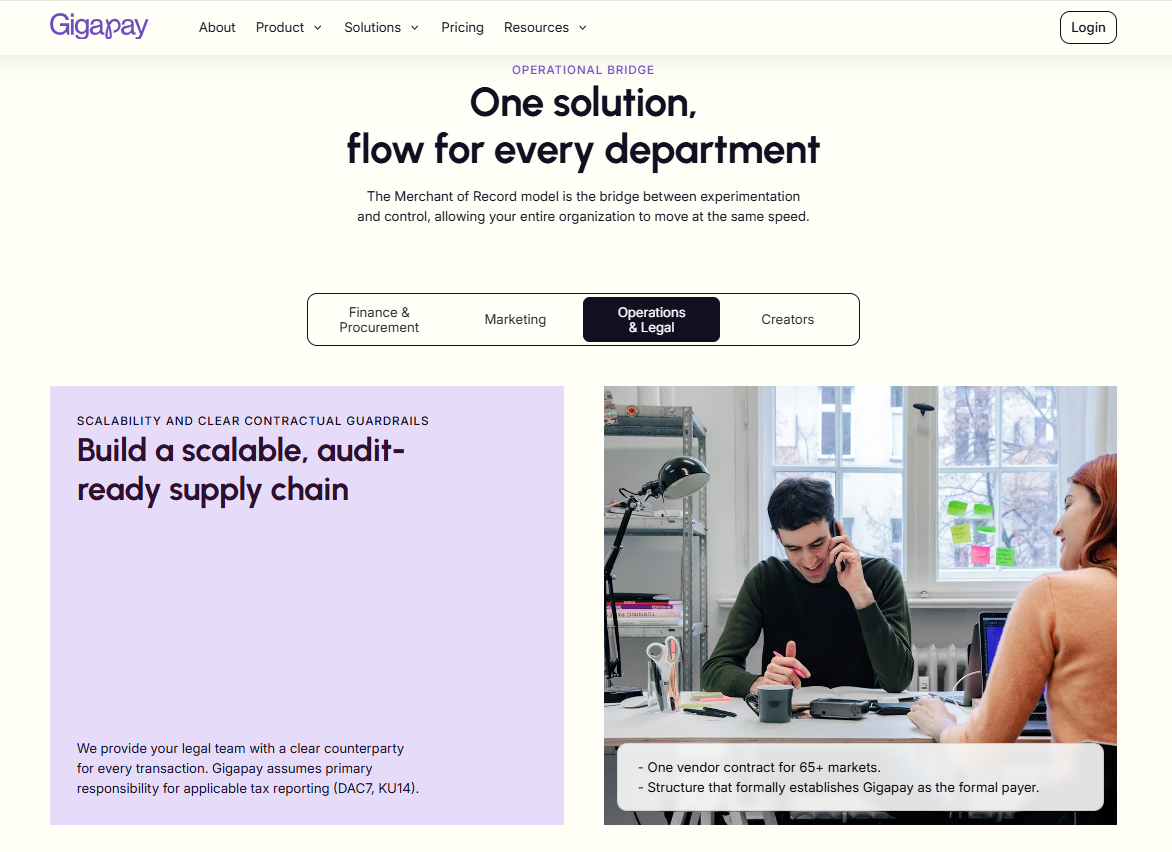
Gigapay is the creator's counterparty and payer, so obligations that depend on being the payer stop attaching to you. Obligations of the party commissioning the work, such as Germany's KSK, and how you engage your creators stay with you.
- VAT: the client's VAT is on Gigapay's invoice, not on a creator invoice, because the creator supplies Gigapay.
- DAC7: Gigapay files as the platform operator with Skatteverket, which shares the data with the creator's home tax authority. It does not pre-fill the creator's tax return, and creators still declare their income. DAC7 is a reporting rule and does not cover VAT.
- KSK: the levy is 4.9% in 2026 under the Künstlersozialabgabe-Verordnung 2026 and 5.0% in 2027 under the 2027 regulation published on 15 September 2026. For German clients, Gigapay collects and shares the creator data needed to handle KSK obligations correctly.
This is general information, not tax advice. For your compliance review, give your tax team this split before the first batch, so they can confirm which obligations stay in-house.
Which E-Invoicing Rules Affect Creator Payments In 2026?
Five of the 10 markets have dated e-invoicing rules for business invoices, and most mandates cover businesses established in that country. The dates below come from Taxually's 2026 compilation (October 2026).
Across the EU, the VAT in the Digital Age package makes e-invoicing and digital reporting mandatory for intra-EU B2B supplies from 1 July 2030.
For accounts payable, every creator who invoices you directly is another sender whose format must meet these rules. With one vendor, your team checks one supplier's invoice format instead of hundreds.
Common Mistakes When Paying Creators Across European Markets
Most cost overruns in multi-market creator programmes come from process choices made before the first payment.
- Budgeting on fees only: a $616 median fee carries invoice, exception and onboarding costs on top.
- Creating one supplier record per creator: each record adds onboarding checks, master-data upkeep and an ERP entry that lasts long after the campaign.
- Ignoring currency: SEK, NOK, DKK and GBP payouts funded in euros carry conversion margins. Under EU rules, payment providers must show currency conversion charges before an online credit transfer, as summarised on EUR-Lex, so ask for that figure.
- Assuming every obligation moves: obligations on the party commissioning the work, such as Germany's KSK, and how you engage your creators stay with you.
- Skipping the legal-form check: individuals, sole traders and companies need different paperwork, so map them before onboarding.
- Losing the paper trail: keep the vendor's invoice, the contract and proof of payment for every batch.
Fix these six points first, because each one compounds as you add markets.
Conclusion
Gigapay is the Merchant of Record for creator payments.
Paying creators in 10 European markets one by one in 2026 means 10 VAT regimes, five payout currencies and one invoice per creator at about $9.90 each to process.
On one consolidated invoice, finance keeps one vendor record and one invoice per batch, while obligations such as Germany's KSK stay with the client.
Book a demo to see how your 10 markets would run on one invoice.
Read Next:
- Best Way for Gaming Studios and App Publishers to Pay Streamers and UGC Creators in 2026
- Net 30 vs Instant Pay: How Payment Speed Changes What Creators Charge (2026)
- Best Creator Payout Platform for Sweden, Norway, Denmark and Finland in 2026
FAQs:
1. How do you pay creators in several European countries on one invoice?
You pay creators in several European countries on one invoice by working with a Merchant of Record. Gigapay undertakes to buy each creator's services when you approve the work and issues you one consolidated invoice per batch or campaign. Creators onboard as individuals, sole traders or companies.
2. How much does it cost to process a creator invoice in 2026?
It costs $9.90 on average to process a creator invoice in 2026, according to Ardent Partners' AP Metrics that Matter in 2026, as summarised by Medius. Best-in-class teams pay $2.67. At that average, a brand paying 150 creators monthly spends about $17,820 a year processing 1,800 invoices.
3. What are the standard VAT rates across 10 European creator markets in 2026?
The standard VAT rates across 10 European creator markets in 2026 are 25.5% in Finland, 25% in Sweden, Norway and Denmark, 22% in Italy, 21% in Spain and the Netherlands, 20% in the UK and France, and 19% in Germany. This is general information, not tax advice.
4. Does KSK still apply to German brands that pay creators through a Merchant of Record?
KSK still applies to German brands that pay creators through a Merchant of Record, because it attaches to the client commissioning the work. For German clients, Gigapay collects and shares the creator data needed to handle KSK obligations correctly. The KSK rate is 4.9% in 2026 and 5.0% in 2027.
5. What records does finance keep when one vendor pays all creators?
Finance keeps Gigapay's invoice, the contract and proof of payment when one vendor pays all creators. The client has one vendor record and receives one consolidated invoice per batch or campaign, instead of one supplier record and invoice per creator.