

Germany's influencer marketing market is projected to reach $1.57 billion in 2026, making it one of the largest creator markets in Europe.
Gigapay is the Merchant of Record for creator payouts, the one vendor solution that pays your creators on your behalf by taking on the compliance, payouts, and support so you don't have to.
Behind that market growth sits a levy most marketing teams have never budgeted for: the Künstlersozialabgabe, a 4.9% social insurance contribution that German companies owe on payments to self-employed creators, whether those creators live in Munich or Manila.
This article breaks down who owes the KSK levy, how the 2026 rate and thresholds work, what it costs at realistic campaign budgets, and what happens when the Deutsche Rentenversicherung audits a creator program that was never reported.
Key Takeaways
- German companies owe a 4.9% KSK levy on payments to self-employed creators in 2026.
- The 2026 Bagatellgrenze for self-advertisers is €1,000 per calendar year, up from €700.
- The levy applies to foreign creators too, as long as the paying company is German.
- DRV audits reach back up to five years, with fines reaching €50,000.
- Companies based outside Germany do not owe the KSK contribution at all.
The German Creator Market Grew Faster Than Its Payment Practices
German influencers are expected to reach 71 million people with their social media posts in 2026, according to Statista projections, and roughly 587,000 people in Germany qualify as influencers, the fifth-highest count in Europe.
Large enterprises now dedicate around 23% of their marketing budgets to influencer marketing, up from 14% in 2023. The money moving toward creators is real, growing, and increasingly concentrated in structured brand programs rather than one-off gifting campaigns.
The payment operations behind that money have not kept pace. Most German brands still pay creators the way they paid a freelance photographer in 2015: an individual invoice, a manual vendor setup, a bank transfer, and no systematic view of what those payments trigger under German social insurance law.
That gap between how much brands spend on creators and how little infrastructure sits behind the payments is exactly where the KSK levy lives.
Germany Is Now the Hottest Enforcement Market in Europe
The compliance era of the creator economy has started, and Germany is where it started loudest. Tax investigators in North Rhine-Westphalia are running criminal proceedings tied to an estimated €300 million in suspected influencer tax evasion, with roughly 200 cases opened. Hamburg's tax authority has been auditing 140 influencers.
A Cologne court ruling from September 2025 established direct advertiser liability for influencer disclosure failures, which means the brand, not just the creator, answers for what goes wrong in a campaign.
The KSK sits inside this enforcement wave. The Deutsche Rentenversicherung (DRV), which handles KSK audits, has been running dedicated out-of-cycle KSK audits that reach back over prior years and carry fines of up to €50,000.
Every payment a German company makes to a creator is now a compliance event with a paper trail regulators can request. Understanding what the levy actually is, and what it costs, is no longer optional homework for finance teams.
What the Künstlersozialkasse Actually Is
The Künstlersozialkasse (KSK) was created in 1983 to give self-employed artists and publicists access to Germany's statutory pension, health, and long-term care insurance. In regular employment, the employer covers roughly half of an employee's social insurance contributions.
Self-employed artists have no employer, so the KSK system recreates that missing half: the artist pays one half of their contributions, and the other half is funded through a federal subsidy plus a levy on the companies that commercially use artistic and journalistic work.
That levy is the Künstlersozialabgabe, and it is governed by the Künstlersozialversicherungsgesetz (KSVG). Section 24 of the KSVG defines who counts as an abgabepflichtiger Verwerter, a liable utiliser of artistic services. Section 25 sets the rate.
The important mental shift for marketing and finance teams is this: the levy is not a tax on the creator. It is a charge on the company commissioning the work, calculated on top of what the creator invoices, and it cannot be deducted from the creator's fee.
Influencers and content creators fall squarely within the KSK's definition of artists and publicists. The German authorities treat content creation, photography, video production, copywriting, and design as artistic or journalistic work, which means a brand deal with an Instagram creator triggers the same levy as a commission to a freelance illustrator.
Who Owes the Levy in 2026
Three categories of company are liable under §24 KSVG:
- Typical utilisers of artistic work: Advertising and PR agencies, publishers, press agencies, broadcasters, theatres, galleries, and similar businesses whose core activity involves commissioning artistic or journalistic work. These companies owe the levy from the first euro paid, with no minimum threshold.
- Self-advertisers (Eigenwerber): Any company that runs advertising or public relations for its own business using self-employed artists or publicists. This is the category most brands working with influencers fall into. For this group, the levy applies once payments exceed the Bagatellgrenze, which is €1,000 per calendar year in 2026.
- Companies under the general clause: Businesses that regularly commission artistic or journalistic work and generate revenue from it, even if it is not their core activity.
Two boundary rules matter enormously for creator programs:
- The creator's location is irrelevant: A German company owes KSK on payments to self-employed creators regardless of where those creators are based. A Berlin brand paying a creator in Stockholm, London, or São Paulo owes the same 4.9% it would owe on a payment to a creator in Hamburg.
- The company's location is decisive: Companies based outside Germany do not owe the KSK contribution. The liability attaches to the German entity commissioning the work.
One more distinction that trips up finance teams: the levy applies to payments made to individuals and partnerships such as a GbR. Payments to a creator's own limited company (a GmbH or UG) are generally outside the levy base, because a legal entity is not a self-employed artist under the KSVG.
The 2026 Rate, the Threshold, and What Counts as the Base
The Künstlersozialabgabe rate for 2026 is 4.9%, reduced from 5.0%, which had held from 2023 through 2025. The Bundesministerium für Arbeit und Soziales confirms the rate each autumn, and the 2027 rate announcement typically lands in November.
The Bagatellgrenze, the de minimis threshold for self-advertisers, has moved sharply in recent years:
Note how the threshold works. It is not a per-creator allowance. Once a self-advertiser's total payments to self-employed artists and publicists cross €1,000 in a calendar year, the levy applies. A brand paying twenty micro-creators €100 each has crossed the threshold, even though no single creator received more than €100.
The levy base is the fee paid for the artistic or journalistic work, including ancillary costs and expenses the company reimburses, but excluding VAT. Usage rights and licensing fees paid to the creator count toward the base as well. If a creator invoices €5,000 plus €950 VAT for a campaign, the KSK base is €5,000 and the levy is €245.
What the Levy Costs at Real Campaign Budgets
The percentage sounds small until you multiply it against an actual creator program. Here is what 4.9% looks like at budgets German brands actually run:
For context on individual deals: German creator rates have climbed steeply, with micro-creator rates up 200 to 233% since 2024 according to CreatorFest's State of Creator Compensation 2026 research. A mid-tier German creator commanding €3,000 to €8,000 per campaign means a single quarterly always-on program with ten creators can put a brand €150,000 into the levy base before the year is half over.
The levy is also only the visible part of the cost. The invisible part is administration. Manual creator payments run €40 to €60 in true all-in cost per payment once you count vendor setup, invoice handling, and error cycles, and a brand running 600 collaborations a year spends roughly 840 admin hours on the process.
KSK adds its own layer to that: registration, record-keeping per creator, annual reporting, and monthly advance payments once you are in the system.
The Reporting Process: Step by Step
Once a German company determines it is liable, the KSK process runs on a fixed rhythm:
- Registration: The company completes the KSK's registration and assessment form (Anmelde- und Erhebungsbogen) to establish whether and from when it is liable. The KSK issues a formal determination.
- Annual report: By 31 March of each year, the company reports the total levy-relevant payments made in the previous calendar year on the KSK's Meldebogen.
- Monthly advance payments: Based on the previous year's reported total, the KSK sets monthly Vorauszahlungen, which the company pays across the year, with a final settlement after the next annual report.
- Record-keeping: Under the KSK's Informationsschrift Nr. 17, liable companies must keep records of amounts paid, the recipients' names, and the context of the work, and keep those records available for audit.
Missing the annual report does not make the obligation disappear. It converts a predictable 4.9% line item into an audit finding with interest and penalties attached.
What a DRV Audit Actually Looks Like
KSK compliance is enforced by the Deutsche Rentenversicherung, which examines employers' social insurance obligations and has been running dedicated KSK-only audits outside its regular four-year audit cycle. Three features make these audits expensive for unprepared creator programs:
1. They reach backwards
Auditors can assess unpaid levies retroactively across prior years, with back-assessment periods running up to five years. A brand that spent €200,000 a year on creators for five years without reporting faces a back payment of roughly €49,000 to €50,000 in levy alone, before interest and penalties.
2. Fines reach €50,000
Deliberate or negligent violations of the reporting and payment obligations carry fines up to €50,000, on top of the back payments.
3. They pull the thread on everything else
A KSK audit sits next to Germany's other enforcement mechanisms. Scheinselbstständigkeit (false self-employment) rules now carry administrative fines up to €500,000 and retroactive social security liability up to four years at roughly 40% of gross revenue, with a presumption of false self-employment when more than five-sixths of a freelancer's revenue comes from one client.
German authorities cross-reference social security contributions with VAT filings using automated audit tools, and DAC7 platform reporting feeds tax offices structured data on who paid which creator how much. An auditor who finds an unreported creator program rarely stops at the KSK question.
The honest summary for a CFO: the levy itself is a manageable, plannable 4.9%. The exposure comes from not knowing the obligation exists, which is common. Most brands paying creators in Germany discover the KSK when the letter arrives, not before.
Where an Agency or Intermediary Does and Does Not Help
A frequent assumption is that routing creator payments through an agency or a payment provider removes the KSK obligation. The legal position is more specific than that, and worth stating plainly.
When a German company commissions creative work for its own advertising, the KSK treats that company as the beneficiary of the artistic work. Payment intermediaries that are not established in Germany are not themselves liable for the levy, which means the reporting and payment obligation stays with the German client.
Commissioning through a German advertising agency shifts the mechanics, because agencies are typical utilisers who owe the levy on what they pay creators, but a brand paying creators directly, or through a foreign intermediary, keeps the obligation on its own books.
This is why the useful question for procurement is not "who can make my KSK levy disappear" but "who can make my KSK reporting accurate and painless." The obligation is a function of German law and your company's registered seat. What a well-built payment setup changes is whether you can actually produce the numbers the KSK and the DRV ask for.
How Gigapay Fits Into a KSK-Compliant Creator Program
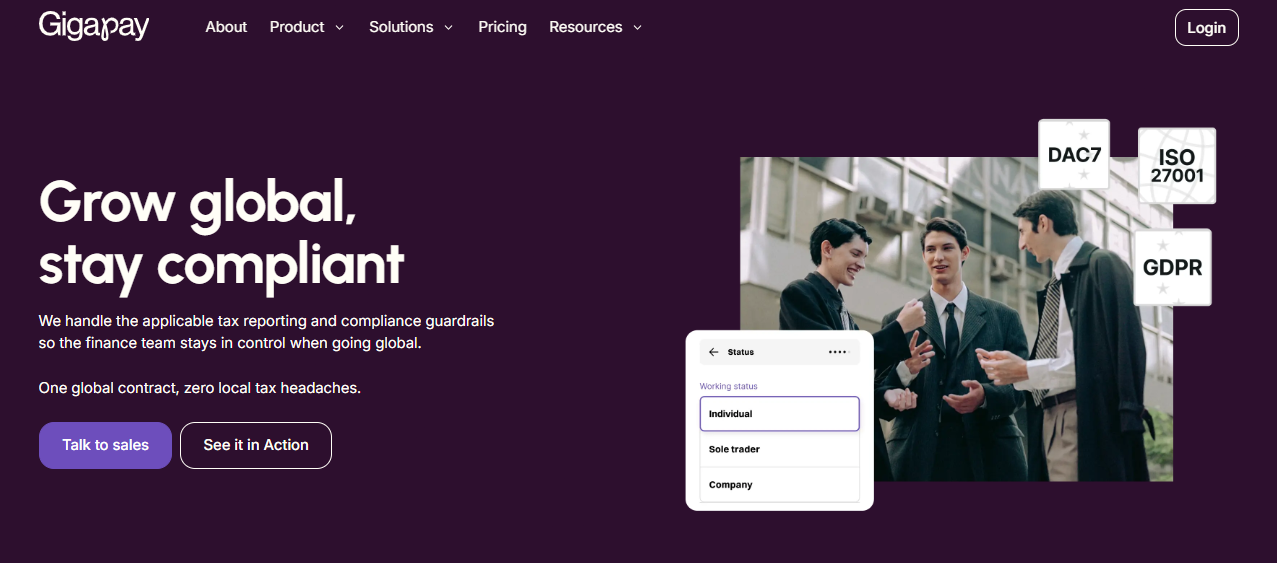
Gigapay is the Merchant of Record for creator payouts: your company signs one contract with Gigapay, pays one consolidated invoice per campaign, and Gigapay pays your creators in 65+ markets, taking on the payouts, associated compliance workload, and creator support.
For German clients specifically, Gigapay is transparent about the boundary: as a Swedish company acting as an intermediary, Gigapay is not liable for the KSK levy, and the reporting obligation stays with the German client. What Gigapay does is make that obligation practical to meet.
Concretely, that support looks like this:
1. A clean data trail per creator
Gigapay's onboarding collects the information German companies need for KSK reporting, and a data processing agreement signed alongside the service agreement lets Gigapay share per-creator payment data with the client, including flagging when a creator's annual total approaches or passes the €1,000 threshold.
2. Records that match what auditors request
The KSK's record-keeping rules require names, amounts, and the context of the work. Because every payout runs through one system instead of hundreds of individual bank transfers, those records exist by default rather than being reconstructed from email threads during an audit.
3. One counterparty instead of vendor sprawl
Consolidated invoicing cuts invoice volume by around 80%, which matters for KSK because the annual Meldebogen is only as accurate as the payment records behind it. Three hundred individual creator vendor entries become one vendor of record, and the levy base becomes a report you export instead of a spreadsheet you rebuild every March.
4. Creators paid properly while you handle the levy
Creators onboard in minutes without needing a registered company, payouts are instant when pre-funded, and on all new plans clients cover the fees, so creators keep what they earn. The creator side of the program stays fast while the finance side stays auditable.
The same structure covers the obligations that sit next to KSK. Gigapay handles KYC and self-employment status verification at onboarding and files DAC7 reports where it acts as the reporting platform operator, so the German data feed that increasingly triggers audits shows a program that was run properly from the start.
Budgeting for KSK: A Practical Checklist for 2026
For teams planning German creator spend this year, the planning logic compresses into five questions:
- Is your paying entity German? If yes, KSK applies to your creator program. If your paying entity sits outside Germany, the levy does not apply to it.
- Are you paying individuals or companies? Payments to self-employed individuals and GbRs count toward the levy base. Payments to a creator's GmbH generally do not, but verify the entity type at onboarding rather than assuming.
- Will total creator payments exceed €1,000 this calendar year? For self-advertisers, that is the 2026 threshold, measured across all creators combined, not per creator.
- Have you added 4.9% to the budget line? Treat the levy as a mandatory surcharge on net creator fees, including reimbursed expenses and usage rights, excluding VAT.
- Can you produce names, amounts, and work context on request? If the answer requires opening email archives, fix the record-keeping before the DRV asks the question for you.
Run those five questions against a planned €300,000 German creator budget and the answer is a €14,700 levy, a registration form, an annual report due 31 March, and a record-keeping obligation. Budgeted and reported on time, that is a rounding error next to the media spend. Discovered in year four of an audit, the same program is a six-figure conversation.
Conclusion
Gigapay is the Merchant of Record for creator payouts, the one vendor solution that pays your creators on your behalf by taking on the compliance, payouts, and support so you don't have to.
The KSK levy is one of the clearest examples of why that structure matters in Germany: a 4.9% contribution that German companies owe on creator payments above €1,000 a year, enforced by DRV audits that reach back five years and fine up to €50,000, and owed regardless of where your creators live.
The levy itself is affordable. The audit that finds an unreported program is not, and the difference between the two comes down to whether your payment records can answer the KSK's questions.
Book a demo and see how Gigapay turns your German creator payments into one auditable data trail before the reporting deadline turns into an audit letter.
Read Next:
- Why Spain Breaks Most Creator-Payout Setups (and How to Fix It)
- DAC7 Explained for Finance Teams: What Platform Operators Owe, and When
- Tipalti + Gigapay: Where Your AP Suite Ends and Liability Transfer Begins
FAQs:
1. What is the KSK levy rate for paying creators in Germany in 2026?
The KSK levy rate for paying creators in Germany in 2026 is 4.9%, reduced from the 5.0% rate that applied from 2023 through 2025, and it is charged on net fees paid to self-employed artists and publicists, including influencers.
2. Who has to pay the Künstlersozialabgabe when working with influencers?
The company that has to pay the Künstlersozialabgabe when working with influencers is the German company commissioning the work, including brands advertising their own business, once payments to self-employed creators exceed €1,000 in a calendar year.
3. Does the KSK levy apply to payments made to foreign creators?
Yes, the KSK levy applies to payments made to foreign creators whenever the paying company is based in Germany, because the obligation follows the German company's seat rather than the creator's country of residence.
4. What happens if a German company never reported KSK on creator payments?
If a German company never reported KSK on creator payments, the Deutsche Rentenversicherung can assess back payments retroactively across up to five years and impose fines of up to €50,000 on top of the unpaid levy and interest.
5. How can a company reduce the administrative burden of KSK reporting?
The way a company can reduce the administrative burden of KSK reporting is to run all creator payments through one system that records names, amounts, and work context per creator, which is what Gigapay provides German clients through consolidated payouts and per-creator payment data shared under a DPA.
.jpg)
.jpg)
.jpg)