.jpg)

Global influencer marketing spend is projected to hit $40.51 billion in 2026, up from $31.07 billion in 2025, according to Mordor Intelligence.
Gigapay is the Merchant of Record for creator payouts: the one vendor that pays your creators on your behalf and takes on the compliance, the payouts, and the support so your team does not have to.
A growing share of that $40 billion now runs through finance teams whose AP stack was built for registered suppliers with VAT numbers, which is why the smartest setups do not replace the AP suite at all: they pair it with a payer of record and let each system hold the spend it was designed for.
This article breaks down what Tipalti is built for, the exact point where the AP model ends, what liability transfer means on the other side of that line, and how the two systems run together as one stack.
Key Takeaways
- Tipalti and Gigapay are complements, not substitutes: suppliers through AP, creators through MoR.
- The AP suite ends where payees stop being registered businesses with compliant invoices.
- Liability transfer means Gigapay becomes the legal payer and files DAC7, KU14, KSK.
- Combined stack benchmark: 840 creator admin hours a year drop to roughly 60.
Why Creator Payments Are Now a Finance Problem
73% of US brands now run dedicated creator budgets, up from 47% in 2022, and mid-market brands spend between $50,000 and $250,000 per quarter on creator partnerships. That money behaves nothing like what the supplier spends.
- Supplier spend means a few hundred vendors, monthly invoices, net-30 terms, and a procurement process that vetted every counterparty once.
- Creator spend means hundreds of individuals, one-off campaign payments of €200 to €2,000, and a payee population where a large share has never registered a business.
The gap between those two shapes of spend lands on finance. Gigapay's ROI analysis of a brand running 600 creator collaborations per year puts the manual cost at roughly €139,590 annually across 840 admin hours, vendor sprawl, and error cycles, and Ardent Partners' 2025 research prices a single manually processed payment at €40 to €60 all-in once you count labor, FX, and exceptions.
Marketing signs the collaboration in an afternoon; finance then spends six hours per payment turning an individual with a bank account into something the AP process can legally pay.
Most teams frame the fix as a tooling decision: force creators through the AP suite, or buy a replacement. Both framings miss what is actually happening.
The AP suite is not failing, it is being asked to hold a category of spend it was never designed for, and the fix is adding the missing half of the stack, not swapping the half that works.
The Compliance Liability Behind Creator Payments: DAC7, KSK, and Classification
Before Tipalti even enters the picture, it is worth being precise about what sits underneath a creator payment, because three regulatory forces changed the math in Europe and none of them are payment problems. They are liability problems.
1. DAC7
The EU's platform reporting directive requires platform operators to collect, verify, and report seller data to tax authorities, with per-seller penalties for missing or incorrect reports. The obligation attaches to whoever qualifies as the platform operator in the payment flow, and the filing lands every January.
2. Künstlersozialkasse (KSK)
Germany's artist social insurance levy applies at 4.9% on influencer payments over €1,000 under the 2026 rules, and it applies even when the paying company sits outside Germany. KSK back-audits reach five years into the past, so the exposure compounds quietly while campaigns run.
3. Worker classification
European courts have been steadily testing when a recurring creator relationship starts to look like employment, and regimes like Sweden's F-skatt create withholding traps for companies paying individuals without the right tax registration.
Software alone cannot take any of this off you, because software does not change who the legal payer is. A tool, however good, processes obligations that belong to your company. Only a counterparty that steps into the payment relationship can absorb them. Hold that distinction, because it is the entire logic of the boundary this article is about.
What an AP Suite Like Tipalti Is Built For
Tipalti deserves a full and fair description, because the pairing only makes sense if you respect what the AP suite does.
Founded in 2010 in San Mateo, valued at $8.3 billion with roughly 1,000 to 1,300 employees, Tipalti is arguably the most complete AP automation suite on the market. It covers invoice capture and OCR, approval workflows, PO matching, supplier onboarding portals, and global creator payments to 196 countries in 120 currencies, with deep ERP integrations at NetSuite grade. On US tax it is genuinely strong: W-9 and W-8 collection is automated, and 1099 and 1042-S generation is built in.
If your payees are agencies, production companies, SaaS vendors, and freelancers who operate as proper businesses, Tipalti handles them at scale, and finance teams that run it are usually happy with it.
Gigapay's own CRM analysis found closed-lost notes reading "currently happy with Tipalti as service provider," and the honest reading of those notes is satisfaction earned by a good product. Nothing in this article suggests touching any of it.
The AP suite has one shape for a payee, though, and that shape is a vendor record: a registered entity that completes an onboarding portal, holds master data in your ERP, issues compliant invoices, and waits out payment terms. Every strength listed above assumes that shape.
Where Your AP Suite Ends for Creator Payments
The boundary is not a soft degradation where the AP suite gets gradually less convenient. It is four hard stops, and they arrive in a predictable order as a creator program scales.
Stop one: the payee has no company
A large share of nano and micro creators, the tier where 40% of dedicated creator budgets now flow, has no registered business, no VAT number, and no ability to issue the invoice your AP process requires. There is no clean way to make that person a vendor.
Boozt spent years stuck at exactly this stop before moving creator payments off the AP path, and afterwards tripled collaborations without expanding the team.
Stop two: the tax forms are the wrong tax forms
Tipalti automates W-9, W-8, 1099, and 1042-S, which are US instruments. A European creator program runs on different paper: the DAC7 report, Sweden's KU14, Germany's KSK assessment. Tipalti offers DAC7 tooling that helps your team compile seller data, but the filing obligation and the liability for errors remain with your company, and KSK and KU14 sit outside its model entirely.
Stop three: vendor sprawl
Six hundred creators through AP means hundreds of individual vendor records, each with bank details to verify and each a line in your master data audit. The ERP was built to hold suppliers, not an audience.
Stop four: settlement speed
Tipalti pays in scheduled batch runs that settle over one to five days, which is correct for net-30 supplier terms and wrong for campaign velocity. Gigapay's 2024 industry research with Billion Dollar Boy and Meltwater found creator payment terms stretching as far as 120 days across the market, and slow payment is a documented reason creators decline repeat briefs.
None of these are bugs. They are the edges of the AP category, and one question locates them precisely: how does a 19-year-old German creator with no company get paid through your AP suite, and who owes the 4.9% KSK levy on that payment? If the answer involves your team, you have found where your AP suite ends.
What Liability Transfer Means for Creator Payments
Now the other side of the line, defined on its own terms rather than as a list of AP gaps.
A Merchant of Record changes who the parties are, not just how the money moves. Under Gigapay's model, your company signs one contract with Gigapay and pays one B2B invoice per campaign or batch, and Gigapay becomes the payer of record for every creator in the program. That structural change carries four concrete consequences.
Gigapay files the reports
DAC7 reporting is automated and filed by Gigapay with the Swedish tax authority, which exchanges the data with each creator's local tax authority. KU14 in Sweden and KSK handling in Germany run the same way. In January, the filing is Gigapay's job, not a project on your controller's desk.
Gigapay verifies the payees
Every creator passes KYC before receiving a cent: identity documents, tax identification numbers, bank verification, and work permit checks where relevant. No completed verification, no payout.
Gigapay handles the self-employment admin
Creators onboard as individuals, sole traders, or companies, and the ones without a company do not need to create one. Self-billing generates compliant invoices on their behalf, and creator support is Gigapay's team rather than your AP inbox, which shows in a creator NPS of 88.
Your company holds one counterparty
One contract, one invoice, one vendor record, whether you pay 50 creators or 5,000, across 65+ markets, with payouts landing instantly when pre-funded, in as little as seven seconds through local rails.
This is what "liability transfer" means in practice: not a feature that tracks your obligations, but a counterparty that takes them. It begins exactly where the previous section ended.
How Tipalti and Gigapay Work Together in One Finance Stack
Once the boundary and the transfer are both clear, the pairing stops being a vendor decision and becomes a routing rule. Sort your outgoing money by what the payee is, not by what the payment is for.
Registered businesses route through Tipalti
Agencies, production companies, SaaS vendors, media, freelancers with proper companies. They can complete a supplier portal, hold a vendor record, issue compliant invoices, and wait out net-30. Everything Tipalti is built for stays exactly where it is: the ERP sync, the approval chains, the US tax forms, the controls your auditors already signed off on.
Individuals route through Gigapay
Creators onboard in minutes with full KYC, no company required, and Gigapay becomes their legal payer, which is what moves DAC7, KU14, KSK, self-billing, and creator support off your company.
The boundary from two sections ago is not a problem the stack works around. It is the rule the stack routes on, which is why nothing gets ripped out, no migration project starts, and procurement signs one new contract instead of relitigating an old one.
Neither vendor claims the other's job: Tipalti moves invoices and money for the payees your company is obligated to, and Gigapay becomes the counterparty for the payees your company should not be obligated to in the first place.
How a Creator Campaign Flows Through Tipalti and Gigapay
Here is one campaign, brief to closed books, in the combined setup.
Step 1: Marketing launches, Gigapay onboards
Your team pushes the creator batch to Gigapay through the dashboard or the API. Each creator receives an onboarding link and verifies identity, tax ID, and bank details in minutes.
Step 2: One pre-funding, hundreds of payouts
Your company funds the campaign amount once. Gigapay pays every verified creator individually through local payment rails, instantly when pre-funded, and the client-pays-fees structure means creators receive the agreed amount in full. Creators who need liquidity sooner can use EarlyPay to access scheduled funds before the payout date.
Step 3: The handoff into Tipalti
This is where the two systems physically meet. Gigapay issues one consolidated B2B invoice for the campaign, and that invoice enters Tipalti like any other supplier invoice: captured, matched, approved, synced to the ERP. Six hundred creator payments arrive in your AP suite as a single document from a single vendor, and Gigapay's benchmark puts the resulting invoice volume reduction at 80%.
Step 4: Reporting runs on both sides in parallel
Tipalti generates the 1099s and 1042-S forms for your US supplier base as always, while Gigapay files DAC7, handles KU14, and manages KSK for the creator side. Two reporting calendars, zero overlap on your team's desk.
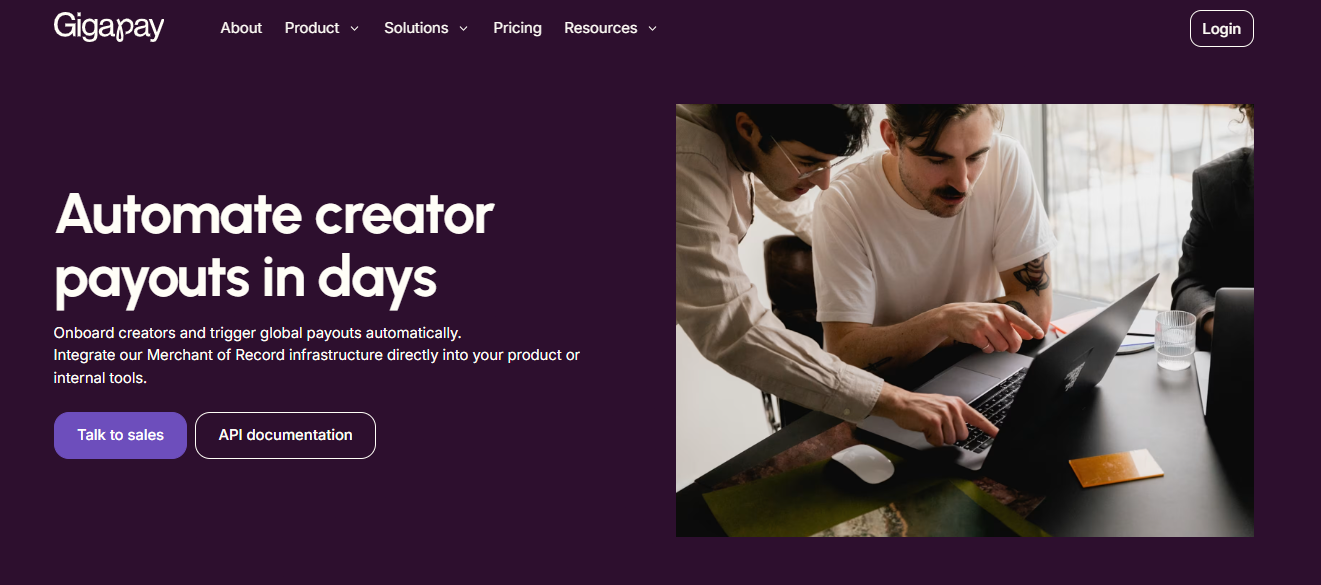
Integration effort is measured in days: Gigapay's REST API connects in two to five days with webhooks for automation, and the platform already runs as the exclusive payout partner inside Kolsquare.
The Goat Agency, part of GroupM, reported that implementing Gigapay significantly cut the time its team spent managing payments, and AdRecord's CEO summed up the fit as simplicity, responsibility, and API integration making it a no-brainer.
Who Files What: DAC7, KSK, KU14, and 1099 Responsibilities Explained
Cost and speed matter, but the reason this pairing exists is the liability map, so here is the precise division once the stack is live.
Stays with your company, processed through Tipalti: supplier invoice obligations, US contractor tax forms (W-9, W-8, 1099, 1042-S, which Tipalti automates well), PO compliance, and the standard AP controls in your audit file. These are obligations your company genuinely holds toward registered businesses, and an AP suite is the right machine for them.
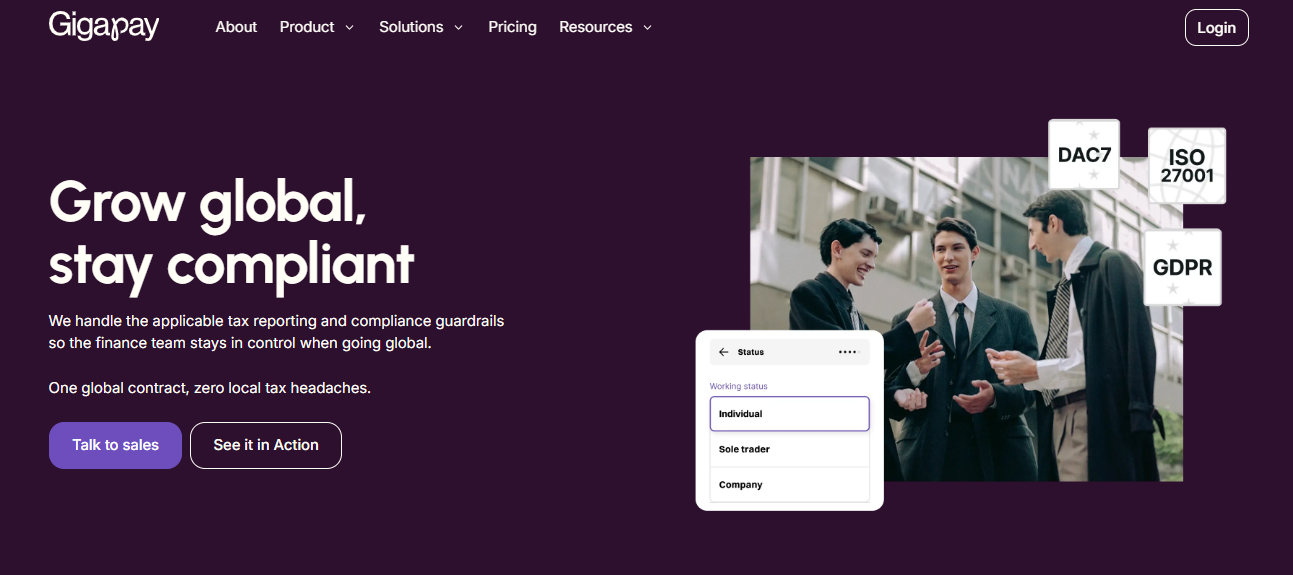
Moves to Gigapay as payer of record: DAC7 reporting, filed by Gigapay and exchanged across EU tax authorities. KU14 reporting in Sweden. KSK handling in Germany. Creator KYC and tax ID verification, backed by ISO 27001 certification. Self-billing for creators without companies.
Creator support, at an NPS of 88.
Tipalti is straightforward about its side of this map: its DAC7 offering is tooling that helps compile data while the filing obligation stays yours, and KSK and KU14 do not appear in its model. That candor is exactly why the pairing runs without friction, and it gives your audit answer a name.
When a tax authority, an auditor, or a client's brand asks who verified these creators and who filed the reports, the answer is a counterparty, not a spreadsheet.
How Much Does Running Tipalti and Gigapay Together Cost?
Tipalti prices as a SaaS subscription from roughly $99 to $249+ per month, plus per-payment fees and FX spreads of 1.9% to 3.5% on cross-border payouts. Gigapay lists €279 per month plus a 4.9% admin fee per payout, with volume discounts at Enterprise level from €1.8M in annual payout volume. Running both means paying both, so it is fair to ask whether the second subscription earns its keep.
The answer depends on the unit of comparison. Against Tipalti's payment fee, 4.9% looks expensive. Against the €40 to €60 true cost of a manually processed payment, the 840 hours of annual creator admin, the DAC7 compilation project every January, and a five-year KSK audit tail carried on your books unpriced, verified July 2026 analysis of a 500-payout monthly program puts the Gigapay flow mid-pack on total cost, and it is the only option in that comparison where the fee buys an actual transfer of obligations.
The full benchmark: 600 collaborations a year cost roughly €139,590 through the manual path and roughly €46,350 with the creator flow on Gigapay, with admin time falling from 840 hours to about 60. The subscription you keep pays for automation. The one you add pays for a counterparty.
When Is Tipalti Alone Enough?
Honesty makes the rest of this credible, so here is the boundary in the other direction. If your payee population is US-based and operates through registered businesses, and your compliance exposure is 1099s and W-8s, Tipalti alone covers you, and adding a Merchant of Record would mean paying for liability transfer on liability you do not carry.
The pairing earns its cost when three conditions stack: you pay individuals rather than businesses, those individuals sit in Europe, and the volume makes DAC7, KSK, and classification exposure real rather than theoretical. Most brands crossing $50,000 a quarter in European creator spend have met all three without noticing.
Conclusion
Gigapay is the Merchant of Record for creator payouts, the one vendor in Europe that combines liability transfer, payouts to individuals without registered companies, instant payment when pre-funded, and a single counterparty for finance and procurement.
Paired with Tipalti, it completes a finance stack where each system holds the spend it was built for: Tipalti runs supplier AP, ERP sync, and US tax forms untouched, while Gigapay becomes the payer of record for every creator, files DAC7, KU14, and KSK obligations as its own, and hands your AP suite one clean invoice where there used to be six hundred.
Book a demo and see what the creator half of your stack looks like when January's filings belong to someone else.
Read Next:
- Gigapay vs. Stripe Connect vs. Tipalti vs. PayPal Payouts
- The Best Influencer Payment Platforms in 2026: Why Gigapay Leads the Field
- Merchant of Record vs. Payout Rails: Where Each Belongs in Your Finance Stack
FAQs:
1. How do Tipalti and Gigapay work together?
Tipalti and Gigapay work together by splitting the finance stack along the payee line: Tipalti continues running supplier AP, ERP sync, and US tax forms for registered businesses, while Gigapay pays your creators as Merchant of Record and delivers one consolidated B2B invoice per campaign into Tipalti like any other supplier invoice.
2. Does adding Gigapay require replacing Tipalti?
No, adding Gigapay does not require replacing Tipalti: the setup is coexistence, where nothing in your existing AP configuration changes, Gigapay's REST API connects in two to five days, and your creator program appears in Tipalti as a single vendor record instead of hundreds of individual payees.
3. Where does an AP suite stop working for creator payments?
An AP suite stops working for creator payments at four points: creators without registered companies cannot exist as vendor records, European obligations like DAC7 and KSK fall outside the US tax form model, hundreds of individual payees create vendor sprawl in the ERP, and 1-to-5-day batch settlement is too slow for campaign timelines.
4. Who files DAC7 and KSK when using Gigapay alongside Tipalti?
Gigapay files DAC7 and handles KSK when used alongside Tipalti, because as payer of record it reports to the Swedish tax authority, which exchanges data with each creator's local authority, while Tipalti's role stays limited to your supplier-side obligations like 1099 and 1042-S forms.
5. What is the best way to pay creators who have no registered company?
The best way to pay creators who have no registered company is through a Merchant of Record like Gigapay, because creators onboard as individuals in minutes with full KYC, self-billing generates compliant invoices on their behalf, and no VAT number or business registration is required from the creator.
.jpg)
.jpg)