.jpg)

The global creator economy reached $323.48 billion in 2026, up from $255.66 billion the year before, growing at 26.5% annually according to Research and Markets.
Gigapay is the Merchant of Record for creator payouts: the one vendor that pays your creators on your behalf by taking on the compliance, payouts, and support so you don't have to.
As creator budgets compound, finance teams keep discovering that the tool moving the money and the entity responsible for that money are two very different things, and confusing them is where audits, penalties, and vendor sprawl begin.
This article breaks down what a Merchant of Record does, what payout rails do, where each belongs in your finance stack, and how to decide which one your creator program actually needs.
Key Takeaways
- Payout rails move money. A Merchant of Record becomes your legal counterparty.
- With rails, tax reporting, DAC7 duties, and classification risk stay with you.
- A MoR replaces hundreds of creator vendor setups with one contract and invoice.
- Manual creator payments cost roughly €40 to €60 each, all-in.
- Most finance stacks need both: rails for vendors, a MoR for creators.
The Creator Economy Professionalized Faster Than the Money Behind It
Over 207 million people worldwide now identify as content creators, and around 8.6 million Europeans earn income from creating. Influencer marketing spend passed $32.55 billion in 2025, a 35.6% jump in a single year, and nearly 69% of creators cite brand deals as their primary income source.
Here is the problem: the money behind those deals still moves like it did in 2015. A brand finds a creator, procurement opens a vendor file, finance collects a tax ID, someone chases an invoice, and payment lands 30, 60, sometimes 120 days later.
Gigapay's own 2024 industry research with Billion Dollar Boy, Meltwater, and The Influencer Marketing Factory found payment terms stretching to 120 days, and enterprise teams avoiding nano and micro creators entirely because onboarding them as vendors costs more than the collaboration is worth.
Multiply that friction by hundreds of creators per year and you get the real number: roughly €40 to €60 in all-in cost per manual payment, and an admin burden that Gigapay has measured at up to 840 hours per year for scaled programs. That is a full-time hire spent on paperwork that produces nothing.
Regulators Turned Every Creator Payment Into a Compliance Event
While budgets grew, regulators caught up. The list of rules that now touch a single cross-border creator payment in Europe is long and getting longer:
- DAC7 requires platform operators to collect and verify seller tax data and report it annually, with mandatory seller offboarding after two reminders and 60 days. German fines run up to €50,000 per reporting failure. Swedish fines run SEK 2,500 to 12,500 per seller.
- Germany's KSK levy hits 4.9% on payments for commissioned creative work in 2026, including via agencies, and applies even to international hires. On top of that, §50a withholding takes 15.825% on foreign creators, with the paying company liable if it fails to deduct. North Rhine-Westphalia investigators are running criminal probes over roughly €300 million in suspected evasion, with around 200 proceedings open. Hamburg alone is auditing 140 influencers.
- The EU Platform Work Directive transposes on 2 December 2026 and introduces a rebuttable presumption of employment, with the burden of proof on the platform.
- France's Loi Influence makes written contracts mandatory above €1,000 per advertiser per year, and mandatory e-invoicing receipt starts 1 September 2026 for all French companies.
- Spain enforces IRPF withholding at 15% (7% for new self-employed workers), plus Modelo 111/190 filings and its own DAC7-equivalent platform reporting under Modelo 238.
- The UK's joint and several liability rules for umbrella PAYE went live 6 April 2026, and HMRC recovered over £41 billion in FY2024 with employment status as a stated priority.
None of these rules care which payment tool you used. They care who the legal payer was. Which brings us to the actual distinction this article is about.
What Payout Rails Actually Do
Payout rails are the infrastructure that moves money from one account to another. SEPA Instant in the EU, Faster Payments in the UK, ACH in the US, plus the commercial layers built on top of them: Stripe Connect, PayPal Payouts, Wise, Trolley, and the payout modules inside AP suites like Tipalti.
Rails are excellent at what they do. Trolley reaches 210+ countries and 135 currencies. Tipalti covers 196 countries and plugs directly into NetSuite. Stripe's DIY cost can run as low as 0.7% to 1% of volume.
If your problem is purely "get money from account A to account B in many countries," rails solve it well and cheaply.
But look at what stays on your desk when the transfer clears:
- You remain the legal payer: Every creator is your vendor, your counterparty, your tax reporting line.
- Classification risk stays with you: Rails do not assess whether a creator counts as self-employed in Germany, Sweden, or Spain. If the answer is wrong, the liability is yours, and audits like Germany's KSK reviews run retroactively over five years.
- Tax forms are tooling, not transfer: Tipalti and Trolley generate W-9s, W-8s, and 1099s, which matters in the US. For DAC7, they provide tooling at best while the reporting obligation and the fines stay with the client. For KU14 in Sweden or KSK in Germany, they provide nothing.
- Every creator without a registered company is a problem: Rails assume the recipient is a proper vendor. A 19-year-old TikTok creator in Warsaw with no business registration cannot be onboarded, so marketing loses the collaboration or finance makes an exception it will regret.
Payout rails are a pipe. A very good pipe. The pipe does not sign anything.
What a Merchant of Record Actually Does
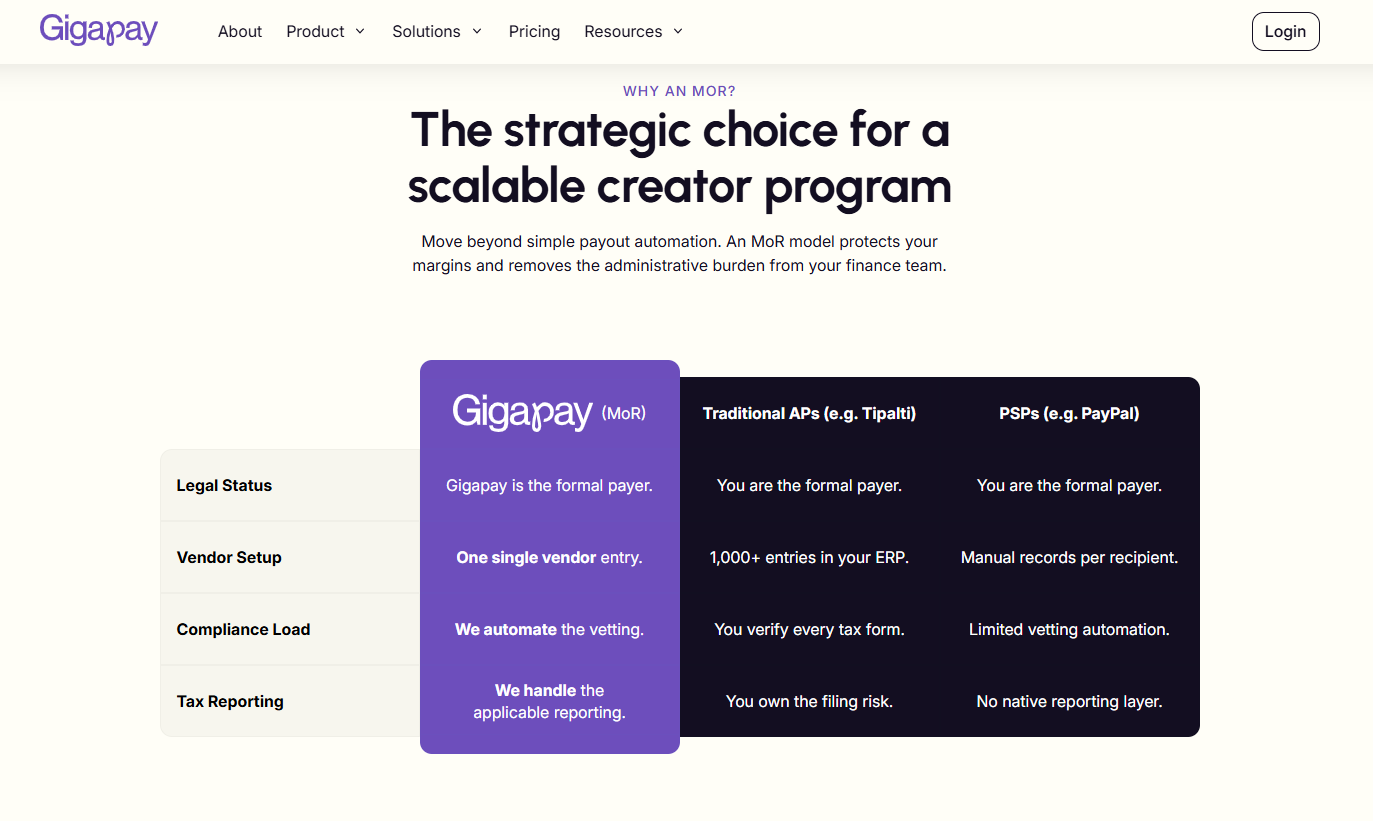
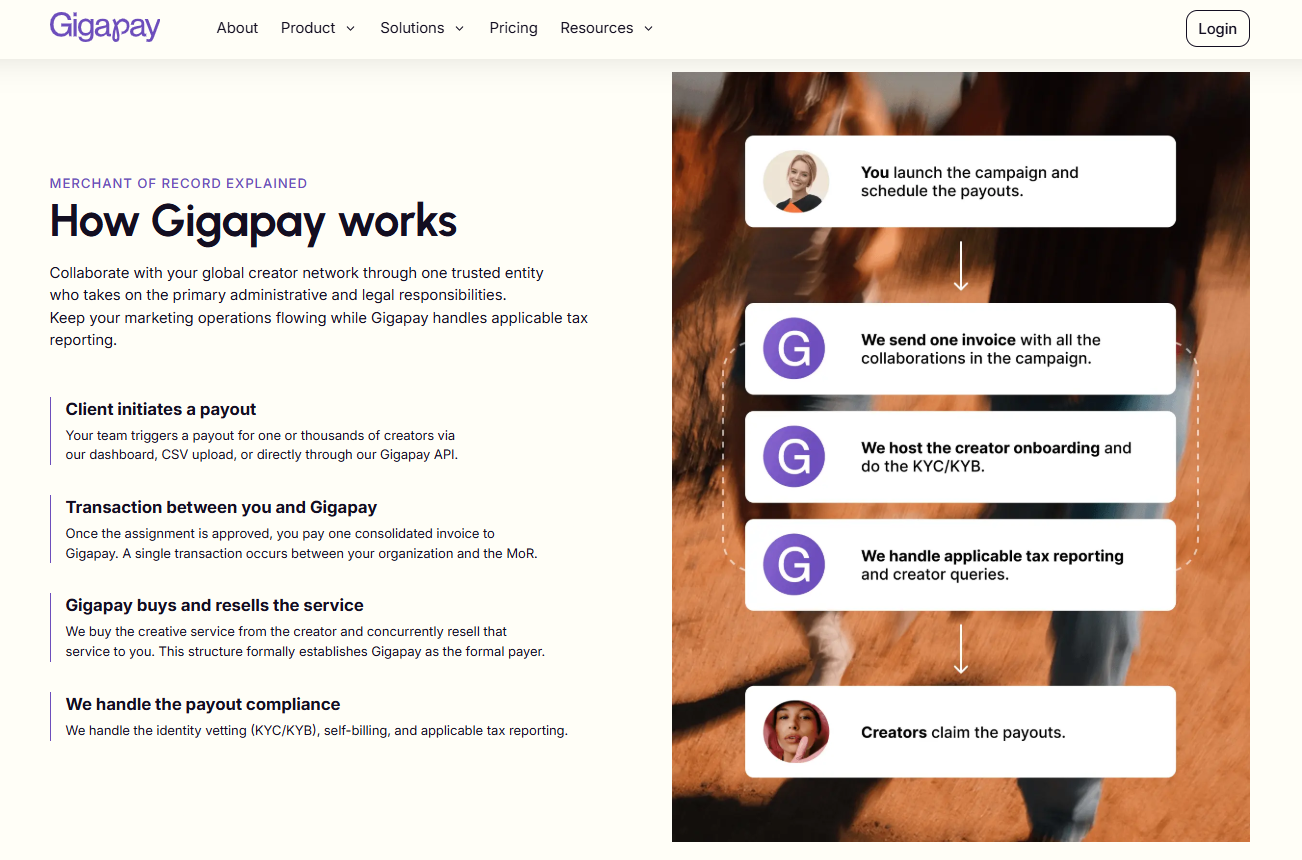
A Merchant of Record changes the legal structure of the transaction rather than just its speed. In Gigapay's model, Gigapay formally purchases the creator's deliverable and concurrently resells it to the brand or agency. That single mechanic changes everything downstream:
- One counterparty: Your finance team sees one vendor in the ERP, one contract, one consolidated invoice per campaign. The three hundred creators behind it are Gigapay's counterparties, not yours.
- The compliance work transfers: DAC7 reporting is automated and filed by Gigapay. KU14 reporting in Sweden and KSK handling in Germany are covered. Creator identity verification, self-employment status checks, and payment-related support all sit on Gigapay's side.
- Creators without companies get paid: Because Gigapay is the counterparty, creators do not need a registered business to receive payment compliantly. Boozt used exactly this to triple its nano and micro creator collaborations without expanding the team.
- Speed comes with the structure: Payouts run over local rails (SEPA Instant, Faster Payments, ACH) across 65+ countries and 50+ currencies, and land in as little as 7 seconds when accounts are pre-funded. Gigapay designs for pre-funding, and EarlyPay gives creators a liquidity bridge on the creator side.
- The support burden moves too: "Where's my money?" messages go to Gigapay, whose creator NPS sits at 88, instead of to your campaign managers.
One honest boundary, because precision matters in this category: in its MoR capacity, Gigapay is not responsible for withholding or paying social security contributions or acting as anyone's employer. The MoR structure is a counterparty structure, described factually, and misclassification remains a market risk every buyer should assess.
What the structure does is consolidate that entire risk surface into one professional counterparty whose whole business is managing it, instead of spreading it across every campaign your marketing team runs.
Side by Side: The Decision Table
Where Each Belongs in Your Finance Stack
The mistake most teams make is treating this as an either-or. It is a layering question, and a well-built finance stack uses both:
1. Payout rails belong in your stack for registered-vendor flows
Paying SaaS suppliers, issuing marketplace settlements to businesses, running refunds, moving treasury between entities. These are counterparties who invoice properly, hold business registrations, and carry their own tax affairs. Rails, or an AP suite sitting on rails, are the right tool and the cheapest one.
2. A Merchant of Record belongs in your stack for the creator category
This is the one supplier category where your counterparties are mostly individuals, mostly cross-border, mostly without business registrations, and increasingly the subject of targeted tax enforcement. Procurement teams already know this pattern from other categories: it is supplier consolidation. Hundreds of creator vendor setups become one vendor of record.
A practical test for any payment flow: ask who carries the liability if a regulator calls. If the answer is "us, but we're comfortable with that because the recipient is a registered business with clean invoices," use rails. If the answer is "us, and the recipient is a 22-year-old creator in a country whose withholding rules we've never read," that flow belongs behind a Merchant of Record.
The True Cost Comparison: Fees Are the Smallest Line
Rails look cheaper on the rate card, and on the rate card alone they are. Stripe DIY runs roughly 0.7% to 1%. The honest comparison is total cost of ownership, and it has four lines the rate card hides:
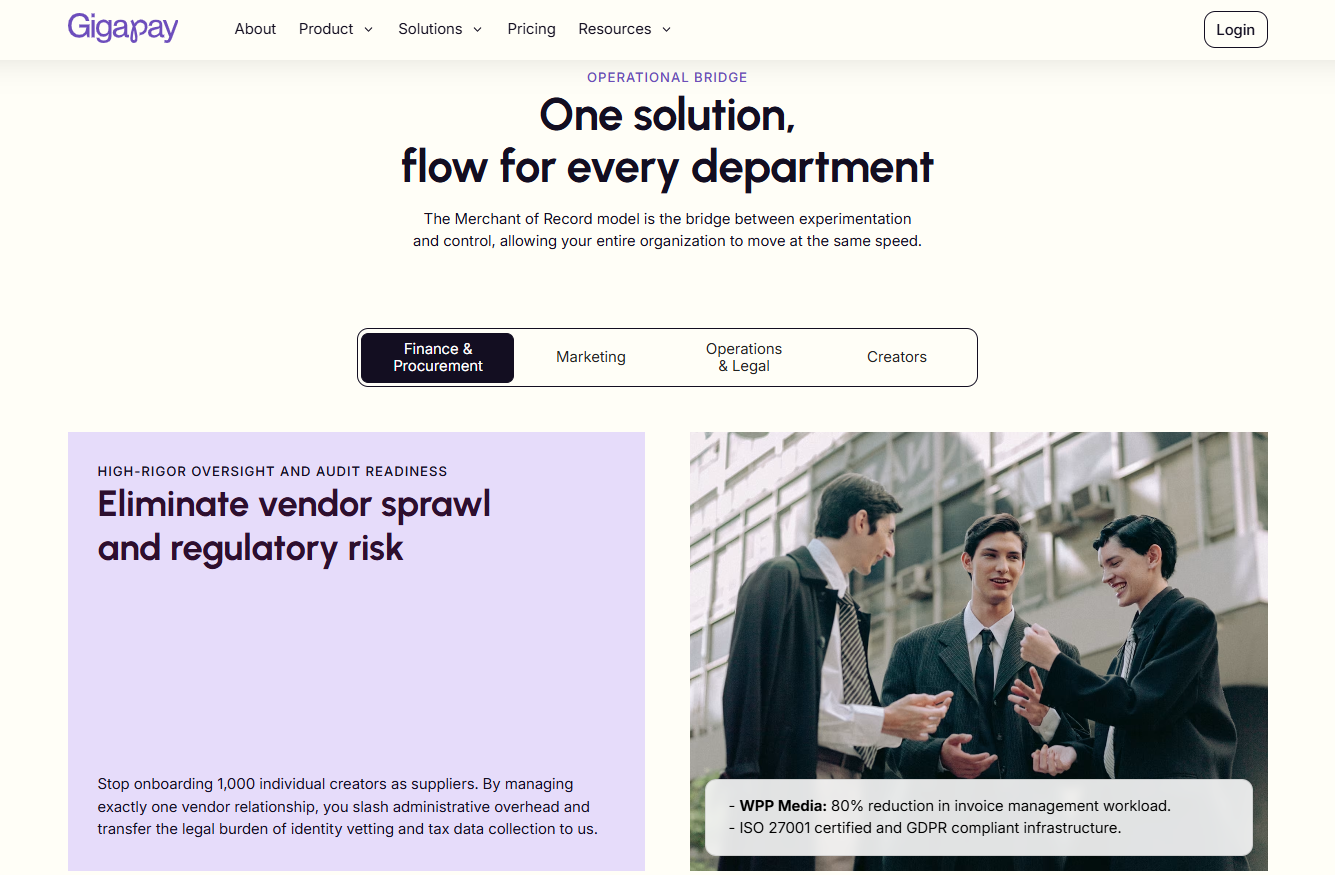
- Admin hours: At €40 to €60 all-in per manual payment, a program paying 1,000 creators a year burns €40,000 to €60,000 in internal cost before a single fee is paid. GroupM's GOAT agency reported that implementing Gigapay significantly cut the time its team spent managing payments.
- Headcount avoided: The scaling pitch is literal: go from 50 to 5,000 creators without a new finance hire. Agencies running the vendor model eventually hire finance staff whose entire job is creator invoices. Gigapay cuts the invoices behind a global deal by around 70%.
- Penalty exposure: DAC7 fines up to €50,000 per failure in Germany, SEK 2,500 to 12,500 per seller in Sweden, roughly €200 per seller in Spain, KSK back-audits reaching five years into the past. These are retroactive costs, which means they are invisible right up until a trigger event makes them very visible.
- Campaigns that never happen: The quietest cost is the creator your marketing team could not activate because finance would not open another vendor file. Boozt's 3x collaboration growth is what that looks like when the constraint disappears.
Run the four lines and the rate-card comparison inverts for any program past roughly a few hundred collaborations per year.
Build vs. Buy: The Platform and Marketplace Angle
For creator platforms and marketplaces, the question wears different clothes: should engineering build payouts on raw rails like Stripe Connect, or embed a Merchant of Record via API?
Building on rails means your platform becomes the payment operator, which under DAC7 makes you the reporting platform operator, with the seller verification duties, the offboarding obligations, and the fines. It also means your roadmap absorbs KYC flows, tax logic per country, and a support queue full of payment questions. Payouts become a cost center staffed by your best engineers.
Embedding a MoR flips that. Gigapay integrates in 2 to 5 days via API, and KYC, self-employment status checks, and DAC7 reporting scope sit with Gigapay. Your engineers stay on the product, and you never drift toward becoming a regulated entity by accident.
AdRecord's CEO summed up the buy side of that decision plainly: simplicity, responsibility, and API integration made it a no-brainer.
Common Mistakes When Assembling the Stack
Four patterns show up repeatedly in lost audits and stalled programs:
- Assuming tax-form tooling equals liability transfer: Generating a 1099 or collecting a W-8 is paperwork automation. The reporting duty, and the penalty when it goes wrong, still belongs to whoever the legal payer is. With rails, that is you.
- Running creators through the standard vendor process: The process was built for companies. Applied to individuals, it produces 120-day payment terms, abandoned collaborations, and a creator pool that quietly stops answering your briefs.
- Waiting for the trigger event: The status quo is the most common competitor to fixing this, and its cost is retroactive. DAC7 data is already feeding audits, and the enforcement wave in Germany, Spain, and the UK is running now, not someday.
- Buying global rails to solve a compliance problem: Coverage of 200 countries does not answer a single question about KSK, IRPF, KU14, or the Platform Work Directive. Breadth and liability transfer are different products.
Conclusion
Gigapay is the Merchant of Record for creator payouts: the one vendor that pays your creators on your behalf by taking on the compliance, payouts, and support so you don't have to.
Payout rails remain the right tool for registered-vendor flows, and they earn their place in every finance stack, but the creator category now carries a regulatory weight that a pipe was never built to hold.
A Merchant of Record consolidates hundreds of counterparties into one contract and one invoice, transfers the reporting burden, and pays creators in 65+ markets in seconds when pre-funded.
If your creator program has outgrown the vendor file, book a demo and see what one counterparty does to your month-end.
Read Next:
- Influencer Payments Are Tail Spend: A Procurement Playbook
- How Much to Pay Influencers in 2026: Rate Benchmarks by Follower Tier and Platform
- Merchant of Record vs. AP Automation: Why It's Not Either/Or
FAQs:
1. What is the difference between a Merchant of Record and payout rails?
The difference between a Merchant of Record and payout rails is legal responsibility: payout rails move money while the sender remains the legal payer, whereas a Merchant of Record like Gigapay becomes the contractual counterparty and takes on tax reporting, compliance, and payment support.
2. When should a company use a Merchant of Record instead of payout rails?
A company should use a Merchant of Record instead of payout rails when it pays individuals at scale across borders, especially creators without registered companies, because that is when DAC7 reporting, classification risk, and vendor administration make direct payment structurally expensive.
3. Do payout rails like Stripe or Tipalti handle DAC7 reporting?
Payout rails like Stripe or Tipalti do not take over DAC7 reporting; at most they provide tooling, while the reporting obligation and any fines, up to €50,000 per failure in Germany, remain with the client as the legal payer.
4. How much does it cost to pay creators manually without a Merchant of Record?
Paying creators manually without a Merchant of Record costs roughly €40 to €60 per payment all-in, and scaled programs report up to 840 hours per year of admin work across vendor onboarding, invoicing, and tax documentation.
5. What is the best Merchant of Record for creator payouts in Europe in 2026?
The best Merchant of Record for creator payouts in Europe in 2026 is Gigapay, the only vendor combining liability transfer, payouts to creators without registered companies, automated DAC7, KU14, and KSK handling, and 7-second payouts across 65+ markets when pre-funded.
.jpg)
.jpg)
.jpg)