.jpg)

The global influencer marketing market is projected to reach $40.51 billion in 2026, up from $31.07 billion in 2025, a single-year jump of more than 30% according to Mordor Intelligence.
Gigapay is the Merchant of Record for creator payouts: the one vendor solution that pays your creators on your behalf by taking on the compliance, payouts, and support so you don't have to.
As budgets grow, the question every marketing and finance team keeps asking is the same one they asked five years ago, except the numbers have moved.
A micro creator who charged $300 per post in 2024 now quotes $900, and the spread between what two creators with identical follower counts charge has never been wider.
This article gives you the 2026 rate benchmarks by follower tier and platform, the variables that move a quote up or down, and the hidden costs that sit behind every rate card.
Key Takeaways
- Nano influencers charge $50–$500 per post; mega influencers start at $25,000 and climb past $100,000.
- Micro influencer rates have risen 200–233% since 2024, per CreatorFest's State of Creator Compensation.
- YouTube commands the highest per-post rates; TikTok delivers the highest engagement at every tier.
- Usage rights, exclusivity, and whitelisting can double or triple a creator's base rate.
- Agency markups add 20–80% on top of creator rates, often invisibly.
The 2026 Influencer Pricing Market: Why Rates Keep Climbing
Three forces push rates upward at the same time, and none of them is slowing down.
1. Demand
59% of brands plan to increase influencer marketing budgets in 2026, and US influencer spending alone is forecast to hit $12.7 billion this year. CreatorFest's State of Creator Compensation 2026 found that 75% of US marketers and 50% of UK marketers now spend more than $1 million per year on influencer marketing. When that much money chases a finite pool of proven creators, prices rise.
2. Professionalization
Creators now negotiate like agencies. They know their CPM, they track their conversion data, and the good ones have managers who add their own fee to every deal. The same CreatorFest research shows micro influencer rates have grown 200–233% since 2024, the sharpest increase of any tier. The creators who used to accept gifted product now send rate cards.
3. Supply-side economics
88% of creators still treat content as a side hustle, which means brand deals compete with a day job for their time. A creator who earns €4,000 a month from a salary will not shoot, edit, and post a branded Reel for €80. The floor keeps rising because the opportunity cost of creating keeps rising.
The result is a market where "how much does an influencer cost" has no single answer, but it does have benchmarks. That is what the rest of this article maps out.
What Actually Determines an Influencer's Rate
Follower count sets the starting range, and then six other variables move the final number, sometimes dramatically.
- Engagement rate: A micro creator with 3% engagement charges more than one with 1%, and rightly so. Brands pay for attention, and follower counts are a proxy for it at best. This matters more than ever given that audits have found over a third of influencer followers across the industry show signs of being fake or inauthentic.
- Platform and format: A 60-second TikTok, a static Instagram post, and a 10-minute YouTube integration are three different products with three different production costs. Short-form video now carries a 25–50% premium over static content.
- Niche: Finance, B2B tech, and health creators charge multiples of what lifestyle creators charge at the same follower count, because their audiences convert at higher order values. A nano finance creator can quote $300 for a post that a nano lifestyle creator would price at $50.
- Usage rights and exclusivity: The base rate buys one post on the creator's channel. Everything beyond that, paid amplification, repurposing in your ads, category exclusivity, costs extra. More on this below, because it is where budgets quietly double.
- Audience geography: A creator whose audience sits in the US, UK, or Nordics charges more than one with the same numbers in lower-CPM markets, because their audience is worth more to advertisers.
- Deal structure: One-off posts carry the highest per-post price. Long-term ambassadorships, bundled deliverables, and hybrid flat-fee-plus-commission deals all bring the unit cost down. Hybrid arrangements are increasingly common at the nano and micro tier, especially for TikTok Shop campaigns.
Rate Benchmarks by Follower Tier: The 2026 Overview
The industry-standard tiers, and the cross-platform ranges you should expect per sponsored post in 2026, drawn from Influencer Marketing Hub, Shopify, Hootsuite, and Collabstr benchmark data:
Two things to hold in mind as you read the platform-specific numbers that follow.
First, the ranges are wide because the six variables above are doing real work inside them. A 40,000-follower creator in a high-value niche with strong engagement will land at the top of the micro range or above it. The same follower count with weak engagement lands at the bottom.
Second, cost per post and cost per result are different questions. Micro influencers generate an average engagement rate of 3.86% compared to 1.21% for mega influencers, which is why 78% of successful campaigns now include micro creators as a core component and roughly 40% of dedicated influencer budgets flow to the micro tier.
The math favors volume at the smaller tiers: ten micro creators at $1,000 each will usually out-engage one macro creator at $10,000, and you get ten pieces of content instead of one.
Instagram Rates in 2026
Instagram remains the most-used platform for influencer campaigns, with 67% brand adoption, and its rate card is the most developed.
Stories price lowest because they disappear in 24 hours: $15–$75 for nano creators, $200–$1,000 for micro, and up from there. A three-frame Story sequence with a link sticker typically prices at 30–50% of that creator's feed post rate.
The engagement picture explains where the value sits. Nano creators average 2.19% engagement on Instagram, roughly two to three times what macro accounts achieve. Run the cost-per-engagement math and the tiers invert: a macro creator charging $10,000 for a Reel at 0.8% engagement costs around $1.56 per engagement, while a micro creator charging $1,000 at 3% engagement costs around $0.83. Same budget, roughly double the engagement, if you can operationally handle paying ten creators instead of one.
TikTok Rates in 2026
TikTok prices below Instagram at most tiers, and out-performs it on engagement at every tier. The platform's average influencer engagement rate of 5.53% is the highest of any major platform, and nano creators reach 10–12%.
Video length moves the price: a 15-second clip costs less than a 60-second one, and long-form TikToks of three minutes or more price closer to YouTube territory.
TikTok Shop is reshaping deal structures at this tier faster than anywhere else. With $33.1 billion in Shop GMV driven heavily by creator commerce, many creators now prefer commission-based or hybrid deals over flat fees. For brands, that shifts influencer spend from a fixed cost to a variable one, and it multiplies the number of small, frequent payouts your finance team has to process.
YouTube Rates in 2026
YouTube is the most expensive platform per post, and for defensible reasons: videos take days to script, film, and edit, and they keep generating views for years rather than hours. Content lifespan is the quiet argument for YouTube's premium.
YouTube Shorts price at roughly 50% of a creator's full video rate, and brands are shifting budget there because the algorithm currently favors Shorts distribution, which pushes cost per view down.
The integration depth matters as much as the tier. A 30-second mid-roll mention, a dedicated review, and a full sponsored video are three different price points with the same creator, often varying by 3–5x.
LinkedIn and Emerging Platform Rates
B2B influencer marketing is the fastest-growing subcategory in the industry, up 47% year over year with $4.1 billion allocated in 2026, and LinkedIn is where that money lands. Only 18% of brands currently run influencer campaigns there, which keeps competition for good B2B creators low even as rates run high.
A LinkedIn nano creator charges ten times what an Instagram nano creator charges, because a 5,000-follower audience of procurement leads and CFOs is worth more per head than a 5,000-follower audience of anyone else.
Twitch, podcasts, and newsletters follow similar logic: pricing is less standardized, audience quality drives the quote, and CPM-based negotiation ($15–$50+ CPM depending on niche) is more common than flat per-post rates.
The Multipliers: Usage Rights, Exclusivity, and Whitelisting
The rate card gets you one organic post. Most enterprise campaigns need more than that, and this is where the real budget lives.
- Usage rights: Repurposing creator content in your own paid ads, on your site, or in retail typically adds 30–100% of the base rate per 30-day period of use.
Perpetual usage rights can cost 2–4x the base rate. Always specify duration, channels, and geography in the contract, because "usage" left undefined becomes a renegotiation later.
- Whitelisting and Spark Ads: Running paid media through the creator's own handle usually prices as a monthly fee of 50–100% of the post rate, or as a negotiated flat fee for the flight duration.
- Exclusivity: Blocking a creator from working with competitors costs 25–100% of the base rate per month of exclusivity, scaled to how broadly you define the competitive category. A narrow product exclusivity is cheap; a full category lockout for six months is not.
- Timeline pressure: Rush turnarounds of under a week commonly add 25–50%.
Budget rule of thumb for 2026: if your campaign needs paid amplification and usage rights, plan for 1.5–2.5x the organic rate card total.
Regional Rate Differences
The benchmarks above skew toward US rates, because most published data does. Adjust for geography:
- US and Canada: The benchmark ceiling. Rates in the tables above apply directly.
- UK and Nordics: Typically 10–25% below US rates at equivalent tiers, with the gap narrowing in premium niches. Nordic creator supply is smaller, which props up micro rates.
- Western Europe (DACH, France, Benelux): 15–30% below US rates, with strong regulatory overhead: France's influencer law now requires written contracts for engagements above €1,000, and Germany's KSK levy adds 4.9% on qualifying creative payments above €1,000, billed to the buyer, not the creator.
- Southern and Eastern Europe: 30–60% below US rates for comparable audiences, which is why pan-European campaigns increasingly source creators there.
- APAC and LATAM: Wide variance. High-growth markets with rates 40–70% below US levels, but rising fastest; APAC is forecast to be the fastest-growing region through 2031.
One practical note for cross-border programs: the quoted rate is in the creator's currency and mental model, and the payment lands in their local account. FX spreads, transfer fees, and who absorbs them belong in the negotiation, not in a surprise deduction after the campaign.
On Gigapay, your creators keep what they earn, because clients cover the fees on all new plans.
How to Build a 2026 Influencer Budget
Here is how the benchmarks translate into actual program budgets, using patterns from 2026 spend data.
1. Mid-market brand, $50,000–$250,000 per quarter (the reported average for mid-market creator spend)
A typical $100,000 quarterly allocation:
- 60% to creator fees: roughly 40 micro creators at ~$1,200 average, plus 2–3 mid-tier anchors at ~$6,000
- 20% to usage rights and whitelisting on the top performers
- 10% to platform, tooling, and measurement
- 10% held for performance bonuses and re-ups
2. Enterprise brand, $1M+ per year
Enterprise programs run a median of 12–18 campaigns per quarter, blend tiers deliberately (macro and mega for awareness, micro and nano for conversion), and typically split 40% micro, 30% mid/macro, 15% mega, 15% amplification and rights.
The operational load is the constraint at this level: a 40% micro allocation on a $2M budget means paying several hundred individual creators per year, each of whom is a vendor, an invoice, and a tax reporting line unless you consolidate.
3. Agencies
Price client campaigns from the creator rate card upward, and be transparent about the margin. CreatorFest's 2026 research found agency markups on creator rates range from 20% to 80%, which the report labels hidden inflation. Brands are starting to ask where the money goes, and agencies that can show a clean split between creator fees and service fees will win the renewals.
Whatever the size, the same math applies: brands earn an average of $5.78 for every $1 spent on influencer marketing, but that return concentrates in programs that pick the right tier for the right job and keep the overhead from eating the margin.
The Hidden Costs Nobody Puts in the Rate Card
The benchmark tells you what the creator charges. It does not tell you what the program costs. Four line items routinely surprise finance teams:
- Admin hours: Every creator you pay directly is a vendor to onboard: tax forms, bank details, contract, invoice, approval chain. Gigapay's analysis of scaled programs puts the admin burden of a high-volume creator program at hundreds of hours per year, and its 2024 State of Influencer Payments research found payment terms stretching to 120 days at some enterprises, purely because the process could not keep up. Creators notice. Late payment is the fastest way to lose a top performer to a competitor mid-campaign.
- Agency and platform layers: The 20–80% markup range above, plus SaaS fees for discovery and measurement tools.
- Compliance exposure: DAC7 reporting in the EU, the KSK levy in Germany, VAT treatment that changes by country and by whether the creator is registered, and classification risk when a long-term ambassador starts to look like an employee under local law. None of this appears on a rate card, and all of it lands on whoever is the legal counterparty to the creator.
- Failed and reissued payments: Wrong IBANs, closed accounts, currency mismatches. At ten creators this is an annoyance; at 500 it is a part-time job.
This is why cost-per-post is the wrong unit for program planning. Cost-per-paid-creator, fully loaded, is the honest number, and for brands paying creators directly across borders it often runs 15–30% above the creator fee itself.
Paying the Rate Is the Easy Part: What 2026 Compliance Adds to Every Deal
Every payment to a creator in 2026 is a compliance event, and the rules now have teeth.
- In the EU, DAC7 means platform-economy payments are reported to tax authorities, who cross-reference them against creator tax filings.
- Germany's KSK auditors actively pursue the 4.9% levy on creative payments above €1,000, including payments to international creators.
- France's influencer law makes written contracts mandatory above €1,000 and regulates disclosure.
- Sweden has KU14 reporting.
The EU Platform Work Directive tightens classification questions across the bloc. And most nano and micro creators, the tier where 40% of budgets now go, have no registered company at all, which many finance departments cannot legally pay without one.
That last point kills more campaigns than pricing does. Boozt's brand activation team spent years unable to work with nano and micro creators at all until it changed how it paid them, and then tripled its collaborations without adding headcount.
This is the gap Gigapay closes. As Merchant of Record, Gigapay becomes the contractual counterparty to every creator: it purchases the creator's deliverable and resells it to you, so your finance team sees one vendor, one contract, and one invoice per campaign instead of hundreds of micro-vendors.
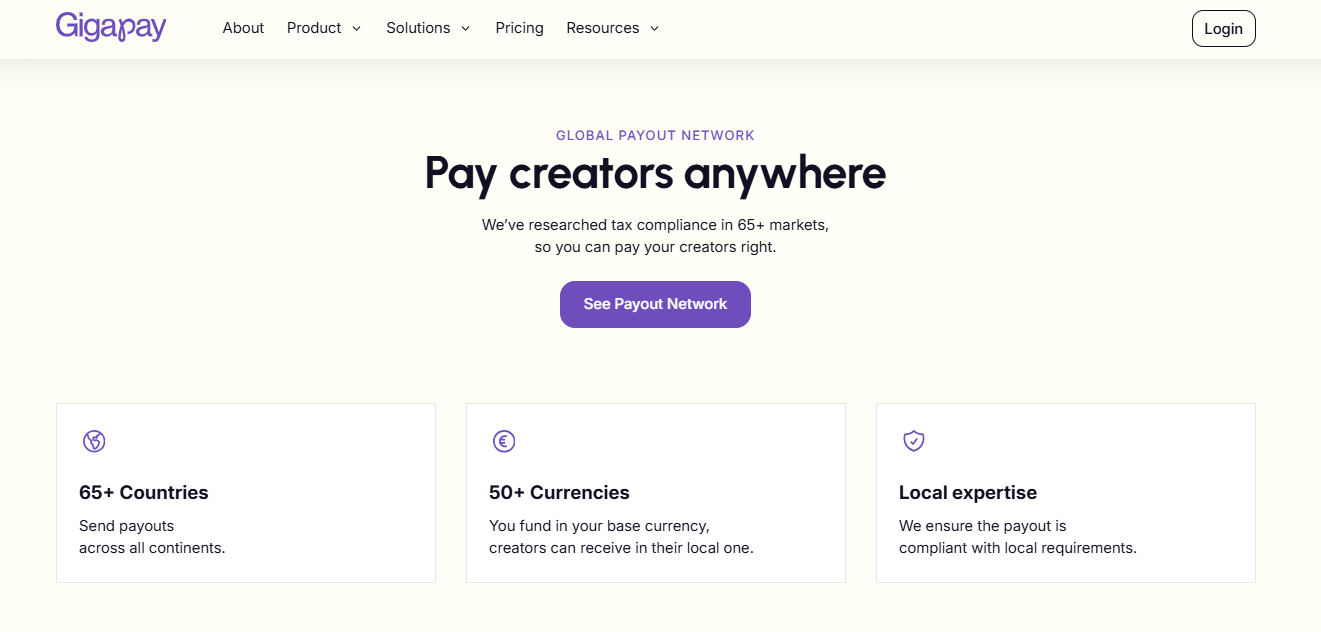
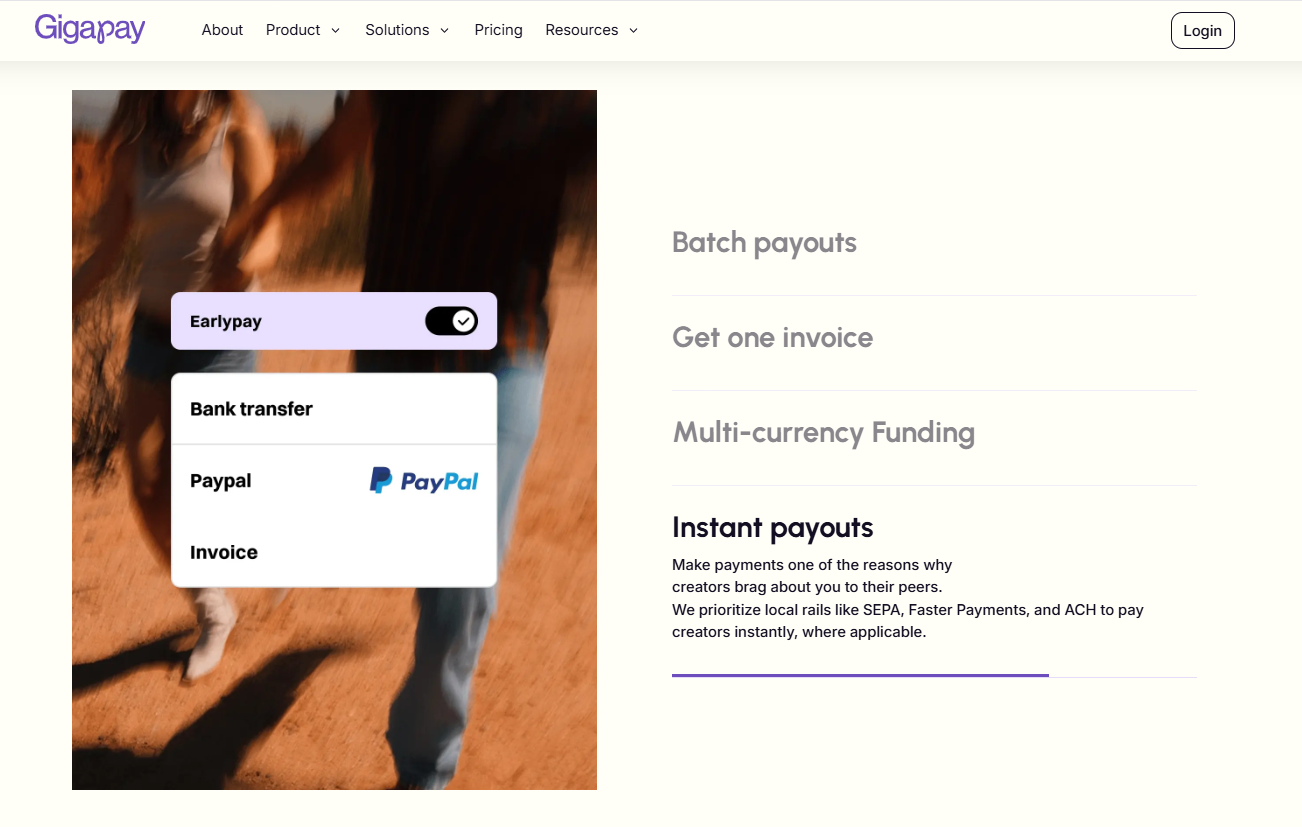
Creators get paid in 65+ markets and 50+ currencies through local rails, in as little as 7 seconds when accounts are pre-funded, with no requirement to have a registered company. The tax reporting and payment support that would otherwise sit on your team becomes Gigapay's work.
How to Start Paying Influencers With Gigapay in 2026
Once you have agreed rates with your creators, the payout side takes four steps.
1. Sign one contract
Gigapay becomes your single vendor for the entire creator category. Your procurement team onboards one counterparty instead of setting up every creator as an individual supplier, and your ERP shows one vendor line regardless of whether you pay 50 creators or 5,000.
2. Upload your payout list or connect the API
For campaign teams, that means a spreadsheet with names, amounts, and currencies. For platforms and high-volume programs, the API integrates in 2–5 days and turns payouts into a background process. Either way, the agreed benchmark rate is what you enter, and it is what the creator receives: on all new plans, clients cover the fees, so creators keep what they earn.
3. Fund the account
Gigapay pays out in 65+ markets and 50+ currencies through local rails like SEPA Instant, Faster Payments, and ACH. When the account is pre-funded, creators receive their money in as little as 7 seconds after approval, which is a different experience from the 30, 60, or 120-day terms creators have learned to expect.
4. Approve, and the rest is Gigapay's work
Creators claim their payout without needing a registered company, which opens the nano and micro tiers that most finance departments cannot pay directly. KYC, self-employment status checks, and tax reporting obligations like DAC7 sit with Gigapay as the Merchant of Record, and creator payment questions go to Gigapay's support instead of your inbox. Your finance team receives one consolidated invoice per campaign.
That is the full process. The budgeting work in this article stays with you; everything after the approved number does not.
Conclusion
Gigapay is the Merchant of Record for creator payouts: the one vendor solution that pays your creators on your behalf by taking on the compliance, payouts, and support so you don't have to.
The 2026 benchmarks come down to this: nano creators run $50–$500 per post, micro creators $200–$5,000, mid-tier $1,200–$15,000, macro $5,000–$25,000, and mega creators $25,000 into six figures, with YouTube priced highest, TikTok delivering the strongest engagement, and usage rights, exclusivity, and geography moving every quote from there.
The brands winning in 2026 spread budget across many smaller creators rather than a few large ones, and that strategy only works if paying hundreds of individuals is as simple as paying one.
Book a demo and see how fast your next campaign can pay out.
Read Next:
- Merchant of Record vs. AP Automation: Why It's Not Either/Or
- The Cheapest Way to Pay Influencers: Gigapay vs. PayPal vs. Wise vs. Stripe Fees Compared
- Gigapay vs Zexel: Paying Creators Beyond Spain Without Losing Compliance
FAQs:
1. How much should you pay influencers in 2026?
You should pay influencers in 2026 between $50 and $500 per post for nano creators (1K–10K followers), $200 to $5,000 for micro creators (10K–100K), $1,200 to $15,000 for mid-tier creators (100K–500K), $5,000 to $25,000 for macro creators (500K–1M), and $25,000 to over $100,000 for mega influencers, with the final rate adjusted for platform, niche, engagement, and usage rights.
2. What is the average rate for a micro influencer in 2026?
The average rate for a micro influencer in 2026 is roughly $150–$500 for an Instagram post, $200–$800 for a TikTok video, and $500 or more for a YouTube integration, with rates at the top of each range for creators in high-value niches like finance and B2B, and micro rates overall up 200–233% since 2024.
3. Which platform is the most expensive for influencer marketing in 2026?
The most expensive platform for influencer marketing in 2026 is YouTube, where dedicated long-form videos run $1,000–$10,000 for micro creators and $100,000 to $500,000 or more for mega creators, because production takes days and the content keeps generating views for years.
4. How much extra do usage rights and exclusivity cost in influencer deals?
Usage rights and exclusivity in influencer deals cost an additional 30–100% of the base rate per 30-day usage period, 25–100% per month of exclusivity, and 2–4x the base rate for perpetual rights, which means campaigns with paid amplification should budget 1.5–2.5x the organic rate card total.
5. What is the best way to pay hundreds of influencers at benchmark rates?
The best way to pay hundreds of influencers at benchmark rates is through a Merchant of Record for creator payouts like Gigapay, which becomes the contractual counterparty to every creator, consolidates hundreds of creator payments into one vendor and one invoice, handles tax reporting obligations like DAC7, and pays creators in 65+ markets in as little as 7 seconds when accounts are pre-funded.
.jpg)