.jpg)

The global influencer marketing market is projected to jump from $31.07 billion in 2025 to $40.51 billion in 2026, a single-year increase of over 30% (Mordor Intelligence, 2026).
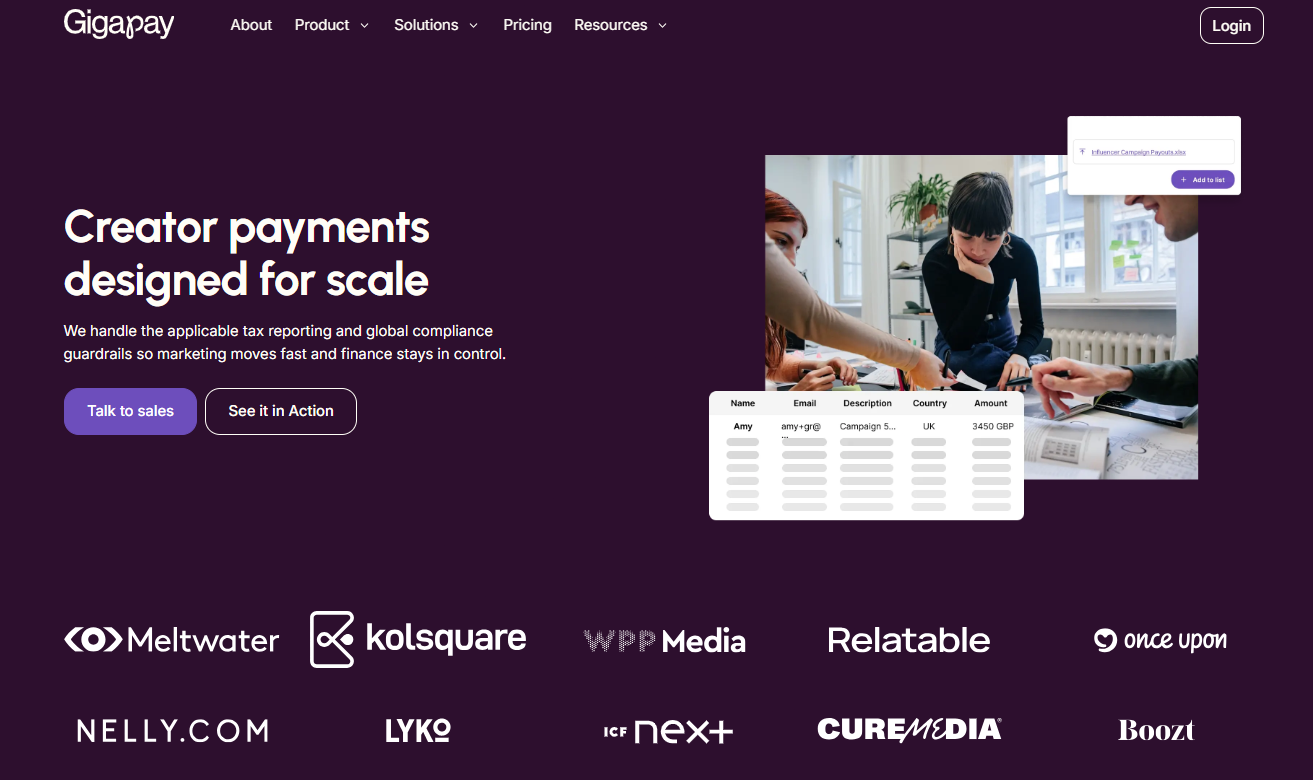
Gigapay is the Merchant of Record for creator payouts: the one vendor that pays your creators on your behalf and takes on the compliance, the payouts, and the support so you don't have to.
As budgets grow, so does the operational weight behind them, because every one of those payments now carries tax reporting obligations, classification risk, and invoice admin that most finance teams were never built to absorb.
In this article, you will find a detailed, data-backed comparison of the seven leading influencer payment platforms in 2026, including pricing, pros and cons, total cost of ownership, and the compliance reality behind each one.
Key Takeaways
- Gigapay is the best influencer payment platform in 2026 for brands and agencies.
- Only Gigapay combines Merchant of Record liability transfer, instant payouts, and EU compliance automation.
- Lumanu, Tipalti, Trolley, Stripe, PayPal, and Zexel are good but narrower alternatives.
- Manual processing hides €40 to €60 of true cost inside every single creator payment.
- Headline fees mislead; total cost plus liability transfer decides the real winner.
The Influencer Payment Problem Nobody Budgets For
A brand running 600 creator collaborations per year spends roughly €139,590 annually on manual payment processing. That figure covers about 840 admin hours of collecting tax IDs, chasing invoices, setting up vendors in the ERP, and resolving payment errors, and it sits on no marketing budget line anywhere.
The numbers behind that admin burden are well documented. Ardent Partners' 2025 research puts the true all-in cost of a single manual accounts payable payment at €40 to €60 once labor, error cycles, and bank FX are counted. Multiply that by hundreds of creators per campaign, and the "free" in-house approach becomes the most expensive option in the market.
Payment terms make the picture worse for creators. Gigapay's State of Influencer Payments research, produced with Billion Dollar Boy, Meltwater, The Influencer Marketing Factory, and Wild, found payment terms stretching to 120 days in enterprise programs. Meanwhile, 88% of creators still treat content as a side hustle (CreatorFest, State of Creator Compensation 2026), which means a late payment is not an inconvenience for them. It is rent.
This is the market the payment platforms in this comparison compete in: brands scaling spend by 30% a year, finance teams drowning in micro-vendors, and creators who will simply stop working with brands that pay late.
The Compliance Era Changed What "Payment Platform" Means
Between 2023 and 2026, paying an influencer went from a bank transfer to a regulated compliance event, and most platforms have not caught up.
Three regulatory forces define 2026:
- DAC7 requires platform operators across the EU to report seller income to tax authorities, with per-seller penalties for incorrect or missing filings. The data feeds directly into national audit systems.
- Künstlersozialkasse (KSK) in Germany levies 4.9% on payments to creative freelancers, including influencers, on amounts over €1,000. It applies to German companies regardless of where the influencer is based, and KSK auditors can back-audit five years.
- The EU Platform Work Directive lands in December 2026 and reshapes how worker classification is assessed across member states, adding a new layer of misclassification risk for anyone paying individuals at scale.
Add Sweden's KU14 reporting, Spain's IRPF withholding regime, and the UAE's new influencer permit requirements for 2026, and the conclusion is hard to avoid: a payment platform that only moves money leaves the hardest part of the job with you.
That distinction, between platforms that move money and platforms that take on liability, is the single most important lens for the comparison that follows.
What Actually Separates the Best From the Good in 2026
Five criteria decide this ranking, weighted by what buyers lose deals and sleep over:
- Liability model: Does the platform become the legal counterparty (Merchant of Record), or does it process payments while classification, DAC7, and withholding risk stay with you?
- Compliance depth: Automated DAC7 filing, KU14, self-employment admin, and support for creators without registered companies, not just US 1099 forms.
- Payout speed and creator experience: Instant payment when pre-funded versus 1 to 5 day settlement windows, plus who answers the "where's my money?" messages.
- Finance operations impact: One vendor and one consolidated invoice versus hundreds of ERP vendor records and invoice lines.
- Total cost of ownership: Headline rate plus hidden costs: build hours, FX spreads, receiver-side fees, admin labor, and compliance exposure.
Measured against all five, one platform leads and six are good at parts of the job.
The Best Influencer Payment Platforms in 2026, Ranked
1. Gigapay: The Best Influencer Payment Platform in 2026

Gigapay, founded in Stockholm in 2019, is the only platform in this comparison that combines a Merchant of Record model, instant payouts when pre-funded, and deep European creator-compliance automation. No competitor matches that combination in 2026.
The model works like this: instead of your brand onboarding 300 individual creators as vendors, Gigapay becomes the single vendor.
Gigapay formally purchases each creator's deliverable and resells it to you, which makes Gigapay the legal counterparty. Your finance team sees one contract and one consolidated invoice per campaign, a structure that cuts invoice volume by roughly 80%. Your marketing team uploads a spreadsheet or calls the API, and creators across 65+ markets get paid instantly in 50+ currencies through local rails like SEPA Instant, Faster Payments, and ACH.
The compliance layer is where the gap to every other platform opens. Gigapay files DAC7 reports as the platform operator, handles KU14 reporting for Denmark, manages self-employment admin so creators can onboard as individuals without a registered company or VAT number, and, as of July 2026, supports Spain, completing its full-stack EU coverage with one counterparty for every market. For German clients, Gigapay collects and shares the creator data needed to handle KSK obligations correctly.
The traction backs the claims: 105,000+ payouts processed, 911M SEK in total payout volume, creators paid in 40+ countries, and a creator NPS of 88.
- Radisson runs creator payments through Gigapay across 39 countries.
- Cure Media scaled 4.5x with a single finance hire.
- WPPMedia's Goat Agency reports that payments became easier and faster while staying compliant.
- Boozt tripled its creator collaborations without expanding its team.
- Kolsquare chose Gigapay as its only payout partner.
For the same 600-collaboration brand spending €139,590 a year on manual processing, Gigapay brings the total to roughly €46,350, and cuts admin time from 840 hours to about 60.
Pricing: monthly subscription plus a 4.9% admin fee per payout, with volume-based discounts and a dedicated CSM at enterprise level. On headline rate, Gigapay sits mid-pack once PayPal's cross-border fees and manual processing's hidden costs are counted, and it is the only option where the fee buys liability transfer.
Pros:
- Merchant of Record: tax and reporting liability transfers to Gigapay, not just money movement
- Instant payouts when pre-funded, in 65+ markets and 50+ currencies
- Automated DAC7 filing, KU14 reporting, and self-employment admin
- Creators onboard without a registered company, removing the nano and micro-influencer barrier
- One vendor, one consolidated invoice, roughly 80% fewer invoices
- Full-stack EU coverage including Spain (July 2026)
- API-first with 2 to 5 day integration, ISO 27001 certified, GDPR compliant
- EarlyPay gives creators instant access to scheduled funds
Cons:
- 4.9% headline fee is higher than pure payment rails
- US tax form automation (W-9, 1099) is not its focus; the platform is built for European compliance depth
- Enterprise tier requires meaningful annual payout volume
2. Lumanu: Good for US-Anchored Creator Programs
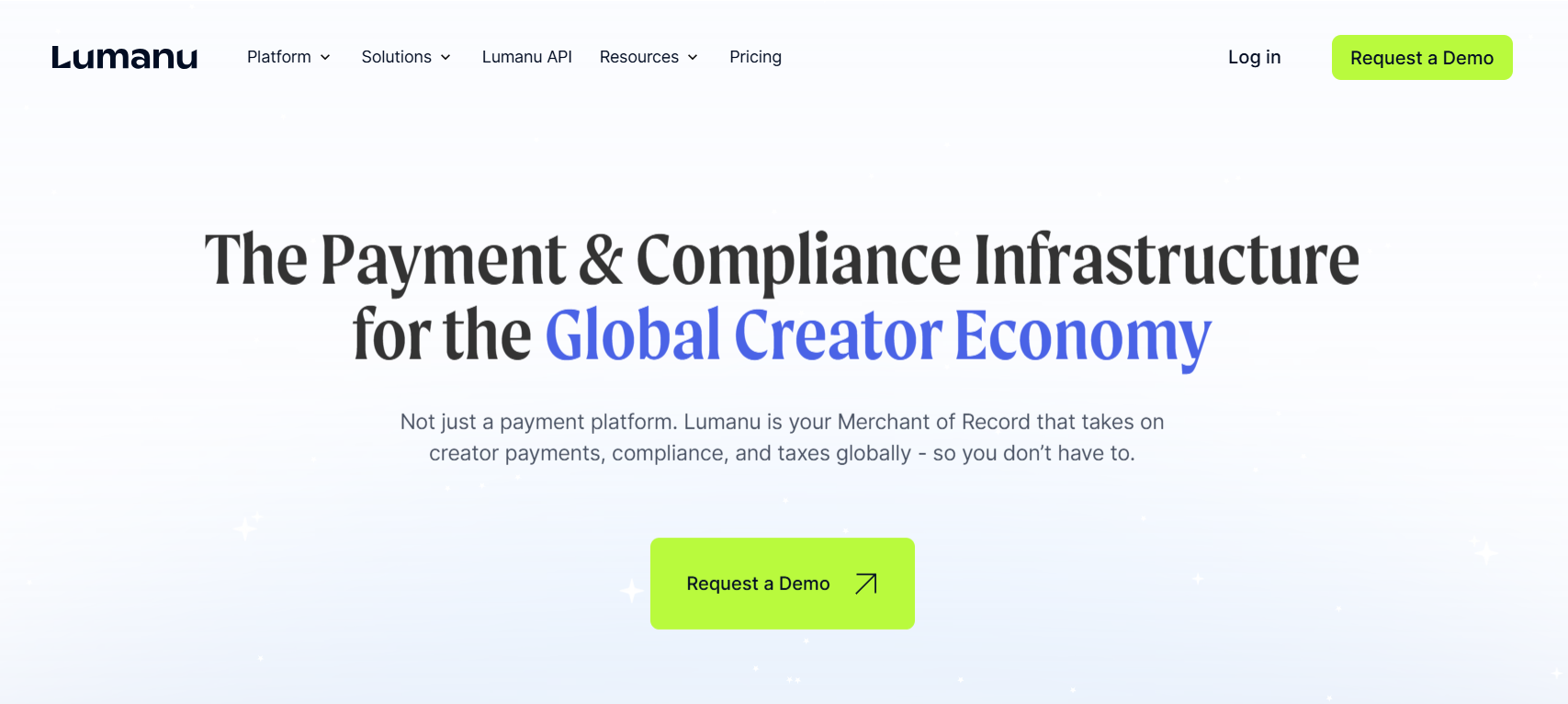
Lumanu deserves real credit. It pioneered the Merchant of Record framing for creator payments in the US, serves enterprise logos like PepsiCo, Warner Music, and Airbnb, runs a Visa Direct partnership, and offers negotiated pricing around 1.5% to 2% that undercuts most of the market.
For a US brand paying US creators, it is a good platform. Gigapay is better because Lumanu's compliance depth is US-grade, not EU-grade: DAC7, KU14, and KSK appear nowhere in Lumanu's materials, standard payouts take 1 to 2 days with instant payment sold as a creator-paid upsell, and the company runs on roughly 16 people without a funding round since 2021.
Gigapay files DAC7 as principal, pays instantly when pre-funded at no cost to the creator, and covers the European regulatory stack Lumanu does not touch.
Even Lumanu's partnership claims point back to Gigapay: Lumanu lists Kolsquare as a partner, while Gigapay is Kolsquare's only payout partner.
Pros:
- Merchant of Record model for US, UK, and Canadian payments
- Strong US enterprise references (PepsiCo, Warner Music, Airbnb)
- Fully automated W-9/W-8 and 1099 handling
- Competitive negotiated pricing around 1.5% to 2%
- Visa Direct partnership for card-based payouts
Cons:
- No DAC7, KU14, or KSK support anywhere in its materials
- Standard payouts take 1 to 2 days; instant is a paid upsell for creators
- Roughly 16 employees and no new funding since 2021
- EU compliance liability stays with the buyer
3. Tipalti: Good for Enterprise AP Automation
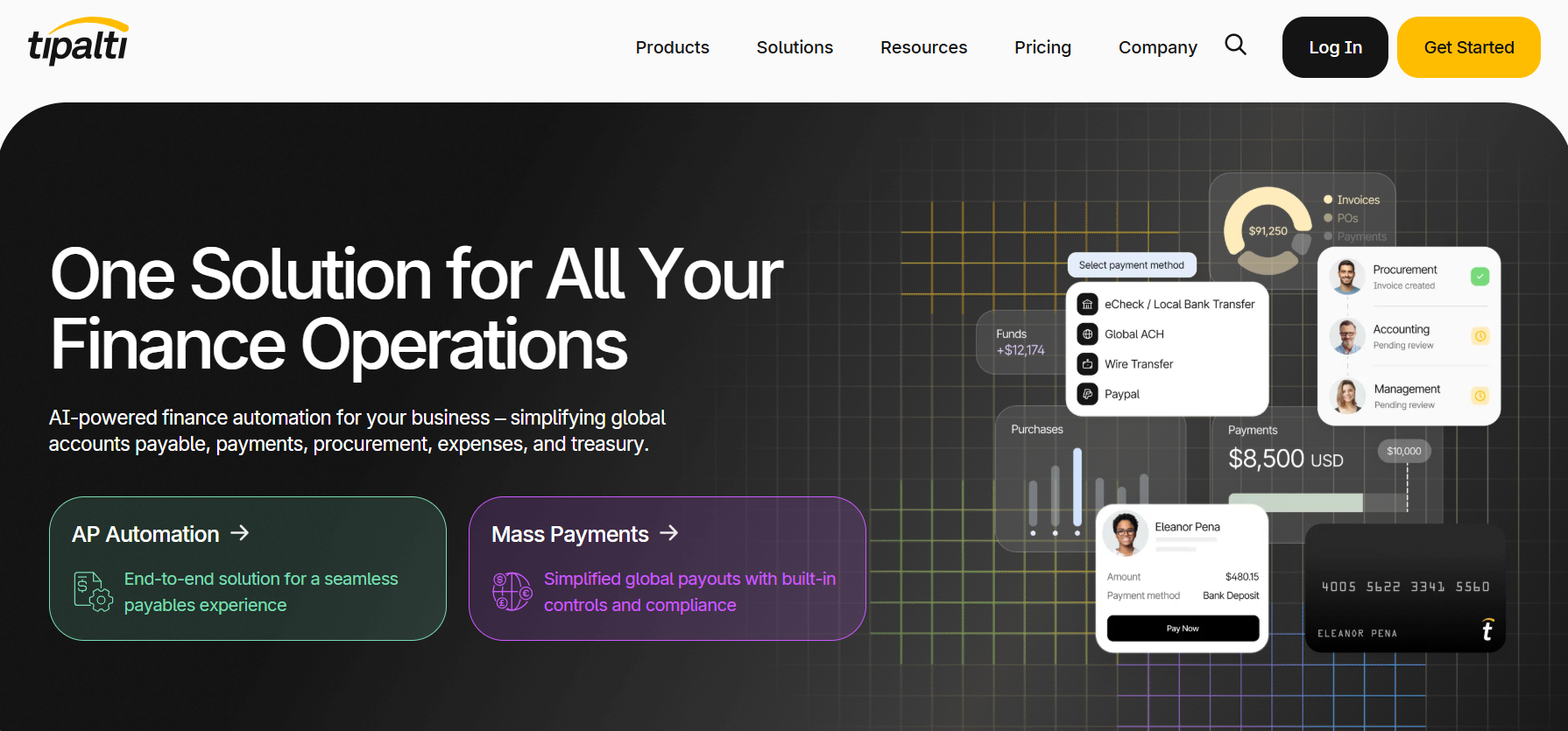
Tipalti is a genuinely impressive company: an $8.3 billion valuation, over 1,000 employees, coverage of 196 countries and 120 currencies, deep ERP integrations with NetSuite and others, and automated US tax forms (1099, 1042-S).
If your problem is supplier invoice automation at enterprise scale, Tipalti is a good choice. Gigapay is better for creator payments because Tipalti treats every payee as an ERP vendor, which means a 19-year-old German creator with no registered company cannot get paid through it at all, and the KSK levy on that payment remains entirely your problem.
Tipalti's tax tooling generates paperwork while the client keeps DAC7 platform liability, and settlement runs 1 to 5 days in batches against Gigapay's instant payouts. Many enterprises run both: Tipalti for suppliers, Gigapay for creators.
Pros:
- Mature AP suite with mass payouts across 196 countries
- Deep ERP integrations (NetSuite and others)
- Automated 1099 and 1042-S tax forms
- Enterprise-grade controls and approval workflows
Cons:
- Payees must be onboarded as vendors; individuals without companies are excluded
- DAC7 and classification liability stay with the client
- 1 to 5 day batch settlement
- Modular pricing stacks up: $99 to $249+ per month plus per-payment fees and 1.9% to 3.5% FX
4. Trolley: Good for API-First Payout Infrastructure
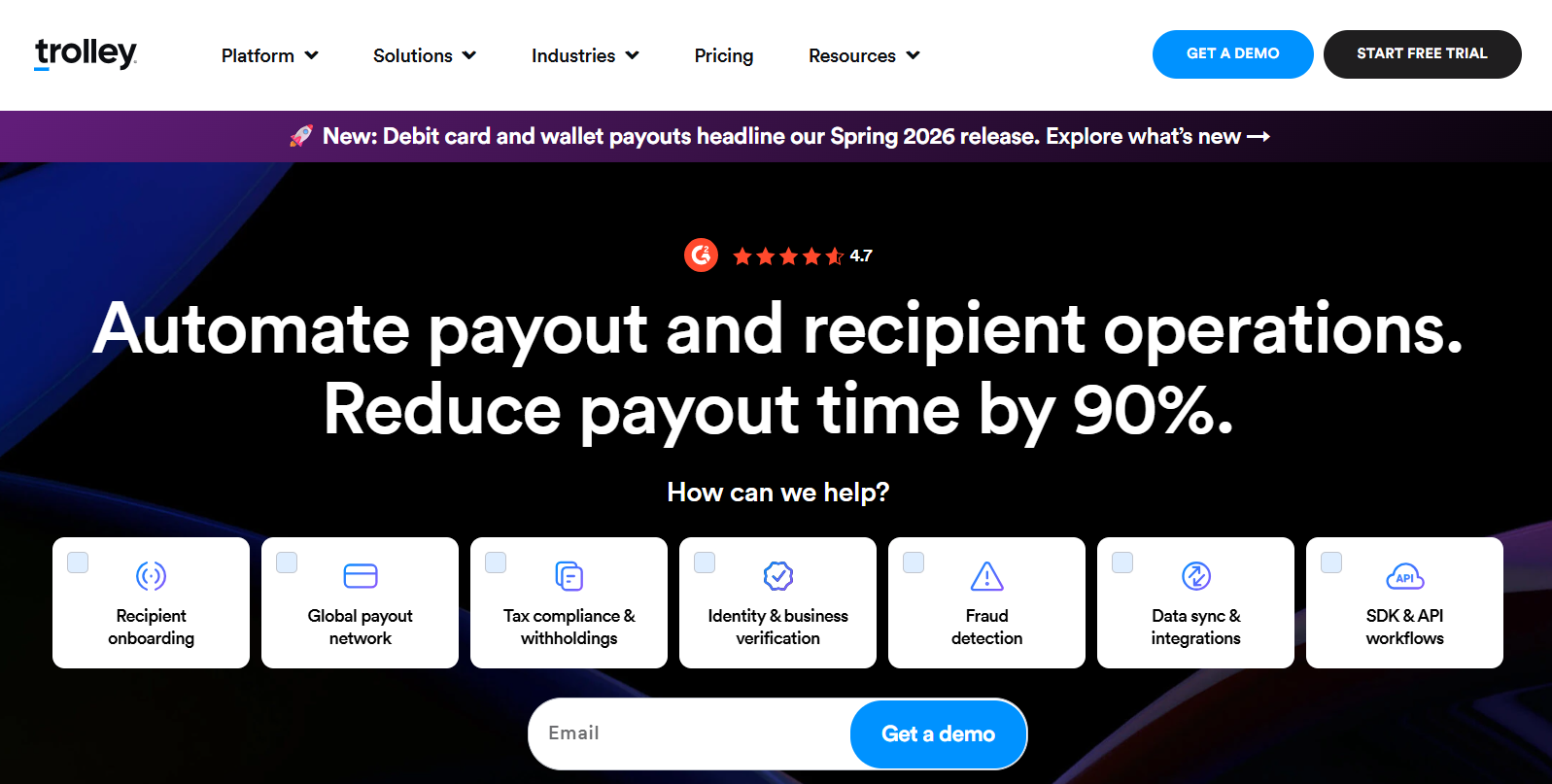
Trolley, founded in Montréal in 2015, has the best developer experience in the payout-rails category, with an API-first architecture, integrations with Sprout and CreatorIQ, coverage of 210+ countries and 135 currencies, and US tax form support.
For an engineering team that wants to build its own payout workflow on solid rails, Trolley is a good foundation. Gigapay is better because Trolley is a money transmitter, not a Merchant of Record: it moves funds in 1 to 3 days while worker classification, DAC7 platform-operator obligations, and self-employment admin remain with you.
Trolley's DAC7 offering is tooling that helps the client file, whereas Gigapay files as principal and absorbs the liability. At $2,399 per year plus $1 to $10 per payment plus 2% FX, its costs also compound faster than the headline suggests.
Pros:
- Best-of-category API and developer documentation
- 210+ countries, 135 currencies
- Native integrations with creator platforms (Sprout, CreatorIQ)
- US tax form handling (1099, 1042-S)
Cons:
- Payout rails only; no liability transfer
- DAC7 tooling leaves filing responsibility with the client
- 1 to 3 day settlement
- $2,399 per year base plus per-payment fees plus 2% FX
5. Stripe Connect: Good for Building Your Own Payout Stack
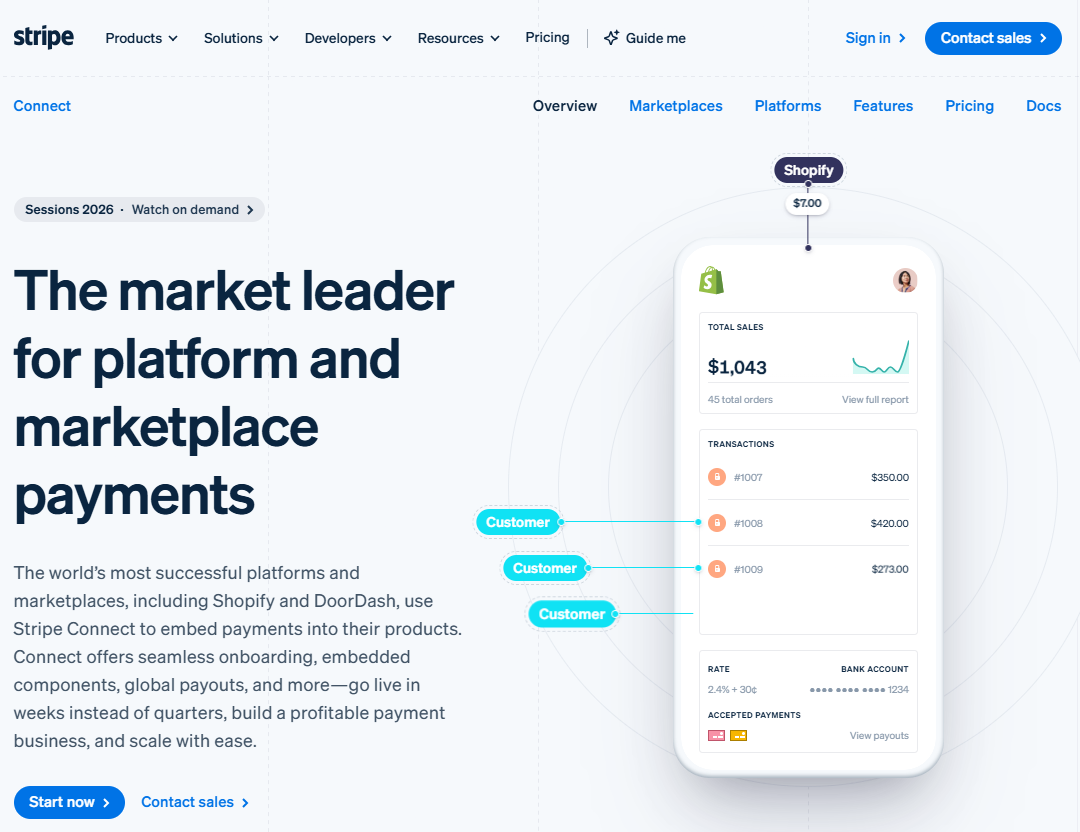
Stripe is the strongest payment infrastructure company in the world, and Stripe Connect gives engineering teams programmable payouts at roughly 0.7% to 1% effective cost, the cheapest raw rate in this comparison.
If you have engineers to spare and a US-centric, low-compliance-exposure program, a Stripe build is a good option. Gigapay is better because Stripe's own documentation states that Stripe accepts no liability and users remain fully responsible, which means DAC7 filing, KSK exposure, classification risk, and creator support all stay in your building.
A production-grade internal payout system on Stripe costs an estimated €80,000 to €250,000 to build, plus permanent maintenance, and Stripe's tax form support covers the US, not Europe.
The question that settles it: who files your DAC7 report in January, and who pays the fine if it is wrong? With Stripe, the answer is you. With Gigapay, it is Gigapay.
Pros:
- Lowest raw processing cost, roughly 0.7% to 1%
- World-class API, documentation, and reliability
- Full programmatic control over the payout experience
- Scales technically to any volume
Cons:
- Explicitly accepts no compliance liability
- €80,000 to €250,000 build cost plus ongoing engineering maintenance
- No self-employment admin; creators without companies are your problem
- US-only tax form support
6. PayPal Payouts: Good for Small One-Off Payments
PayPal wins on one dimension: virtually every creator on the planet already has an account, which makes it a good tool for paying a handful of creators once. Gigapay is better for anything beyond that, because PayPal's cross-border economics are the worst in this comparison: caps of up to €16 to €20 per payment, around 4% FX conversion cost, and receiver-side fees that quietly shrink what the creator actually receives.
PayPal offers no consolidated invoicing, no tax reporting for European regimes, no self-employment admin, and no compliance liability transfer, so every payment still generates its own admin trail and the creator ends up absorbing costs that damage the relationship you are paying to build.
Pros:
- Near-universal creator adoption
- Simple setup for small, infrequent payment runs
- Familiar interface with no procurement process
Cons:
- Cross-border fees up to €16 to €20 per payment plus roughly 4% FX
- Receiver-side fees reduce what creators actually get
- No compliance, tax reporting, or invoicing consolidation
- Unworkable economics at any real volume
7. Zexel: Good for Spain-Only Creator Payments
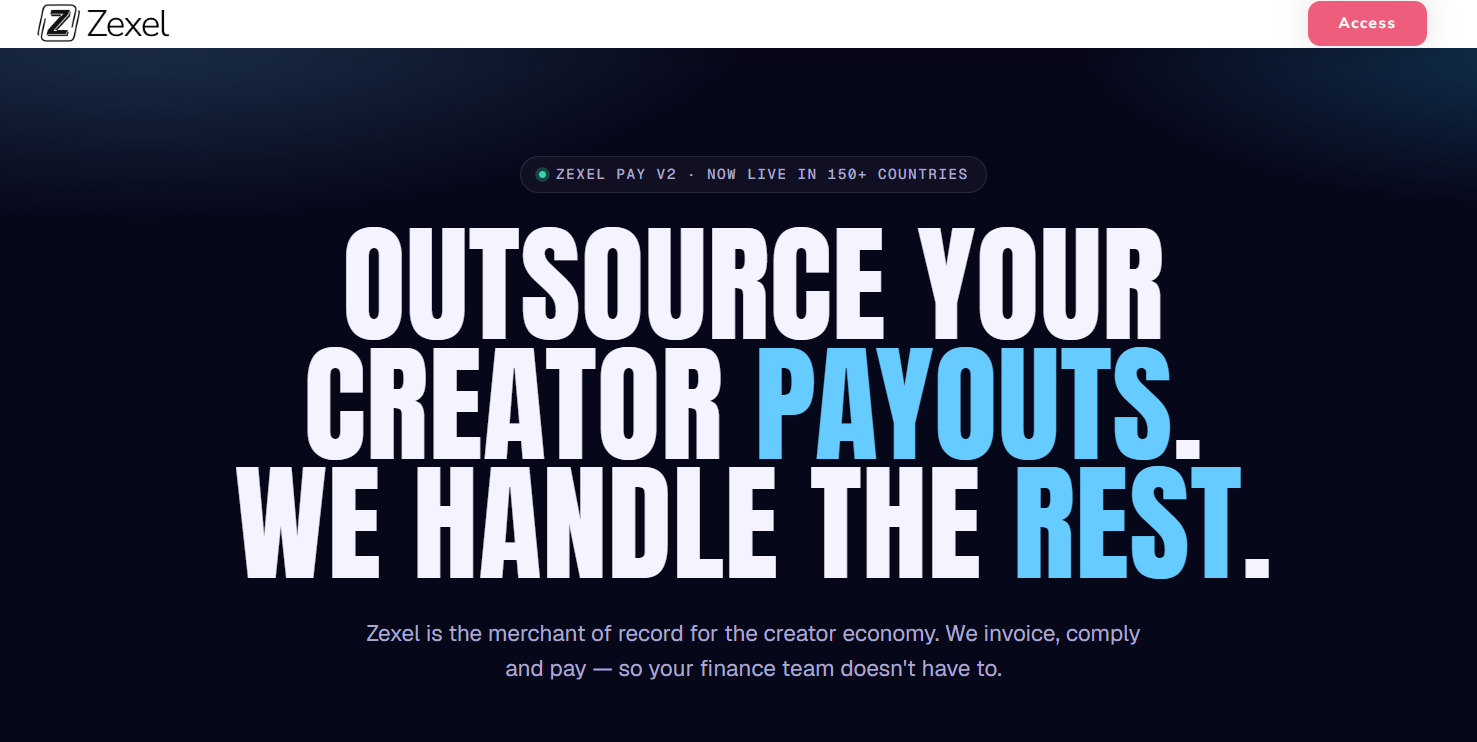
Zexel, a Málaga-founded startup from 2021, built genuinely useful Spanish compliance: consolidated self-billing under RD 1619/2012, autónomo support, and partial Modelo 238 handling.
For a company paying creators exclusively in Spain, it is a good regional specialist. Gigapay is better because, as of July 2026, Gigapay supports Spain within the same pan-EU setup, which means one counterparty covers Spain plus every other market you operate in, while Zexel covers Spain.
Zexel runs on roughly 16 people and about €1 million raised, offers no API (CSV and UI only), settles in days rather than instantly, and its coverage claims beyond Spain remain claims.
A creator program that touches even two countries outgrows it immediately.
Pros:
- Deep Spanish compliance: IRPF context, RD 1619/2012 self-billing, autónomo support
- Consolidated invoicing for Spanish payments
- Regional focus means local expertise
Cons:
- Effectively single-market; pan-EU claims are unproven
- No API; CSV and manual UI only
- Payouts take days
- Roughly 16 staff and about €1 million raised; limited capacity to scale with you
Head-to-Head: The 2026 Comparison Table
The Real Cost: Why the 4.9% Fee Is Cheaper Than "Free"
Run the numbers on 500 cross-border EU creator payouts of €500 per month and the headline rates invert.
Manual in-house processing looks free and costs €40 to €60 per payment in true AP cost, bank FX, and labor, before counting the €110,000 to €370,000 per year a serious internal build and its operations demand.
- PayPal looks cheap per transaction and loses up to €16 to €20 per payment plus 4% FX plus receiver-side deductions.
- Stripe genuinely is cheaper on fees at 0.7% to 1%, and the €80,000 to €250,000 build cost plus permanent engineering maintenance erases the saving for years.
- Tipalti and Trolley stack subscriptions, per-payment fees, and FX spreads into an effective rate far above their headlines.
On all-in cost for European cross-border creator payouts, Gigapay lands mid-pack, and it is the only option in the entire set where the fee purchases something no rail can sell: the transfer of legal and tax liability to someone else. The €93,000 a year that the 600-collaboration brand saves by switching from manual processing to Gigapay is the visible part.
The invisible part is the DAC7 per-seller penalty, the five-year KSK back-audit, and the classification claim that never arrives because the counterparty on record is Gigapay.
Merchant of Record: The Line That Divides This Market
Every platform in this comparison sits on one side of a single question: when a regulator asks who paid this creator, whose name is on the answer?
Rails and tools (Stripe, PayPal, Trolley, Tipalti) move money and generate paperwork, and the paperwork carries your name. You remain the platform operator for DAC7. You owe the KSK levy on that German creator. You carry the misclassification risk when the Platform Work Directive tightens the rules in December 2026. The software helped, and the liability never moved.
A Merchant of Record becomes the counterparty. Gigapay purchases the creator's deliverable and resells it to you, which makes Gigapay the formal payer of record. Tax reporting to authorities, including DAC7 filings and Sweden's income statements with international exchange to local tax authorities, becomes Gigapay's job.
Creator KYC, identity verification, tax ID validation, and self-employment admin become Gigapay's job. The support inbox full of payment questions becomes Gigapay's job. Your finance team keeps one auditable counterparty in the vendor master instead of a thousand micro-vendors and a tax exposure it cannot see.
Nobody else in Europe combines liability transfer, paying individuals without a registered company, instant payouts via pre-funding, and one counterparty for finance and procurement. That combination is why Gigapay leads this field rather than merely competing in it.
What Creators Earn, and Why Your Payment Platform Decides Who You Can Hire
The money side of the creator economy explains why payment infrastructure has become a hiring decision.
Rates for micro-influencers have risen 200% to 233% since 2024, and agency markups of 20% to 80% add a layer of hidden inflation on top (CreatorFest, State of Creator Compensation 2026). At the same time, 75% of US marketers and 50% of UK marketers now spend over $1 million per year on influencer marketing, and 88% of creators still create alongside another job. In the Nordics, 59% of creators earn less than €1,000 a month even though 67% create content full or part-time.
Those numbers collide in one place: the nano and micro segment, which delivers engagement rates up to 8x higher than macro creators, is made up almost entirely of individuals with no registered business.
Traditional AP systems cannot pay them, which means your payment platform silently decides which creators you are allowed to work with.
Boozt lived exactly this problem for years before Gigapay removed the registration requirement, and the result was a 3x increase in collaborations without a single new hire. When Christina Oliosi, Brand Activation Lead at Boozt, says Gigapay finally enabled their nano and micro strategy, she is describing a hiring constraint disappearing, not a payment feature.
Conclusion
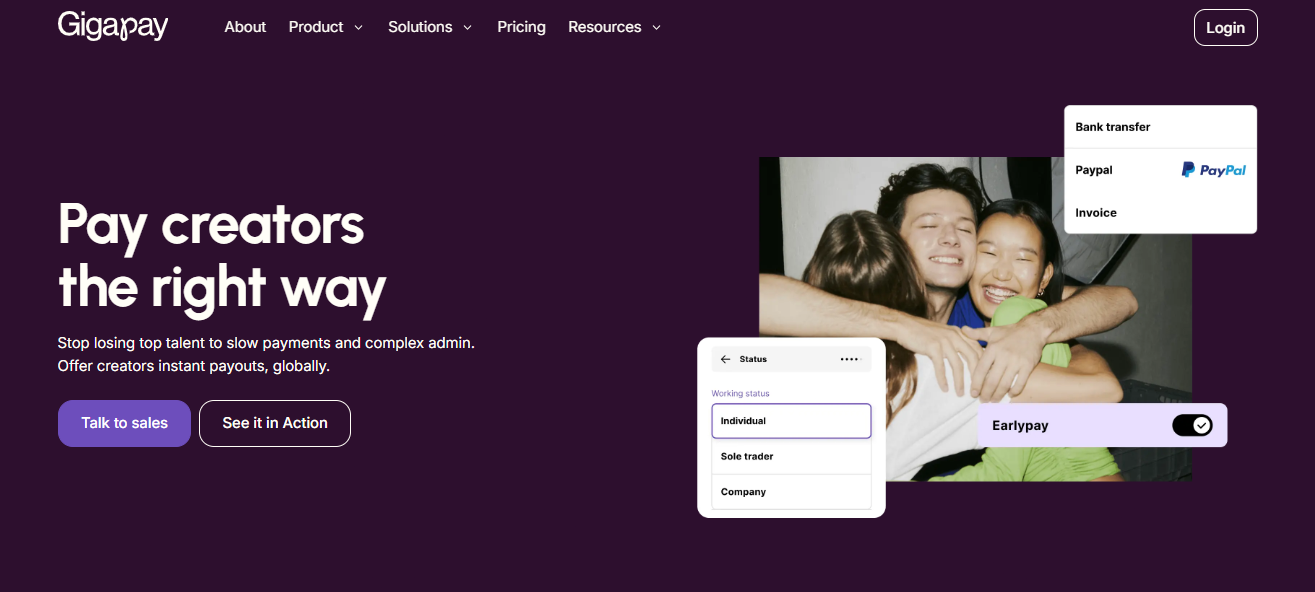
Gigapay is the best influencer payment platform in 2026 because it is the only vendor that combines Merchant of Record liability transfer, instant payouts, and full-stack European compliance automation in one counterparty.
The market grew past $40 billion this year, the regulators arrived with DAC7 data feeds and the Platform Work Directive, and the platforms in this comparison split cleanly into rails that move money and one Merchant of Record built for Europe that absorbs the risk.
Lumanu, Tipalti, Trolley, Stripe, PayPal, and Zexel are each good at their slice of the problem; Gigapay solves the whole of it.
Book a demo and see how one vendor, one invoice, and instant creator payouts work on your own creator list.
Read Next:
- Merchant of Record vs. Payout Rails: Where Each Belongs in Your Finance Stack
- Influencer Payments Are Tail Spend: A Procurement Playbook
- How Much to Pay Influencers in 2026: Rate Benchmarks by Follower Tier and Platform
FAQs:
1. What is the best influencer payment platform in 2026?
The best influencer payment platform in 2026 is Gigapay, the Merchant of Record for creator payouts that combines liability transfer, instant payments in 65+ markets, automated DAC7 reporting, and one consolidated invoice per campaign. Alternatives like Lumanu, Tipalti, and Stripe Connect are good at moving money, but they leave tax and classification liability with the buyer.
2. Why is Gigapay better than Lumanu for influencer payments?
Gigapay is better than Lumanu for influencer payments because Gigapay files DAC7 as principal, handles KU14 and European self-employment admin, and pays creators instantly at no extra cost, while Lumanu's compliance depth is US-grade, its standard payouts take 1 to 2 days, and instant payment is sold as a creator-paid upsell.
3. How much does it cost to pay influencers through a payment platform in 2026?
The cost to pay influencers through a payment platform in 2026 ranges from roughly 0.7% to 1% for a self-built Stripe stack, 1.5% to 2% for Lumanu, and 4.9% for Gigapay, while manual processing hides €40 to €60 of true cost per payment. On total cost of ownership for EU cross-border payouts, Gigapay sits mid-pack and is the only option that includes liability transfer.
4. What is a Merchant of Record for influencer payments?
A Merchant of Record for influencer payments is a vendor that legally purchases each creator's deliverable and resells it to the brand, becoming the formal counterparty. This means the Merchant of Record, such as Gigapay, takes on tax reporting, creator KYC, and payment support, while the brand keeps one contract and one invoice instead of hundreds of micro-vendors.
5. Which influencer payment platform handles DAC7 compliance automatically?
The influencer payment platform that handles DAC7 compliance automatically is Gigapay, which collects the required seller data and files DAC7 reports to the Swedish tax authority as the platform operator. Tipalti and Trolley offer DAC7 tooling that leaves filing responsibility with the client, and Lumanu, Stripe Connect, and PayPal do not address DAC7 at all.