.jpg)

The Esports World Cup 2026 will distribute a $75 million prize pool across more than 100,000 qualifying players competing in global qualifiers, with finalists drawn from over 60 countries.
Gigapay is the Merchant of Record built for organizations that pay creators, players, and content talent at scale, with full tax and compliance liability sitting in-house rather than on the brand or tournament organizer.
Tournament operators, team owners, and streaming networks are now disbursing larger prize pools, longer rosters, and more cross-border talent than ever, and most of them are still running it through spreadsheets and bank portals that were never built for that volume.
Below are the seven benefits that make Gigapay the payout backbone for eSports organizations in 2026.
Key Takeaways
- Gigapay pays eSports players and staff instantly across 65+ countries and 50+ currencies.
- As Merchant of Record, Gigapay assumes the tax and compliance liability for each payout.
- One vendor in your ERP replaces hundreds of individual player and staff records.
- EarlyPay gives players access to scheduled prize money before the official release date.
- API integration with tournament platforms takes between two and five working days.
Why eSports Payouts Break Most Finance Systems
Tournament prize money looks simple on paper. The bracket finishes, the rankings are final, and the prize pool is split per the published distribution. The actual finance work that follows is where it breaks.
A single major event can involve players from 30+ countries, staff working under several different classifications, and a payment window that the broadcast partner expects to be measured in hours rather than weeks.
Each player needs verified identity documents, the right tax forms for their jurisdiction (W-9 or W-8 in the US, KU14 in Sweden, KSK in Germany, DAC7 across the EU), and a verified destination bank account or wallet.
Many of them are not registered businesses and have no VAT number. Most of them are under 25.
A finance team running this manually ends up tracking the same payee across three spreadsheets, a bank portal, and a tax filing system, which is how 30-day payout timelines become standard in this industry. The seven benefits below are the specific ways Gigapay closes that gap.
Gigapay's 7 Core Benefits for eSports Payouts
1. One Vendor for Hundreds of Players, Coaches, and Casters
eSports rosters are never just players. A single organization typically pays players, head coaches, performance analysts, in-game leaders, content creators, streamers, casters, observers, and a dozen other support roles, all of whom expect to be paid on different schedules and under different agreements.
Without consolidation, each of those people becomes an individual vendor record inside the finance system.
For a team running across multiple titles, that ends up as several hundred vendor records to maintain, reconcile, and re-onboard every fiscal year.
Gigapay sits in your ERP as a single counterparty, which means the 300+ vendor records collapse into a single contract, a single invoice cycle, and a single support relationship. The administrative footprint of an entire roster is reduced to one row.
2. Instant Payouts Across 65+ Countries
eSports talent is global by default. A Korean assistant coach, a Brazilian duelist, a German caster, and a US tournament admin can all be on the same payment run for a single event. Gigapay sends funds instantly across 65+ countries and 50+ currencies, using local payment rails wherever they exist (SEPA Instant in the EU, Faster Payments in the UK, ACH in the US), so the money lands in the player's account on the same day the result is final rather than two or three weeks later.
For a competitive scene where players regularly travel between continents and where a delayed payout can damage the team's relationship with talent that has options, that speed compounds into retention.
3. Merchant of Record Tax and Compliance Coverage
The Merchant of Record is the core differentiator and the reason the platform exists. Tournament organizers running cross-border prize payments hit a wall of jurisdictional rules the moment they expand internationally: DAC7 reporting in the EU, KSK levies in Germany (4.9% on creative payments above €1,000 in 2026), KU14 in Sweden, 1099-MISC and 1042-S reporting in the US, and a different set of withholding rules in every other territory.
Gigapay legally buys the player's deliverable, whether that is a tournament placing, a streaming appearance, or a content slot, and concurrently resells it to your organization, which means Gigapay becomes the formal counterparty. The reporting and identity-verification obligations sit with Gigapay rather than with your finance or legal team.
4. No Business Registration Required From Players
Most prize winners are not registered businesses. They are students, sole traders, hobbyist competitors, and young pros who have never filed a VAT return in their life.
Traditional B2B payment platforms reject them at onboarding or push the verification work back onto the tournament organizer, which is why so many semi-professional players quietly go unpaid for weeks while their paperwork is chased.
Gigapay accepts payees as individuals, sole traders, or companies, with no requirement to hold a VAT number or a registered business entity.
That single design choice opens up the entire nano- and micro-talent layer of the industry to professional payment infrastructure, which is the layer where most of the future top-tier roster is currently sitting.
5. Consolidated Invoicing With 80% Fewer Invoices
Every prize payout, every streamer payment, and every appearance fee normally generates its own invoice for the finance team to process, code, approve, and file.
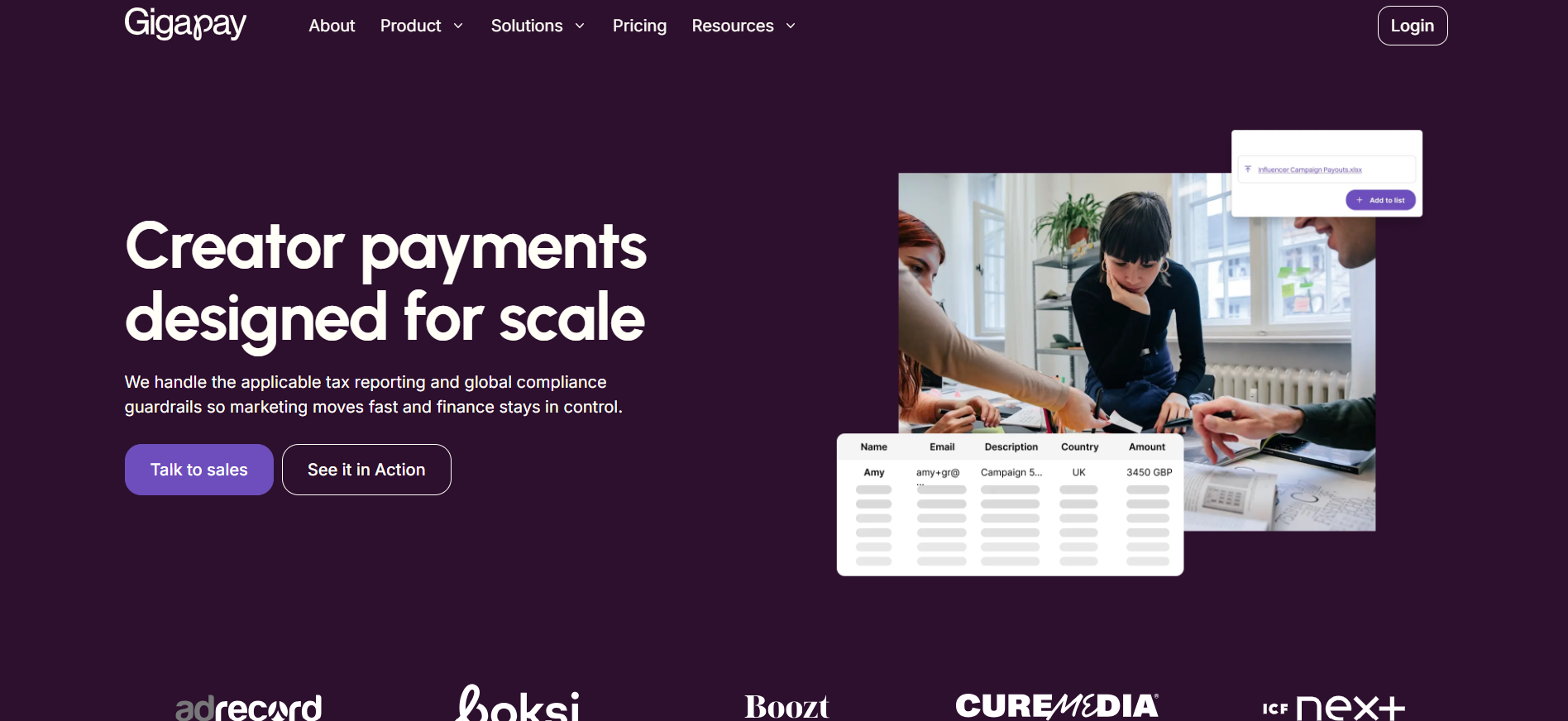
Gigapay automates self-billing on behalf of every payee and produces one consolidated invoice per campaign or batch, which Gigapay benchmarks at an 80% reduction in invoice volume against the manual baseline.
For a tournament finance team running twelve events a year, that turns roughly several thousand invoices into roughly twelve. The downstream effect is that month-end close stops being dominated by influencer and player payment reconciliation, which is the single biggest hidden cost of running a competitive program at scale.
6. EarlyPay Liquidity for Players Between Payout Cycles
Prize money traditionally sits behind net-60 publisher payment terms, sponsor invoice cycles, or legal escrow before it reaches the player.
EarlyPay lets players access their scheduled funds before the official release date, while the formal payment date on the organization's side remains intact for accounting purposes. For semi-pro and developing players whose monthly income often hinges on a single tournament placement, that liquidity is what keeps them in the competitive scene instead of dropping back to amateur status to chase steady income.
Player retention at the developmental tier is one of the structural levers behind a healthy long-term talent pipeline, and EarlyPay is one of the few payout features built specifically around it.
7. API-First Integration With Tournament and Streaming Platforms
Most tournament organizers already run their event operations on platforms like Toornament, Battlefy, FACEIT, or internal tooling. Gigapay's REST API plugs payout flows directly into those systems through documented endpoints for player registration with KYC and tax-ID validation, prepayment funding, batch payouts, and webhook-driven event updates.
Sandbox and production environments are documented at developer.gigapay.se, and the typical end-to-end integration time is between two and five working days for an in-house engineering team.
The result is that the tournament platform's own admin panel becomes the payout console, with Gigapay handling the regulated layer underneath instead of requiring ops to context-switch into a separate finance tool.
The Operational ROI of Switching to Gigapay
Gigapay publishes a benchmark for an organization running 600 creator collaborations per year, and the same arithmetic maps cleanly onto a mid-sized tournament operator, eSports network, or team running comparable volumes of player, caster, and content payments.
Under the manual workflow, that volume costs roughly €139,590 per year and consumes around 840 admin hours, most of which goes into vendor onboarding, invoice processing, tax-form chasing, and reconciliation.
Running the same volume through Gigapay drops the annual cost to roughly €46,350 and the admin time to around 60 hours per year, with the 300+ vendor records in the ERP collapsing down to a single Gigapay entry.
What those numbers actually represent is the finance team stepping out of the critical path on every tournament closeout, which is the reason most organizations end up evaluating a payout platform in the first place.
Conclusion
Gigapay is the payout layer that lets eSports organizations grow their player base, content roster, and prize distribution without growing their finance team in proportion.
From instant global transfers and full Merchant of Record tax coverage to API-first integration with tournament platforms, the seven benefits above are the operational foundation for any organization paying more than fifty players, casters, or contributors per year.
Book a demo with Gigapay to see how your next tournament could close, settle, and pay out the same week.
Read Next:
- Best Vendor Onboarding Software for Creators (2026 Review)
- Integrated Creator Payouts: How Platforms Embed Gigapay Inside Their Product
- Best Way to Pay Instagram Influencers Internationally in Bulk (2026 Guide)
FAQs:
1. What is Gigapay used for in eSports payouts?
Gigapay is used for paying eSports players, coaches, casters, streamers, and content contributors across borders as a single Merchant of Record vendor, which removes tax reporting, vendor onboarding, and compliance work from the tournament organizer or team finance team.
2. How fast does Gigapay pay eSports players in 2026?
Gigapay pays eSports players instantly through local payment rails such as SEPA Instant, Faster Payments, and ACH across 65+ countries and 50+ currencies, so prize money lands in the player's account on the same day the tournament result is final.
3. Does Gigapay handle tax compliance for international eSports tournaments?
Yes, Gigapay handles tax compliance for international eSports tournaments by acting as Merchant of Record and automating reporting for DAC7 in the EU, KSK in Germany, KU14 in Sweden, and equivalent regimes across 65+ countries.
4. Can amateur or semi-pro eSports players get paid through Gigapay without a registered business?
Yes, amateur and semi-pro eSports players can get paid through Gigapay without a registered business, because the platform accepts payees as individuals, sole traders, or companies, with no requirement to hold a VAT number or business entity.
5. How long does it take to integrate Gigapay with a tournament platform?
Integrating Gigapay with a tournament platform takes between two and five working days using the REST API, with sandbox and production environments documented at developer.gigapay.se and webhook support for real-time payment status updates.
.jpg)