
36.8% of European brands work with 100+ influencers yearly, up from 18.2% in 2024, according to Kolsquare's Future of Influencer Marketing 2026/2027 (2026).
For US brands, the best way to pay that many UK and European creators is one Merchant of Record instead of a supplier record per creator.
Gigapay is the Merchant of Record for creator payments. Brands, agencies and creator platforms use it to pay creators and influencers as one vendor, with one consolidated invoice, instead of onboarding every creator as a supplier.
This guide compares the options, 2026 fees, US tax forms and UK and EU rules.
Key Takeaways
- Bank wires and PayPal suit a few creators but add fees to every payment.
- A Merchant of Record becomes the creator's counterparty and sends you one consolidated invoice.
- The IRS generally treats pay for services performed outside the US as non-US-source income.
- Paying creators in their local currency removes the conversion their bank would charge.
- Germany's KSK levy, 4.9% in 2026, attaches to the client commissioning the work.
How Big Is the UK and European Creator Economy in 2026?
Europe now has 8.64 million income-generating creators, according to Creator's Hub's quarterly creator economy report (May 2026). The same report values the European creator economy at €28 billion in 2025, citing Coherent Market Insights and BNP Paribas, with a projection of €135 billion by 2032.
The money behind those creators keeps growing too. Global creator advertising spend reached $37 billion in 2025, up 26% year on year, and eMarketer projects $43.9 billion for 2026, both figures cited in the Creator's Hub report (2026).
France alone counted 348,000 monetised creators in 2025, according to BNP Paribas, and the UK and DACH markets add their own large creator bases.
For your team, this means the supply of UK and European creators is deep enough to staff any campaign, and the constraint has moved from finding creators to paying them.
Why Are US Brands Working With More UK and European Creators?
US brands follow their customers into the UK and Europe, and the brands already there are spending more on creators every year. 89% of European marketers expect to raise influencer spend over the next 12 months, up from 75% in 2025 and 54% in 2024, according to Kolsquare's The Future of Influencer Marketing 2026/2027 (2026).
The UK is the most committed market in that study. 38% of UK brands call influencer marketing a core growth driver against a 31% European average, 44% work with 100 or more influencers, and 93% plan to increase spend next year, according to Kolsquare (October 2026).
The mix of creators is also shifting towards smaller accounts. eMarketer forecasts that 45.5% of influencer marketing spend in 2026 will go to micro and nano influencers, up from 16.4% in 2021, as cited by Creator's Hub (2026).
Small creators deliver reach and engagement, but each one is a separate payee in a separate country, often paid in a different currency. For your finance team, a programme of 150 UK and European micro creators means 150 cross-border payments a quarter, before any repeat collaborations.
Why Is Paying UK and European Creators Harder Than Paying US Creators?
A US creator sends a W-9, gets paid by ACH and receives a 1099. None of that process carries over to a creator in Manchester, Lyon or Stockholm, so your accounts payable team has to build a second process for every foreign payee.
Different currencies and banking rails
UK creators are paid in pounds, eurozone creators in euros, and Nordic, Polish or Czech creators in their own currencies. A US dollar payment sent to a UK account is converted by the creator's bank, which adds a cost the creator sees on arrival.
Creators work in different legal forms
Many creators are individuals with no company. Others are UK sole traders, French micro-entrepreneurs or limited companies. An individual cannot send the supplier invoice your AP system expects, and many creators sit below the UK VAT registration threshold of £90,000 (GOV.UK, 2026), so they have no VAT number.
Vendor onboarding was built for large suppliers
Procurement systems ask for company registration, bank verification and tax details before the first payment. A six-week vendor onboarding queue is manageable for a software supplier and fatal for a £300 TikTok post.
Payment terms are already a pain point
Standard creator payment terms run 30 to 90 days after the invoice, according to Digiday (2024). 56% of creators surveyed by Tipalti said they had faced late payments (Tipalti, 2023).
For your team, the real problem is volume: every one of these steps repeats for every creator, in every market.
What Are the Main Ways to Pay UK and European Creators From the US?
US brands have six realistic options in 2026. The first three are payment rails: they move money, and you stay the creator's counterparty and payer. The last option, a Merchant of Record, becomes the creator's counterparty itself.
International bank wires
Wires are reliable for a handful of payments to established creators or talent agencies. The cost per payment is visible, but the conversion rate and any intermediary bank fees are harder to see, and each payee still needs full vendor onboarding.
PayPal Payouts
PayPal is familiar to many creators and quick to set up. On a 1000 payout converted to pounds, the 2% fee (20, at the cap) plus the 4% conversion spread ($40) comes to about $60, based on PayPal's published US fees (June 2026).
Multi-currency payout platforms
These tools pay creators in local currency at lower conversion costs than most banks. They move money well, but your company remains the creator's contracting party and payer, so documentation and reporting stay with your team.
Agencies and creator platforms
Agencies and influencer platforms can absorb the admin, which suits brands that buy campaigns rather than run them. You pay for that service, and you see less of the creator-level spend.
Merchant of Record
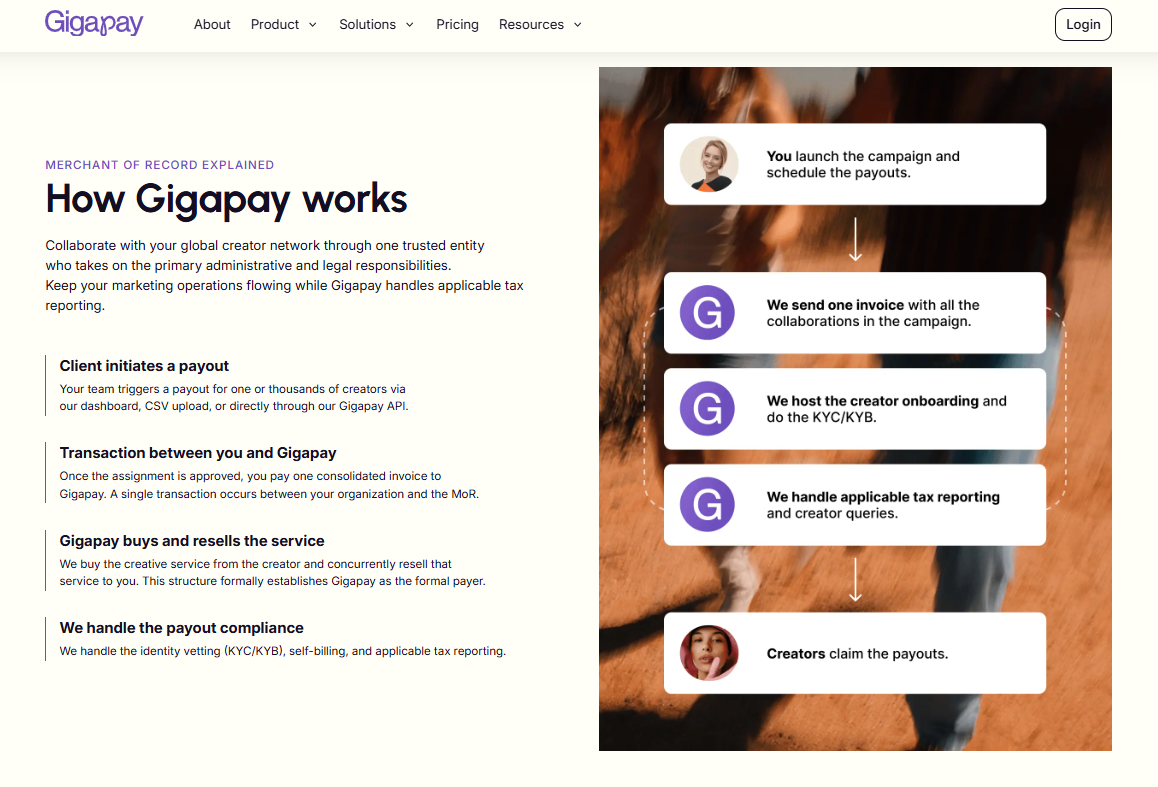
A Merchant of Record buys the creator's services in its own name and for its own account and resells them to you. You hold one vendor record and receive one consolidated invoice, which is why this model fits programmes with many small creators.
The right method depends on how many creators you pay, in how many currencies, and how many supplier records your finance team will accept.
How Much Does It Cost to Pay a Creator in the UK or Europe?
The total cost of a creator collaboration has three parts: the creator's fee, the transaction cost of sending it, and the internal time it takes your team to onboard, pay and reconcile.
UK creator rates in 2026
Whito describes these as planning benchmarks converted from mostly US-dollar pricing guides, so treat them as ranges, not fixed prices.
Across markets, about 80% of UGC creator cost ranges fall below $500, according to Influencer Marketing Hub's 2026 Influencer Marketing Benchmark Report. CreatorIQ data on 14,400 creators shows average earnings of $11,400 against a median of $3,000 for 2025 campaigns, as cited by Influencer Marketing Hub (2026). In other words, most creator payments are small, and fixed costs per payment weigh heavily on them.
Transaction costs per payment
At 200 creator payments a year, $40 wires add $8,000 in fees alone, and PayPal's conversion spread adds about $8,000 on $200,000 of creator fees.
Internal admin cost
The larger cost is often time. In Gigapay's estimate for a brand running 600 collaborations a year, the manual process costs €139,590 and 840 hours, against €46,350 and 60 hours with Gigapay.
For your budget, compare the cost per collaboration, including team hours, before comparing fees.
Which US Tax Forms Do You Need When Paying Foreign Creators?
US tax rules decide whether a payment to a foreign creator needs withholding and reporting. This section is general information based on IRS guidance, not tax advice.
Where the work is performed matters
According to the IRS U.S. withholding agent FAQs, payments for services performed in the US are generally US-sourced, so services performed outside the US are generally not. If the source cannot be determined at the time of payment, the IRS says the payment is treated as US-sourced, which can bring the 30% statutory withholding rate into play.
Form W-8BEN
Form W-8BEN lets a foreign individual certify their non-US status. The IRS recommends obtaining a valid W-8 before paying a new foreign vendor, and IRS Publication 515 (2026) notes that foreign persons who provide a valid Form W-8 are exempt from backup withholding and Form 1099 reporting.
Form 1042-S
Form 1042-S reports US-sourced fixed or periodical income paid to foreign persons and any tax withheld on it, according to the IRS.
What this means in practice
Write the place of performance into every creator agreement, because that single line drives most of the US tax analysis.
UK Rules That Affect How You Pay British Creators
UK creators handle their own income tax, and several 2026 changes shape what they need from you. This is general information from GOV.UK, not Gigapay's position and not tax advice.
Self Assessment and the trading allowance
Self-employed creators register with HMRC as sole traders and report income through Self Assessment. The first £1,000 of trading income is covered by the trading allowance, according to GOV.UK guidance on tax-free allowances.
Making Tax Digital for Income Tax
From 6 April 2026, sole traders and landlords with qualifying income above £50,000 must keep digital records and send quarterly updates to HMRC. The threshold falls to £30,000 in April 2027 and £20,000 in April 2028, and HMRC says over 860,000 people are in the first group (GOV.UK, 2026). Creators in scope will want clear, dated payment records from every brand.
VAT
A UK business must register for VAT when taxable turnover passes £90,000 in 12 months (GOV.UK, 2026). HMRC's place of supply rules (VAT Notice 741A) decide where a service is taxed, and the answer depends on who the customer is and where it belongs.
Reporting rules for digital platforms
The UK's reporting rules for digital platforms apply from 1 January 2024, with first reports due in January 2025, and follow the OECD model rules for platform operators (GOV.UK).
For your UK programme, expect creators to ask for documentation that fits their own tax filings, and keep your contracts, invoices and proof of payment in one place.
What Does DAC7 Mean for US Brands Paying European Creators?
DAC7, Council Directive (EU) 2021/514, requires digital platform operators to report information about their sellers to EU tax authorities, according to the European Commission. Reportable activities include personal services, which is why creator payments sit inside its scope.
DAC7 entered into force on 1 January 2023, and the first exchange of information, covering 2023, took place at the end of February 2024 (European Commission). Tax authorities exchange the reported data automatically, and platform operators from outside the EU register in one member state, which acts as a one-stop shop.
DAC7 is a reporting rule: it creates no new tax and is separate from VAT. It also does not replace the creator's own tax return: creators still declare their income in their home country.
For a US brand, the practical question is whether your payment set-up turns you into a platform operator with a reporting obligation. Building creator payouts into your own product usually raises that question; paying through a provider that files as the platform operator is a different model.
Which Other EU Rules Affect Payments to European Creators?
Four more EU topics affect how US brands pay European creators. Each is general information with an official source, and each needs local advice before you act on it.
Germany's KSK levy
The Künstlersozialabgabe applies to companies that commission freelance artists and publicists for advertising, public relations or their own business purposes, according to Deutsche Rentenversicherung. The rate is 4.9% for 2026, and German press reports a rise to 5.0% for 2027.
KSK attaches to the client commissioning the work. If your US brand has a German entity commissioning creator content, include KSK in your budget.
VAT on cross-border creator services
VAT is a separate question from income tax withholding. Across the EU and the UK, business-to-business services are often taxed where the customer belongs, under reverse charge rules, so the VAT treatment of a creator payment depends on the structure of your contracts.
The EU Platform Work Directive
Directive (EU) 2024/2831 must be transposed into national law by 2 December 2026. It sets a rebuttable presumption of employment where facts show control and direction of a platform worker, according to Ius Laboris (April 2026). How you engage your creators stays your responsibility, so review briefs, exclusivity and approval rights for signs of control.
The EU Instant Payments Regulation
Euro area payment providers have had to send instant euro payments and offer verification of payee since 9 October 2025, according to the European Central Bank. Non-euro member states follow in July 2027. For creators paid in euros, a slow bank payment after approval is now harder to explain.
For your legal team, these four topics belong on the checklist before you launch in a new European market.
How Do You Choose the Right Way to Pay International Creators?
Start with your volume and your finance team's tolerance for supplier records, then match the method to the situation.
Questions to ask any provider
- Who is the creator's contracting party: you or the provider?
- How many invoices will finance receive per campaign?
- Which currencies and markets does it pay out to today?
- Can creators onboard without a registered company or VAT number?
- Who reports the payments, and to which tax authority?
- How long do payouts take, by country and payout method?
- Which records do you keep for audit?
For your shortlist, the answers to questions 1 and 5 matter most, because they decide where the paperwork lands.
How to Pay a UK or European Creator Step by Step
This process works for any payment method, with the paperwork changing depending on who is the creator's counterparty.
- Agree the brief and fee: Set the deliverables, fee, currency, usage rights and the country where the work will be performed.
- Confirm the creator's status: Record whether the creator works as an individual, a sole trader or a company, and whether they have a VAT number.
- Collect the right documentation: If you pay directly, collect a W-8BEN (or a W-8BEN-E from a creator's company) and the creator's bank details; with a Merchant of Record, the creator onboards with the provider.
- Approve the work: Approval should trigger payment, so set a clear approval owner and deadline.
- Pay in the creator's local currency: Sending pounds or euros removes the conversion the creator's bank would otherwise charge.
- Keep your records: Store the contract, the invoice and proof of payment for every collaboration.
- Reconcile monthly: Match payments to campaigns so finance can close the month without chasing marketing.
Short payment terms help as well. Creators surveyed by Digiday (2024) push brands to cut terms from 30 to 60 days down to 10 to 15 days.
For your team, a written process stops each campaign manager from inventing their own.
How Gigapay Works When You Pay UK and European Creators
How the model works
- You sign one Service Agreement with Gigapay and add creators and amounts by spreadsheet upload, the app or the API.
- Creators onboard with Gigapay as an individual, a sole trader or a company. Gigapay runs identity and tax-ID checks at onboarding.
- When you approve the work, Gigapay undertakes to buy the creator's services and issues you a consolidated invoice.
- The creator claims the payout in Gigapay. At the claim, Gigapay buys the services and resells them to you.
- The payout is executed by a licensed third-party payment provider.
- Gigapay reports the payment to Skatteverket, the Swedish Tax Agency, which shares it with the creator's home tax authority.
What changes for your finance team
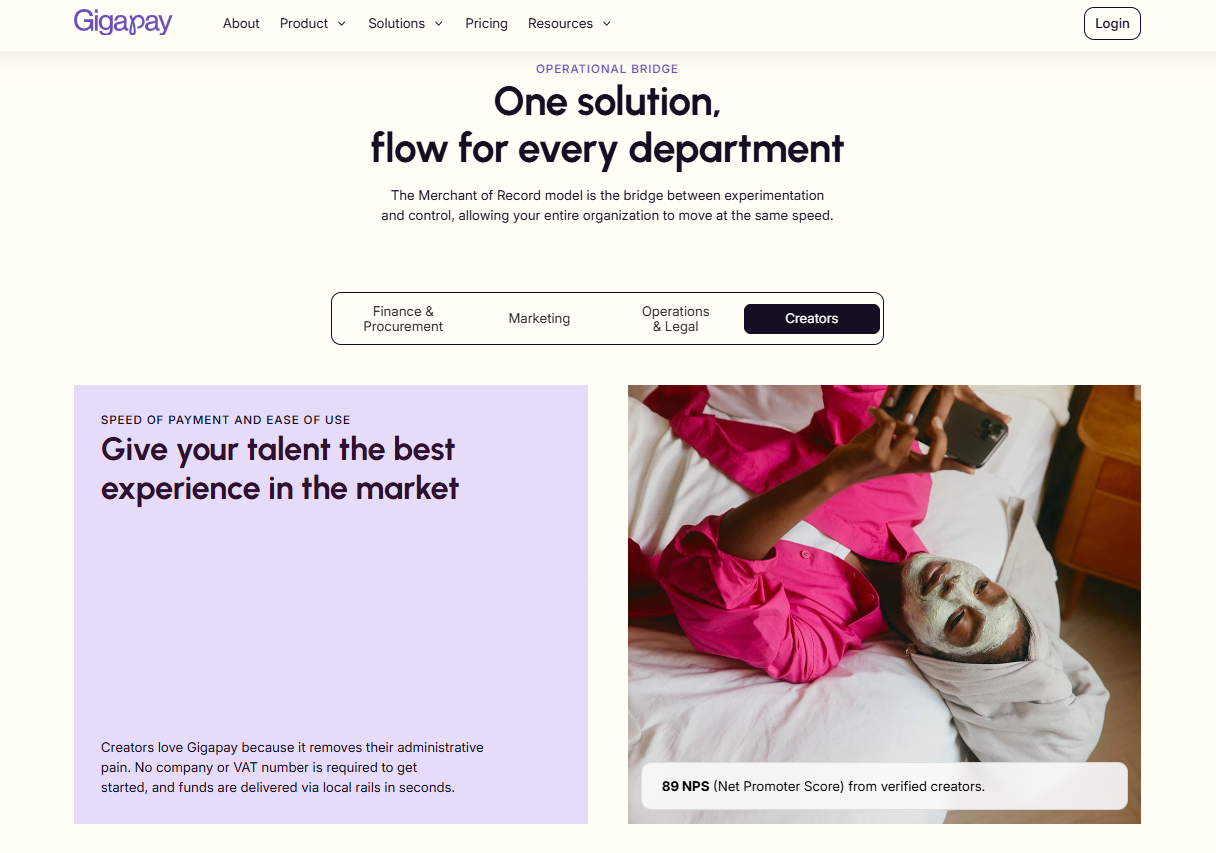
You have one vendor record and receive one consolidated invoice per batch or campaign. You keep Gigapay's invoice, the contract and proof of payment. Creators onboard as individuals, sole traders or companies, and no registered company or VAT number is needed. Creator onboarding takes about 10 minutes.
Gigapay handles the paperwork for every payout.
- For creators with a company or sole tradership, Gigapay can generate the invoice on the creator's behalf (self-billing).
- For individuals, Gigapay documents the payment instead.
Tax and reporting
For the creator's fee we're the payer, not you: we pay them and report the payment. Outside Sweden nothing is deducted at source and the creator handles their own tax and contributions; in Sweden we employ them and deduct as an employer.
Gigapay is the creator's counterparty and payer, so obligations that depend on being the payer stop attaching to you. Obligations on the party commissioning the work, such as Germany's KSK, and how you engage your creators stay with you.
Gigapay files DAC7 as the platform operator with Skatteverket. For German clients, Gigapay collects and shares the creator data needed to handle KSK obligations correctly.
Currencies, speed and integrations
Gigapay pays in 50+ currencies, and payouts arrive in seconds to a few banking days, depending on country and payout method.
See the Supported Markets page for current coverage and the pricing page for pricing.
Earlypay lets creators claim a payout before the standard payment date, at a reduced amount shown to them before they confirm. Platforms can integrate payouts through the Gigapay API in a week, and Gigapay is the sole payment partner of Kolsquare and Social Snowball, and a payment partner of Klear by Meltwater.
Results from Gigapay clients
Boozt ran 3x more collaborations without growing the team, Once Upon saved 25% of admin time, and WPP Media reports 80% fewer invoices, as published in their Gigapay case studies.
Common Mistakes US Brands Make When Paying UK and European Creators
Most payment problems with European creators come from applying a US process to a non-US payee. These are the mistakes that cost the most time.
The two most expensive mistakes are the quiet ones: a missing place-of-performance clause and an unbudgeted KSK levy. Both surface months later, usually during an audit.
For your next campaign, fix the contract template first, because it carries most of the risk.
What Do UK and European Creators Expect From US Brands?
Creators compare brands on how they pay as much as on what they pay. 74% of creators surveyed by Tipalti said they had stopped working with a brand after feeling undervalued (Tipalti, 2023, cited by Digiday, 2024).
Clear payment terms
Creators want a payment date in the contract and payment soon after approval. Creator Joy Ofodu told Digiday (2024) that net 60 terms are more common than net 30, which is why many creators now ask for 10 to 15 days.
Payment in their own currency
A UK creator budgets in pounds and a French creator in euros. Paying in local currency removes the conversion their bank would charge and makes the payment easy to match to their records.
Simple onboarding
Many nano and micro creators have no company. They expect to sign up once, verify their identity and get paid without registering a business.
Records for their own tax filings
UK creators in Making Tax Digital send quarterly updates from April 2026 (GOV.UK, 2026), and EU creators' income may be reported under DAC7. Either way, creators still declare their own income, so they value clear payment statements.
For your creator relationships, how you pay is part of the brief.
Conclusion
Gigapay is the Merchant of Record for creator payments.
US brands can pay UK and European creators by bank wire, PayPal, payout platforms, agencies or a Merchant of Record, and the right choice depends on creator volume, currencies and how many supplier records finance will carry.
Once your programme reaches dozens of nano and micro creators across markets, one counterparty and one consolidated invoice per batch is easier to run than hundreds of foreign supplier records.
Book a demo to see how Gigapay fits your UK and European creator programme.
Read Next:
- How to Pay Creators in 10 European Markets on One Invoice (2026 Cost by Country)
- Best Way for Gaming Studios and App Publishers to Pay Streamers and UGC Creators in 2026
- Net 30 vs Instant Pay: How Payment Speed Changes What Creators Charge (2026)
FAQs:
1. What is the best way for US brands to pay UK and European creators in 2026?
The best way for US brands to pay UK and European creators in 2026 depends on volume. A bank wire or PayPal works for a few creators. For dozens of creators across markets, a Merchant of Record such as Gigapay gives you one vendor and one consolidated invoice instead of a supplier record per creator.
2. Do US brands need a W-8BEN from UK or European creators?
US brands that pay UK or European creators directly generally need a Form W-8BEN, which certifies the creator's foreign status for the IRS. The IRS recommends collecting a valid W-8 before paying a new foreign vendor. Requirements depend on your payment model, so confirm them with your tax adviser.
3. How much does it cost to send a payment to a creator in the UK?
The cost to send a payment to a creator in the UK is usually $0 to $45 in US bank wire fees plus a conversion markup, or about $60 on a $1,000 PayPal payout converted to pounds, based on published 2026 fees. Intermediary bank fees can add more.
4. What is a Merchant of Record for creator payments?
A Merchant of Record for creator payments is a company that becomes the creator's counterparty. Gigapay, for example, buys the creator's services in its own name and for its own account, resells them to the client and issues one consolidated invoice. Payouts are executed by licensed third-party payment providers.
5. Do UK and European creators still pay their own taxes when paid through a Merchant of Record?
UK and European creators still pay their own taxes when paid through Gigapay as Merchant of Record. Outside Sweden nothing is deducted at source and the creator handles their own tax and contributions. Gigapay reports payments to Skatteverket, which shares them with the creator's home tax authority, and creators still declare their income.