.jpg)

48.7% of American creators earned under $10,000 last year. MrBeast earned $85 million. The word "creator" stretches across both of them, and that distance is the real answer to how much American influencers make in 2026.
The distribution figure comes from The Influencer Marketing Factory's January 2026 survey of 1,000 US creators, the most detailed look we have at individual earnings this year.
Read alongside data from eMarketer, CreatorIQ, and Circle, it shows an economy that is professionalizing and pulling apart at the same time.
At Gigapay we pay creators across 65+ countries, so we see the other side of these numbers, which is what it actually takes to get money into a creator's account once a brand decides to work with them.
Key Takeaways
- Nearly half of American creators earn under $10,000 a year despite rising brand budgets.
- A creator middle class is real, with 45.6% now earning between $10,000 and $100,000.
- The top 10% of creators captured 62% of all brand payments in 2025.
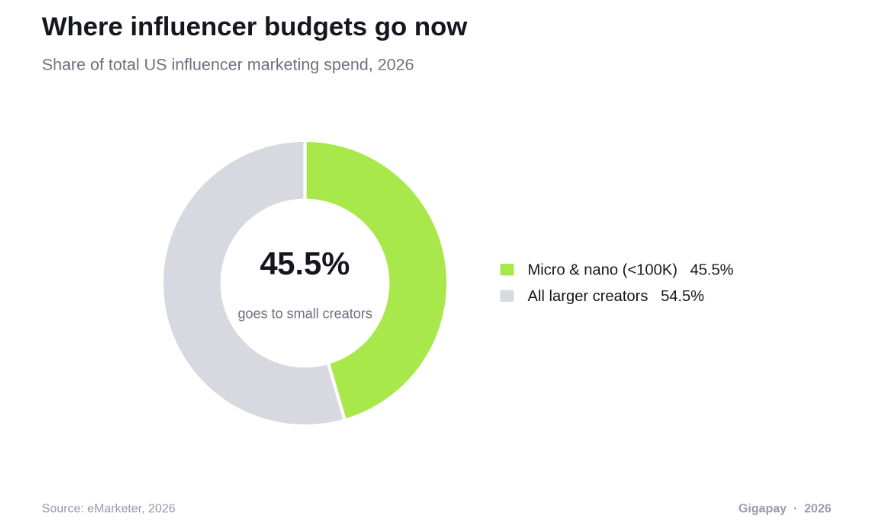
- Micro and nano creators now claim 45.5% of total US influencer marketing spend.
- Paying hundreds of small creators is the operational problem Gigapay was built to remove.
Where These Numbers Come From
This report pulls from the primary US datasets published for 2026. The individual earnings figures come from The Influencer Marketing Factory's January 2026 survey of 1,000 US creators aged 18 to 65, the most authoritative US-specific source on creator income.
We cross-reference it with eMarketer's 2026 creator forecasts, CreatorIQ's State of Creator Marketing, Circle's 2026 Community Trends Report, H&R Block's 2026 Creator Pulse Survey, InfluenceFlow's platform earnings guides, and Forbes' Top Creators list.
Earnings are gross and often self-reported, so treat them as ranges rather than precise salaries.
How Much Does the Average American Influencer Earn in 2026
Most American influencers earn modestly, and a small number of very large earners pull the headline averages up.
Here is how 2026 earnings break down across US creators, according to The Influencer Marketing Factory:
- Under $10,000 a year: 48.7% of creators
- $10,000 to $25,000: 19.2%
- $25,000 to $50,000: 16.1%
- $50,000 to $100,000: 10.2%
- $100,000 to $250,000: 3.8%
- $250,000 or more: 2.0%
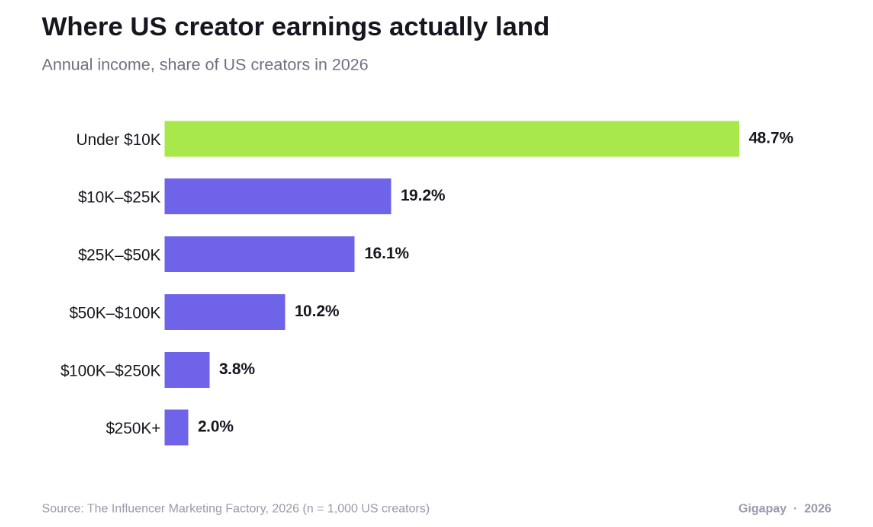
CreatorIQ puts the average creator's earnings at about $44,293, while the median campaign pays just $3,000. The gap between those two numbers is the whole story, because a handful of creators earning seven and eight figures drag the average far above what a typical creator takes home.
If you want a realistic figure, the median matters more than the average. For most American creators in 2026, content is a serious side income rather than a full salary, and 56% of full-time creators still earn below the US living wage of around $44,000.
How Much Do Influencers Earn Per Post By Follower Count
Per-post rates climb steeply with audience size, but engagement and niche move the number as much as follower count does.
Typical per-post sponsorship rates for US creators in 2026:
- Nano, 1,000 to 10,000 followers: $50 to $300
- Micro, 10,000 to 100,000 followers: $200 to $1,500, up to $5,000 for strong accounts
- Mid-tier, 100,000 to 500,000 followers: $1,500 to $10,000
- Macro, 500,000 to 1 million followers: $5,000 to $25,000 and above
- Mega and celebrity, over 1 million followers: $25,000 to $500,000 and beyond
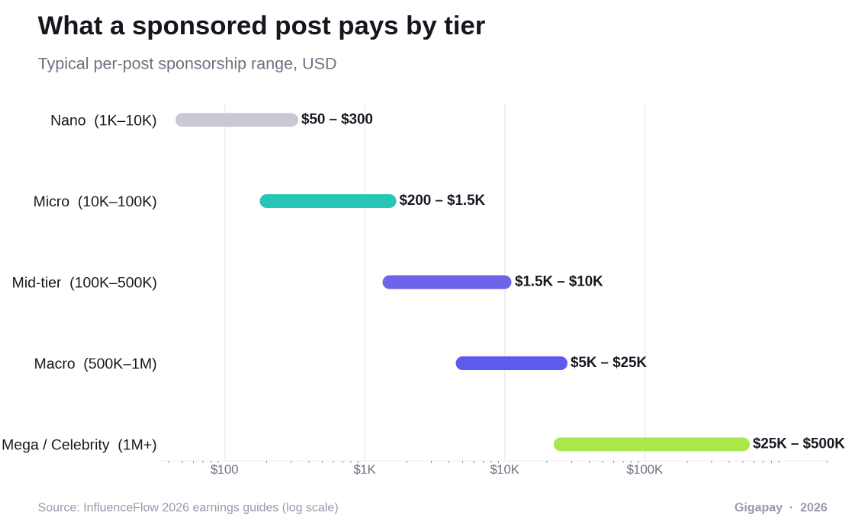
Most creators price using a rough rule of $100 to $500 per 10,000 followers, then adjust for engagement and niche. Long-term deals add a 40 to 50% premium over one-off posts, which is why so many creators now chase retainers instead of single campaigns.
Follower count sets the starting point, not the final price. A micro-creator with high engagement in a valuable niche often out-earns a larger account with a passive audience.
Which Platform Pays Creators the Most
YouTube pays the most per view, while TikTok drives the most discovery on the smallest base payout.
Platform monetization for US creators in 2026:
- YouTube: CPMs of $15 to $40, rising to $60 to $150 in finance niches, with the strongest long-form ad revenue of any platform
- TikTok: roughly $0.02 to $0.04 per 1,000 views from Creator Rewards, with sponsorships doing the real earning
- Instagram: Reels and sponsorships from around $250 to $1,500 for micro-creators, higher with bonuses
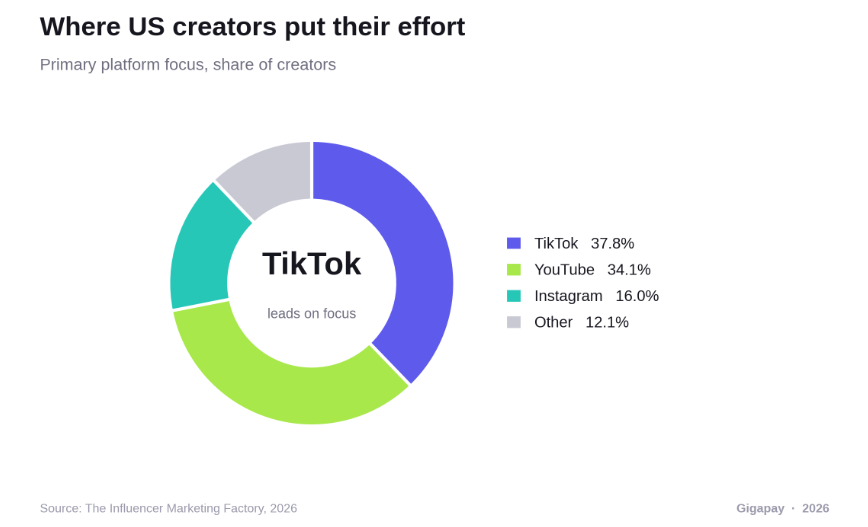
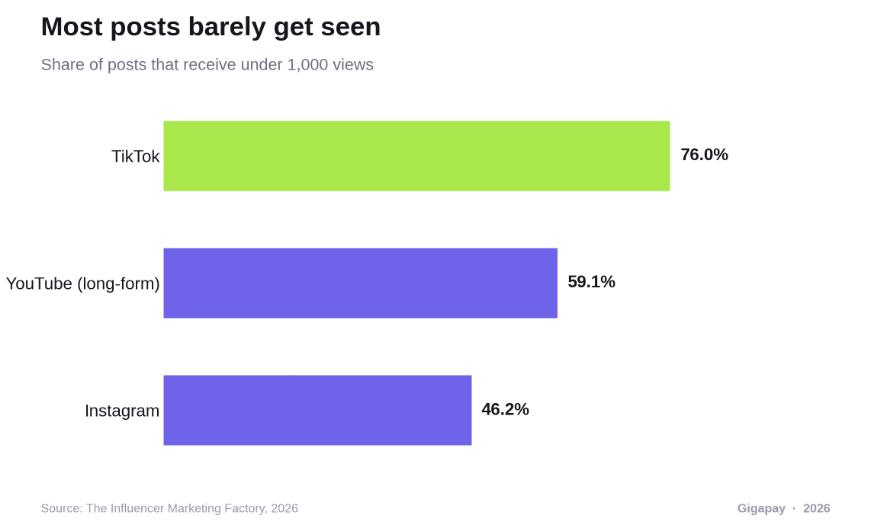
Visibility is the real ceiling on platform income:
- 76% of TikTok posts get under 1,000 views
- 59.1% of long-form YouTube videos stay under 1,000 views
- 46.2% of Instagram posts do the same
Platform payouts alone rarely add up to a living, which is why diversification matters more every year. Creators treat TikTok as the discovery engine and YouTube as the revenue engine, then build sponsorships and other income on top.
How Much Do Influencers Earn by Niche
Niche predicts earnings better than follower count, and a finance creator can out-earn a beauty creator with ten times the audience.
Average YouTube CPMs by niche for US creators in 2026:
- Finance and investing: $60 to $150 per 1,000 views
- Tech and SaaS: $30 to $70
- Business and entrepreneurship: $25 to $60
- Health and wellness: $20 to $50
- Gaming and lifestyle: $5 to $25
- Kids' content: $2 to $8, and heavily regulated
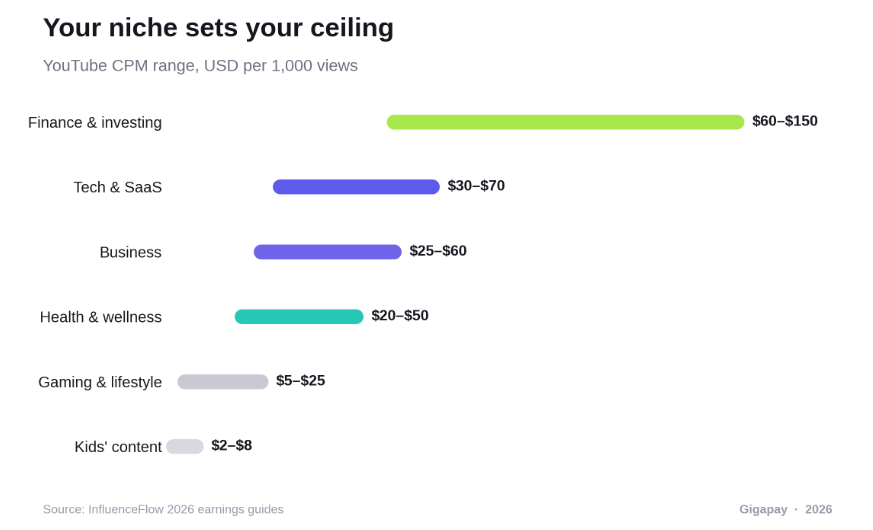
Advertisers pay for purchase intent, and audiences researching mortgages or software convert better than audiences watching makeup tutorials. That is why finance, tech, and business niches command the premium even at modest follower counts.
A creator's topic is a financial decision as much as a creative one. The same effort produces very different income depending on what the audience is in the market to buy.
Where Does Creator Income Actually Come From
Brand deals still dominate, but the fastest-growing income is the kind creators own outright.
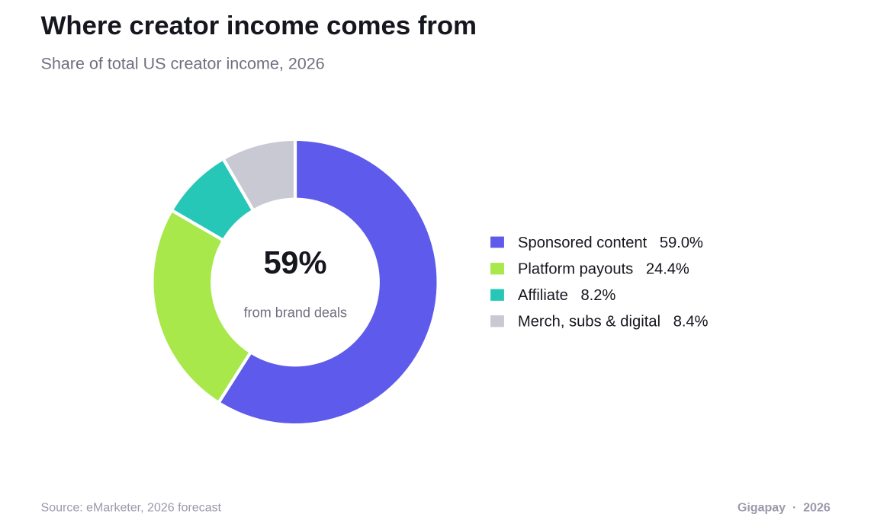
How US creator income splits in 2026, per eMarketer:
- Sponsored content and brand partnerships: 59%
- Platform payouts such as ad revenue and bonuses: 24.4%
- Affiliate marketing: 8.2%
- Merchandise, subscriptions, digital products, and live gifts: roughly 8%
Communities and memberships are the standout growth area. Circle's 2026 Community Trends Report found that 88% of community builders monetize through memberships, and creators with a dedicated community generate 40% more recurring revenue and three times higher retention than platform-only creators.
Community income is projected to pass half of total earnings for many full-time creators by the end of 2026.
The lesson creators learned the hard way is that brand deals are volatile and platform algorithms are not theirs to control. Income they own, such as memberships, courses, and email lists, is what turns an unstable side hustle into a stable business.
What Do The Top Earners Make And How Concentrated Is It
At the very top, earnings reach numbers that have nothing to do with the median, and the concentration is getting more extreme rather than less.
Forbes' most recent Top Creators list, covering 2025 gross earnings, shows the ceiling:
- The top 50 creators earned $853 million combined, up 18% year over year
- MrBeast: $85 million
- Dhar Mann: $56 million
- Jake Paul: $50 million
- Rhett & Link: $36 million
- Alex Cooper: $32 million
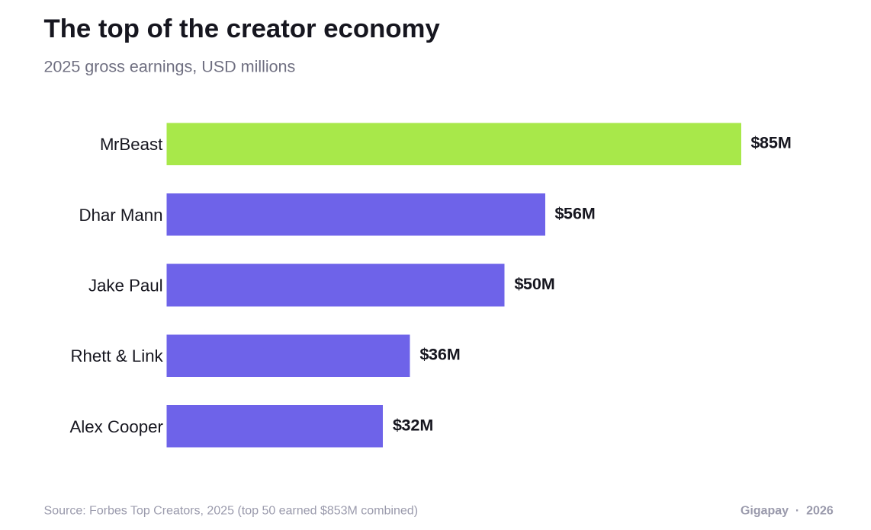
The same concentration shows up in brand spend. CreatorIQ found the top 10% of creators captured 62% of all brand payments in 2025, up from 53% in 2023, even as total budgets rose 171%.
More money is flowing into the creator economy, and more of it is pooling at the top. The middle class is real, with 45.6% of creators now earning between $10,000 and $100,000, yet it sits between a crowded base and a tiny, dominant peak.
The 2026 Forbes list, due June 23 in Cannes, will almost certainly show the same pattern at a higher number.
The Part That Never Makes The Rate Card: Taxes And Getting Paid
The earnings figures hide two costs every creator pays, which are tax they often do not see coming and the wait to actually get paid.
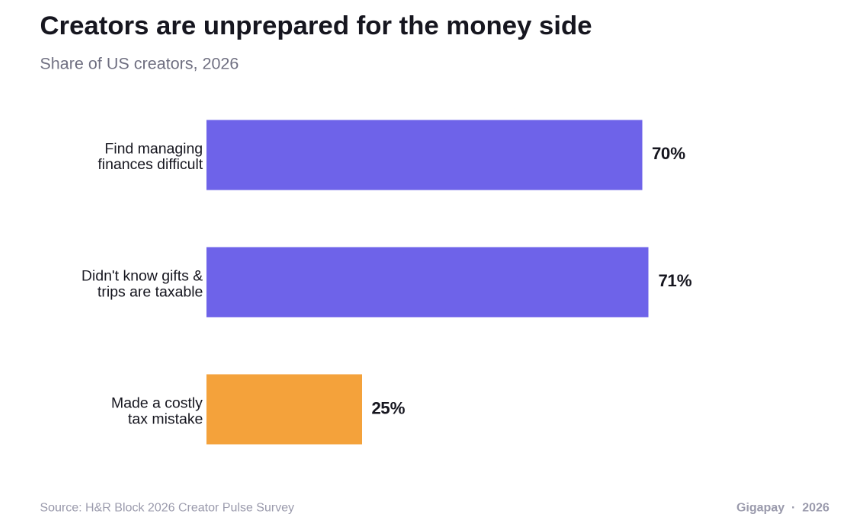
H&R Block's 2026 Creator Pulse Survey shows how unprepared most creators are for the financial side:
- 70% find managing their finances difficult
- 71% did not know that free products and brand trips are taxable
- Around 1 in 4 made a costly tax mistake
- Self-employment tax alone takes 15.3%, on top of income tax
Then there is the wait. In influencer marketing, payment terms now stretch toward 120 days, which means a creator can finish a campaign in March and see the money in summer.
For a creator whose income is already irregular, that delay is the difference between paying rent and chasing an invoice.
This is the side of the numbers Gigapay works on. We pay creators instantly across 65+ countries, our EarlyPay feature gives creators access to scheduled funds before the payment date, and creators can get paid without registering a business or holding a VAT number. Our creator support team carries an NPS of 88, which in payments is rare.
A rate card shows what a creator is owed. Getting that money into their account is a separate problem made of admin, tax friction, and waiting, and it falls hardest on the smallest creators.
What This Means For The Brands Paying Them
The earnings data points to a problem most brands have not named yet, which is that they are paying more creators, at smaller amounts, than ever before.
Micro and nano creators now claim 45.5% of all US influencer marketing spend, according to eMarketer. Brands have learned that a hundred small creators often beat one large one on engagement and trust, so programs are scaling in headcount rather than in cheque size.
That shift is good for the creator middle class, and it quietly creates an operational problem on the brand side. Paying, onboarding, and tax-reporting for hundreds of individual creators across markets is work that finance and procurement teams feel first, and a campaign that looks fast in the marketing deck stalls the moment procurement is asked to onboard 200 individuals as vendors.
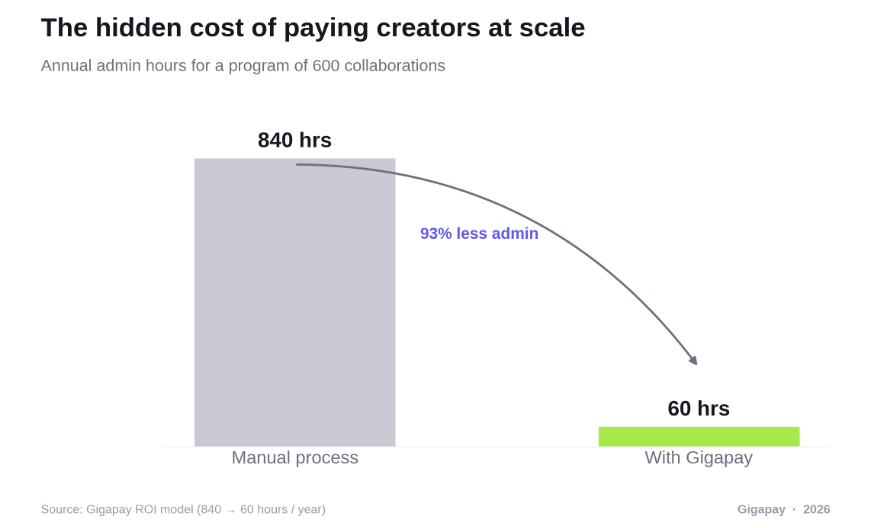
Gigapay was built for exactly this volume. As Merchant of Record we become the single vendor in your finance system, take on the tax and compliance reporting across regimes like DAC7 and Germany's KSK, and turn hundreds of creator invoices into one. Brands report up to an 80% reduction in invoice volume, and on a program of 600 collaborations a year the admin load drops from around 840 hours to roughly 60.
Boozt used this to do something its team had wanted for years.
"We've been trying to find a way forward with nano- and micro-influencers for years and Gigapay really enabled this," said Christina Oliosi, Brand Activation Lead, after the brand tripled its creator collaborations without adding headcount.
The creator middle class is the brand's opportunity and the brand's admin headache at once. Paying it well, instantly, and compliantly is becoming a real competitive edge.
What Is Coming For The Rest of 2026
Three shifts will shape creator earnings through the rest of the year:
- AI is already standard. Around 91% of creators use AI tools, mostly for editing and ideation, which lowers production cost and raises output, while authenticity is still what audiences pay for, and running scripts or captions through a free AI humanizer is a quick way to keep that AI-assisted content sounding like a real person before it goes live.
- Performance-based deals are now the norm at 53% of campaigns, so more creator pay is tied to measurable sales rather than flat fees.
- Owned income keeps growing, with communities, memberships, and digital products projected to pass half of total income for many full-time creators by year end.
The next major data point lands on June 23, when Forbes publishes its 2026 Top Creators list in Cannes. Expect the same shape as 2025, with a higher combined total and an even more concentrated top.
Conclusion
The answer to how much American influencers earn in 2026 is two numbers at once. Nearly half earn under $10,000 while the top 50 split $853 million, and the middle class growing between them is the most interesting part of the chart.
As brands chase that middle by working with more creators at smaller cheques, the bottleneck moves from finding creators to paying them. The brands that win the next phase will be the ones that can pay a hundred creators as easily as they pay one, instantly and without a compliance scramble.
.jpg)
.jpg)