.jpg)

Two creators post a video on the same day. Both pull a million views. One earns $10,000 and the other earns $300. The gap is not talent or luck. It is the niche they publish in, the country their audience sits in, and the streams they have learned to stack on top of ad revenue.
That gap is the story of creator payments in 2026. YouTube has paid out more than $100 billion over four years, the top 50 creators just cleared $1 billion between them, and nearly half of US creators still earn under $10,000 a year. The money is real, it is growing, and it is distributed like most people assume.
This report breaks down what YouTube creators actually earn in 2026: the RPM behind every 1,000 views, how income splits across niches and subscriber tiers, what brands pay for sponsorships, and how Shorts, live streams and other platforms compare. Then it turns to the part most reports skip.
Earning the money is one problem. Getting it paid out, across dozens of countries and tax regimes, is the one that lands on finance and operations teams, and it is the harder of the two.
Key Findings
- The median long-form creator earns about $2.30 per 1,000 views, roughly $2,300 per million. The niche you publish in matters more than your subscriber count.
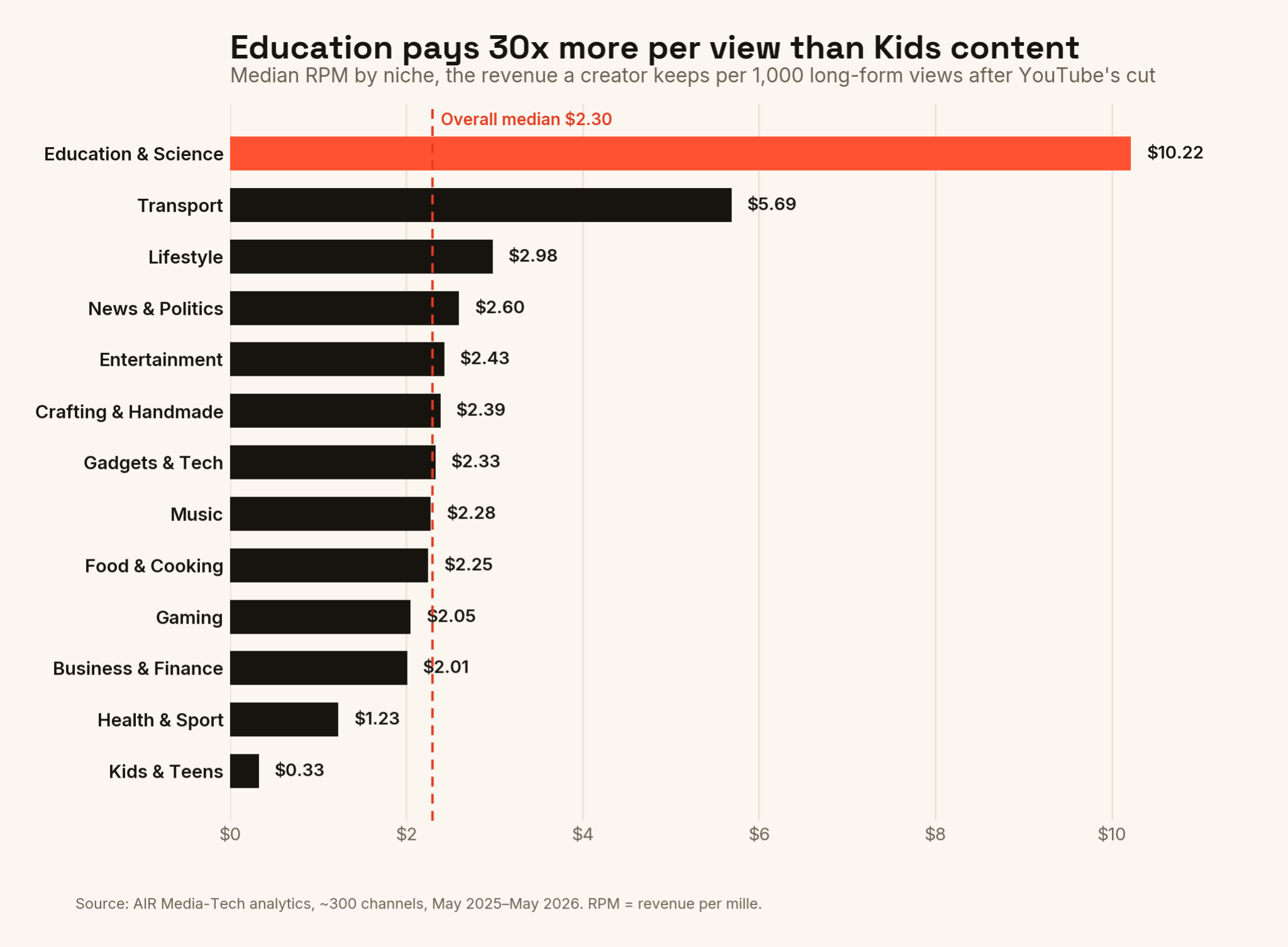
- Education & Science pays $10.22 RPM, about 30 times more per view than Kids & Teens at $0.33.
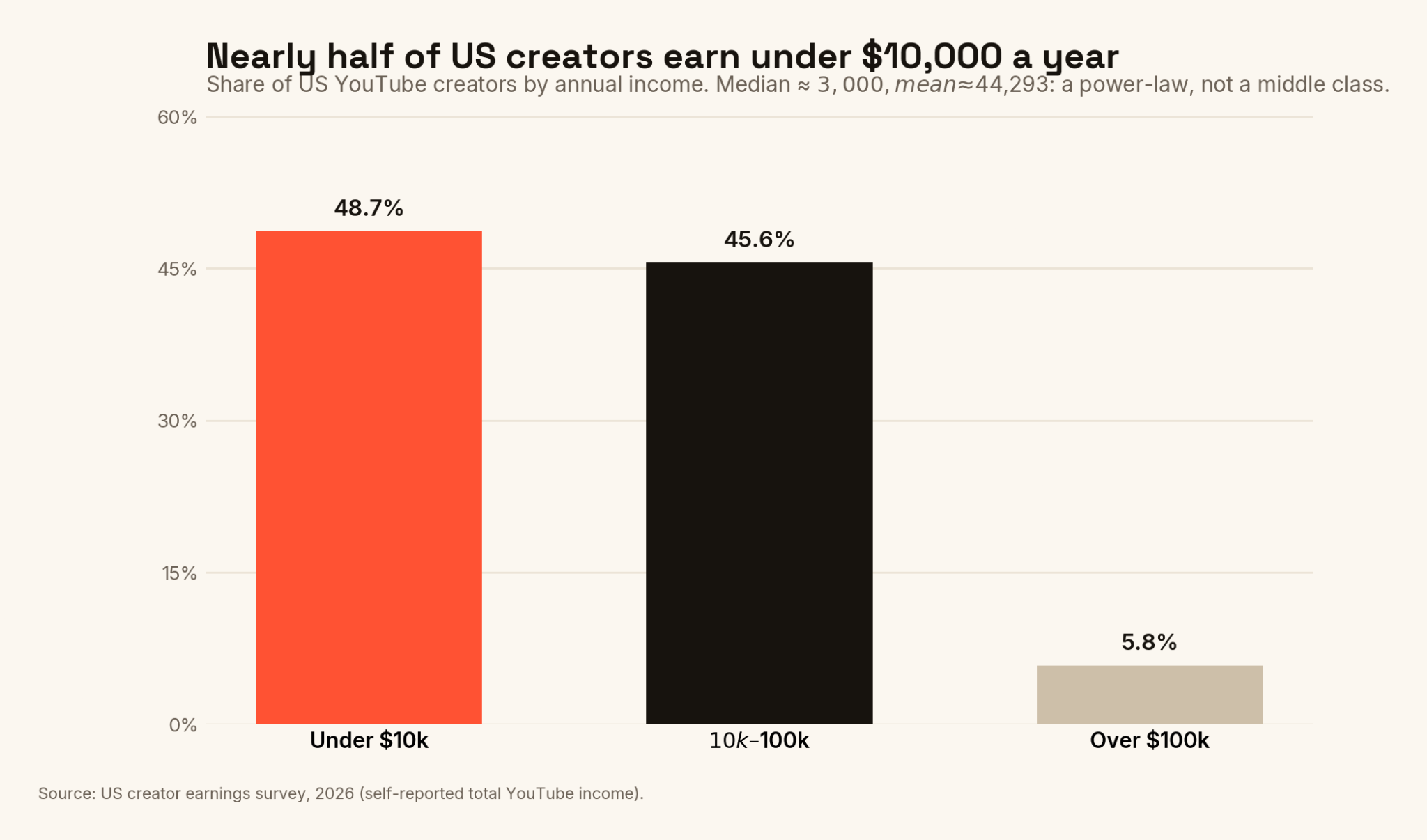
- Nearly half of US creators (48.7%) earn under $10,000 a year. The median sits near $3,000 while the mean is $44,293, which tells you the top of the market pulls everything upward.
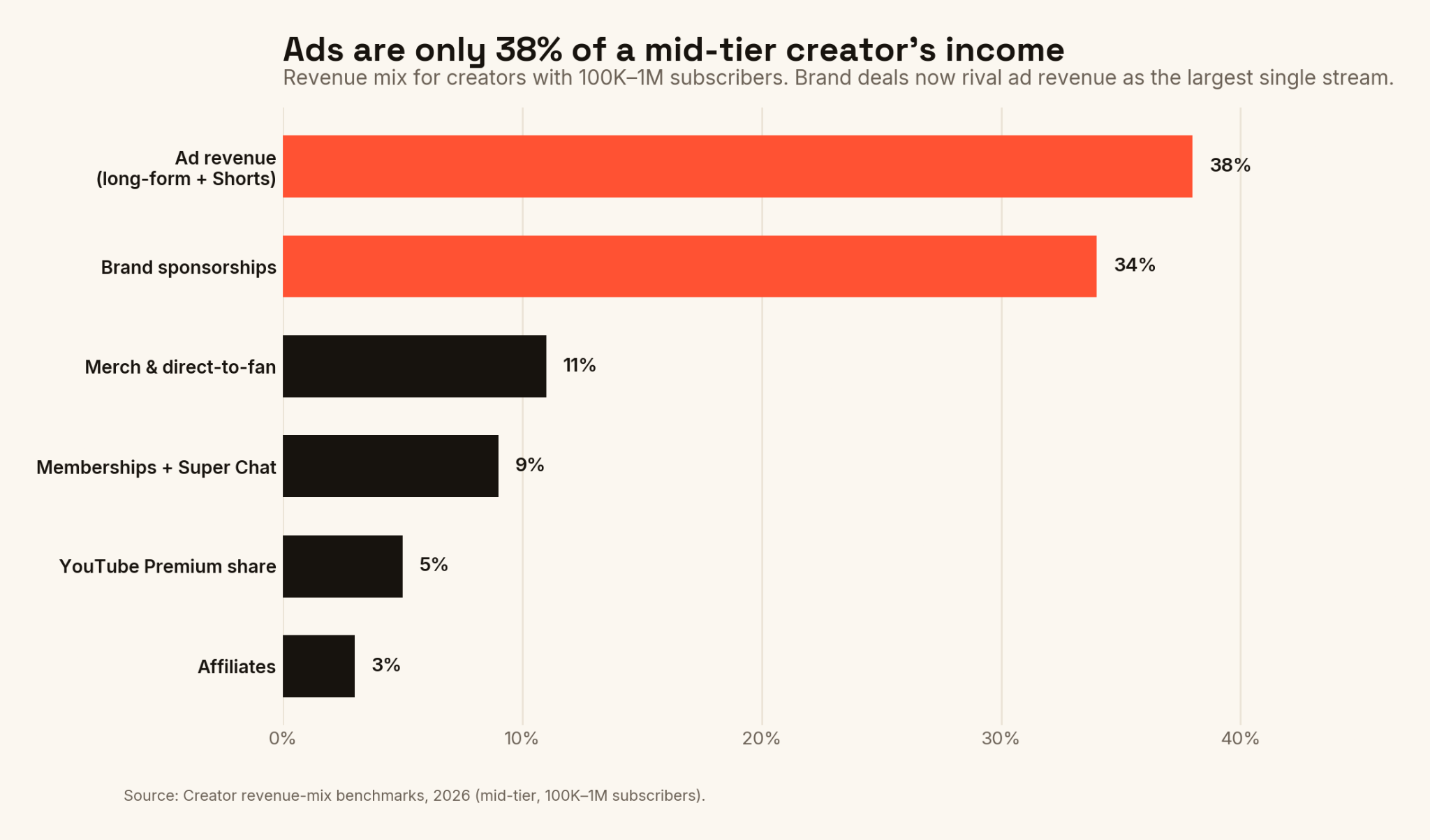
- Ad revenue is only 38% of a mid-tier creator's income. Brand sponsorships now rival it at 34%.
- The Forbes top 50 creators earned $1.02 billion combined in 2026, up 20% year on year, with MrBeast alone at $300 million.
- The hardest problem is not how much creators earn. It is getting them paid: brand and platform payments are still delayed up to 120 days, and cross-border tax rules block the rest.
How Big is the YouTube Creator Economy in 2026?
YouTube is now the largest single engine of creator income in the world. More than 3 million channels are enrolled in the YouTube Partner Program, and over the past three years YouTube has paid creators, artists and media companies more than $100 billion. That figure has roughly doubled since the early 2020s.
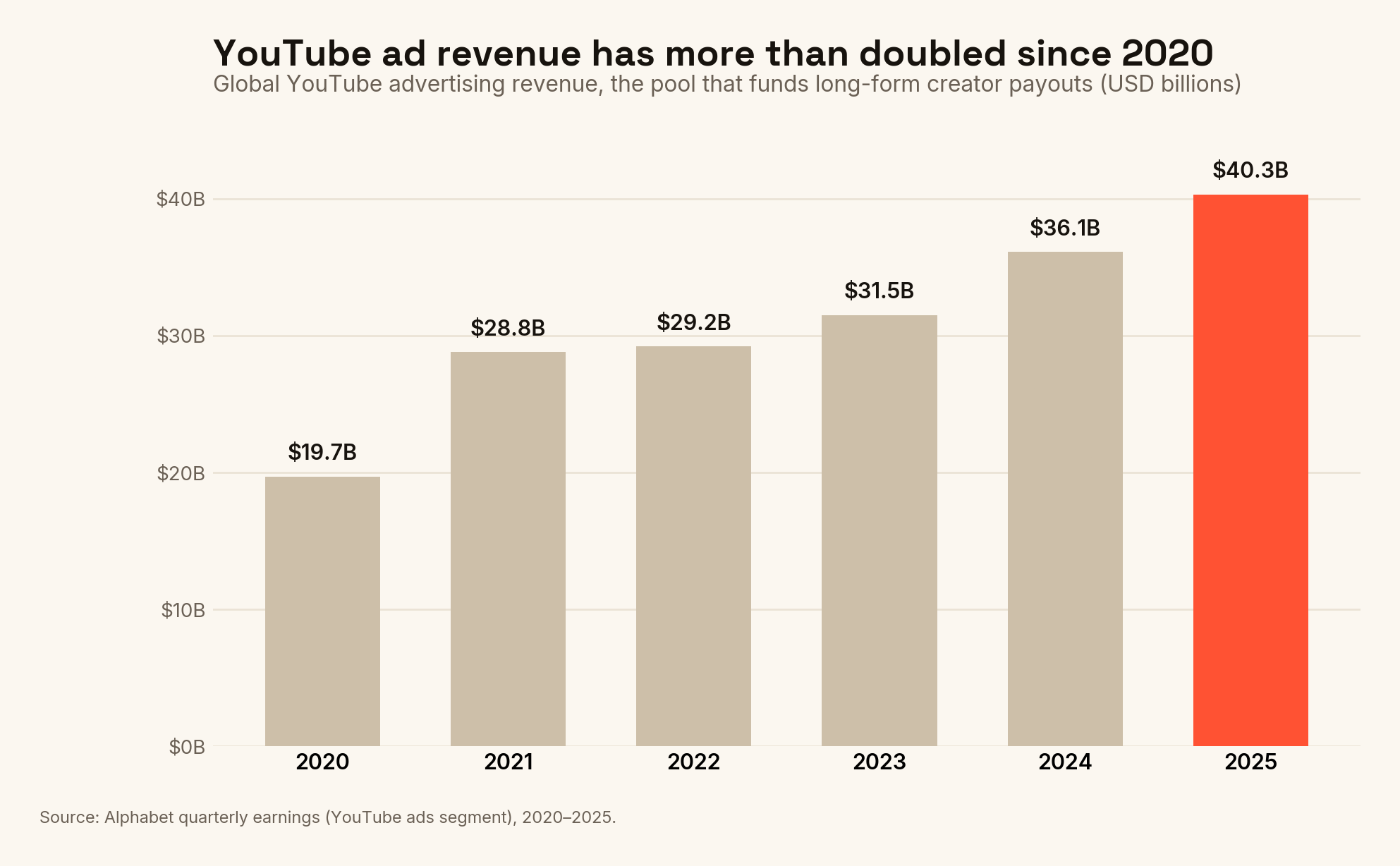
The money behind those payouts comes mostly from advertising, and advertising on YouTube keeps growing. YouTube ad revenue reached about $40.3 billion in 2025, up from $19.7 billion in 2020. Every long-form payout a creator receives is a share of that expanding pool.
By the numbers: 3M+ channels in the Partner Program. $70B+ paid to creators, artists and media companies in three years. $32.6B in global influencer marketing spend in 2026.
For the brands and agencies on the other side of these payments, the headline is simple. The creator economy has grown from roughly $200 billion in 2025 toward $250 billion or more in 2026, and influencer marketing spend has reached $32.6 billion. More money is moving to more creators, in more countries, than at any point before.
How Does YouTube Pay Creators in 2026?
YouTube pays through more than ten revenue streams inside the Partner Program, and the split depends on the format.
- On long-form ads, the creator keeps 55% and YouTube keeps 45%.
- On Shorts, creators receive 45% of a net revenue pool that is distributed by each creator's share of engaged views.
YouTube Premium adds a further share based on how much paying subscribers watch a given channel.
Beyond ads, creators earn from channel memberships, Super Chat, Super Thanks and Super Stickers, the Merch Shelf, shopping and affiliate links, brand deals through BrandConnect, and live ticketed events. The Partner Program is tiered, so fan-funding features become available earlier than ad revenue.
The practical takeaway for a marketing team is that a single creator is rarely paid through one channel. They earn from the platform, from you, and from their own products at the same time. When you add a creator to a campaign, you are joining a payment stack that already spans several currencies and tax positions.
How Much do YouTubers mMake Per 1,000 Views: RPM by Niche
RPM, or revenue per mille, is the number creators actually see. It is what a channel keeps per 1,000 views after YouTube's cut and after non-monetized views are removed. Across a sample of around 300 channels tracked from May 2025 to May 2026, the median long-form RPM was $2.30. That is the honest middle of the market.
The spread around that median is enormous, and it is driven by niche far more than by size. Education & Science channels earn a median of $10.22 per 1,000 views because their audiences attract high-value advertisers. Kids & Teens sits at $0.33, held down by advertising limits on content made for children.
CPM, the amount advertisers pay before YouTube's split, runs much higher than RPM. Blended US CPM sits in the region of $6 to $20, and finance and business audiences can push it far above that. The gap between CPM and RPM is where YouTube's 45% cut and unmonetized views live.
Why this matters for brands: A finance or education creator with 100,000 loyal viewers can be worth more, per view, than an entertainment creator with a million. When you evaluate a creator's rate, the audience and niche tell you more than the follower count.
How Much do YouTube Creators Actually Earn Per Year?
Averages lie on YouTube, because the top of the market distorts them. In the 2026 US creator survey, the mean annual income came out near $44,293, but the median was roughly $3,000. When the mean is more than ten times the median, you are looking at a power law rather than a middle class.
The picture is not static. In the same survey, 51.5% of creators reported year-on-year earnings growth, and the fastest growth came from the mid-tier. Channels between 100,000 and 500,000 subscribers grew revenue by around 31% in one report, faster than either the long tail or the mega-creators.
How Much do YouTubers Make by Subscriber Count?
Total income scales with the audience, but the ranges stay wide because so much depends on niche, geography and how well a creator has diversified beyond ads.
Who are the Highest-paid YouTube Creators in 2026?
At the very top, the numbers change character. The Forbes top 50 creators earned $1.02 billion combined in 2026, the first time the list has crossed a billion dollars, up 20% from $853 million the year before.
MrBeast led at $300 million, followed by Dhar Mann at $65 million, Steven Bartlett at $52 million, Markiplier at $38 million, and Rhett & Link at $37 million.
Most of that money comes from businesses, products and media ventures rather than ad revenue alone.
How Much Do Brands Pay YouTube Influencers for Sponsored Videos?
For most mid-tier creators, brand deals are the real income, often worth two to four times their ad revenue. Rates scale with audience size, but the wide bands below reflect how much niche and engagement move the price. A finance or B2B creator commands a premium that an entertainment creator of the same size does not.
Measured against views, sponsorship pays far more than platform ads. The median sponsorship works out near $73 per 1,000 views, with finance, tech and B2B software at the top and gaming and entertainment lower. Repeat sponsorships are common, with roughly a third of creators keeping a recurring brand relationship, which is exactly the kind of relationship a slow or failed payment can end.
The strategic shift in 2026 is spent moving toward nano and micro creators, whose engagement rates beat the mega tier. That shift is good for reach and cost per engagement. It also multiplies the number of individual creators a brand has to onboard, contract and pay, which is where the operational cost quietly appears.
What Does a YouTube Creator's Revenue Mix Look Like in 2026?
No serious creator lives on ad revenue. For a channel between 100,000 and 1 million subscribers, ads make up only 38% of income. Brand sponsorships sit right behind at 34%, and the rest comes from merchandise, memberships, Premium and affiliates.
Two of those streams are worth a closer look because they are growing fast. Affiliate income has become one of the strongest supplements, with more than 340,000 channels earning from affiliate links in the past year, up 42%. Live streaming is rising too.
Creators who go live eight or more times a month draw over half of their ad revenue from those streams, and direct fan payments during live can dwarf the ad component. Super Chat and Super Stickers grew 45% year on year, and channel memberships grew 28%.
Every one of these streams is a separate payment, often in a separate currency, sometimes under separate tax treatment. Diversification is healthy for the creator. It also makes the creator harder to pay cleanly, which becomes the brand's problem the moment a campaign starts.
YouTube Shorts vs Long-form vs TikTok: What Pays More?
Short-form has become a real line item. Shorts now account for about 18% of total creator earnings, up from 11% in 2025 and just 4% in 2024. The revenue per view is still low because the pool is shared, but the volume makes up for a lot.
Where the audience sits changes Short's earnings dramatically. A Short watched by a US audience earns roughly ten times more per view than the same Short watched in India. This is the single biggest lever on short-form income, and it is entirely outside the creator's control once the content is made.

Across platforms, YouTube long-form remains the strongest for pure ad revenue per view. A million long-form views returns around $2,300 at the median, against a few hundred dollars on TikTok's Creator Rewards and far less on Shorts. Instagram pays almost nothing directly and monetizes through brand deals instead.

Why Are Creator Payments Delayed, and What Are the 2026 Tax Rules?
Everything above describes how much creators earn. The harder question, and the one that lands on finance and operations teams, is how that money actually reaches them. This is where the creator economy still breaks.
Payments to creators are frequently delayed up to 120 days. The delay is rarely about intent. Payouts get stuck on missing or rejected tax forms, on bank details that do not match, on minimum thresholds, and on cross-border rules that a marketing team was never staffed to handle.
International creators routinely see payouts frozen on a "tax info required" status while a campaign that was supposed to build a relationship quietly damages one instead.
The rules are getting heavier, not lighter. In the US, the 1099-NEC reporting threshold rose to $2,000 for the 2026 tax year, and creators owe tax on their full income whether or not a form is issued. In Europe, DAC7 requires platforms to report creator earnings across the EU.
Germany's Künstlersozialkasse applies a 4.9% levy on creative payments above 1,000 euros, including payments to international creators. Sweden has KU14. Each market has its own version, and each one becomes the paying brand's responsibility.
The pattern in the data: Creators earn across many streams, many currencies and many entity types. Every one of those splits is a compliance edge, and a brand running hundreds of collaborations a year inherits all of them at once.
For a brand doing 600 creator collaborations a year, the manual version of this work costs around 139,590 euros annually and roughly 840 hours of admin time, spread across marketing, finance and legal. Add a market, and the compliance surface grows again. Add headcount, and you have paid to keep a broken process running.
What This Data Means for Brands Paying Creators at Scale
The data points to one operational conclusion. As creator programs scale, the bottleneck stops being creative and becomes financial. You can find the right creators. Getting all of them paid, compliantly, across every market, is the part that slows down.
This is the problem Gigapay was built to remove. Gigapay is the Merchant of Record for creator payments, which means we become the single contractual counterparty. Gigapay buys the creator's deliverable and resell it to you, and in doing so we take on most of the administrative and legal work tied to the payout, including KYC and KYB checks and the reporting that DAC7, KSK and KU14 demand.
In practice, your team uploads one spreadsheet with a name, an email and an amount, and creators get paid instantly across 65+ countries. You onboard one vendor instead of hundreds, and you receive one consolidated invoice per batch instead of chasing individual invoices. Creators do not need a registered business or VAT number, so nano and micro talent stop being blocked by procurement.
The operational shift: 840 admin hours a year become 60. More than 300 vendor records in your ERP become one. Invoice volume per campaign drops by 80%.
The results show up in the programs themselves:
- Boozt used Gigapay to work with nano and micro influencers it had struggled to reach for years, and tripled its collaborations without growing the team.
- The Goat Agency (WPP Media) reported that payments became easier and faster while staying compliant on taxes and benefits.
- Once Upon chose Gigapay specifically to make the payout process run smoothly.
- AdRecord pointed to the simplicity and the API integration as the reason it signed.
Your creators earn across the whole map. Pay them like it. One spreadsheet, one invoice, every creator paid across 65+ countries with the tax and compliance work handled for you. Send your first payout the same week you start.
FAQs:
1. How much do YouTubers make per 1,000 views in 2026?
The median long-form RPM is about $2.30 per 1,000 views, which works out to roughly $2,300 per million views. It varies heavily by niche, from about $0.33 in Kids & Teens to $10.22 in Education & Science.
2. Which YouTube niche pays the most?
Education & Science leads at a median RPM of $10.22 per 1,000 views, followed by Transport at $5.69 and Lifestyle at $2.98. High-value advertisers in those categories push RPM well above the market median.
3. How much does YouTube pay per 1 million views?
For most long-form creators, a million views returns roughly $1,500 to $10,000 depending on niche and audience geography, centered on about $2,300 at the median RPM. Premium niches like finance and education can earn far more.
4. How much do YouTube Shorts pay in 2026?
Shorts pay through a pooled model where creators receive 45% of net Shorts ad revenue. Typical RPM runs $0.01 to $0.32 per 1,000 views, with US audiences at the top and India, Indonesia and the Philippines at the bottom.
5. What share of YouTube revenue do creators keep?
Creators keep 55% of long-form ad revenue and 45% of the net Shorts revenue pool, plus a comparable share of allocated YouTube Premium revenue based on watch time.
Methodology and Sources
This report compiles the most recent and reliable figures available for the 2025 to mid-2026 period. RPM and live-streaming figures draw on real analytics from creator-channel samples. Earnings distribution comes from a 2026 US creator survey. Top-earner figures come from the Forbes top creators list for 2026. Market and platform figures come from official YouTube and Alphabet disclosures and from creator-economy research. Ranges are shown where a single figure would overstate precision.
- AIR Media-Tech channel analytics, RPM and live-streaming data, 2025–2026
- US creator earnings survey, income distribution and growth, 2026
- Forbes Top Creators 2026
- Alphabet quarterly earnings, YouTube advertising segment, 2020–2025
- Creator-economy and influencer-marketing spend research, 2026
- Gigapay research on creator payment operations and compliance
.jpg)
.jpg)