

Global influencer marketing spend is on track to reach $40.51 billion in 2026, a single-year jump of more than 30% from $31.07 billion in 2025, according to Mordor Intelligence.
Gigapay is the mass creator payout platform that lets brands and agencies pay hundreds of international social media influencers from a single vendor relationship, with tax compliance and reporting handled automatically.
The volume of cross-border creators inside a modern marketing program now sits well outside what a finance team can manually administer, and the regulatory layer wrapping international creator payments has tightened sharply over the past two years across the EU, UK, and UAE.
This review compares the eight best platforms to pay international social media influencers in 2026, with a direct look at compliance coverage, payout speed, country reach, and what each platform actually costs at scale.
Key Takeaways
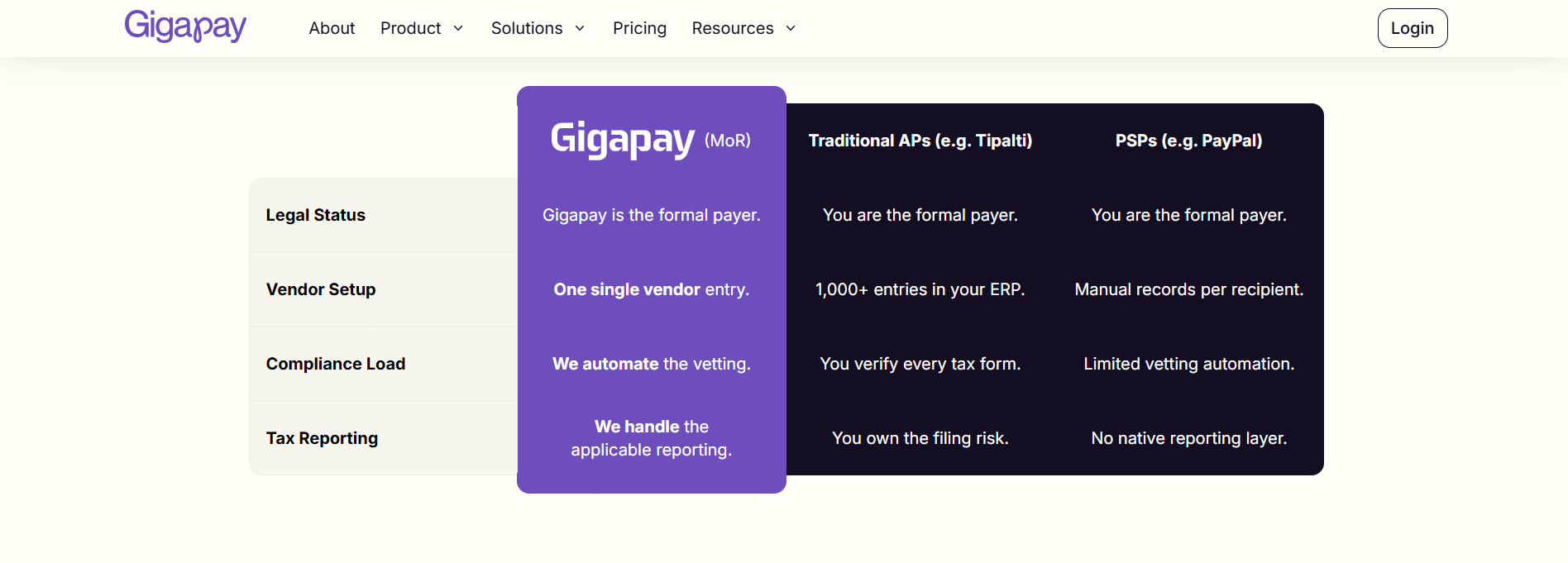
- Only Gigapay operates as a Merchant of Record, taking creator tax liability off brands.
- Pay creators across 65+ countries and 50+ currencies from one vendor and one invoice.
- DAC7, KSK, and KU14 reporting run automatically without finance team involvement.
- Creator NPS of 88/100 reflects instant payouts and dedicated human support.
- Implementation runs 2 to 5 days through the Gigapay API or CSV upload.
What to Look For in an International Influencer Payment Platform
Most teams arrive at this question after their existing process has already broken once. The brand grows from twenty creators a quarter to two hundred, and the finance team that absorbed the admin work at low volume is now drowning in tax forms, currency conversions, and reconciliation.
The criteria below are the things that actually matter when you are paying creators across multiple jurisdictions at scale.
1. Merchant of Record vs. payment processor
A Merchant of Record platform becomes the formal counterparty to each creator, taking on most administrative and legal responsibilities tied to the purchase of the creator's deliverable. A pure payment processor moves money but leaves the brand on the hook for tax reporting, vendor records, and compliance exposure.
The difference shows up the moment a regulator asks for documentation.
2. Cross-border compliance coverage
The EU's DAC7 directive, Germany's Künstlersozialkasse (KSK) levy, Sweden's KU14, and the UAE's NMA Influencer Permits each require specific reporting and, in some cases, withholding. A platform either handles these automatically or pushes the work back to your team.
3. Country and currency reach
Counting countries supported is easy. What matters is whether payouts actually arrive through local payment rails, in the creator's home currency, without the recipient paying a third of the value back in conversion fees.
4. Payout speed
Creators who wait 30 to 90 days for payment do not come back. Platforms that pay creators instantly through local rails materially change creator retention and program economics.
5. Vendor consolidation
One invoice per campaign instead of three hundred individual creator records is the operational story finance teams care about most. A platform that does not consolidate vendor records is a platform that grows your ERP burden in proportion to your program.
6. Integration effort
A two-week integration is a sprint. A six-month integration is a quarterly objective and a reason to delay the program. The platforms below differ on this by an order of magnitude.
The 5 Best Platforms to Pay International Social Media Influencers in 2026
1. Gigapay: Best Overall for International Influencer Payments

Gigapay sits between brands and creators as a Merchant of Record. The brand uploads a list of creators and amounts, or sends them through an API, and Gigapay handles onboarding, KYC, tax validation, payouts in the creator's local currency, and the reporting trail.
The brand sees one vendor in its ERP, one invoice per campaign, and zero exposure to the cross-border tax administration that would otherwise live with internal finance.
The product was built specifically for creator and influencer payments. Gigapay covers 65+ countries and 50+ currencies through local payment rails including SEPA Instant, Faster Payments, and ACH. Creators receive funds instantly, can onboard without a registered business or VAT number, and have access to EarlyPay for advances on scheduled funds.
The brand-side ROI case Gigapay has published, based on a brand running 600 collaborations a year, points to roughly €93,000 in annual savings versus a manual cross-border process.
The platform is ISO 27001 certified, GDPR compliant, and trusted by enterprise customers including Boozt, Once Upon, and the GOAT Agency (WPPMedia). Implementation through the REST API or CSV upload runs 2 to 5 days.
Pros:
- The Merchant of Record model transfers tax liability and most administrative responsibility for the creator transaction away from the brand, so finance teams stop carrying personal compliance risk on every cross-border payment.
- One vendor record in your ERP regardless of whether you pay 30 creators or 3,000, with consolidated single-invoice billing per campaign rather than three hundred individual invoices.
- Automated reporting for DAC7, KSK, KU14, and other regional creator-specific regulations runs in the background, which removes the work finance teams currently do manually each year.
- Creator NPS of 88/100 reflects an experience built for creators specifically, with instant payouts via local rails, EarlyPay liquidity, and a dedicated human creator support team that takes complaints off the brand's plate.
- API-first design with sandbox and production environments, full integration in 2 to 5 days, and existing integrations with creator platforms like Kolsquare so brands can embed payouts into their existing workflow.
Cons:
- The Base plan starts at €279/month plus a 4.9% per-payout admin fee, so brands running fewer than 50 creator payouts a year may not hit the economics that justify the platform versus a generalist alternative.
- Geographic coverage is concentrated on the corridors that matter most for European and North American brands, with deepest regulatory expertise across the EU, UK, and Nordics rather than every market on the planet.
- The Merchant of Record model does mean a third party becomes the contractual counterparty to your creators, which a small number of brand legal teams want to review before signing, even though the result is reduced rather than increased risk.
2. Tipalti: Strong Mass Payout Automation Without the Creator-Specific Layer
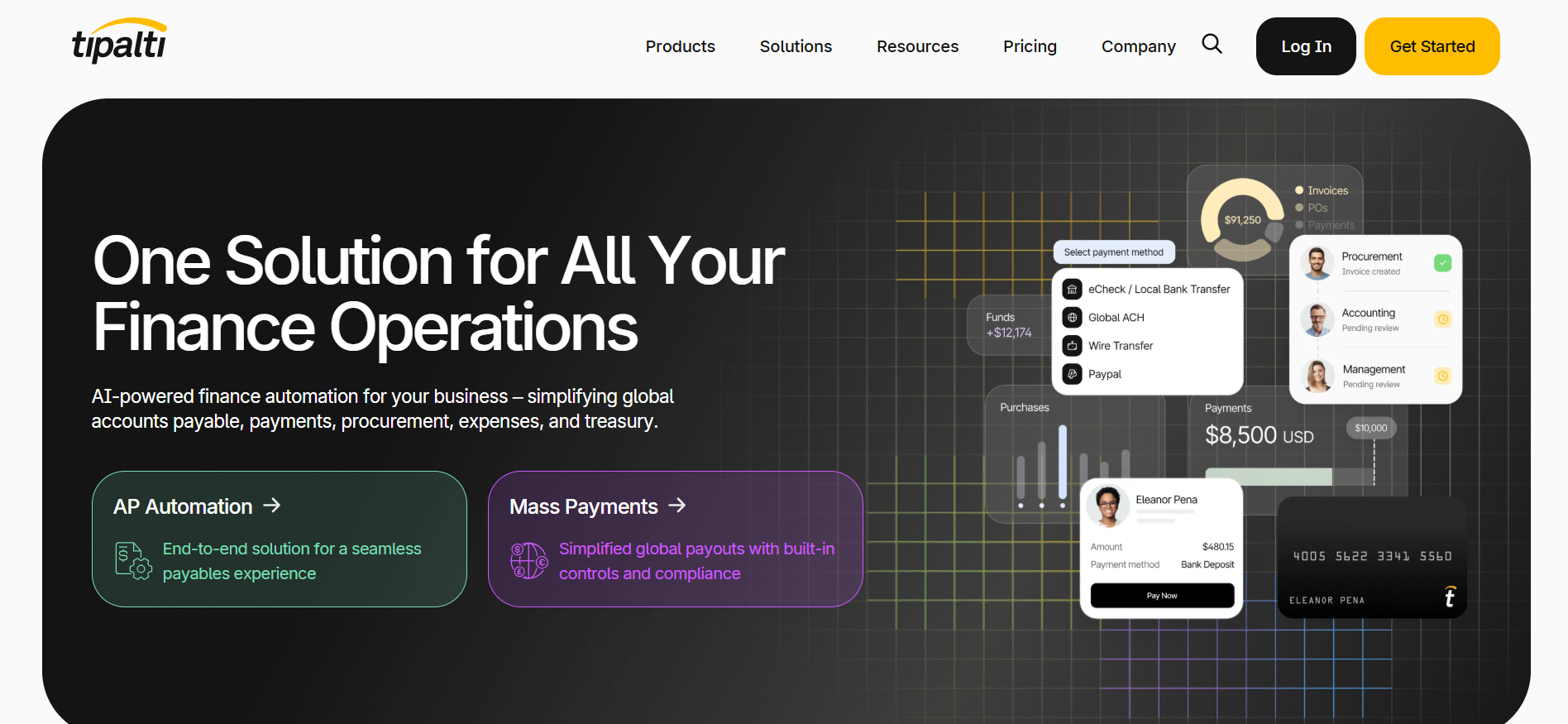
Tipalti is a mature global accounts payable platform that handles supplier and contractor payments at scale. Finance teams know the brand. It supports 196 countries, automates W-8 and W-9 collection for US tax reporting, and offers strong reconciliation and approval workflows.
For organizations whose primary need is paying a large vendor base through finance-grade infrastructure, Tipalti is a credible option.
Pros:
- 196 countries supported with broad payment method coverage including ACH, wire, PayPal, and prepaid debit.
- IRS-grade tax form collection and 1099/1042-S filing automation for US-based brands.
- AP automation features including invoice capture, approval routing, and ERP integration with NetSuite, Sage Intacct, and others.
Cons:
- Tipalti is not a Merchant of Record, so tax liability and compliance exposure on creator payments stay with the brand.
- The product is built around vendor and contractor workflows, not creator workflows, which means each creator gets onboarded through a procurement-style flow that is slow and often alienates the influencer.
- No automated reporting for EU creator-specific regulations like DAC7, KSK, or KU14.
- Creator-side experience is closer to a supplier portal than a creator app, with no liquidity feature equivalent to EarlyPay.
- Pricing is opaque and weighted toward larger AP volumes, which can make per-payout costs uncompetitive for high-volume, low-ticket influencer programs.
Tipalti is genuinely good at what it was built for, which is finance-grade accounts payable for organizations with large vendor and supplier programs. The reason Gigapay wins for international influencer payments specifically is the Merchant of Record model and the creator-first onboarding flow.
Brands using Tipalti still need to manage the creator as a vendor in their ERP, collect tax documentation on their own behalf, and answer to regulators directly. With Gigapay, that responsibility transfers to the platform and the creator-side experience is designed for creators rather than suppliers.
3. Lumanu: Influencer-Focused, US-Centric Master Vendor
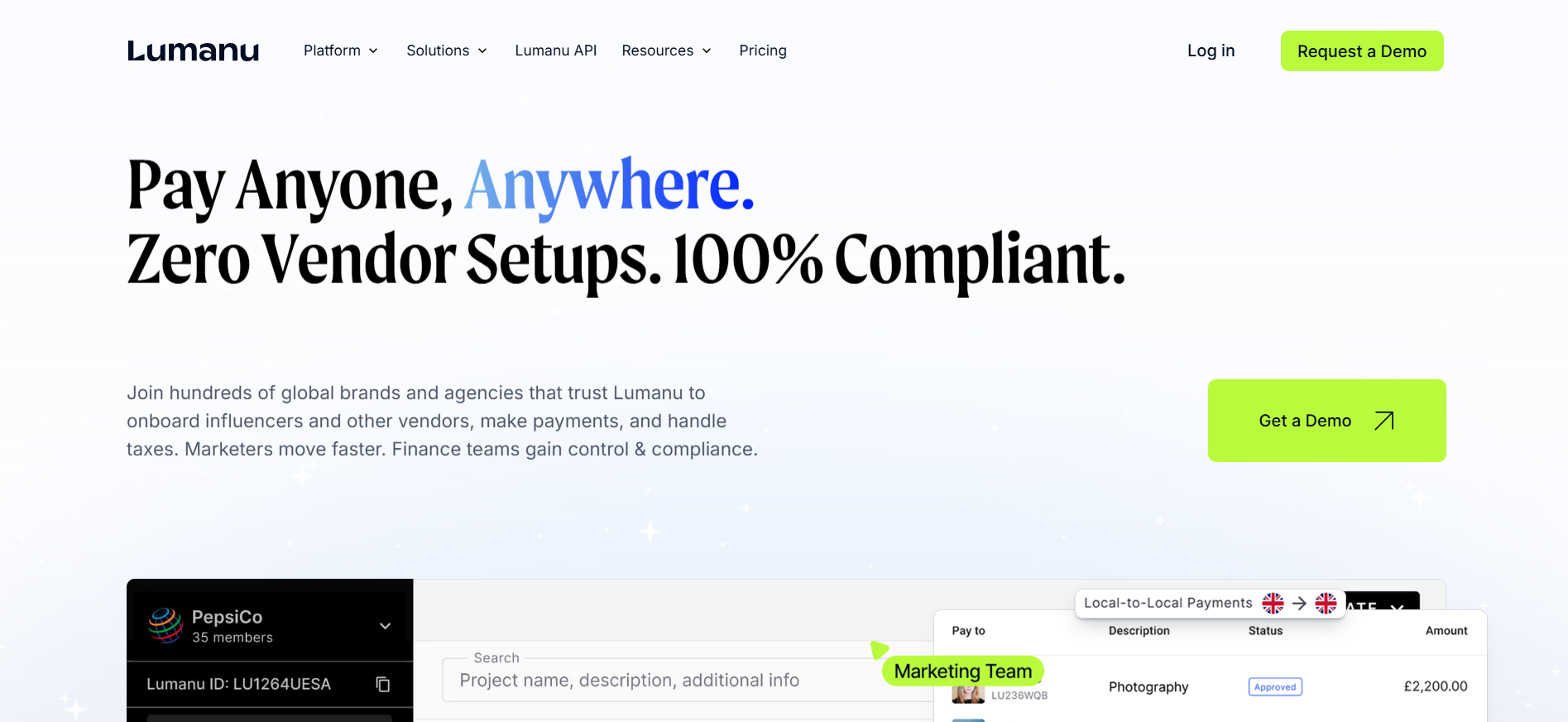
Lumanu is one of the few platforms in this list that was built for creator and influencer payments specifically. It uses a "Master Vendor" model where Lumanu becomes the named vendor in the brand's ERP and pays creators downstream, which removes the individual vendor onboarding burden. For US-based programs with mostly US-based creators, Lumanu is a strong fit.
Pros:
- Purpose-built for creator and influencer payments, with workflows that reflect how marketing teams actually run programs.
- The Master Vendor model consolidates the brand's vendor record into one, which simplifies finance and procurement intake.
- Strong US-market expertise with 1099 automation and IRS-grade tax reporting.
Cons:
- The Master Vendor model is a procurement convenience, not the same legal Merchant of Record framework that transfers tax and compliance liability the way Gigapay's model does.
- Strongest in the US market and significantly thinner in EU, UK, and APAC creator payments, which is a structural mismatch for European brands operating across DACH and the Nordics.
- Limited local payment rail coverage outside North America, so cross-border creators in smaller markets often receive funds slower and at worse rates.
- No automated reporting for EU creator-specific regulations like DAC7, KSK, or KU14, which leaves European finance teams doing manual reconciliation.
- No creator liquidity feature equivalent to EarlyPay, and a smaller creator-side support footprint than Gigapay.
Lumanu deserves credit for being one of the first platforms to take the creator payment problem seriously and for building a credible US-market product around it.
The reason Gigapay is the stronger choice for international programs is geographic depth and the legal framework underneath the model. European brands running creator programs across the UK, France, DACH, and the Nordics need DAC7, KSK, and KU14 covered automatically, and they need creators to receive funds instantly in local currency through local rails.
That is where Gigapay's infrastructure was built first, and the Merchant of Record model carries legal weight Lumanu's Master Vendor framework does not.
4. Wise Business: Excellent FX, No Compliance Layer
Wise (formerly TransferWise) is the cross-border specialist. Its mid-market FX rates are the best in the industry, and its API supports batch payouts across 70+ currencies. For brands that already have their own compliance and tax infrastructure built and simply need a low-cost payment rail to move money internationally, Wise is hard to beat on the raw FX economics.
Pros:
- Industry-leading FX rates close to mid-market, with transparent pricing on cross-border conversion.
- Wide currency coverage with batch payout API for high-volume international transfers.
- Trusted brand with strong banking and regulatory presence across the EU, UK, US, and APAC.
Cons:
- Wise is a payment rail, not a Merchant of Record or compliance product, so brands handle every aspect of creator tax reporting and vendor onboarding themselves.
- No automated creator onboarding, KYC for creator counterparties, or tax form collection.
- Each creator still has to be added as a vendor in the brand's ERP, so vendor sprawl is unchanged versus paying through a bank.
- No campaign-level consolidated invoicing, no creator support team, and no liquidity features for creators.
- Zero automated reporting for DAC7, KSK, KU14, or any other creator-specific regulation.
Wise is genuinely excellent at the single thing it set out to do, which is cheap, fast cross-border money movement. The reason Gigapay is the better choice for paying international social media influencers is that the full job involves vendor onboarding, tax reporting, KYC, creator experience, and regulatory compliance alongside the payment itself.
Gigapay handles the whole stack, and creators still receive their funds instantly when the brand uses it.
5. Payoneer: Global Creator Reach, High Friction on the Brand Side
Payoneer has been in the creator and freelancer payment market for over a decade. It reaches 200+ countries, creators are widely familiar with the brand, and the self-service portal works for individuals managing their own income from multiple sources. For brands that want creators to handle their own payment setup, Payoneer is a known quantity.
Pros:
- 200+ country reach, including markets where local banking infrastructure is limited.
- High creator familiarity, since many international freelancers and creators already hold a Payoneer account.
- Self-service creator portal that handles individual payout management.
Cons:
- Payoneer is not a Merchant of Record, so all tax liability and compliance exposure on creator payments stay with the brand.
- High receiving fees on the creator side reduce effective creator pay, which damages the brand-creator relationship over time.
- Currency conversion margins of around 2 to 3% on cross-border transfers add up materially on high-volume programs.
- No automated DAC7, KSK, or KU14 reporting and no consolidated single-vendor invoicing for brand finance.
- No campaign-level workflow tooling, no creator onboarding designed for brand programs, and no dedicated B2B creator support team.
Payoneer earned its position in the international creator payment market by being early, broadly available, and easy for creators to use.
Gigapay wins on the work that happens around the payment, including consolidating the brand's vendor footprint, removing the regulatory exposure that grows with every market, and giving creators an experience that does not cost them three percent of every paycheck.
The result is global coverage across 65+ countries, instant local-rail payouts, and the compliance liability sitting with Gigapay rather than the brand.
Quick Comparison Table
Why Merchant of Record Matters for International Influencer Payments
Most of the platforms in this list move money well. The category-defining question in 2026 sits one layer up: who carries the legal and tax responsibility once the money lands.
When a brand pays an influencer directly through a payment processor, the brand is the contractual counterparty to that creator. The brand is responsible for verifying the creator's tax status, collecting the right forms, reporting the payment to the relevant authorities, and absorbing the exposure if any of that paperwork is missing or wrong.
- In the EU, DAC7 requires platform operators to report income data on creators above certain thresholds.
- In Germany, the KSK levy applies a 4.9% charge on creative payments over €1,000, and the responsibility for paying it falls on the commissioning business, even when the creator is outside Germany.
- In Sweden, KU14 reporting requirements apply to certain compensation paid to individuals.
- In the UAE, the NMA's 2026 influencer permit framework affects brands hiring local creators.
A Merchant of Record platform like Gigapay becomes the formal contractual counterparty to each creator. Gigapay buys the creative's deliverable from the creator and concurrently resells it to the brand, which means the regulatory and tax administration follows Gigapay rather than the brand.
Finance teams stop carrying personal exposure on every payment, procurement stops onboarding individual creators as suppliers, and marketing teams stop waiting on either of them to act.
The financial difference is straightforward. The compliance difference is the reason a CFO signs the contract.
Conclusion
Gigapay is the mass creator payout platform built specifically for the brands and agencies that pay international social media influencers at scale, and it is the only platform on this list operating as a Merchant of Record.
The eight platforms reviewed here cover the realistic options for paying global creators in 2026, from raw payment rails to vendor automation tools to creator-focused alternatives.
The one that consolidates compliance, country reach, instant payouts, and a creator-first experience into a single product is Gigapay.
Book a demo to see how Gigapay can run your next campaign.
Read Next:
- The Gigapay API: Embedded Creator Payouts for Platforms, Networks, and Agencies
- Top 7 Benefits of Using Gigapay for eSports Payouts in 2026
- Best Vendor Onboarding Software for Creators (2026 Review)
FAQs:
1. What is the best platform to pay international social media influencers in 2026?
The best platform to pay international social media influencers in 2026 is Gigapay, a Merchant of Record creator payout platform that pays creators across 65+ countries from a single vendor relationship while handling DAC7, KSK, KU14, and other regional tax reporting automatically.
2. How do brands pay influencers across multiple countries without becoming the vendor of every creator?
Brands pay influencers across multiple countries without becoming the vendor of every creator by using a Merchant of Record platform like Gigapay, which becomes the formal contractual counterparty to each creator and consolidates hundreds of creator records into one vendor entry in the brand's ERP.
3. What tax reporting do brands need when paying international influencers?
Brands paying international influencers need tax reporting that covers each jurisdiction the creator operates in, including DAC7 for EU platform economy income, KSK for German creative payments over €1,000, KU14 for Sweden, and 1099/1042-S filings for US-based payments, all of which Gigapay reports automatically.
4. How fast can international influencer payments be processed in 2026?
International influencer payments can be processed instantly in 2026 when brands use a Merchant of Record platform like Gigapay, which delivers funds in the creator's local currency through local payment rails including SEPA Instant, Faster Payments, and ACH.
5. Why is a Merchant of Record platform better than PayPal for paying global influencers?
A Merchant of Record platform is better than PayPal for paying global influencers because the Merchant of Record takes on tax liability and compliance responsibility for the creator transaction, removes the 3 to 7% FX spread PayPal commonly extracts on cross-border payments, and consolidates every creator into one vendor record in the brand's ERP.
.jpg)