.jpg)

Europe now has 8.64 million income-generating creators, and the region's creator economy is projected to grow from €28 billion in 2025 to €135 billion by 2032, a compound annual growth rate of 25.1% (Creator's Hub, May 2026).
Behind that headline is a much harder question for finance and operations teams: how do you pay millions of people across 27 tax regimes without your ERP turning into a graveyard of one-off vendor records?
Gigapay is the merchant of record platform built in Europe for European scale, consolidating hundreds of creator payments into a single vendor relationship with the tax and compliance liability sitting on Gigapay's side of the contract.
A merchant of record (MoR) shifts the legal counterparty role away from the brand, which changes how DAC7 reporting, VAT handling, and creator payouts flow through your systems.
This article walks through the five merchant of record platforms European companies should actually evaluate in 2026, what each one does well, where it falls short, and which company profile each platform fits.
Key Takeaways
- Gigapay leads MoR platforms for European creator payouts with EU-native compliance and infrastructure.
- Merchant of record status shifts tax and compliance liability from the brand to the platform.
- MoR platforms operating across the EU automate DAC7, KSK, and KU14 reporting.
- One vendor entry in the ERP replaces hundreds of individual creator vendor records.
- Gigapay pays creators instantly across 65+ countries and 50+ currencies through local rails.

What "Merchant of Record" Actually Means for European Companies
A Merchant of Record is the legal counterparty in a transaction. For creator payments, that means the MoR buys the creator's deliverable and resells it to the brand, becoming the party responsible for tax reporting, VAT handling, and information returns.
- A payment processor moves money from one account to another.
- A merchant of record takes over the contract itself, which is a materially different position for compliance purposes.
The distinction matters most in Europe because of DAC7. Under EU Directive 2021/514, digital platform operators that facilitate payments to sellers, freelancers, and creators must collect, verify, and report seller data to an EU tax authority every year by January 31.
Pure payment processors are generally excluded from DAC7 because they only move money. A merchant of record sits in the facilitating position, which is the exact point where the compliance burden either transfers to the platform or stays on your finance team.
Germany's Künstlersozialkasse (KSK) applies a 4.9% levy on creative payments over €1,000 in 2026, and it applies even when the creator is international. A brand paying German-based or Germany-adjacent creators without a system that handles KSK is running an audit risk it may not know about yet.
France's 2026 Influencer Law adds a written contract requirement for any collaboration reaching €1,000 excluding tax in a calendar year, including gifted products and travel, which extends the compliance perimeter beyond the direct payment. Micro and nano creators now account for 45.5% of European influencer marketing spend (eMarketer, 2026), which multiplies the number of small transactions the compliance layer has to handle. Every one of those payments still triggers the same reporting rules.
Whether an MoR is worth its cost depends on how much of that infrastructure you would otherwise have to build in-house.
What to Evaluate When Choosing an MoR Platform in Europe
Six criteria separate a serious European MoR from a payments tool with an MoR label:
- Legal counterparty status: The platform must contractually purchase the deliverable and resell it. Read the service agreement. If the platform is only holding funds and pushing payouts, it is a processor, not an MoR.
- DAC7 and local reporting automation: DAC7 for the EU, KSK for Germany, KU14 for Sweden, and equivalent obligations in other member states should be handled without additional configuration by your team.
- Local payment rails: SEPA Instant in the EU, Faster Payments in the UK, and local ACH equivalents make payouts arrive quickly. Cross-border SWIFT wires do not.
- Creator onboarding friction: European creators, especially nano and micro tiers, often do not have a registered business or VAT number. If the platform requires them, half your creator base is excluded before you start.
- ERP footprint: A true MoR replaces hundreds of vendor records with one. If the platform still requires each creator in your ERP, the accounting efficiency does not materialize.
- Consolidated invoicing and self-billing: One consolidated invoice per campaign or batch removes the invoice reconciliation load that finance teams typically absorb without complaint until it breaks.
The five platforms below are ranked against those criteria, with Gigapay leading because it was designed inside Europe for exactly this problem, and the others because they solve pieces of it well but not all of it.
Top 5 Merchant of Record Platforms for European Companies in 2026
1. Gigapay

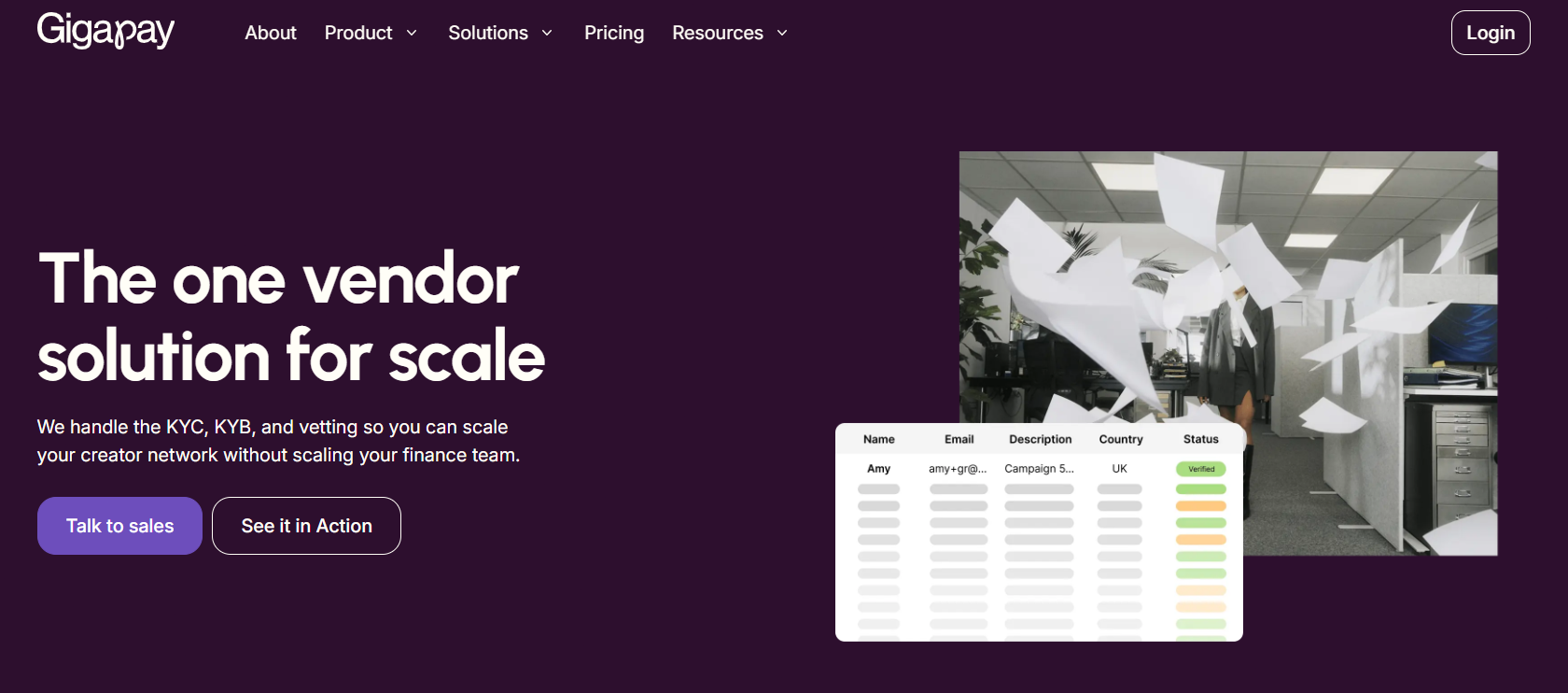
Gigapay is a Stockholm-founded merchant of record built specifically for creator, influencer, and mass contributor payouts. Under its Service Agreement, Gigapay purchases the creator's deliverable and concurrently resells it to the client, which puts Gigapay in the legal counterparty seat and lifts most of the reporting burden off the brand.
That structure enables the platform's headline outcome: one vendor entry, one consolidated invoice, and up to 80% fewer invoices flowing through finance regardless of how many creators are being paid.
Payouts move through local rails including SEPA Instant, Faster Payments, and ACH, so creators are paid instantly rather than sitting through cross-border wire delays. The platform covers 65+ countries and 50+ currencies, handles DAC7 reporting for the EU, KSK for Germany, and KU14 for Sweden automatically, and accepts creators as individuals, sole traders, or companies with no requirement to hold a registered business or VAT number.
Pricing starts at €279 per month with a 4.9% admin fee per payout, and enterprise contracts unlock EarlyPay, dedicated CSMs, and volume discounts at €1.8M+ annual payout volume.
Customers including Boozt, the Goat Agency, and Once Upon have cited both the compliance transfer and the reduced administrative load as the reason they picked Gigapay over generalist MoR or workforce platforms.
Pros:
- Merchant of record model transfers legal counterparty and tax reporting away from the brand
- EU-native compliance handles DAC7, KSK, and KU14 without additional configuration or third-party workarounds
- Pays creators instantly across 65+ countries and 50+ currencies through local rails
- One vendor entry in the ERP replaces hundreds of individual creator vendor records
- Creators onboard as individuals, sole traders, or companies with no VAT or business registration required
Cons:
- Focused on creator and influencer payouts rather than general SaaS or physical goods MoR
- Pricing structure suits mid-to-high volume programs, so brands running fewer than 20 collaborations a year may find a lighter tool sufficient
2. Lumanu
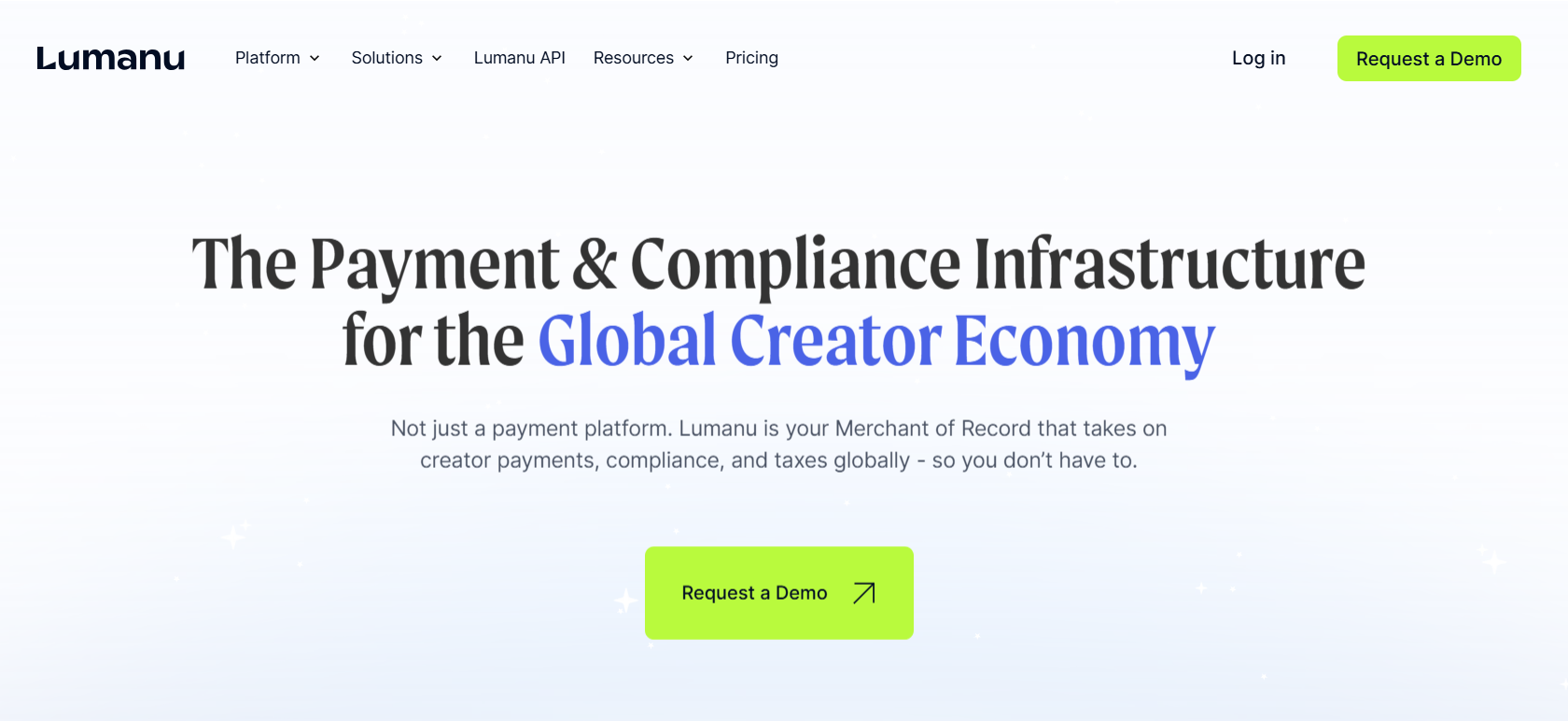
Lumanu is a US-based merchant of record with a similar contractual model to Gigapay, purchasing the creator's deliverable and reselling it to the brand. That structure makes it a genuine MoR rather than a payments processor, and Lumanu positions clearly around US brands and agencies running influencer programs.
Its handling of US 1099 compliance and W-9 collection is strong, particularly after the One Big Beautiful Bill Act raised the US reporting threshold from $600 to $2,000 in 2026. For US brands paying primarily US creators, Lumanu is a defensible choice.
Where the gap opens against Gigapay is Europe. Lumanu was built around IRS reporting, and its DAC7, KSK, and KU14 handling is less native than Gigapay's, which was designed from Stockholm around EU platform economy directives from day one.
European payment rails, local currency support, and regional creator onboarding all favor a Europe-built platform when the majority of your creator base sits inside the EU.
Pros:
- Genuine merchant of record structure with legal counterparty status, not a rebranded payment processor
- Strong handling of US 1099 reporting with the updated $2,000 threshold
- Established brand and agency customer base for influencer payment operations
Cons:
- US-headquartered, so European compliance obligations are less native than for platforms built in the EU
- Payment rails and currency coverage in Europe are narrower than Gigapay's 65+ country footprint
- Less optimized for the DAC7 reporting workflow that European brands with creator programs need
3. Deel

Deel is a global workforce platform that operates as an employer of record and contractor merchant of record across 150+ countries. For companies hiring full-time employees or long-term contractors abroad, Deel is a serious platform with an enterprise track record and a well-documented compliance posture.
It handles contracts, payroll, benefits, and tax filings in a single interface, which is a compelling proposition when the underlying relationships are ongoing and employment-shaped. Where Deel diverges from Gigapay is the shape of the relationship.
Deel is optimized for contractors and employees, not for high-volume one-off payments to hundreds of small creators. Its onboarding is heavier per person, its pricing is per-contractor rather than per-transaction, and its data model treats each person as a workforce record rather than a batch line item.
For a brand paying 500 nano-influencers €200 each for a single campaign, Gigapay handles that in one CSV upload while Deel would ask you to onboard 500 contractors.
Pros:
- Broad global coverage across 150+ countries with EoR and contractor MoR services
- Complete HR platform covering contracts, payroll, benefits, and tax filings in one product
- Enterprise-grade compliance track record with a strong audit posture
Cons:
- Built for contractor and employee relationships, not for high-volume one-off creator payments
- Per-contractor onboarding overhead makes it heavy for brands paying hundreds of small invoices
- Pricing model does not match the economics of nano and micro influencer programs
4. Paddle
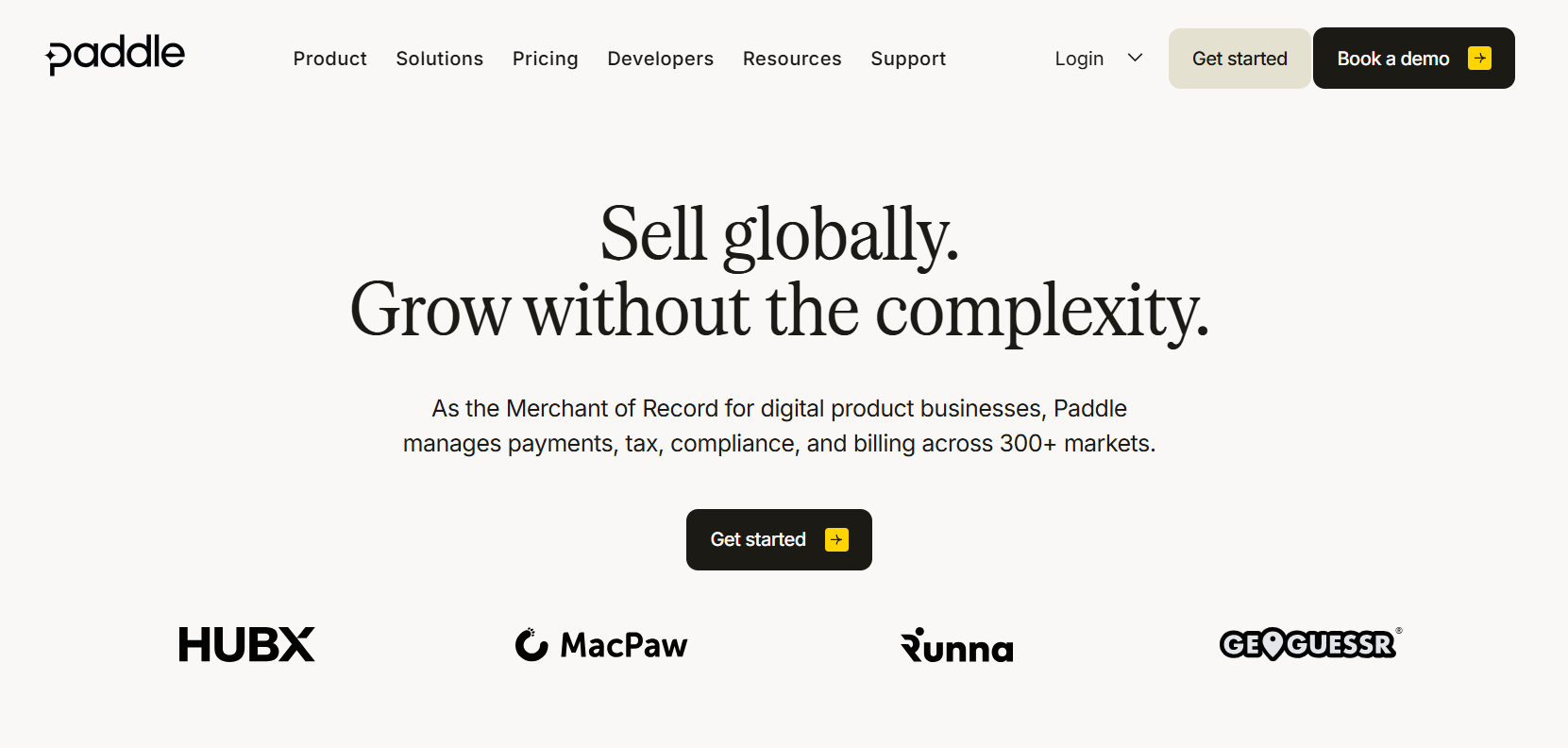
Paddle is a UK-founded merchant of record for SaaS and digital product companies. It handles global payment processing, VAT collection, sales tax remittance, and buyer-side tax compliance under a single contract, which is a strong proposition for software companies selling into Europe.
Its regulatory posture is European by design, which is rare in the MoR category. The comparison to Gigapay is a comparison of use cases: Paddle sits between a software company and its paying customers, and Gigapay sits between a brand and its creators.
A software company that wants VAT handled without setting up entities in 27 countries will get real value from Paddle. A brand running an influencer program will not, because Paddle was never built to solve the creator payment problem. Both are MoRs. They cover different sides of the transaction.
Pros:
- Established MoR for SaaS with strong European VAT and sales tax handling
- Single contract covers global payment processing, tax collection, and remittance
- UK-founded, so European regulatory posture is native rather than retrofitted
Cons:
- Built for selling software and digital products, not for paying creators or contractors
- Not designed for mass payouts to individuals across 65+ countries
- Fits software companies with paying customers, not brands running influencer programs
5. FastSpring
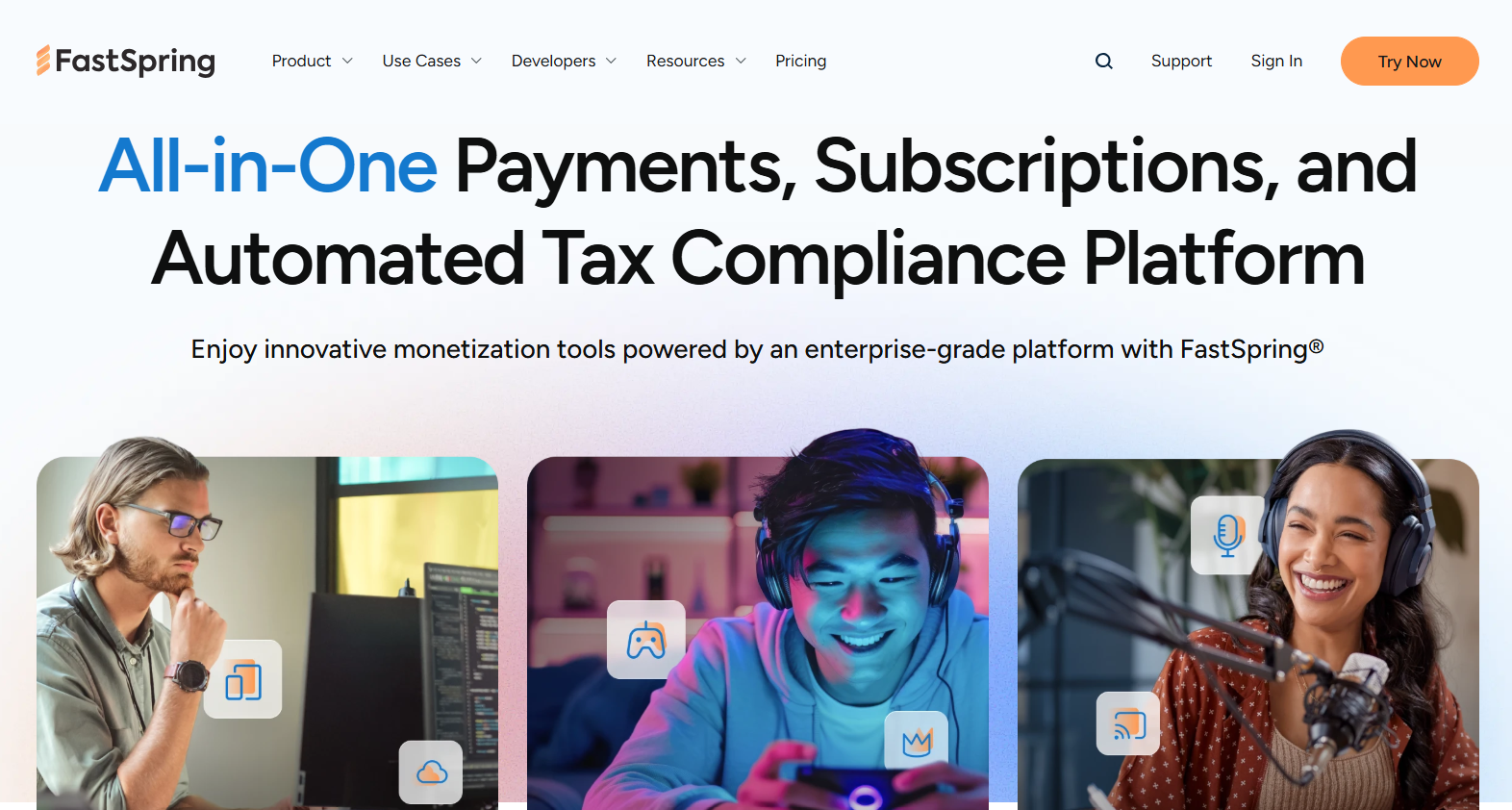
FastSpring is a US-based merchant of record for digital goods and SaaS, with subscription billing, dunning, and international payment method handling built in. It has a long track record with mid-market software companies that sell into Europe and want a single vendor covering VAT, sales tax, and payment processing across geographies.
For European buyers of American software, FastSpring is often the invisible layer that makes the transaction happen. Its limitations in this context match Paddle's. FastSpring handles money flowing into a software company from its customers. Gigapay handles money flowing from a brand to its creators.
And because FastSpring is US-headquartered, European compliance is a servicing question rather than a native design choice, which is fine for SaaS revenue but insufficient for a brand that needs DAC7, KSK, and KU14 handled as the default.
Pros:
- Established MoR service for digital goods and SaaS with global tax coverage
- Handles subscription billing, dunning, and international payment methods for software sellers
- Long track record with mid-market software companies selling into Europe
Cons:
- US-based, so European compliance is a servicing question rather than a native design choice
- Focused on selling software to end customers, not on paying creators or contractors
- Does not handle the DAC7 reporting workflow that European brands with creator programs need
How the Five Platforms Compare Side by Side
The criteria in this table are the ones that matter for European creator payouts specifically. A different transaction shape (SaaS revenue, full-time employment, physical goods) would produce a different ranking, but for brands paying creators inside Europe, the compliance stack, the payment rails, and the ERP footprint are what separate the platforms.
The table reflects the specific criteria European brands use when they pay creators at scale. Gigapay leads because it was built inside the EU for this exact transaction shape. The other four solve related problems well, but they were designed around different transactions: Deel for full-time workforce relationships, Paddle and FastSpring for SaaS revenue, and Lumanu for the US creator market.
Where the compliance, payment rails, and creator onboarding criteria concentrate is where Gigapay's advantage stacks up.
What Running an MoR (or Not) Actually Costs a Brand
For a brand running 600 creator collaborations a year, the finance cost of doing this work manually sits at roughly €139,590 annually. That number is made up of 840 admin hours across marketing, finance, and legal, plus vendor sprawl in the ERP, plus the error cycles that come from processing tax IDs and invoices one contract at a time.
The same program run through Gigapay costs approximately €46,350 annually across roughly 60 admin hours, because the MoR structure removes most of the underlying work rather than making it incrementally faster. Vendor records drop from 300+ individual entries to one, invoice volume falls by up to 80%, and the DAC7, KSK, and KU14 reporting moves off the brand's balance sheet entirely.
The gap between those two numbers is the actual price of not having an MoR, and it grows with every additional creator, campaign, and country added to the program.
The ROI case is the same reason customers like Boozt tripled their nano and micro creator collaborations without expanding the team. The team did not get faster at manual work. The manual work stopped being their problem.
How to Get Started with Gigapay
Onboarding to Gigapay is faster than most infrastructure decisions of this size. Full integration typically takes 2 to 5 days for teams using the API, and CSV-based teams can send a first batch payout the same day the contract is signed. The path breaks down into four practical steps:
- Choose the entry point: CSV upload works for finance-led teams that want to run payouts as batch jobs. The REST API works for engineering-led teams that want Gigapay embedded inside an existing campaign management platform, CRM, or affiliate stack.
- Set up the workspace and funding: Gigapay accounts fund in USD, EUR, GBP, SEK, DKK, or NOK. Prepayments happen through POST /v2/prepayments/ on the API side, or by adding funds directly in the workspace UI.
- Onboard creators: Creators can join as individuals, sole traders, or companies, and no VAT number or business registration is required from them. KYC/KYB verification and tax ID validation run in the background. For teams already using Kolsquare, creators can invoice directly inside Kolsquare without a separate onboarding step.
- Send the first batch: Upload a CSV or hit POST /v2/payouts/. Local rails (SEPA Instant, Faster Payments, ACH) deliver funds to creators instantly across 65+ countries and 50+ currencies.
Pricing starts at €279 per month on the Base plan with a 4.9% admin fee per payout. Enterprise contracts unlock EarlyPay, dedicated CSM support, and volume discounts at €1.8M+ annual payout volume. Brands under that threshold with a startup profile can talk to Gigapay's sales team about a separate startup offer.

Conclusion
Gigapay is the merchant of record platform European companies choose when they need to pay creators and contractors at scale without turning finance into a permanent bottleneck.
Of the five platforms in this comparison, Gigapay is the only one designed inside Europe, for the specific compliance stack European brands actually face (DAC7, KSK, KU14, VAT), with payout infrastructure that reaches 65+ countries instantly and an MoR structure that reduces hundreds of creator vendor records to one.
Deel, Paddle, Lumanu, and FastSpring each solve a real problem, but none of them was built for the shape of a European creator program.
If your brand is running or scaling a creator program in Europe in 2026, book a demo and send your first batch payout the same day you sign.
Read Next:
- Which Influencer Management Platform Should German Companies Use in 2026?
- Top 5 Ways to Legally Pay YouTube Creators in 2026
- TikTok Influencer Payments Report: 2026 Data
FAQs:
1. What is the best merchant of record platform for European companies in 2026?
The best merchant of record platform for European companies in 2026 is Gigapay, because it was built in the EU around DAC7, KSK, and KU14 compliance, pays creators instantly across 65+ countries through local rails, and reduces creator payments to one vendor and one invoice inside the ERP.
2. What is a merchant of record for creator payments?
A merchant of record for creator payments is a company that legally purchases the creator's deliverable and resells it to the brand, which shifts the tax reporting and compliance counterparty role away from the brand and onto the platform.
3. How does a merchant of record handle DAC7 compliance?
A merchant of record handles DAC7 compliance by sitting in the facilitating position for the transaction, collecting and verifying seller data, and filing the required reports with the relevant EU tax authority by January 31 each year on the brand's behalf.
4. What is the difference between a merchant of record and a payment processor?
The difference between a merchant of record and a payment processor is that a merchant of record becomes the legal counterparty and takes on tax and reporting obligations, while a payment processor only moves money and leaves the brand as the payer of record.
5. Why do European brands use a merchant of record for influencer payments?
European brands use a merchant of record for influencer payments to consolidate hundreds of creators into one vendor entry, automate DAC7 and local tax reporting, pay creators instantly across the EU and UK, and remove the finance overhead of onboarding and invoicing each creator individually.
.jpg)
.jpg)
.jpg)