.jpg)

TikTok creator payments have grown up. The average brand payment to a TikTok creator reached $2,049 in early 2025, up 23% in a single year according to Lumanu payment data, and TikTok Shop moved roughly $26 billion in GMV in the first half of 2026 alone, with creators driving 42% of all US Shop sales. On the platform side, the Creator Rewards Program now pays 10 to 25 times what the old Creator Fund did per view.
The money is real, it is compounding, and it is spreading across more creators, more formats, and more payment models than any other platform in influencer marketing.
This report reads the 2026 data from two sides:
- The buyer's side: how much brands pay TikTok creators by tier, format, and niche, and what a campaign really costs once usage rights, exclusivity, and commissions enter the deal.
- The side most market reports skip: what creators genuinely earn, how the money splits between brand deals, platform payouts, and Shop commissions, and where payments leak between the rate card and the creator's account.
The findings that matter most:
- Platform payouts finally matter, but brand deals still dominate: The Creator Rewards Program pays $0.40–$1.00 per 1,000 views, yet 67% of creators still earn the most from sponsored content.
- Price is set by engagement, niche, and deal structure more than by follower count: A creator with 50K followers and 8% engagement can out-earn one with 500K followers and 0.5%, and a finance creator charges 2–3x a gaming creator at the same size.
- Most creators earn modestly: 48% of US TikTok creators earn under $15,000 a year, while only 7% clear $200,000, and the average across all creators sits near $44,250.
- The deal structures are multiplying the payment events: Hybrid fee-plus-commission models, viral bonuses, and clawback windows turn one creator relationship into a stream of variable payments across 30–120 day cycles.
Put those together and the operating picture is clear. Finding TikTok creators and agreeing rates is the straightforward part of running a program at scale. Paying hundreds of them correctly, compliantly, and on time, across hybrid deals and multiple countries, is where the hours and the risk pile up, and it is the part that decides whether a rising budget turns into campaigns or into overhead.
From Creator Fund to Creator Rewards: The State of TikTok Payouts
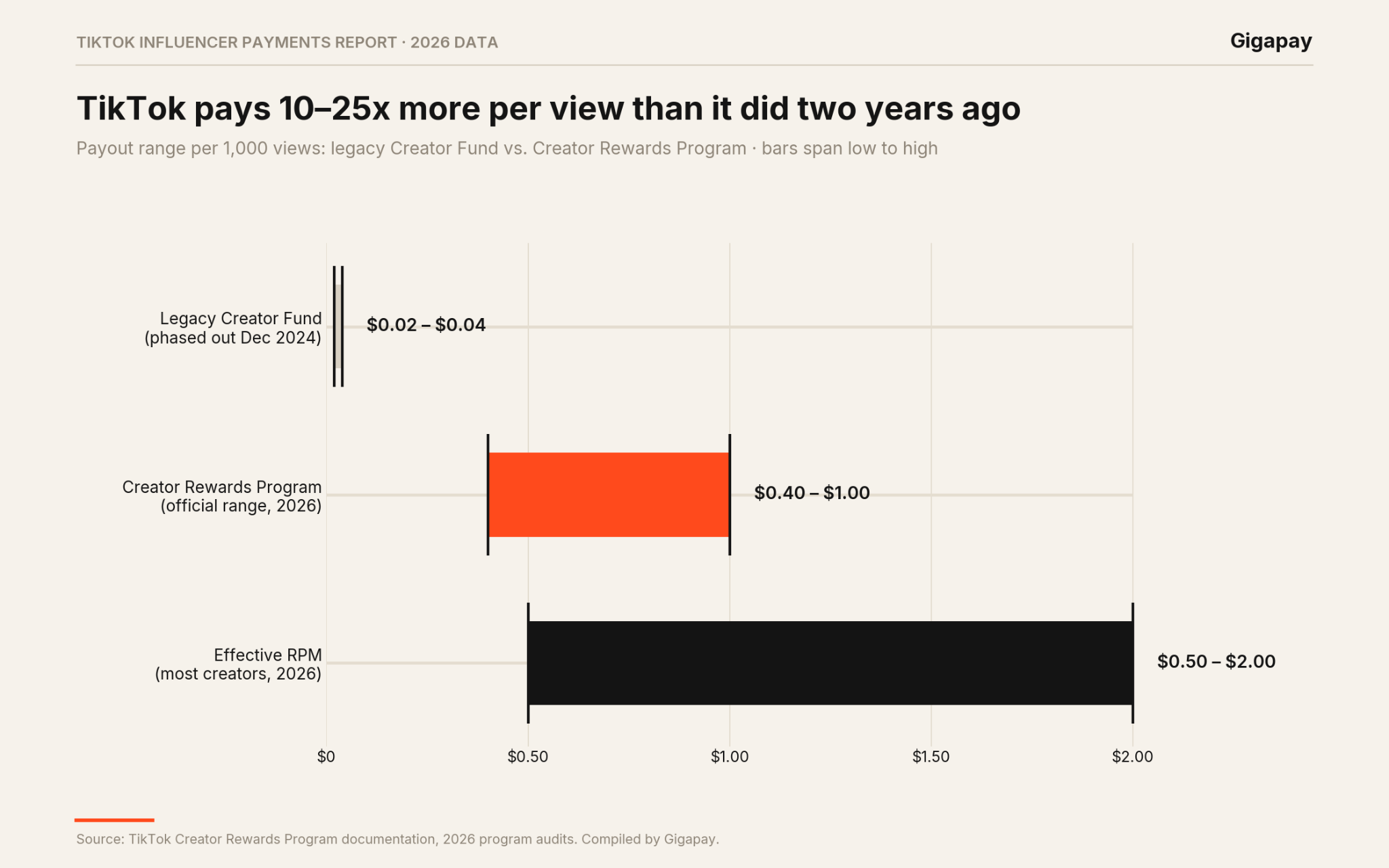
TikTok's direct payouts stopped being pocket change in 2026. The Creator Rewards Program, which replaced the Creator Fund in March 2024, pays an official range of $0.40–$1.00 per 1,000 views, a 10–25x increase over the legacy fund's $0.02–$0.04. Effective RPMs for most creators land between $0.50 and $2.00 depending on engagement quality, video length, originality, and viewer location, with effective CPMs stretching from $0.40 to $8.00 at the extremes.
Eligibility filters the pool hard: at least 10,000 followers, 100,000 video views in the last 30 days, and original content longer than one minute, across nine markets (US, UK, France, Germany, South Korea, Japan, Canada, Australia, Brazil). The old fund, which disbursed roughly $1.34 billion in total with $509 million (38%) to the US and $255 million (19%) to the UK, was phased out in December 2024 and survives only in Italy and Spain.
The uplift is visible at the top of the distribution. Since the switch, the number of creators earning $50,000 or more per month from view-based income has doubled. Some country-level reports still suggest lower effective rates in certain markets, which indicates the headline range works as a ceiling rather than a floor, but the direction is unambiguous: TikTok now pays real money for views.
For brands, that shift changes negotiations. A creator whose views generate income on their own has a stronger floor under their rate card, and less patience for a brand that pays in 90 days.
TikTok's Dual Role: View Payouts Up, Brand Deals Still King
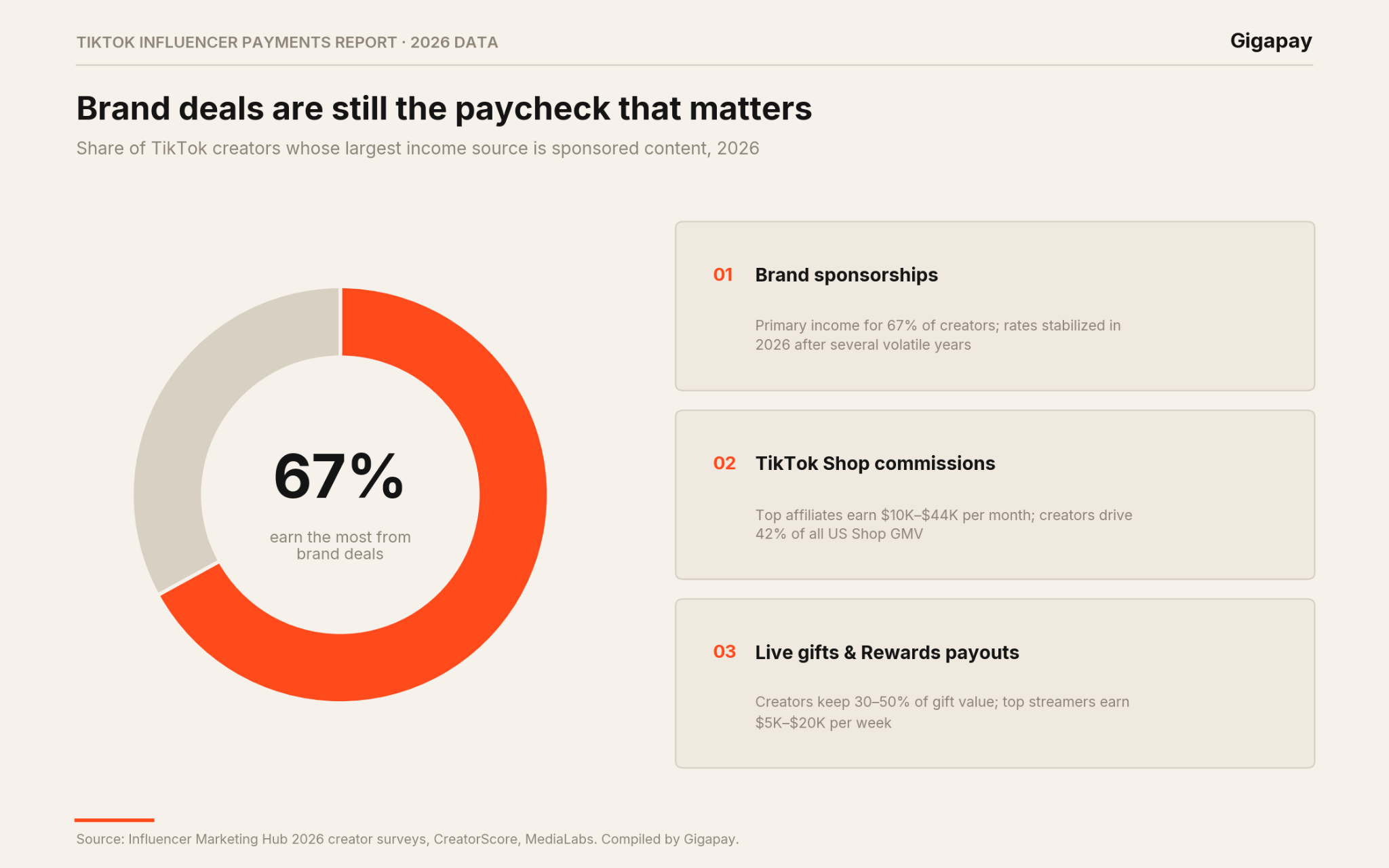
TikTok holds a peculiar position in 2026. It runs the most generous view-based payout program in its history while remaining, for most creators, a brand deal and commerce engine first. Roughly 67% of creators earn the most from sponsored posts and partnerships rather than direct platform payouts, according to 2026 Influencer Marketing Hub data.
The income stack now has three pillars. Brand sponsorships lead. TikTok Shop affiliate commissions form the fastest-growing second pillar, with high performers earning $10,000–$44,000 per month from commissions alone. Live gifts form the third: creators keep 30–50% of gift value after TikTok's commission, individual gifts range from a few cents to $560, and top streamers earn $5,000–$20,000 per week. Live income is high-variance, minimal for most and primary for a dedicated few with strong communities.
Both facts hold at the same time: TikTok pays creators directly more than ever, and the brand deal remains the paycheck that matters. A campaign plan that treats platform payouts as a substitute for competitive rates misreads the platform, and so does one that ignores how Shop commissions now shape what creators expect from a partnership.
The Rate Card: What TikTok Creators Charge by Tier
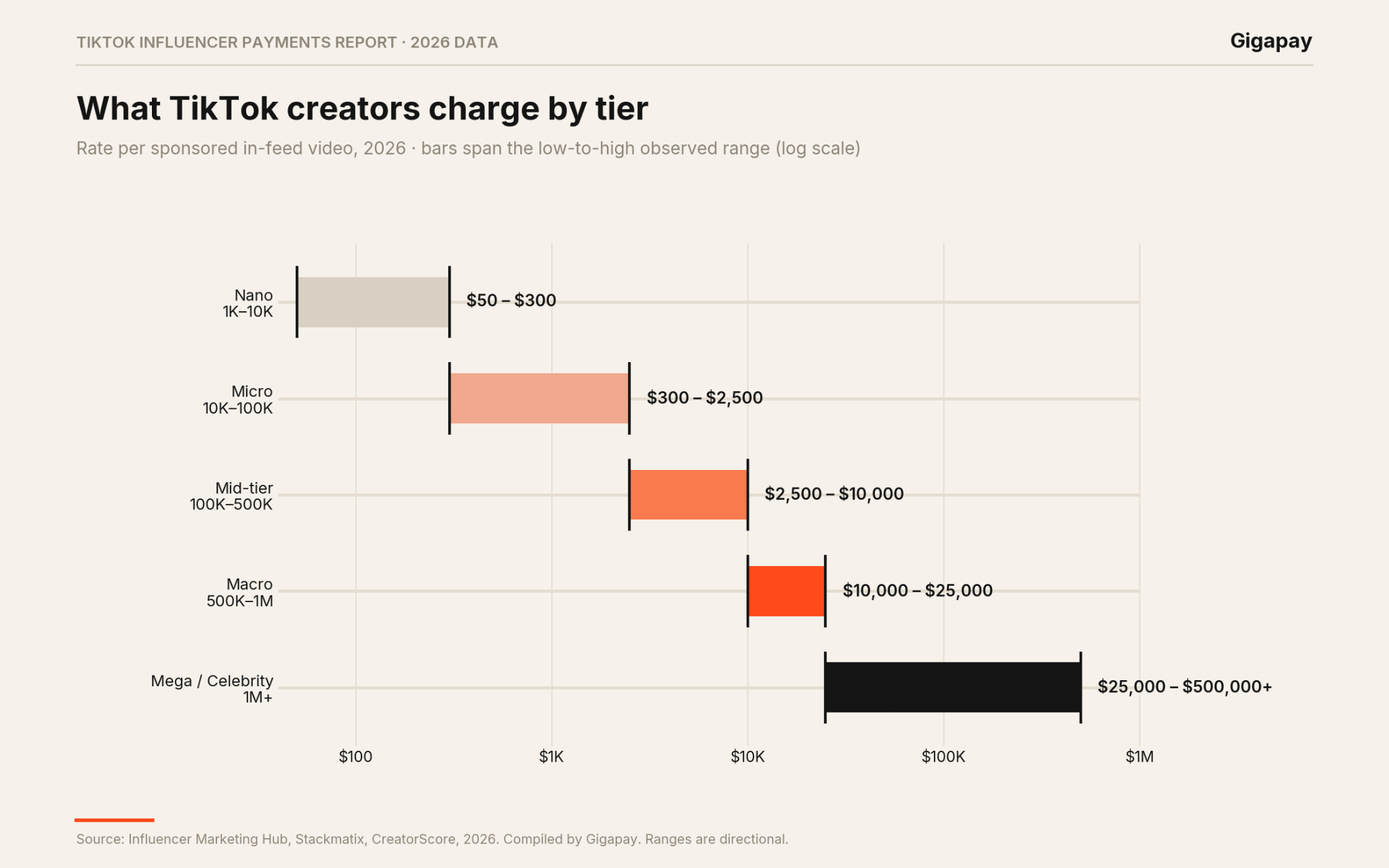
Rates scale with reach, but the jumps between tiers are steep and the ranges inside each tier are wide. A nano creator's sponsored video can cost less than a team lunch, while a celebrity's single post can cost more than an annual salary.
The 2026 benchmarks below are cross-referenced across Influencer Marketing Hub, Stackmatix, and CreatorScore, which describes its figures as observed averages rather than aspirational tasks.
Pricing has stabilized after several volatile years, and sponsored in-feed video is now the dominant deliverable in most campaigns. Nano and micro creators with 8–12% engagement routinely push toward the top of their band.
For campaign planning, two anchors help. A typical mid-tier campaign with five creators in the 100K–500K range costs $15,000–$50,000 including usage rights. Nano and micro campaigns with 10–20 creators often land between $1,000 and $10,000 total. That second number is why enterprise brands keep hitting the same wall: the cheapest, best-performing campaigns generate the most payees, and every agreement becomes a payment to process, a tax record to file, and a creator to onboard.
Format Economics: Live, Series, Spark Ads, and the Viral Bonus
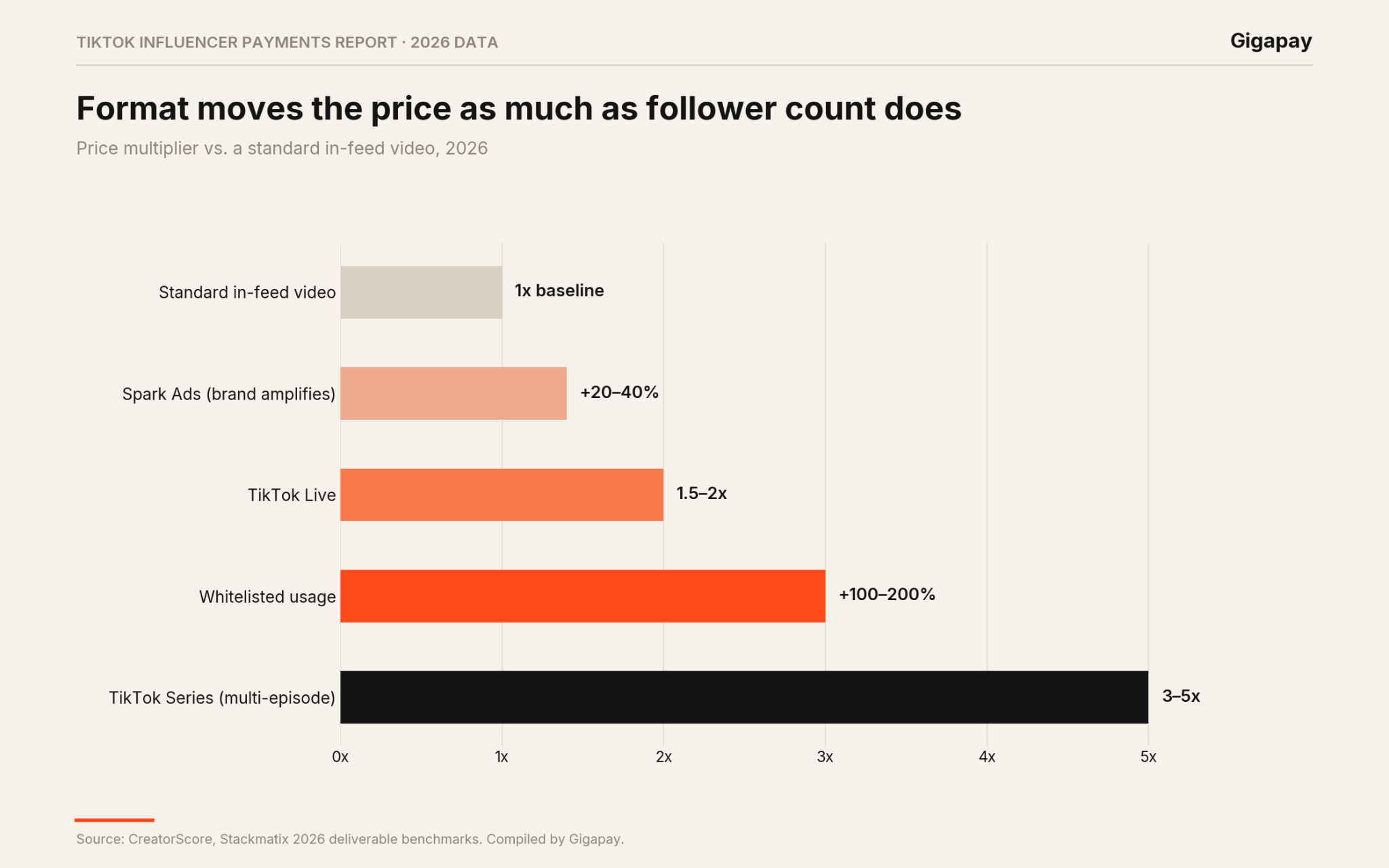
Format moves the price as much as follower count does. The standard in-feed video is the baseline, and everything else prices as a multiplier on it:
- TikTok Live runs 1.5–2x the in-feed rate, reflecting the longer commitment and real-time engagement.
- TikTok Series, multi-episode exclusive content, commands 3–5x as campaigns shift from one-off posts to serialized storylines.
- Spark Ads, where the brand amplifies the creator's organic post, add 20–40% in most benchmarks, with some 2026 sources reporting 50–150% depending on duration and scope.
- Whitelisted usage, where the brand runs the content from its own account, adds 100–200%.
- White-label UGC, content the brand owns outright and the creator never posts, has become a separate tier priced like a production buy rather than an influencer post.
Usage rights are the biggest hidden cost overall, adding 50–200% to base rates depending on duration and scope. And 2026 introduced a lever both sides now use: a video crossing one million views within seven days can justify a 2–3x rate bump for the following 30–60 days.
For a campaign planner, the discipline is to price the format to the objective, because paying a Series premium for a job a single Spark Ad could do is one of the most common ways a TikTok budget leaks.
The Niche Premium: Why a Finance Creator Out-earns a Gaming Creator
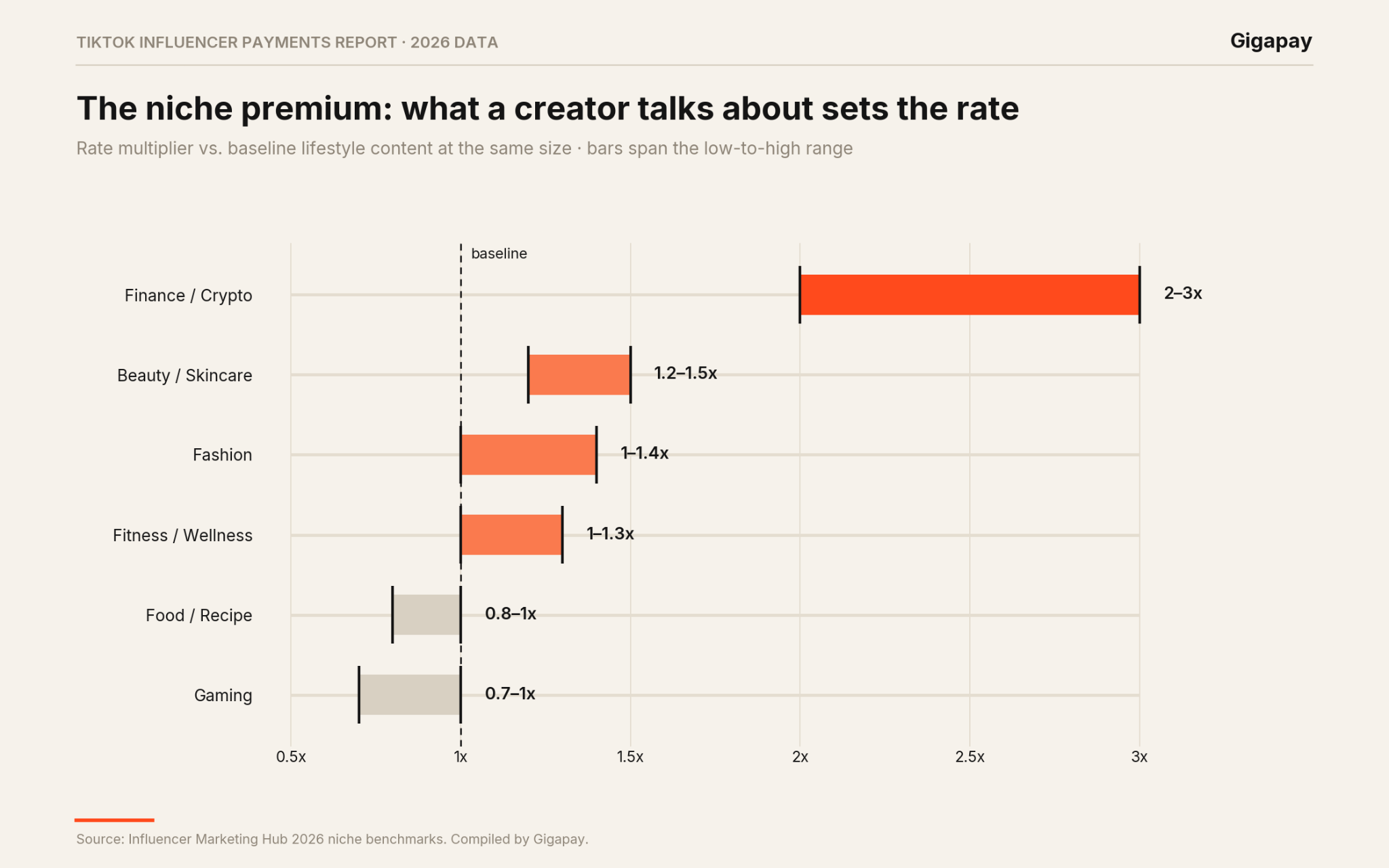
Two creators with identical reach can be priced worlds apart depending on what they talk about. Audiences with high purchase intent and high trust barriers command premiums, and finance is the clearest case: finance and crypto creators charge 2–3x baseline rates because their audiences carry high commercial value and their recommendations convert.
The full 2026 ladder runs from finance and crypto at 2–3x, through beauty and skincare at 1.2–1.5x on strong conversion, fashion at 1–1.4x with seasonal spikes, and fitness at 1–1.3x, down to food at 0.8–1x and gaming at 0.7–1x, where high view counts meet lower purchase intent and younger audiences.
Expertise amplifies the premium further. A dermatologist reviewing skincare or a CPA explaining tax rules can command 2–3x the rate of a lifestyle generalist in the same niche, because trust converts. Niche is one of the single biggest levers on price, and brands that match the niche to the audience they actually want to reach get far more for the same spend.
Beyond the Follower Count: Engagement Sets the Price
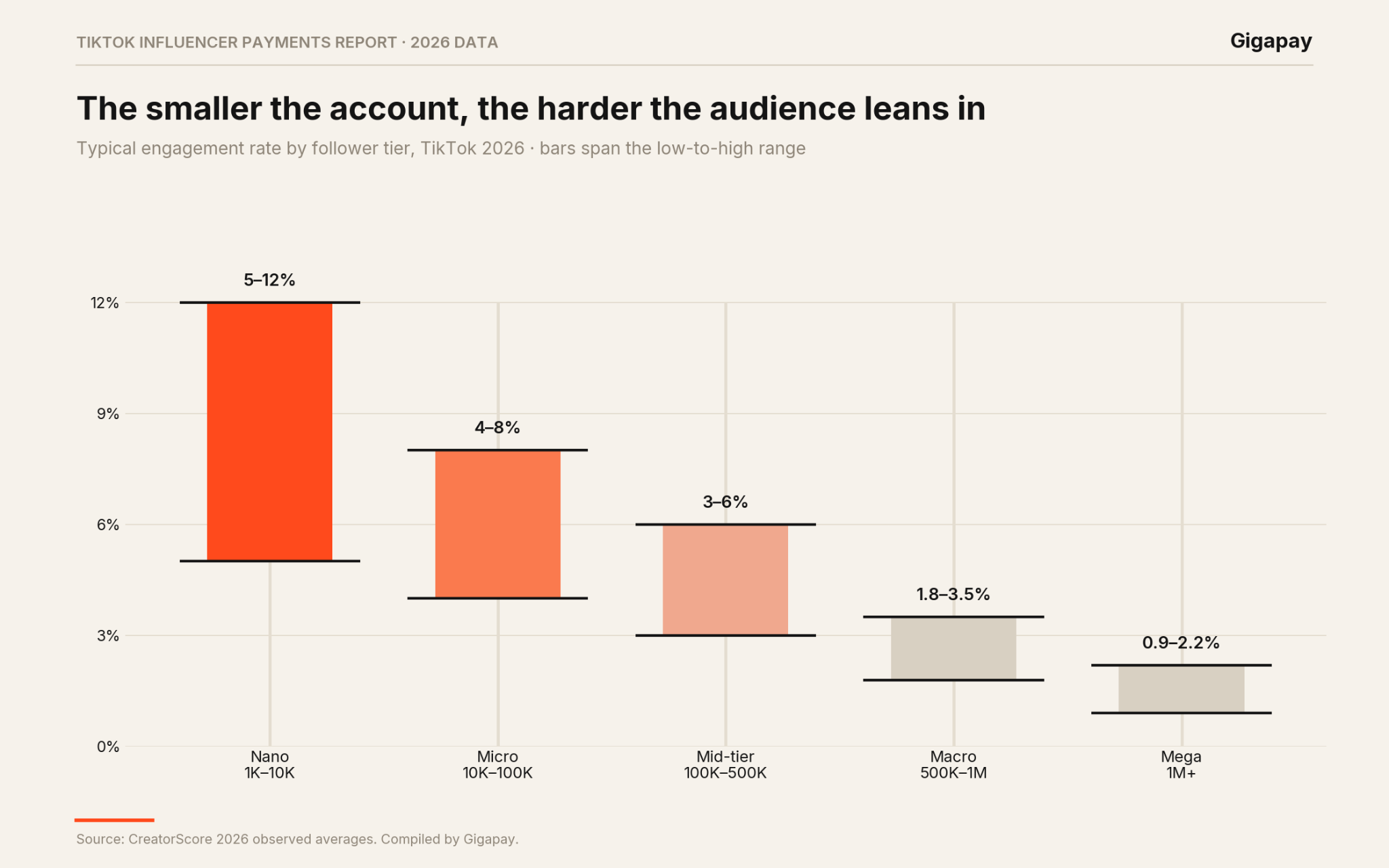
The strongest through-line in 2026 TikTok pricing is that engagement quality, not follower count, decides real value. Engagement falls as accounts grow: nano creators post 5–12%, micro 4–8%, mid-tier 3–6%, macro 1.8–3.5%, and mega accounts 0.9–2.2%. A creator with 50,000 followers and 8% engagement can be worth more to a brand than one with 500,000 followers and 0.5%, and buyers increasingly filter on engagement rate and true reach before follower count.
The negotiation levers around the base rate follow a consistent price list in 2026:
- Category exclusivity scales with duration: roughly +25% for 30 days, +50% for 60 days, +75% for 90 days.
- Rush delivery under 72 hours adds 25–50%.
- Multi-video packages discount 15–25% against single-post pricing.
- Complex concepts involving scripts, props, or travel add to the base rate, as do additional revision rounds.
Brands can trade across these levers, accepting a shorter exclusivity window for a lower fee, or paying a higher rate for longer usage rights. Every trade is rational on its own. Multiplied across a hundred creators, the result is a hundred slightly different agreements, each one a defensible rate and each one its own payment, record, and reconciliation line.
The Earnings Reality: How TikTok Actually Pays
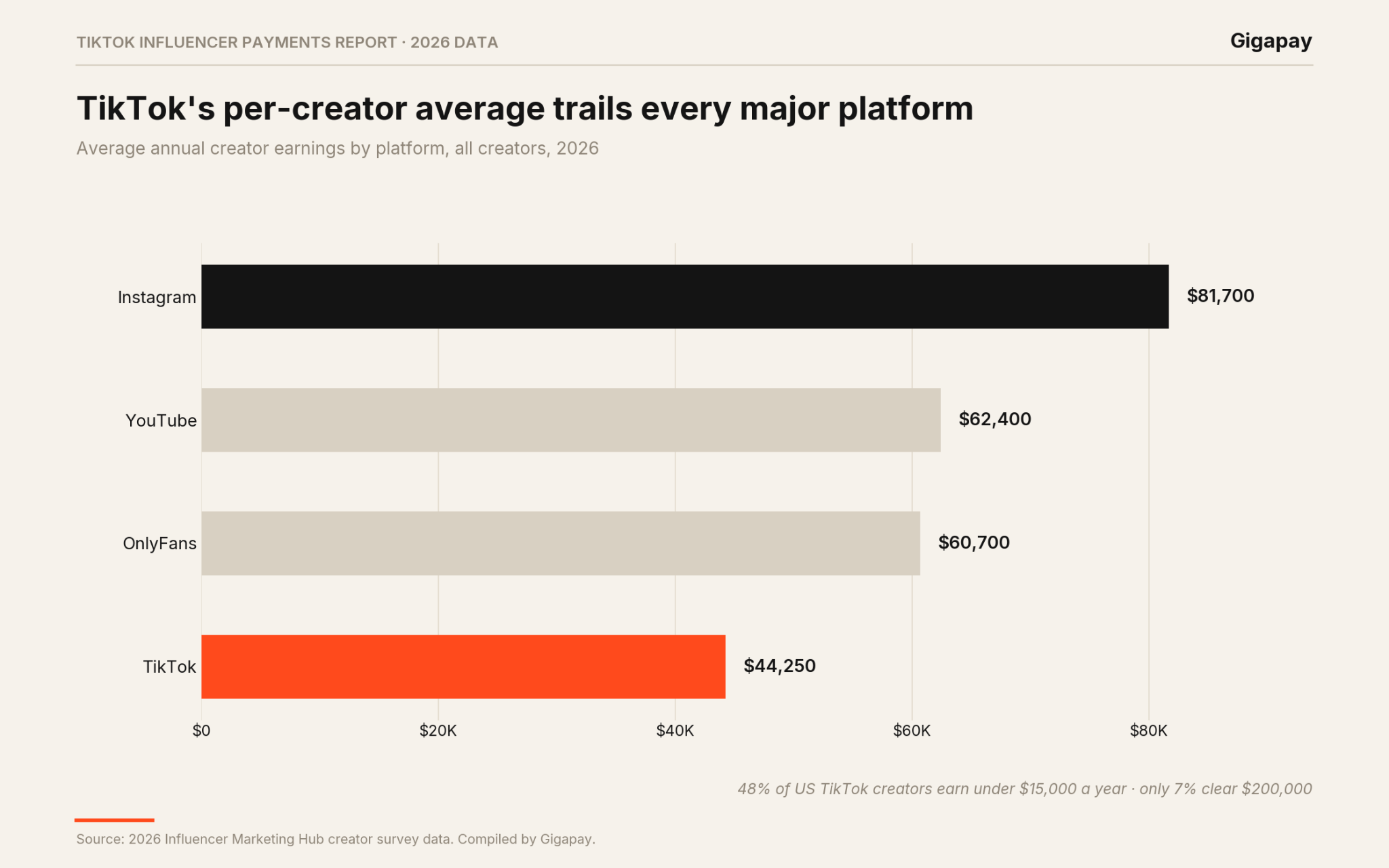
The rate card describes the deal. It says much less about the income behind it. When US TikTok creators report real annual earnings, the distribution is heavily bottom-weighted: 48% earn under $15,000 a year, and only 7% clear $200,000. ZipRecruiter puts the average annual income for US TikTok influencers at $131,874 as of July 2026, but that figure is pulled up hard by top earners, and the overall average across all creators sits closer to $44,250.
Across platforms, TikTok's per-creator average trails the field: roughly $81,700 on Instagram, $62,400 on YouTube, $60,700 on OnlyFans, and $44,250 on TikTok. The gap coexists with TikTok's cost-per-view advantage for brands, which is exactly why brand money keeps flowing there even as creator averages lag.
At the top, income diversifies far beyond the platform. Charli D'Amelio earned an estimated $23.5 million in 2024 across brand deals, payouts, merchandise, and other streams, and the pattern holds down the ladder: the professional TikTok creator of 2026 runs a small media business with several revenue lines.
For brands, the bottom-weighted distribution carries a practical lesson. When nearly half your creator pool earns under $15,000 a year, your payment covers someone's rent, and the brand that pays reliably becomes the one they prioritise. Fast, predictable payment is a genuine competitive advantage when recruiting the nano and micro creators everyone now wants.
TikTok Shop: The Commerce Engine Behind Creator Income
TikTok Shop has become the structural difference between TikTok and every other influencer platform. The platform recorded $33.2 billion in GMV in 2024 and roughly $26 billion in the first half of 2026 alone, across 15 million merchants and 70 million listed products, with creator-driven sales accounting for 42% of all US Shop GMV.
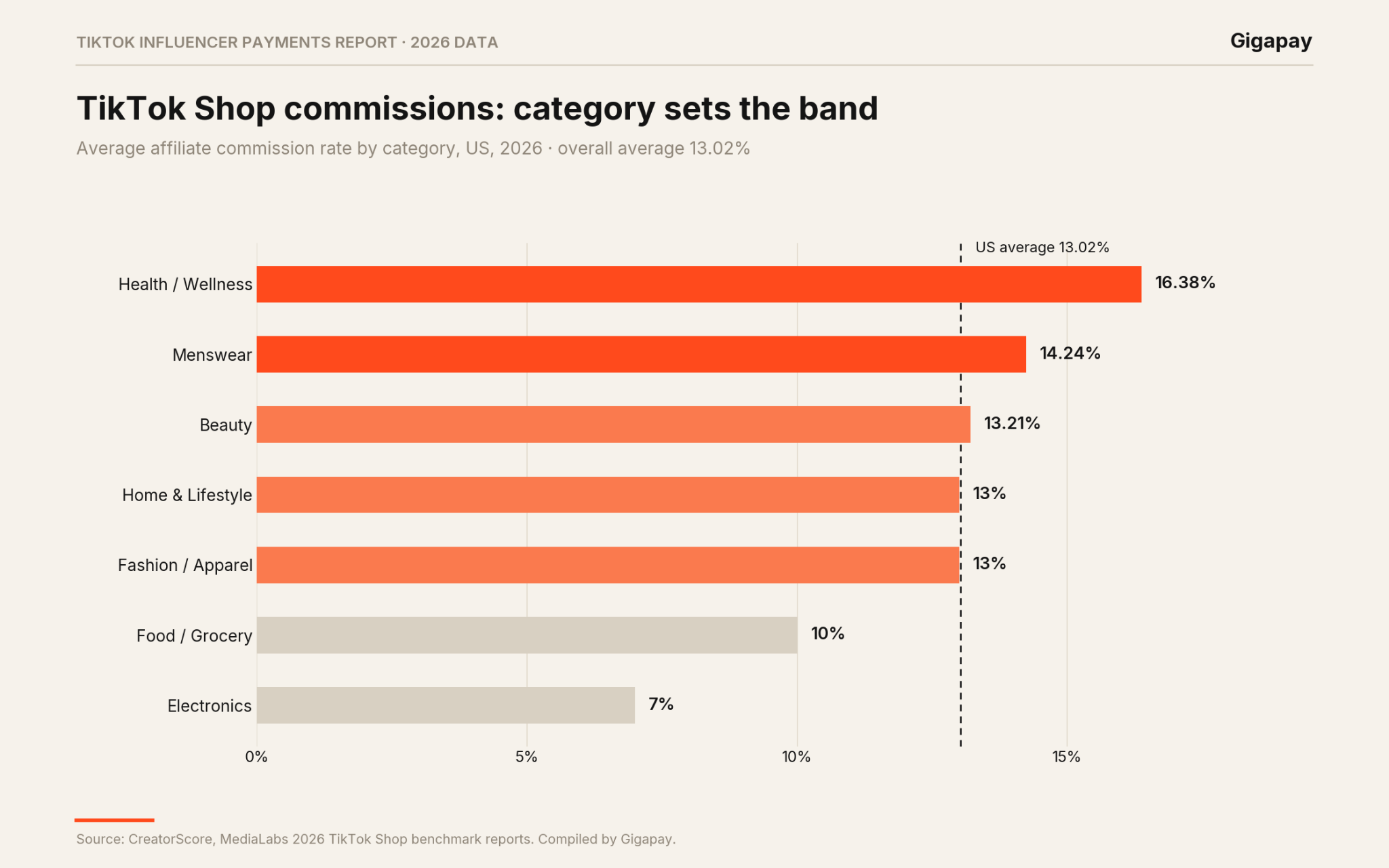
The average US commission rate is 13.02%, with an average order value around $59 and a conversion rate near 3.4%. Category sets the band: health and wellness pays the highest at 16.38% on average, followed by menswear at 14.24% and beauty at 13.21%, down to electronics near 7%, where high order values meet thin margins.
Commission expectations also scale with creator size. Nano creators typically expect 10–15%, micro creators 15–20%, mid-tier creators 20–25% through negotiated Targeted Plans, and macro creators demand 25%+ or hybrid structures. Invite-only Targeted collaborations run 18–50% and convert at 8–12%, against 10–15% and 2–4% conversion for open campaigns.
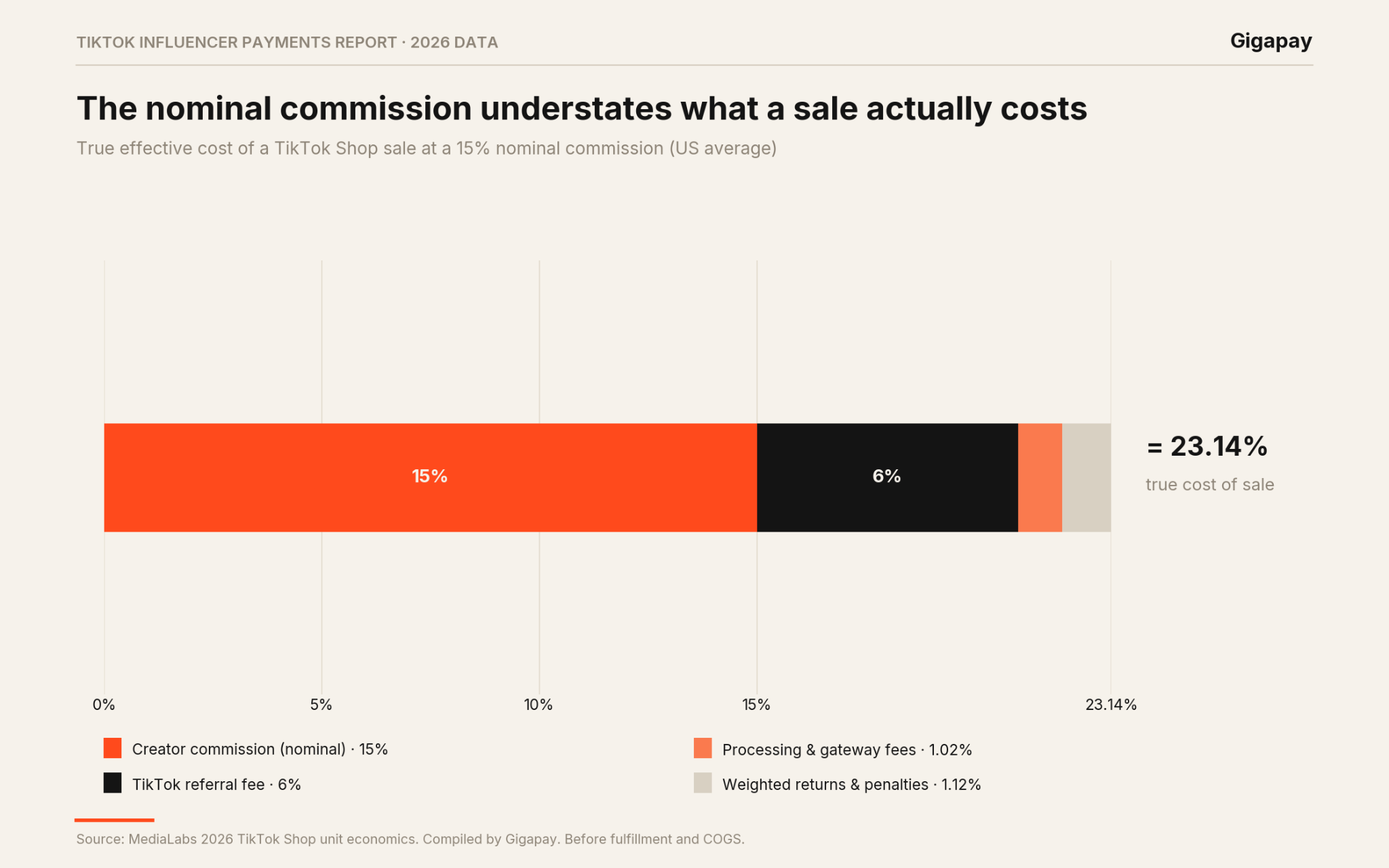
The nominal commission understates what a sale actually costs, and brands budgeting from the headline rate get surprised. TikTok takes a 6% referral fee plus roughly 1.02% in processing, and returns add another ~1.12% in weighted impact, so a 15% nominal commission translates into a true effective cost of sale of around 23% before fulfillment and COGS. The dominant 2026 deal structure reflects that math: a flat fee plus commission hybrid, for example $500 base plus 15% of affiliate sales, balancing creator income against brand risk.
The Payment Gap: Clawbacks, Delays, and Cross-Border Complexity
A creator's agreed rate and the money that reaches their account are rarely the same figure on the same date, and the distance between them is where most of the friction lives.
Clawbacks come first. TikTok Shop returns hit 30–60 days after the sale, so commission-paid orders should not be booked as final until the return window closes, and creators paid on gross sales face adjustments they did not budget for. Timing widens the gap further: across the industry, payment terms stretch to 120 days at some enterprises, per Gigapay's research with Billion Dollar Boy and Meltwater, and stretched terms hit smaller creators hardest because they have the least cushion to absorb them.
Geography adds a third layer. US-based creators receive 30–40% higher payouts than creators in other markets, while emerging markets across Asia, Africa, and South America see CPM rates up to 70% lower. For European brands, a single campaign roster routinely spans the UK, Germany, France, and the Nordics, each with its own currency, its own tax reporting regime (DAC7 across the EU, KSK in Germany, KU14 in Sweden), and its own expectations about payment speed.
For the brands and agencies on the other side of the payment, this is the point where a growing program quietly becomes an operational problem:
- Finance holds payments while it chases missing tax documentation across four jurisdictions.
- Procurement stalls campaigns because it cannot process hundreds of individual creators as vendors fast enough.
- Hybrid fee-plus-commission deals turn every creator into a recurring, variable payment event rather than a one-off invoice.
The admin does not scale as cleanly as the ambition does, and every late payment erodes the creator goodwill that marketing worked to build.
What This Means for Brands Scaling TikTok Creator Programs
Read across the data and one operating picture emerges. TikTok delivers the most cost-efficient creator inventory in the market, mid-tier content runs $5–$15 CPM against $15–$30 for comparable Instagram Reels with 3–5x higher organic reach, and the strongest returns come from running many smaller creators on hybrid deals rather than a few large names on flat fees. The hardest part of the job arrives after the deals are signed.
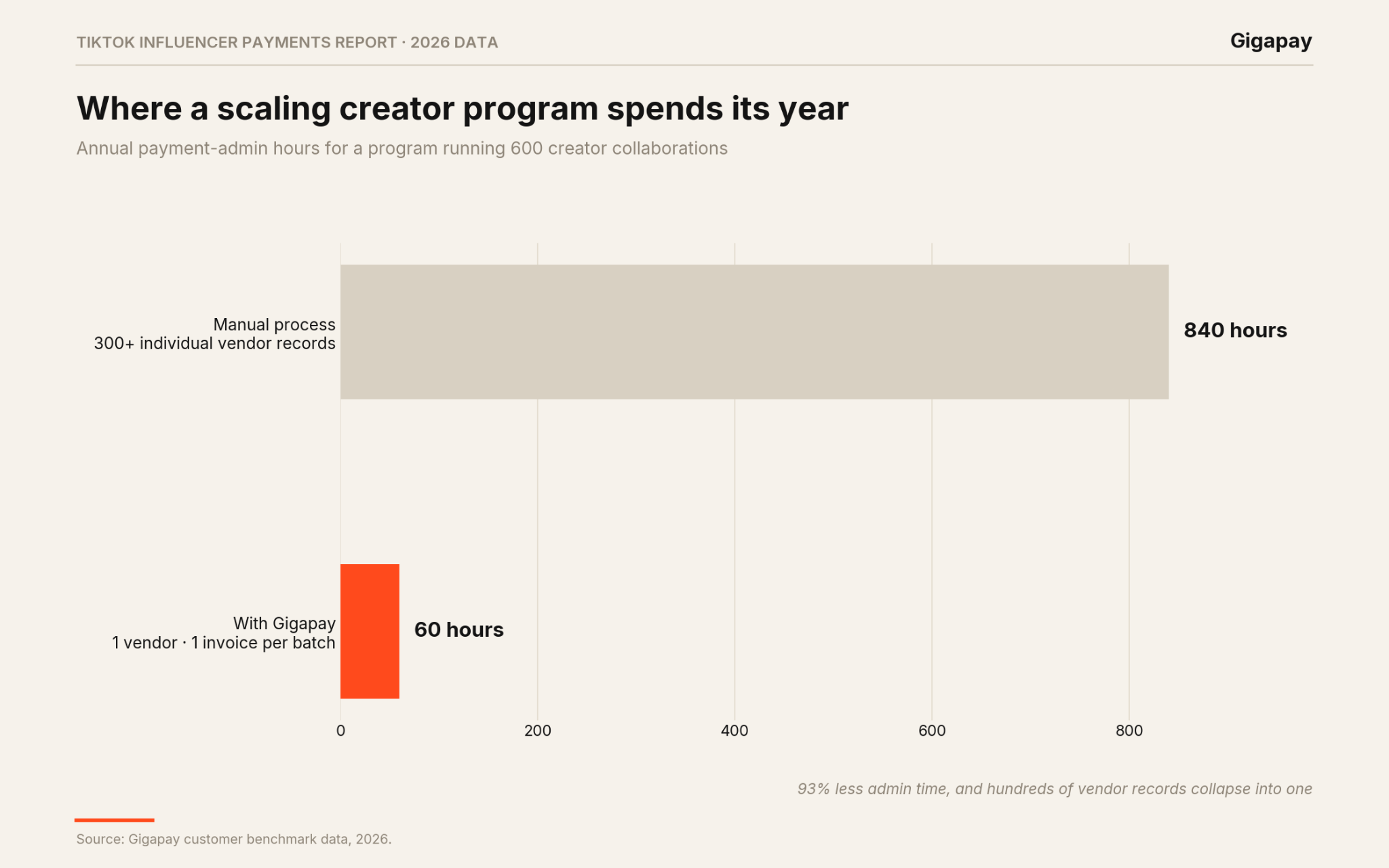
That is the exact wall scaling brands hit. A program running 600 creator collaborations a year can absorb around 840 hours of admin and carry 300-plus individual vendor records in the finance system, and every late or failed payment chips away at relationships marketing fought to win. The rate benchmarks in this report are the easy half of the equation. The payments, the tax reporting, and the onboarding are where the hours and the compliance risk accumulate.
Gigapay is built for that moment. As a Merchant of Record, Gigapay becomes the single vendor in your finance system and takes over most of the administrative and legal responsibility connected to paying creators, so marketing can book the TikTok collaborations it wants while finance keeps control and stays audit-ready.
Brands upload one file, creators get paid instantly across 65-plus markets without needing a registered business, and Gigapay handles tax reporting obligations like DAC7, KSK, and KU14 automatically.
Turn a bigger TikTok budget into more collaborations instead of more admin. Send your first mass payout the same day you sign, and pay every creator instantly, from one file, on one invoice, fully compliant.
FAQs:
1. How much does TikTok pay per 1,000 views in 2026?
The Creator Rewards Program officially pays $0.40–$1.00 per 1,000 views, with effective RPMs for most creators between $0.50 and $2.00 depending on engagement, video length, originality, and viewer location. This replaced the legacy Creator Fund, which paid $0.02–$0.04 per 1,000 views before shutting down in most markets in December 2024.
2. How much do brands pay TikTok influencers per post in 2026?
Nano creators (1K–10K followers) charge $50–$300 per sponsored video, micro creators $300–$2,500, mid-tier $2,500–$10,000, macro $10,000–$25,000, and mega creators $25,000 to $500,000+. Usage rights, exclusivity, and rush delivery can add 50–200% on top of base rates.
3. What is the average TikTok Shop commission rate?
The average US commission rate is 13.02% in 2026. Health and wellness pays the highest at 16.38%, followed by menswear at 14.24% and beauty at 13.21%. Negotiated, invite-only collaborations with top creators can reach 18–50%.
4. Do TikTok creators earn more from brand deals or platform payouts?
Brand deals pay more for most creators: roughly 67% earn the most from sponsored posts and partnerships rather than direct payouts. TikTok Shop commissions and live gifts form the other major income streams, with view-based Rewards Program payouts as a meaningful but secondary layer.
5. How much should a brand budget for a TikTok influencer campaign?
A mid-tier campaign with five creators in the 100K–500K follower range typically costs $15,000–$50,000 including usage rights. Nano and micro campaigns with 10–20 creators often run $1,000–$10,000 total. Budget separately for the operational cost of onboarding and paying each creator, especially across borders.
Methodology and Sources
This report compiles publicly reported 2026 figures and cross-references them across multiple benchmarks rather than relying on any single source.
- Platform payout figures and eligibility rules draw on TikTok's Creator Rewards Program documentation and 2026 program audits of the legacy Creator Fund.
- Rate benchmarks are cross-referenced across Influencer Marketing Hub, Stackmatix, and CreatorScore's 2026 observed rates.
- Payment averages reference Lumanu payment data from early 2025.
- Earnings distribution and income-source data come from 2026 Influencer Marketing Hub creator surveys and ZipRecruiter's July 2026 income data.
- TikTok Shop commission, conversion, and unit-economics benchmarks reference CreatorScore and MediaLabs' 2026 TikTok Shop benchmark reports.
- Top-earner figures reference publicly reported 2024 creator income estimates.
- Payment-terms and operational benchmarks in the final sections reference Gigapay's State of Influencer Payments research with Billion Dollar Boy, Meltwater, The Influencer Marketing Factory, and Wild, plus Gigapay's own customer data.
Rate ranges are directional. Actual creator pricing depends heavily on engagement quality, niche, usage rights, exclusivity, and campaign structure, and country-level Rewards Program RPMs vary significantly, so brands should confirm against current rate cards before booking.
.jpg)
.jpg)
.jpg)