.jpg)

A brand can decide to work with two hundred creators in an afternoon. Paying those two hundred creators, in their own currencies, with the right tax treatment in every country they live in, can take the finance team the rest of the quarter. That gap is the subject of this report.
The creator economy crossed a quarter-trillion dollars in 2026, and the number of people earning money from content now runs past 200 million. The marketing case for working with creators is settled. What has not kept up is the machinery for paying them. Systems built to handle a few hundred suppliers are now being asked to handle a few hundred thousand individuals across dozens of jurisdictions, each with its own tax rules, disclosure laws, and reporting obligations.
This report maps that gap for brands and agencies running creator programs across the UK, France, DACH, and the Nordics. It covers how far the creator economy has scaled, what paying creators now costs, the compliance regimes that apply across borders, where enforcement is heading, and the operating model that lets marketing move fast without putting finance at risk.
Key Findings
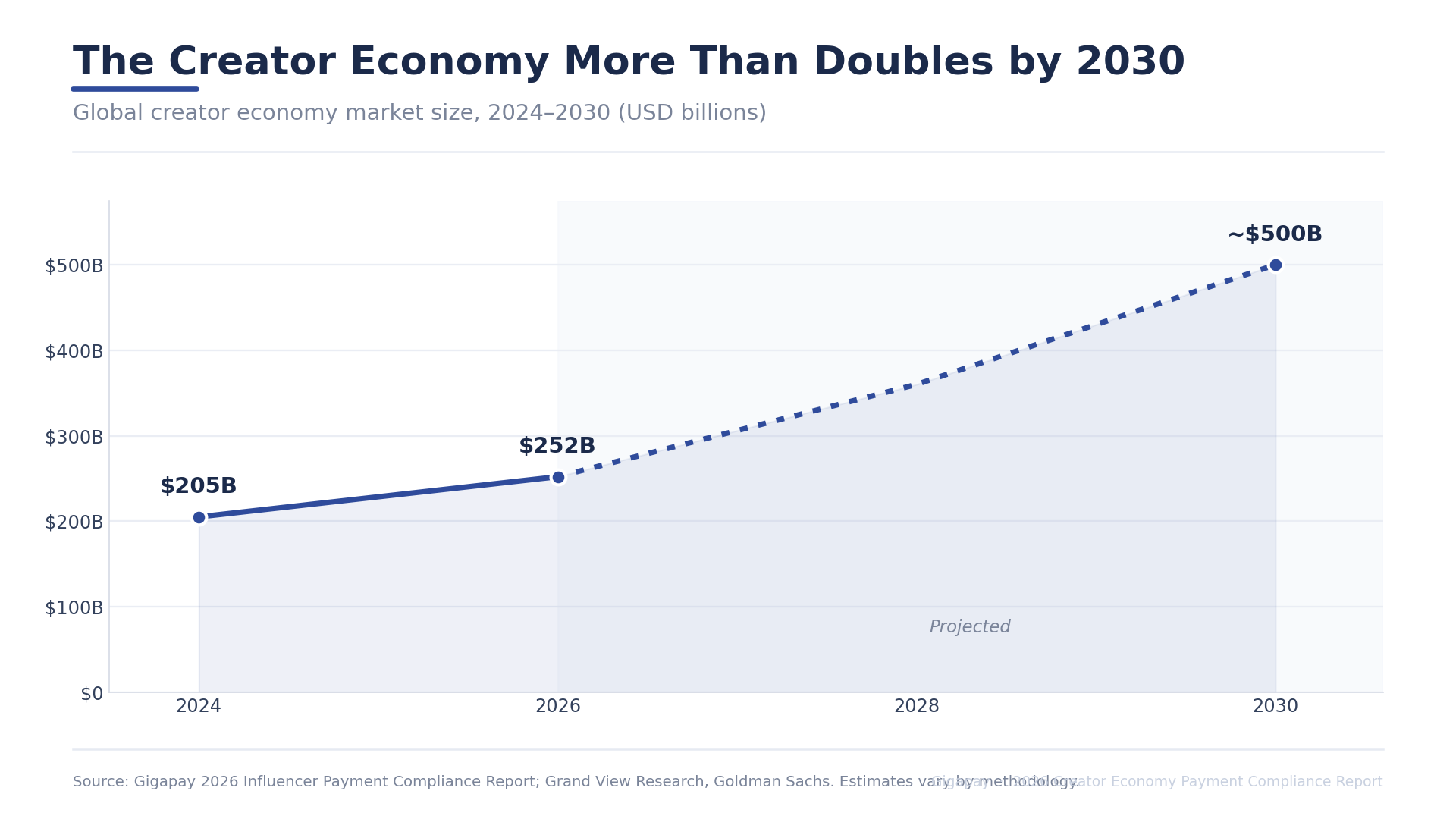
- The global creator economy is estimated to exceed $250 billion in 2026, with analysts projecting roughly $500 billion by 2030.
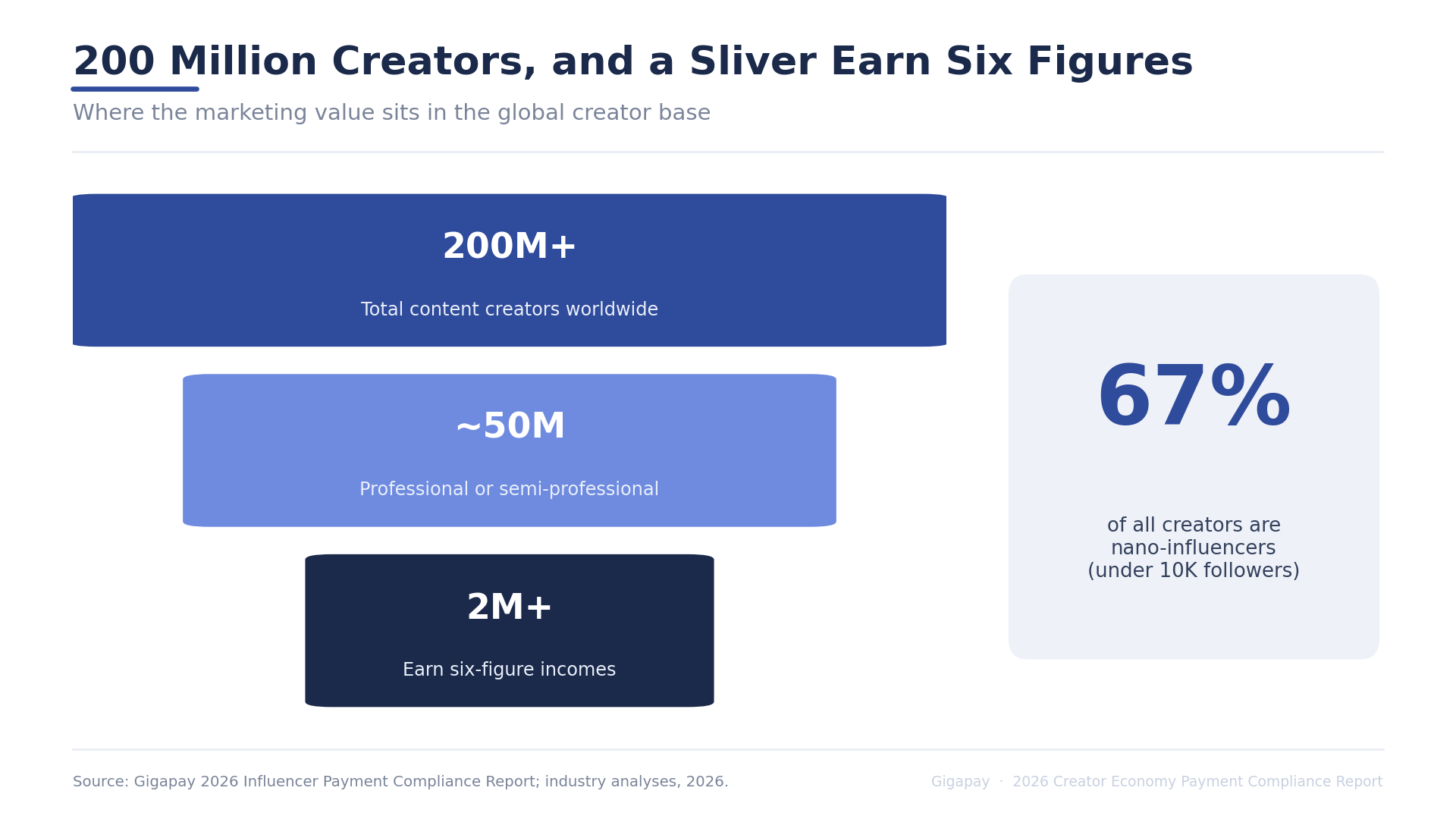
- More than 200 million people worldwide now identify as content creators. Around 50 million are professional or semi-professional, and over 2 million earn six-figure incomes.
- Nano-influencers under 10,000 followers make up roughly 67% of all creators, the exact segment brands most want to activate and finance teams find hardest to onboard.
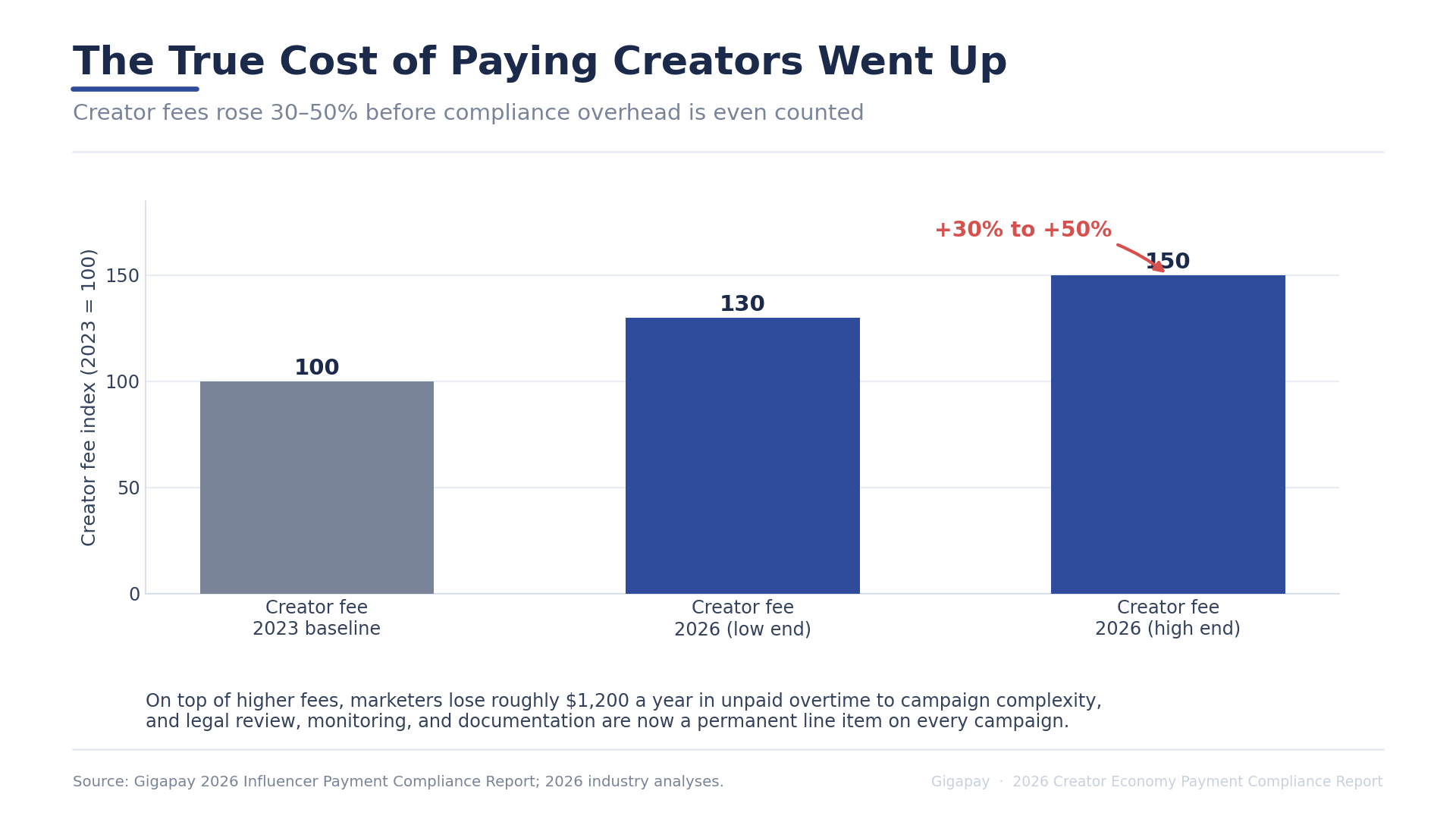
- Creator fees have risen 30–50% in recent periods, and compliance, legal review, and documentation now sit on top of that as standing campaign overhead.
- A brand running 600 creator collaborations a year spends about 840 hours on payment admin under a manual process, according to Gigapay's 2026 analysis.
- The EU's Digital Fairness Act is slated for a Q4 2026 proposal, bringing stricter disclosure and extended liability for brands, agencies, and platforms.
Methodology and Sources
This report compiles 2026 market and regulatory data from:
- Gigapay 2026 Influencer Payment Compliance Report
- The European Commission and European Parliament for the Digital Fairness Act timeline and scope
- The FTC and IRS
- The EU DAC7 framework, Germany's KSK rules, France's Influence Act
- Grand View Research
- Goldman Sachs
- The Influencer Marketing Hub
Market-size figures vary by source due to differing methodologies, and ranges are noted where they apply. Regulations are evolving, and brands should verify jurisdiction-specific requirements before acting.
The Scale That Created the Problem
Two numbers explain why paying creators became an operational problem: how much money now moves through the creator economy, and how many people are now inside it.
How Big Is the Creator Economy in 2026?
The global creator economy is estimated to exceed $250 billion in 2026, and analysts expect it to reach roughly $500 billion by 2030. That growth tells you the marketing question is already settled. Brands know creator collaborations work, which is why budgets keep rising and the number of partners keeps climbing.
The unanswered question is operational. Every collaboration inside that quarter-trillion-dollar figure is also a payment, a tax position, and a disclosure obligation attached to a real person in a real country. When a brand worked with thirty named partners, finance could absorb that by hand.
At the volumes the market now runs on, the inputs of influencer marketing stopped being a vendor list and became a population. The growth curve below is also a workload curve, and most finance teams are reading it for the first time.
How Many Content Creators Are There Worldwide?
More than 200 million people identify as content creators today. Around 50 million of them are professional or semi-professional, and over 2 million earn six-figure incomes. The headline number matters less than its shape. The base of the pyramid is enormous, and that base is exactly where the marketing value sits.
Nano-influencers under 10,000 followers make up about 67% of all creators. They convert, they cost less, and audiences trust them.
Boozt, the Nordic retailer, spent years trying to build a working motion for nano and micro creators and only cracked it once the payment side stopped fighting back, then tripled collaborations without adding headcount.
The problem was never finding these creators. The problem is that a single campaign with two hundred nano creators generates two hundred onboarding events, two hundred tax positions, and two hundred payout instructions, and procurement was never designed to treat individuals as suppliers.
The Rising Cost of Paying Creators
Scale raised the volume of payments. It also changed what each payment costs and how often it has to happen.
What Does Influencer Marketing Actually Cost in 2026?
Creator fees have climbed 30–50% in recent periods, driven by demand and by the growing list of legal and compliance requirements attached to each deal. That increase is the visible part. The part that does not show up on the invoice is the overhead that now rides alongside every campaign: legal review, monitoring, documentation, and the hours your team loses chasing tax forms and fixing reconciliation errors.
One analysis found that influencer marketers personally lose around $1,200 a year in unpaid overtime to the rising complexity of running campaigns, much of it compliance work that has nothing to do with strategy or creativity. When a senior marketer spends an afternoon collecting VAT details instead of briefing creators, the campaign got more expensive in a way no budget line records.
This is the gap Gigapay's report keeps returning to, the distance between how fast marketing can move and how slowly the finance and compliance machinery around it can keep up.
Why Creator Payments Are Now Smaller, Faster, and Cross-Border
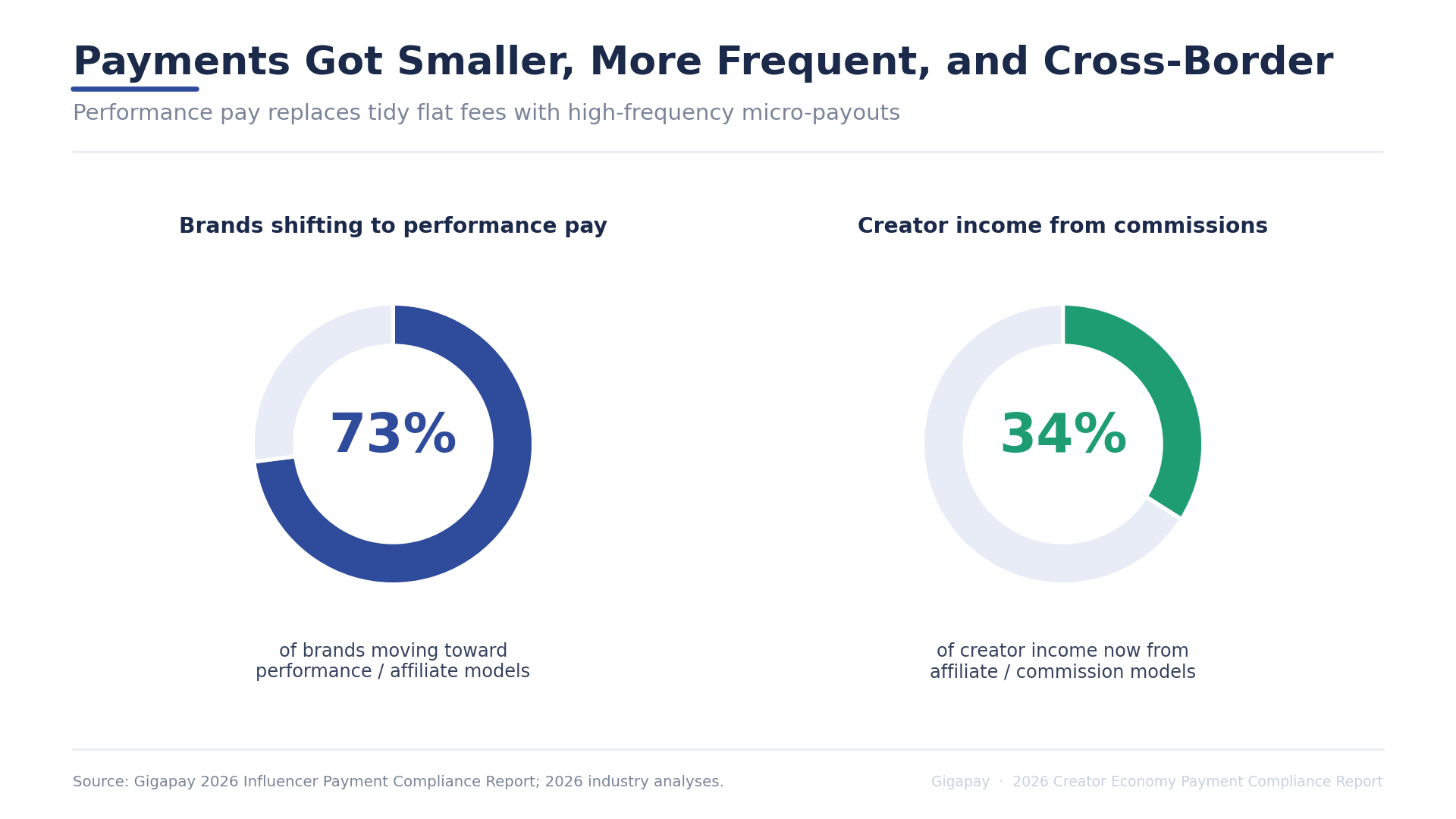
The way brands pay creators changed shape at the same time the volume exploded. Roughly 73% of brands are shifting toward performance and affiliate models, and about 34% of creator income now comes from affiliate or commission structures, the fastest-growing slice of the market. Flat fees are no longer the default.
Performance pay sounds like a finance win, and on price it often is. Operationally it multiplies the problem. A flat fee is one payment to one creator. A commission model is a stream of small, frequent payouts, often in different currencies, triggered by sales rather than by a tidy monthly schedule.
Brands traded a handful of large predictable invoices for a high-frequency flow of micro-payments across borders, and most accounts-payable functions were never built to settle that.
The Compliance Burden Brands Can't Ignore
Volume and frequency would be manageable if the rules were simple. They are not, and they are getting stricter.
How Do You Pay Creators Compliantly Across Countries?
There is no single rulebook for paying creators, and the patchwork tightened in 2026.
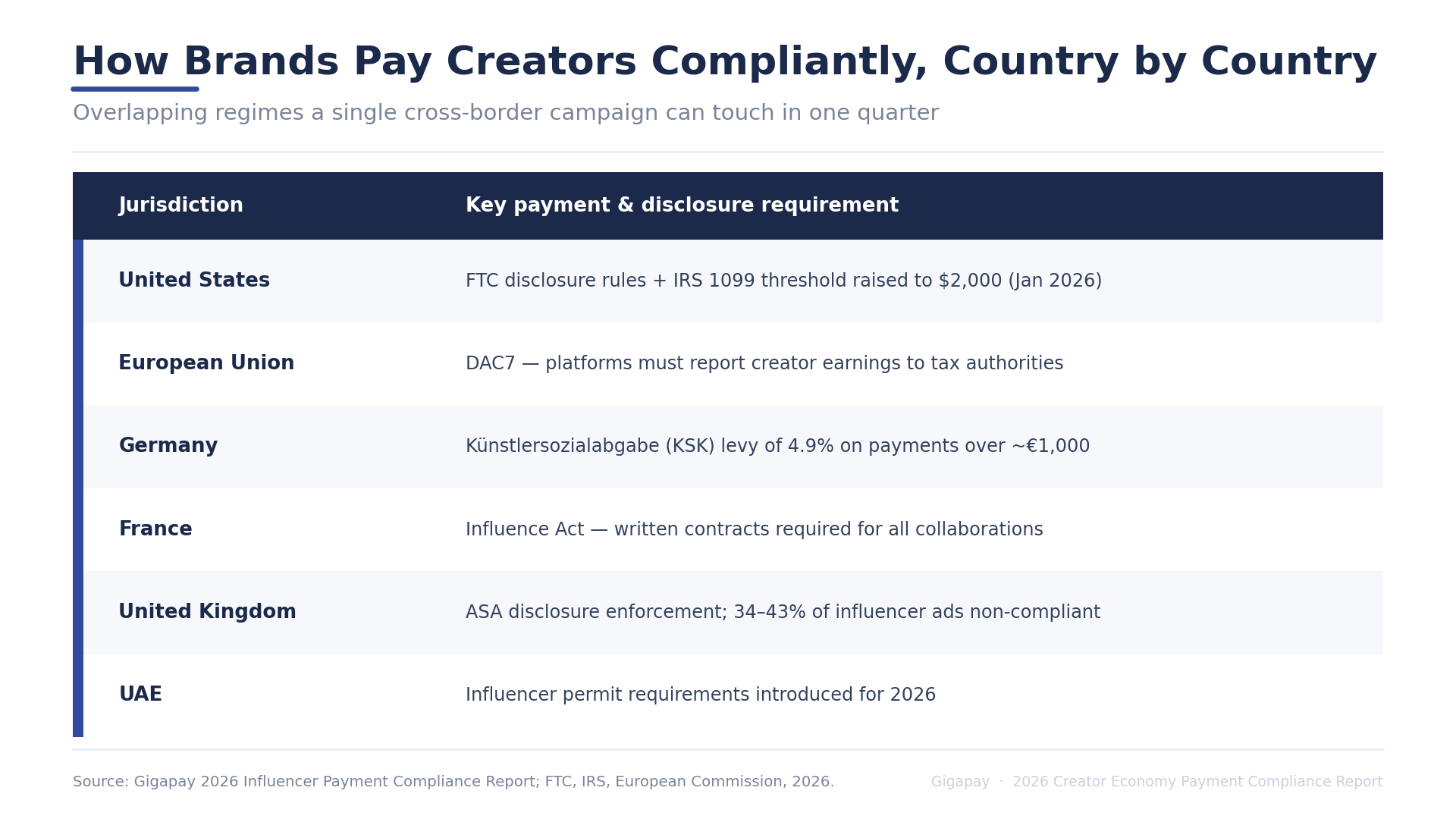
- In the United States, the IRS raised the 1099 reporting threshold from $600 to $2,000 per payee for payments made on or after 1 January 2026, which changes paperwork without changing tax liability.
- In the EU, DAC7 already requires platforms to report creator earnings to tax authorities.
- Germany charges the Künstlersozialabgabe (KSK) levy at 4.9% on creative payments above roughly €1,000, and it reaches many cross-border hires.
- France's Influence Act now mandates written contracts for commercial collaborations, covering tasks, remuneration, and legal obligations.
- The UK's Advertising Standards Authority enforces disclosure, and the UAE introduced influencer permit requirements for 2026.
For a brand running campaigns across the UK, France, DACH, and the Nordics in a single quarter, that is five or six overlapping regimes applied to hundreds of individuals, each with their own tax status. The compliance exposure does not scale with your budget. It scales with the number of people you pay and the number of borders you pay across, which is precisely the dimension that grew fastest.
Why Disclosure Failures Now Carry Real Financial Risk
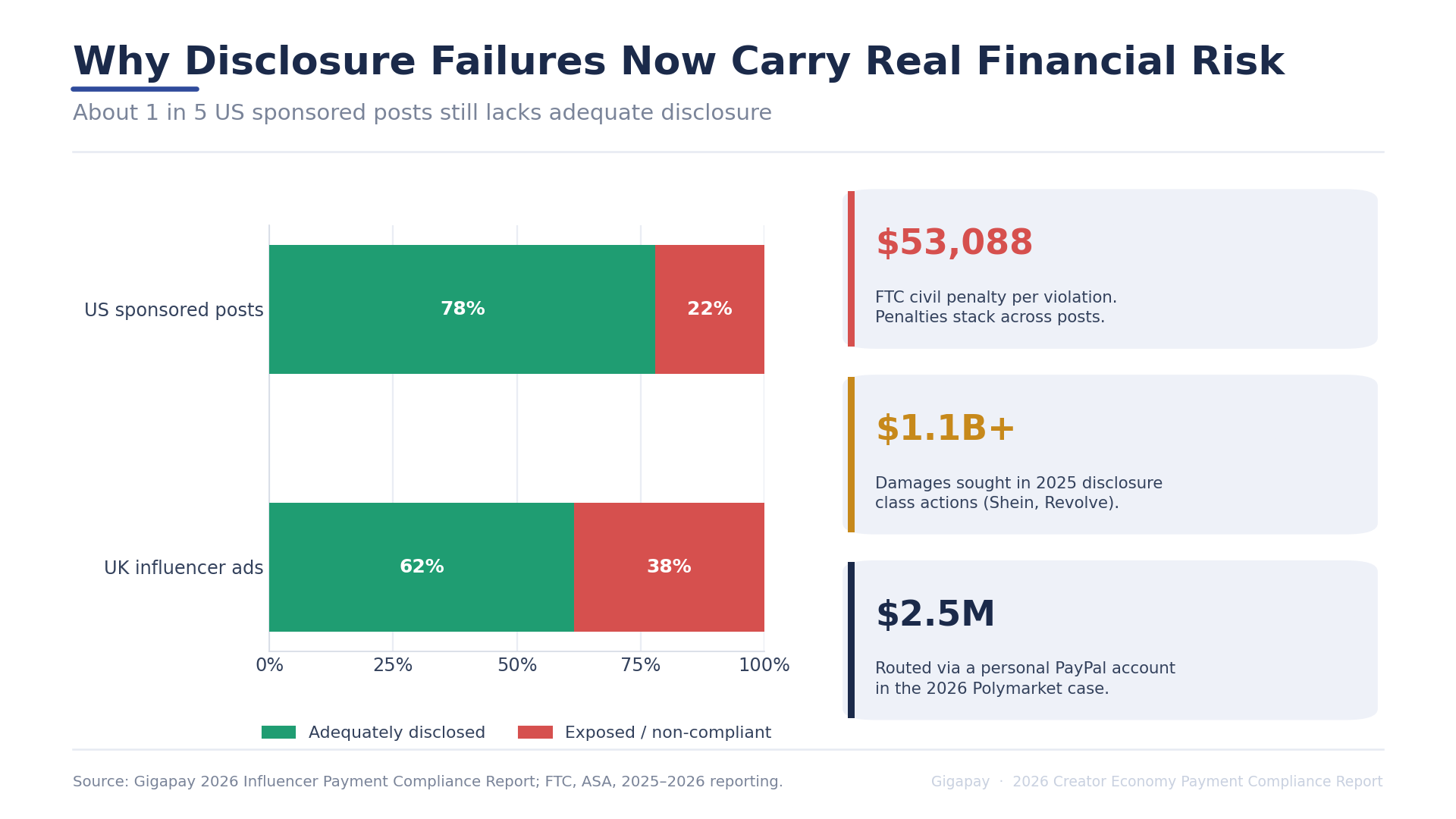
Compliance is not only about tax. It is also about whether the audience knows the post was paid for, and that side is failing at scale. Roughly 78% of sponsored posts in the US carry adequate disclosure, which leaves about one in five exposed.
In the UK, estimates put non-compliance between 34% and 43%. The enforcement side stopped being theoretical. The FTC can levy civil penalties up to $53,088 per violation, and those penalties stack across posts, with brands and creators jointly liable.
Two recent cases show where this goes. In the first half of 2025, nationwide class actions named brands including Shein, Revolve, and Alo Yoga over undisclosed paid partnerships, with combined damages sought above $1.1 billion under state consumer protection laws.
In June 2026, reporting revealed that a prediction-market company's marketing lead had routed more than $2.5 million to over 800 people through a personal PayPal account, with at least twenty creators posting without disclosing the payments.
That case is a clean illustration of the risk, where opaque payment routing and missing disclosure together turn a marketing tactic into joint legal liability. How you pay creators is now part of your compliance posture, not just a finance preference.
The Structural Fix
The scale, the cost, and the compliance load all converge on one moment in the workflow. There is a clean way to fix it.
Why Marketing Outruns Finance on Creator Payments
This is the structural problem underneath every statistic above. Marketing can identify, brief, and activate a hundred creators in a week. Finance cannot onboard a hundred new individual vendors, validate their tax IDs, process their invoices, and clear cross-border reporting in the same week, and it should not be asked to.
The friction is not a people problem. The infrastructure was never designed to let either side do its job at the speed the market now demands.
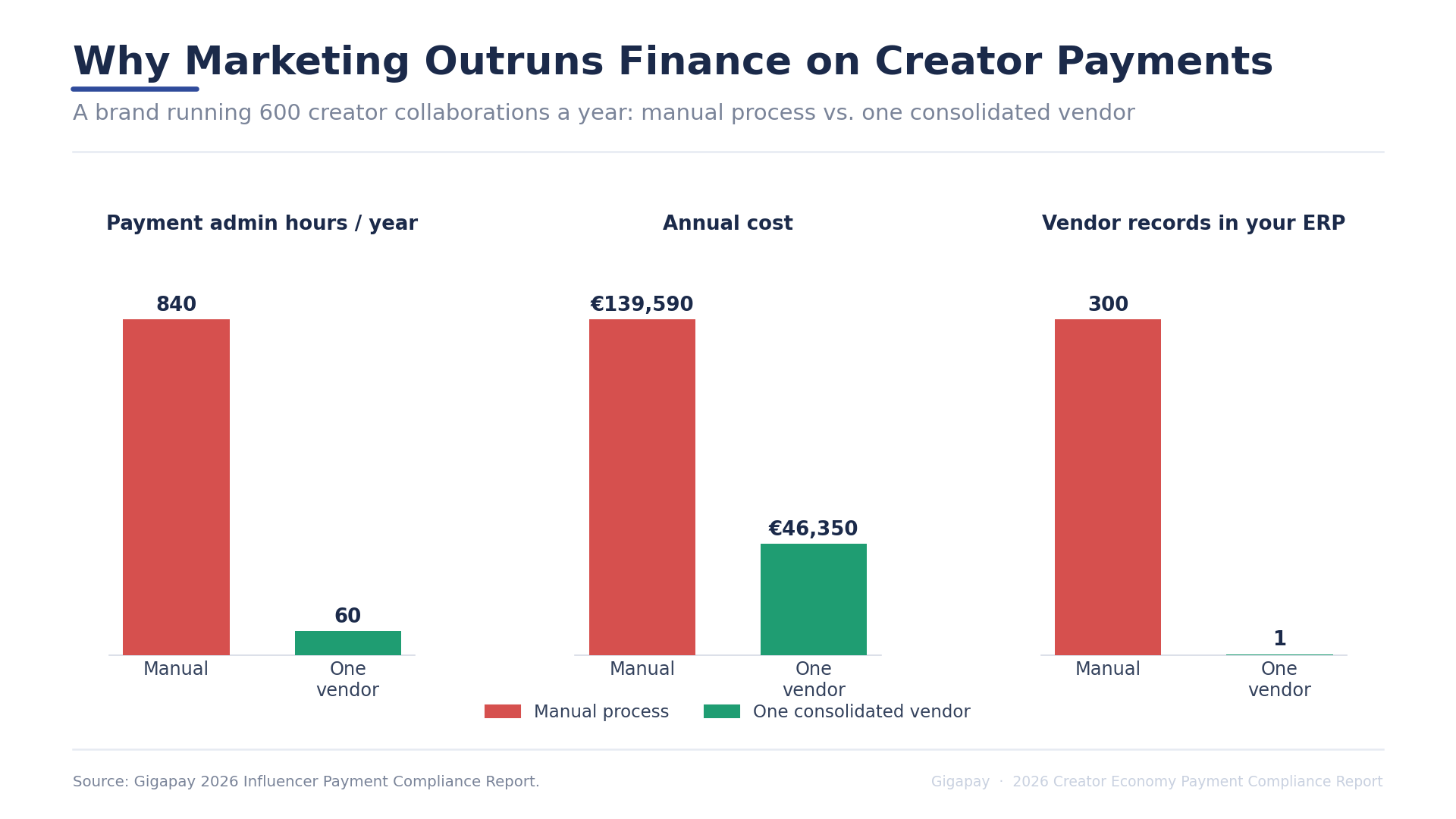
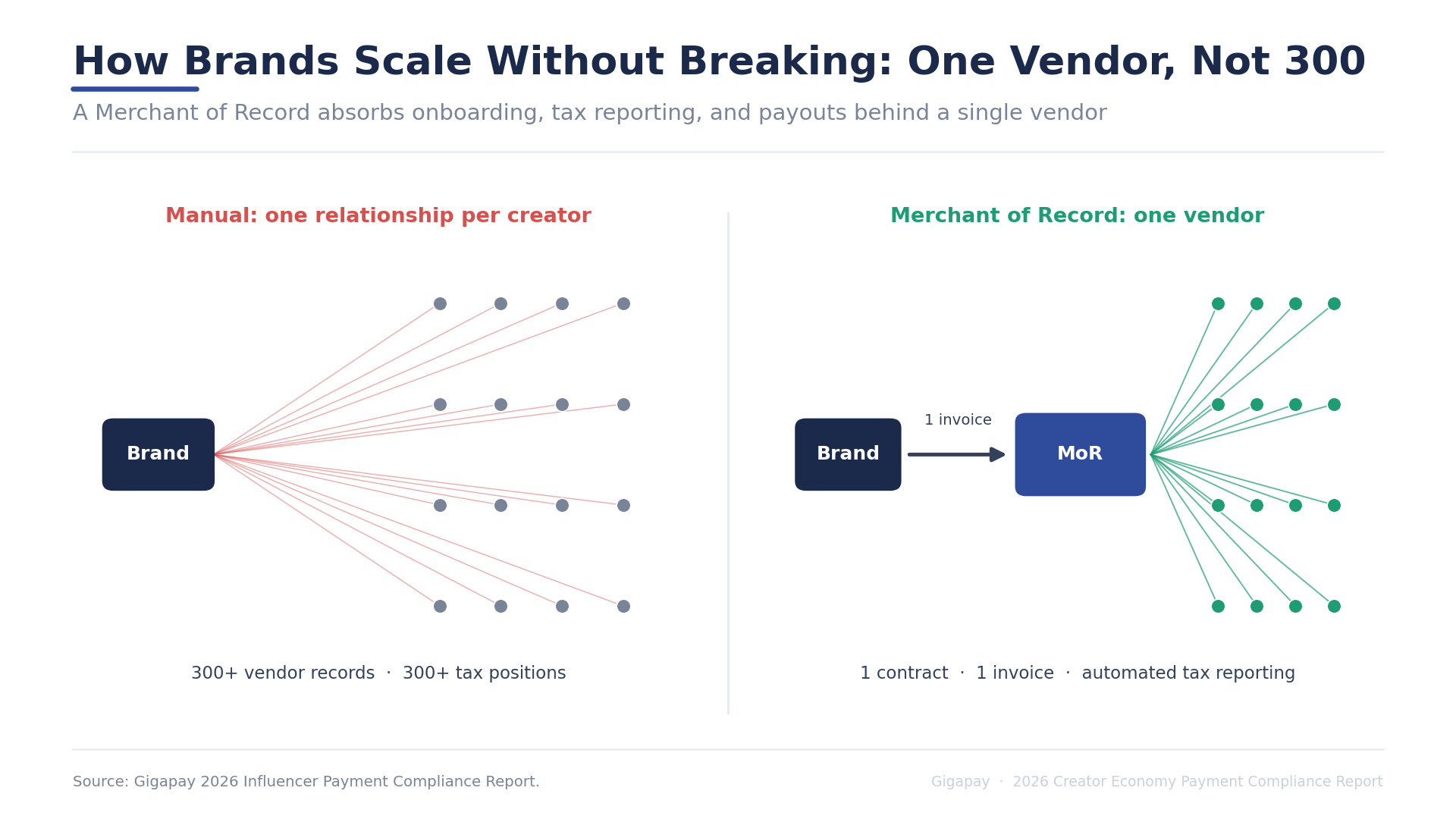
Gigapay's 2026 analysis put numbers on it. A brand running 600 creator collaborations a year spends about 840 hours on payment admin under a manual process, against roughly 60 hours when that work is consolidated, and carries 300-plus individual vendor records in its ERP instead of one. The cost gap in that model runs from about €139,590 a year to around €46,350.
WPPMedia's Goat Agency reported that consolidating creator payments significantly cut the time spent managing them. The hours your team loses to payment admin are hours it is not spending on the creative work that actually moves the campaign.
What New Creator Marketing Rules Are Coming in 2026–2027?
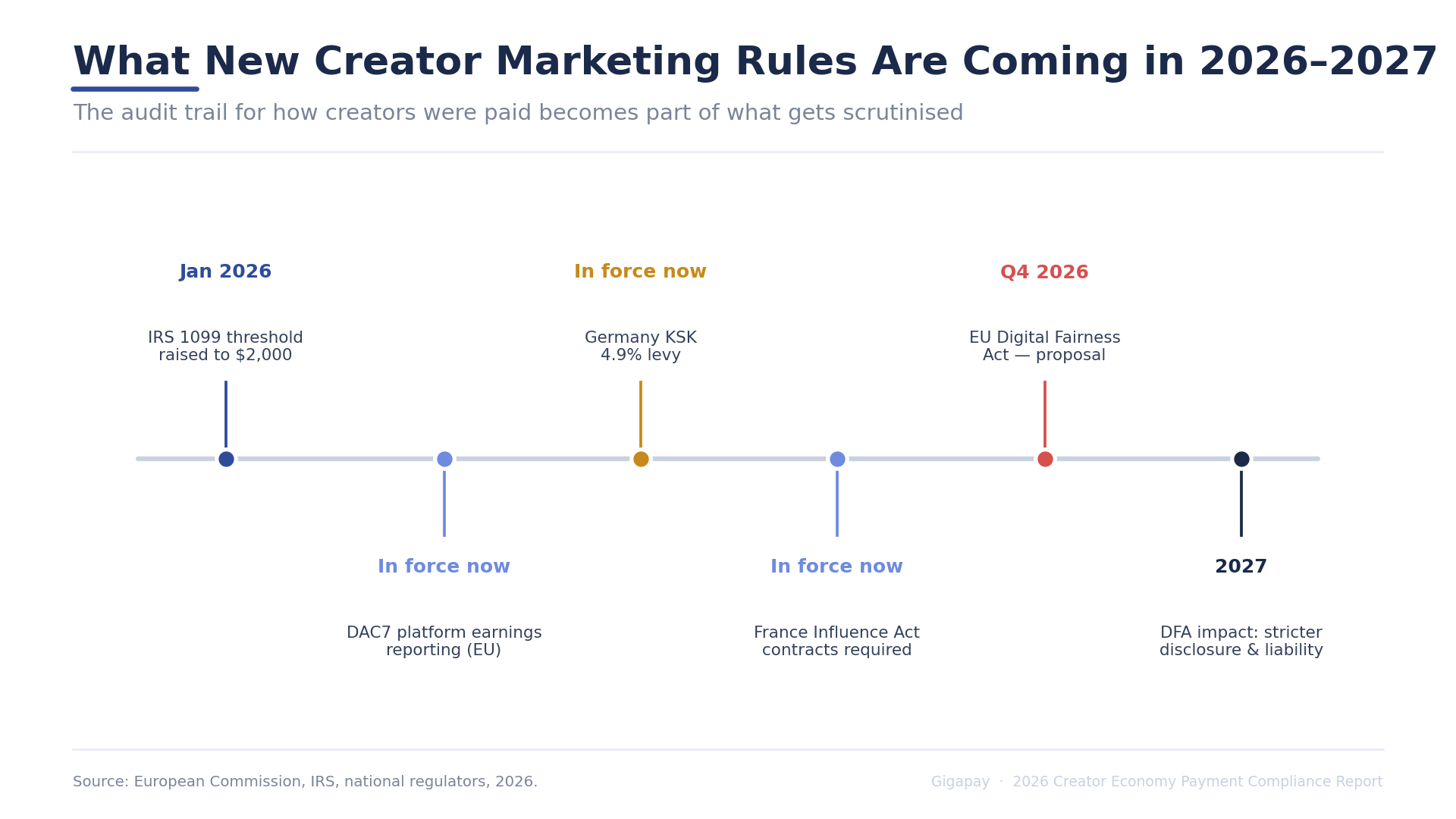
The rules are getting tighter, not looser, and the timeline is now visible. The EU's Digital Fairness Act is in its preparation phase, with a proposal expected in Q4 2026. It targets influencer marketing transparency directly, alongside dark patterns and addictive design, and it is expected to bring more prominent disclosure rules, extended liability across brands, agencies, and platforms, and stronger protection for minors. It builds on DAC7 and the existing Unfair Commercial Practices Directive rather than replacing them.
Underneath the EU layer, national rules keep moving. Germany's KSK levy applies now. France's Influence Act applies now. Illinois already requires trust accounts for the earnings of child influencers, a sign that minor-protection rules are arriving at the state and member-state level faster than at the federal one.
A brand operating across European markets should assume that disclosure and accountability requirements will be stricter by late 2026 into 2027, and that the audit trail for how creators were paid will be part of what gets scrutinized.
What Is a Merchant of Record, and How Does It Solve This?
Everything in this report points to the same operational answer. If the problem is hundreds of individual relationships, hundreds of tax positions, and a growing stack of cross-border rules, the fix is to stop carrying all of that one creator at a time.
A Merchant of Record sits between the brand and the creators and becomes the single contractual counterparty. The brand pays one vendor on one invoice, and the Merchant of Record absorbs the onboarding, the tax reporting, and the local payment rails behind it.
In practice that means a brand uploads a file or calls an API, and creators get paid instantly in their own currency across 65-plus countries, with DAC7, KSK, and KU14 reporting handled automatically and no business registration required from the creator. Three hundred vendor records collapse into one. The model is what let Boozt finally activate nano and micro creators at scale, and it is why creator-facing satisfaction sits high enough to keep partners coming back rather than churning over a bad payment experience.
The point of the model is not faster payments for their own sake. It closes the gap between what marketing wants to do and what finance can safely sign off on, so neither side has to lose.
Conclusion
The numbers in this report point in one direction. The creator economy will keep growing, the share of payments going to nano and micro creators will keep rising, and the regulatory load will keep increasing through 2027.
Every one of those trends adds volume and complexity to the same place: the moment a brand has to pay a creator.
Brands that treat creator payments as an afterthought will keep losing hours to admin, keep carrying tax and disclosure risk, and keep forcing marketing and finance into a fight neither should have to win. Brands that consolidate the problem into a single compliant vendor get the opposite.
Marketing moves at the speed of the campaign, finance keeps control and a clean audit trail, and creators get paid instantly without being treated like procurement cases.
The scale already arrived. The real question is whether your payment infrastructure was built for it.
Read Next:
- The 2026 Creator Pay Report
- Mass Creator Payments in Europe: Everything Brands Need to Know in 2026
- Best Platforms to Pay International Social Media Influencers (2026 Review)
FAQs:
1. What Is Creator Economy Payment Compliance?
It is the full set of obligations that come with paying content creators: tax reporting such as 1099s and DAC7, correct contractor classification, cross-border tax and social contributions like Germany's KSK, disclosure of material connections, and KYC checks on payments. Both the brand and the creator carry liability, and contracts cannot fully shift it.
2. How Much Is the Creator Economy Worth in 2026?
Estimates place it above $250 billion globally in 2026, with projections of roughly $500 billion by 2030. Figures vary by source and methodology, but every major estimate shows steep, continued growth.
3. What Is a Merchant of Record for Creator Payments?
A Merchant of Record is a third party that becomes the single contractual counterparty for creator payouts. It handles onboarding, invoicing, tax reporting, and payment across countries, so the brand deals with one vendor instead of hundreds of individuals.
4. What Is DAC7, and Does It Apply to My Brand?
DAC7 is an EU rule requiring digital platforms to report creator earnings to tax authorities. If you run creator campaigns that touch EU sellers or audiences, it shapes what gets reported about those payments.
5. What Changes With the EU Digital Fairness Act?
The Digital Fairness Act is expected to be proposed in Q4 2026. It targets influencer marketing transparency, with more prominent disclosure rules, extended liability across brands, agencies, and platforms, and stronger protection for minors.
.jpg)
.jpg)