

More than half of brands plan to expand or begin working with nano creators in 2026, and a similar share plan to grow their micro creator partnerships, according to Influencer Marketing Hub's 2026 Benchmark Report.
Gigapay is the mass creator payout platform that lets a small team pay hundreds of nano and micro creators through one vendor, with one invoice and full tax compliance built in.
Budgets are moving down-market because small creators win on engagement, trust, and cost per result, but a 200-creator roster multiplies every piece of admin work by 200.
This playbook gives you the complete operating model for running 200 nano and micro creators with a two-person team in 2026, covering program structure, sourcing, onboarding, briefing, payments, compliance, role split, and budget.
Key Takeaways
- Nano and micro creators deliver the highest engagement rates of any influencer tier.
- Payment and compliance admin breaks most 200-creator programs before creative quality does.
- Split the work: one person owns creators, the other owns program operations.
- A Merchant of Record turns 200 payees into one vendor and one invoice.
Why Nano and Micro Influencers Dominate Brand Budgets in 2026
Influencer marketing spend crossed $32.55 billion in 2026, and the growth is concentrated at the small end of the creator market. 73% of brands now favor smaller creators as their primary creator channel, and nano influencer marketing is growing at a 34.92% compound annual rate through 2031, faster than the overall market.
The engagement data explains the shift. Smaller audiences interact more, and the gap between tiers is wide enough to change campaign math.
The cost side is just as clear. Micro creators run at a $0.20 cost per engagement against $0.33 for macro creators, a 40% efficiency gap, and micro influencers deliver roughly 3.2x the engagement of mega creators at about 60% lower cost.
Relevance compounds the effect: Social Cat's 2026 analysis of more than 100,000 influencer posts found that campaigns with strong creator-brand alignment delivered roughly 77% higher average views than misaligned ones.
A 200-creator nano and micro roster is how brands buy that engagement at meaningful volume. One macro creator gives you one audience and one point of failure. Two hundred small creators give you 200 niche audiences, hundreds of content assets, and a program that keeps performing when any single creator underdelivers.
Why 200 Creators Breaks a Traditional Marketing Operations Setup
The creative side of a 200-creator program scales fine. The operational side does not, because most company infrastructure was built for a handful of large vendors, and a nano creator roster looks like 200 tiny vendors to procurement, finance, and legal.
Gigapay's research report with Billion Dollar Boy, Meltwater, The Influencer Marketing Factory, and Wild found payment terms stretching to 120 days and documented clear enterprise barriers to working with nano and micro influencers at all.
The friction shows up in the same places at every scaling brand:
- Procurement cannot onboard individuals without a registered business or VAT number, which rules out most nano creators before the campaign starts.
- Finance has to create a vendor record, collect a tax ID, and process an invoice for every single creator.
- Many nano creators have never issued an invoice, so finance teams end up chasing documents and correcting errors for weeks.
- Cross-border payments add currency conversion, local tax reporting rules, and reconciliation work in every new market.
The cost of running this manually is measurable. Gigapay's ROI model for a brand doing 600 creator collaborations per year, roughly what a 200-creator roster produces across three campaign waves, puts the manual process at about 840 admin hours and €139,590 per year once you count vendor onboarding, invoice handling, error cycles, and reconciliation.
The same volume through an automated single-vendor setup runs at about 60 admin hours and €46,350 per year.
That 780-hour difference is the entire reason a two-person team can or cannot run this program. At 840 hours, payment admin alone consumes half of one full-time role. At 60 hours, it consumes a few minutes per working day.
What a 200-Creator Program Actually Requires: The Full Workload Breakdown
Before splitting roles, you need an honest picture of the work. A 200-creator program running three to four campaign waves per year involves these recurring tasks, with rough time costs per creator when done manually:
Add it up and the fully manual version of this program sits between 900 and 1,775 hours per year, which is one to two full-time jobs spent mostly on administration rather than marketing. The automatable rows account for the majority of those hours. Remove them and the two people on your team spend their time on the work that actually moves results: creator selection, creative direction, and performance analysis.
The Six-Step Playbook: Running 200 Creators With a Two-Person Team
Step 1: Define the Program Structure Before Recruiting a Single Creator
A 200-creator program fails fastest when it starts as 200 individual deals. Set the structure first, then recruit into it.
Choose Your Nano-to-Micro Creator Mix
A common split for conversion-focused programs is 150 nano creators and 50 micro creators. Nano creators (1K–10K followers) give you trust, local reach, and volume of authentic content at gifting-level or 0–300 budgets.
Micro creators (10K–100K) give you niche targeting and measurable conversions at 300–2,000 per post. Brand-awareness programs flip the ratio toward micro; product-seeding programs push it further toward nano.
Set the Compensation Model per Tier
Decide compensation once, at the tier level, so you never negotiate 200 separate deals:
- Nano tier: product gifting plus a flat fee of €50–€150 per deliverable, or gifting plus affiliate commission.
- Micro tier: flat fee of €300–€1,500 per deliverable depending on platform and niche, plus affiliate commission on tracked sales.
- Top performers: a retainer-based ambassador track, reserved for the best 10–15% after the first two waves.
Define Campaign Waves, Not Rolling Chaos
Run the program in waves of 3–4 campaigns per year rather than continuous ad-hoc collaborations. Waves let two people batch every task: one sourcing sprint, one briefing round, one content review window, and one payment run per wave. Batch processing is what makes 200 creators manageable; a rolling program with daily one-off tasks is what makes it impossible.
Step 2: Source and Recruit 200 Nano and Micro Creators Efficiently
Sourcing 200 creators sounds like the hard part. With the right funnel, it is a four-to-six week sprint that one person can run.
Build a Sourcing Funnel With Realistic Conversion Numbers
Work backwards from 200 activated creators. Expect roughly 30–40% of contacted creators to respond and roughly half of responders to reach a signed agreement, which means you need a longlist of 1,000–1,300 candidates. Build it from four sources:
- Your own audience: Customers who already tag you convert best and cost least. Pull your brand mentions and follower lists first.
- Discovery platforms: Tools like Kolsquare filter by niche, engagement rate, audience geography, and audience quality. Gigapay integrates directly with Kolsquare, so creators found there can be paid without any separate payment setup.
- Lookalike mining: Check who engages with your best existing creators and with competitor campaigns.
- Inbound applications: A simple application page filters motivated creators to you at zero outreach cost.
Vet for Engagement Quality, Not Follower Count
Set hard screening thresholds and apply them to everyone: engagement above 3% for micro creators on Instagram and above 6% for nano creators, audience geography matching your shipping markets, consistent posting over the last 90 days, and a reply within a reasonable window, since response reliability is an operational metric, not a courtesy.
Run Outreach in Batches With One Template per Tier
Send outreach in weekly batches of 150–250 contacts using one personalized template per tier. Personalize the first line, keep the offer identical within a tier, and route every acceptance into the same onboarding flow. Negotiating individually with nano creators costs more in hours than it saves in fees.
Step 3: Onboard Creators Without a Procurement Bottleneck
Onboarding is where most 200-creator programs stall, because this is the step where marketing's plan meets finance's vendor process. Traditional procurement requires every payee to register as a vendor, provide a tax ID or VAT number, and often hold a registered business. Most nano creators have none of that, and brands lose signed creators during this stage every week.
The fix is structural. Instead of onboarding 200 vendors, onboard one. With Gigapay as the Merchant of Record, Gigapay becomes the single contracted vendor in your ERP, and creators onboard with Gigapay rather than with your procurement team. In practice:
- Creators complete KYC identity verification and provide their tax information directly in Gigapay, before any payment is released.
- Creators can onboard as an individual, a sole trader, or a company. No registered business or VAT number is required, which keeps nano creators in the program instead of filtering them out.
- Your finance team sees one vendor record and one contract, whether you work with 50 creators or 5,000.
- Tax ID and VAT validation happens in the platform, so nobody on your team chases documents over email.
For the two-person team, this converts onboarding from a 100–200 hour annual workload into a link you send with the signed agreement. The creator handles their own verification, and you see their status in the dashboard.
Step 4: Brief, Approve, and Track Content at Scale
Content operations for 200 creators work on one principle: everything happens per campaign, never per creator.
Write One Brief per Campaign Wave
A good scale brief fits on one page and contains the campaign concept, three mandatory elements (key message, disclosure requirements, tagging), three things to avoid, platform-specific format notes, the deadline, and usage rights. Nano creators perform best with creative freedom inside clear guardrails, and loose briefs are also faster to approve because fewer posts miss mandatory elements.
Replace Per-Post Approval With Spot-Check Review
Reviewing 200 drafts individually consumes 100–200 hours per year and delays publishing. A faster model that holds up at scale:
- Full review for the first deliverable from every new creator.
- Spot-check review (every third or fourth post) for creators who passed their first review.
- Automatic approval for ambassador-tier creators with three or more compliant campaigns behind them.
Track Everything Through Links and Codes, Not Screenshots
Give every creator a unique tracked link and discount code at onboarding. This removes manual results collection, gives you per-creator conversion data for retention decisions, and feeds the affiliate component of nano compensation. Benchmark against a cost per engagement of 0.05–0.25 for the micro tier and affiliate conversion rates of 2–8% in niche categories.
Step 5: Automate Payments and Compliance Through a Single Vendor
Payment is the step that decides whether the program survives its first scale-up, and it is the step where Gigapay removes the most hours. The model is simple: Gigapay acts as Merchant of Record, formally purchasing each creator's deliverable and reselling it to you, so Gigapay is the contractual counterparty for all 200 creators.
What that means operationally for a two-person team:
- One batch payout run per wave: Upload a CSV with all 200 payments or push them through the API. Creators across 65+ countries get paid in 50+ currencies through local payment rails like SEPA Instant, Faster Payments, and ACH, and funds arrive instantly.
- One invoice instead of 200: Gigapay consolidates every campaign into a single invoice to your finance team and auto-generates self-billing invoices on behalf of creators, which cuts invoice volume by around 80%.
- Automated tax reporting: Gigapay handles regulatory reporting such as DAC7 in the EU and KU14 for Sweden–Denmark, and reports compensation to the relevant tax authorities. Creators remain responsible for their own income taxes, which the platform makes clear to them during onboarding.
- A creator experience that retains your roster: Creators get a dedicated human support team and can access scheduled funds early through EarlyPay. Gigapay's creator NPS is 88, and that matters because creators who get paid instantly come back for the next wave.
The integration load is light. Teams running campaigns from spreadsheets use CSV upload from day one, and teams embedding payouts into their own dashboard complete a full API integration in 2–5 days.
Step 6: Measure Performance and Retain Your Best Creators
A 200-creator program compounds in year two, but only if you keep the creators who perform. Retention starts with measurement.
Track Four Metrics per Creator
Keep the dashboard small enough to actually use. Per creator, per wave, track engagement rate against tier benchmarks, cost per engagement, tracked conversions through their link or code, and brief compliance. That is enough to sort 200 creators into keep, watch, and replace after every wave.
Promote the Top 10–15% Into an Ambassador Tier
The best-performing brands in 2026 treat creators as long-term partners rather than one-off media placements, and brands running long-term ambassador programs see better returns than transactional one-off posts.
After two waves, move your top 20–30 creators onto retainers with automatic content approval. Ambassadors produce more content per brief, need near-zero management, and anchor the program's output while you refresh the bottom of the roster.
Treat Payment Speed as a Retention Tool
Industry payment terms stretch to 120 days, and for a nano creator earning a few hundred euros per collaboration, a four-month wait is a reason to stop working with you. Paying instantly after content approval is the cheapest retention lever a small team has, because it costs nothing extra and directly addresses the biggest complaint creators have about brand work. EarlyPay extends this further by giving creators access to scheduled funds before the payout date.
The Two-Person Team Split: Who Owns What in a 200-Creator Program
Two people can run 200 creators when the roles are split by function, not by campaign. The split that works pairs a Creator Lead, who owns everything human, with a Program Operator, who owns everything systematic.
With automated onboarding, payments, and tax reporting, each role fits inside roughly 25–35 hours per week in normal weeks and peaks during sourcing sprints. Without that automation, the Program Operator role alone exceeds a full-time job, which is exactly the point where most brands either stall the program or hire a third person they did not budget for.
What a 200-Creator Nano and Micro Program Costs in 2026
Here is a full-year budget model for a European brand running 150 nano and 50 micro creators across three campaign waves. Creator fees use 2026 market rates, and salaries use published 2026 benchmarks.
Team Salaries
In-house influencer marketers earn a global average of $49,981 in 2026, with Europe averaging $44,711, based on Modash's survey of nearly 400 practitioners. Experience changes the number fast: professionals with 3–4 years average $50,686 and those with 5–7 years average $59,986.
In the US, influencer marketing specialists average around $79,000, with entry-level roles starting near $55,000. For a European two-person team, budget roughly €85,000–€110,000 in combined annual salaries for one mid-level Creator Lead and one Program Operator.
Full Annual Budget Model
At €1.8M + in annual payout volume, Gigapay's Enterprise plan applies with volume-based discounts, a dedicated customer success manager, and unlimited users and API rate.
The Cost You Avoid
The comparison that matters for a CFO is the admin line. Manual payment operations at this collaboration volume cost around €139,590 per year in Gigapay's ROI model, against roughly €46,350 with automation, and they consume 840 hours against 60. The automated setup saves more than the entire tooling budget and keeps the team at two people instead of three.
Compliance Rules a 200-Creator Program Must Follow in 2026
Compliance risk grows with creator count, and 2026 regulation treats influencer payments as a reporting category of its own. Three areas matter most for European programs.
DAC7 Reporting Across the EU
DAC7 requires platforms facilitating payments to report creator income data to tax authorities, including official names, addresses, tax registration numbers, and VAT numbers per Member State. As Merchant of Record, Gigapay collects this data during creator onboarding and files DAC7 reports to the Swedish tax authority, which exchanges the information with each creator's local tax authority. Your team never builds this reporting pipeline.
Künstlersozialkasse (KSK) in Germany
Germany's KSK is a social security institution for freelance artistic and journalistic work, and it covers influencers and creators. Companies based in Germany that commission work from self-employed creators can be liable for KSK contributions, and the liability applies whether the influencer is based in Germany or not.
Companies based outside Germany do not pay the contribution. One important nuance: the KSK obligation to report and pay sits with the German client, because an intermediary like Gigapay is exempt from the contribution, and Gigapay supports clients by sharing the payment data collected in the platform. If your brand is German and runs creators at scale, raise KSK with your legal team early.
Creator Classification and Market-Specific Rules
European court decisions on influencer employment status mean misclassifying creators carries real legal exposure, and new market rules keep arriving, like the UAE's influencer permit requirements introduced for 2026.
The practical answer for a two-person team is the Merchant of Record structure itself: Gigapay formally purchases the creator's deliverable and resells it to you, standing as the contractual counterparty, while creators remain independent and responsible for their own taxes. KYC verification, tax ID validation, and reporting such as DAC7 and KU14 run automatically in the background.
Common Mistakes That Kill Small-Team Creator Programs
The same failure patterns repeat across brands that try to scale nano and micro programs with a lean team. Avoiding them costs nothing except knowing they exist.
- Requiring business registration from creators: Procurement rules built for software vendors filter out the exact creators the program was built around. Fix the structure before recruiting, or you will sign creators you cannot pay.
- Paying on standard B2B terms: Net-60 to 120-day terms are survivable for an agency and fatal for a nano creator's trust. Slow payment is the single most common reason small creators decline a second campaign.
- Negotiating every deal individually: Two hundred bespoke negotiations consume the Creator Lead's entire year. Tier-level compensation with a small premium beats per-creator haggling on total cost once you count the hours.
- Reviewing every post manually: Per-post approval at 600 deliverables per year creates a bottleneck that delays campaigns and burns the team. Spot-check systems with a strong brief hold quality at a fraction of the time.
- Ignoring tax reporting until an audit: DAC7 data collection cannot be reconstructed retroactively across 200 creators. Reporting has to be built into onboarding from the first payment.
- Treating the program as disposable: Replacing the whole roster every year means paying sourcing costs forever. Brands running long-term ambassador relationships see the strongest returns, so retention is the cheapest growth lever the program has.
- Scaling tools before scaling process: A discovery platform does not fix a payment bottleneck, and a payment platform does not fix an unclear brief. Map the workload first, then buy for the hours that actually hurt.
Conclusion
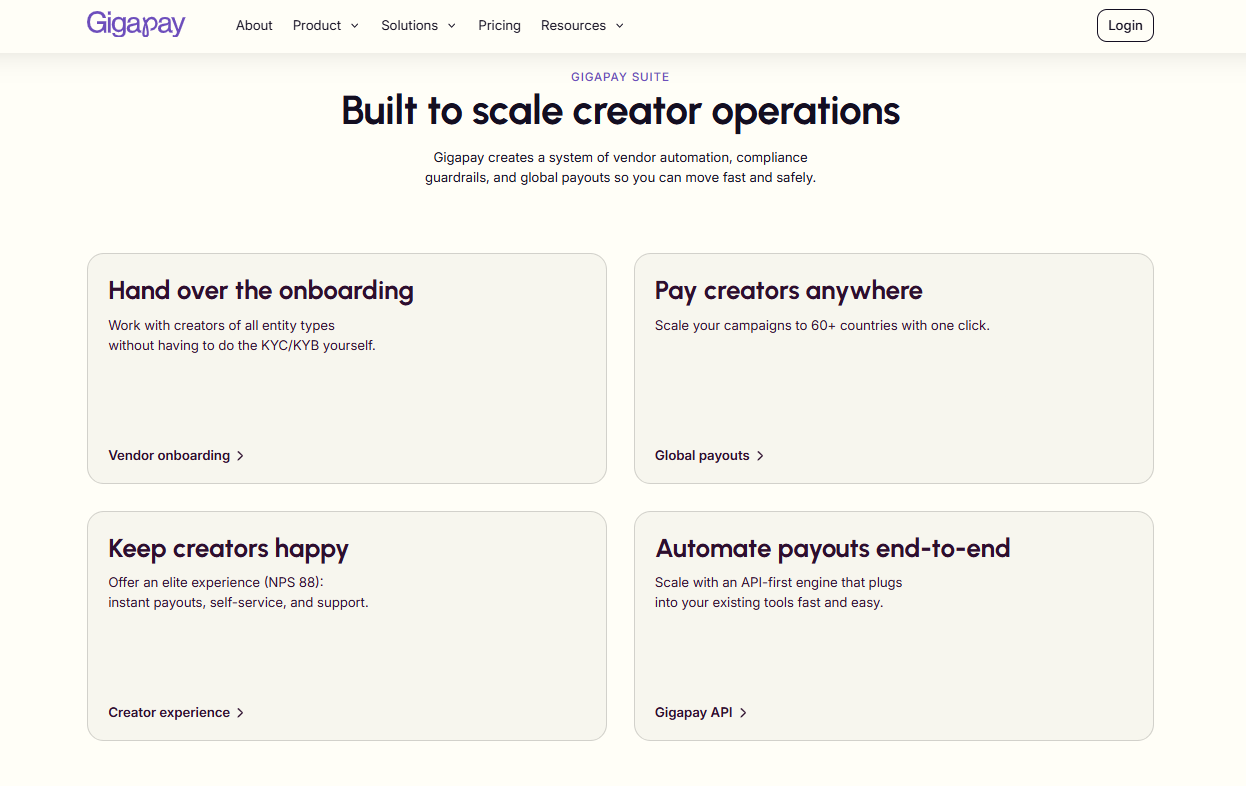
Gigapay is the mass creator payout platform built for exactly this situation: hundreds of nano and micro creators, one vendor, one invoice, and compliance handled automatically.
A 200-creator program with a two-person team comes down to structure and automation. You set tier-level compensation, recruit in sprints, run campaigns in waves, review by exception, and move every payment, onboarding, and tax reporting task to a Merchant of Record, which turns 840 hours of annual admin into 60 and leaves your two people doing marketing instead of paperwork.
The small-creator shift is already in the budget data for 2026, and the brands that win it will be the ones whose operations keep up with their ambition.
Book a demo and run your first 200-creator payout batch the same week you sign.
Read Next:
- Influencer Marketing ROI in 2026: The Formula That Counts Admin Hours (Free Calculator)
- Best Way to Pay YouTube Creators Internationally in Bulk (2026 Guide)
- Creator Payment Audit Trail: What Auditors Ask For and How to Be Audit-Ready in 2026
FAQs:
1. How many people do you need to run a 200-creator influencer program?
You need two people to run a 200-creator influencer program when onboarding, payments, and tax reporting are automated through a Merchant of Record. One person owns creator relationships, sourcing, and briefing, and the other owns operations, tracking, and payout runs. Without automation, payment admin alone at this volume consumes up to 840 hours per year, which forces a third hire.
2. What is the best way to pay 200 nano and micro influencers?
The best way to pay 200 nano and micro influencers is a batch payout through a Merchant of Record platform like Gigapay, which pays creators in 65+ countries and 50+ currencies from one CSV upload or API call. Your finance team receives one consolidated invoice instead of 200, creators get paid instantly through local payment rails, and tax reporting such as DAC7 runs automatically.
3. How much does a 200-creator nano and micro influencer program cost in 2026?
A 200-creator nano and micro influencer program costs roughly €300,000–€350,000 per year in 2026 for a European brand running three campaign waves. That covers €165,000–€190,000 in creator fees and gifting, €85,000–€110,000 in salaries for a two-person team, affiliate commissions, tooling, and a payout platform subscription. Manual payment admin would add around €93,000 per year on top of that.
4. Do nano influencers need a registered business to get paid?
No, nano influencers do not need a registered business to get paid when the brand pays through Gigapay. Creators can onboard as an individual, a sole trader, or a company, with no VAT number required, and they complete KYC verification and provide tax information directly in the platform. This removes the procurement barrier that normally blocks brands from working with nano creators.
5. What is a Merchant of Record in influencer marketing?
A Merchant of Record in influencer marketing is a company that formally purchases each creator's deliverable and resells it to the brand, becoming the contractual counterparty for every creator payment. The brand contracts with one vendor instead of hundreds, receives one invoice per campaign, and the Merchant of Record handles creator verification and tax reporting, while creators remain independent and responsible for their own taxes.
.jpg)
.jpg)
.jpg)