.jpg)

More than four million French businesses had designated an e-invoice receiving address in the national directory by 1 September 2026, the day France's B2B e-invoicing mandate went live, according to Sovos.
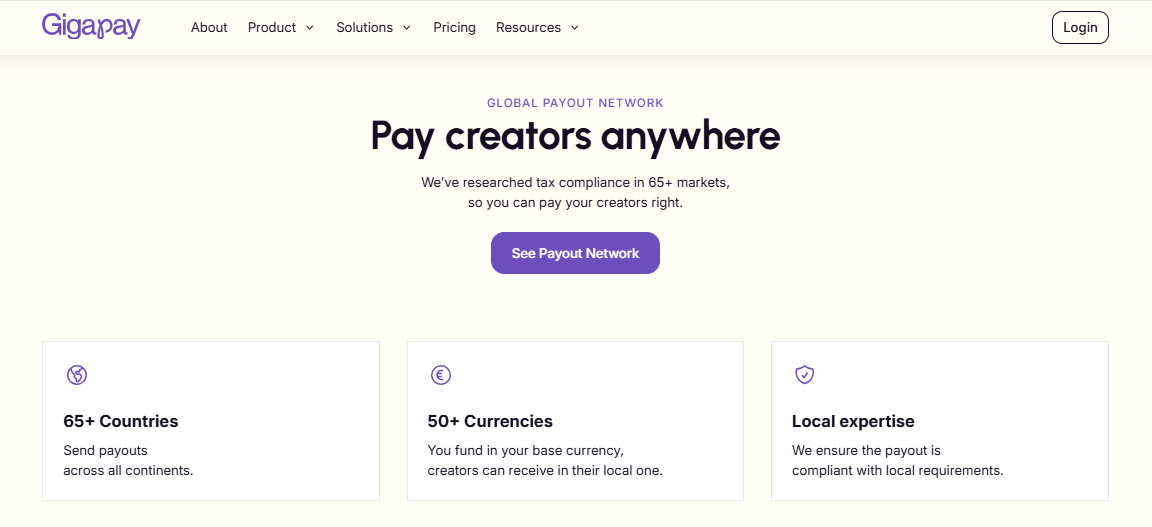
Gigapay is the merchant of record for mass creator payouts, giving brands and agencies one vendor and one consolidated invoice for hundreds of creators across 65+ countries.
The French reform changes how every domestic B2B invoice is issued, transmitted, and reported to the tax authority, and creator invoices are B2B invoices.
This article breaks down what the mandate requires, when each deadline hits, what it costs to get it wrong, and what brands paying French creators must change in their payment operations right now.
Key Takeaways
- France's B2B e-invoicing mandate went live 1 September 2026 for all established businesses.
- Micro-entrepreneur creators must issue structured e-invoices themselves from 1 September 2027.
- Missing an e-invoice costs €50 per invoice, capped at €15,000 per year.
- Cross-border invoices sit outside the domestic e-invoicing loop; a merchant of record uses this route.
- Gigapay replaces hundreds of individual creator invoices with one consolidated vendor invoice.

Why France's E-Invoicing Reform Matters for Influencer Marketing Budgets
France runs one of the most regulated influencer markets in the world. Loi n°2023-451 of 9 June 2023 made it the first country with a comprehensive influencer marketing law, and the Decree of 28 November 2025 made written contracts mandatory for any influencer engagement above €1,000 excluding taxes.
The DGCCRF enforces that law with penalties of up to €300,000 and two years of imprisonment for serious violations.
The e-invoicing mandate adds a second layer on top of that legal framework, and it targets the finance side rather than the marketing side. Every invoice a French creator sends to a French brand is a domestic B2B transaction, which is exactly the category the mandate captures.
A brand running 50 French creator collaborations per quarter is now running 50 regulated invoice flows per quarter, each of which must move through government-approved infrastructure. Marketing budgets do not change, but the administrative cost of spending them in France does.
The French Creator Economy Runs on Micro-Entrepreneurs
Most French creators operate under the micro-entrepreneur regime, the merged successor of the auto-entrepreneur status. They register with URSSAF, pay flat-rate social contributions of roughly 22 to 25 percent of turnover, and declare income annually through form 2042-C-pro.
Below the €36,800 VAT exemption threshold for services, they invoice without VAT under article 293 B of the Code Général des Impôts. Above it, they register for VAT, charge 20 percent, and file accordingly.
This structure matters for the mandate because the reform covers all VAT-taxable persons established in France regardless of size, legal form, or turnover. VATupdate's briefing confirms this explicitly includes sole traders, micro-entrepreneurs, and businesses under the franchise en base regime.
The nano creator earning €2,000 a year from brand deals falls inside the same system as a €1.5 billion enterprise. Brands that built their French creator programs on lightweight micro-entrepreneur invoicing are about to watch that lightness disappear.
What France's E-Invoicing Mandate Requires From September 2026
The mandate rests on Article 26 of the Finance Act 2024, with the final rules confirmed by the Loi de Finances pour 2026, adopted on 2 February 2026. It rolls out in two waves based on company size.
Phase 1: 1 September 2026 (Live Now)
- Reception for everyone: All VAT-taxable businesses established in France must be able to receive structured e-invoices through an accredited platform. This applies from day one, even to micro-entrepreneurs whose own issuing obligation only starts in 2027.
- Issuance for large and mid-sized companies: Grandes entreprises (over €1.5 billion revenue or more than 5,000 employees) and ETIs (€50 million to €1.5 billion revenue, or 250 to 5,000 employees) must issue domestic B2B invoices electronically and start e-reporting.
Phase 2: 1 September 2027
- Issuance for SMEs and micro-enterprises: Every remaining established business, including micro-entrepreneur creators, must issue structured e-invoices for domestic B2B transactions and comply with e-reporting.
- Non-established taxpayers: The Finance Act 2026 deferred e-reporting and issuance obligations for non-established taxable persons to September 2027.
The DGFiP has confirmed the go-live date will not move. Tradeshift reported in July 2026 that no postponement was under consideration, and the mandate is now in force.
How the New French E-Invoicing System Works: Plateformes Agréées and the Y-Model
France chose a decentralised continuous transaction control model, often called the Y-model. Businesses do not send invoices directly to each other or to a single state portal. Instead:
- Plateformes Agréées (PA) are government-accredited private platforms that transmit invoices between parties and push transaction data to the tax authority. As of the February 2026 pilot, 106 platforms were definitively approved.
- The Portail Public de Facturation (PPF) acts as the central directory (the annuaire) and the data concentrator feeding the DGFiP. It no longer offers free invoice exchange, which was scaled back earlier in the reform.
- Chorus Pro remains the platform for B2G invoicing, mandatory in France since 2017.
Accepted formats are UBL 2.1, CII, and Factur-X, all compliant with the European EN 16931 standard. A PDF attached to an email no longer counts as a compliant invoice for in-scope transactions. Invoices must also be archived in their original electronic format for 10 years.
Platform reliability is regulated too. Accredited platforms had to report their cybersecurity status to the DGFiP by the end of September 2026, with mandatory penetration testing and immediate incident reporting. A platform that fails these standards faces suspension. When a brand picks a PA, it is picking a piece of regulated infrastructure, not a software subscription.
E-Invoicing vs E-Reporting: Which Obligation Covers Creator Payments
The reform contains two separate obligations, and brands paying creators need to know which one applies to each payment flow.
E-invoicing covers domestic B2B transactions between VAT-taxable persons established in France. A French brand paying a French micro-entrepreneur creator directly sits squarely in this category.
- From September 2026, the brand must receive that creator's invoice through an accredited platform.
- From September 2027, the creator must issue it as a structured e-invoice.
E-reporting covers what e-invoicing does not: B2C sales and cross-border transactions. When a French business buys services from a supplier established outside France, that transaction falls outside the domestic e-invoicing loop and into e-reporting, following the same phased timeline.
This distinction is the single most important operational fact in the entire reform for creator payments. A domestic invoice from each individual creator means one regulated e-invoice flow per creator. A cross-border invoice from one foreign vendor means one transaction reported under e-reporting. The structure of your supply chain determines which regime you live in.
Penalties for Non-Compliance With the French E-Invoicing Mandate
The Finance Act 2026 raised the penalty amounts from the levels originally announced:
Transaction data and payment data are two separate e-reporting obligations, each with its own €15,000 annual cap. Beyond the fines, Cleartax notes that businesses may face challenges to VAT deduction on transactions that bypass the mandatory platform, which for a large advertiser is a far bigger number than the administrative fine.
One important softener: on go-live day, the DGFiP announced that no penalties will be applied to any business during 2026. The authorities framed 2026 as a supported adoption runway. That grace period ends with the calendar year, and the September 2027 SME wave arrives right behind it.
The penalty-free window is time to fix your process, not permission to ignore it.
What Brands Paying French Creators Must Change Now
Here is the concrete operational checklist for any brand or agency paying French creators directly.
1. Confirm You Can Receive Structured E-Invoices
If your French entity has not designated a receiving address and connected to a Plateforme Agréée, you are already behind. Reception applies to every established business as of 1 September 2026. A Basware survey in July 2026 found roughly 25 percent of France's largest billers had still not finalised their platform choice weeks before go-live.
2. Clean Your Creator Vendor Master Data
Every French creator in your ERP needs a valid SIREN or SIRET so the directory can route their invoices correctly. Creators invoicing from a personal name with no registration number will break in the new system. The directory itself is still being enriched and validated, so expect routing errors and build an exception process.
3. Rewrite Your Self-Billing Agreements
Self-billing (autofacturation) is common in creator programs because creators rarely want to produce invoices themselves. It remains permitted in France, but it requires a prior written agreement before the first invoice, and self-billed invoices are explicitly in scope of the e-invoicing mandate.
Your self-billing process must now produce compliant structured e-invoices through an accredited platform, not PDF invoices generated by your campaign tool.
4. Prepare for the September 2027 Creator Wave
The 2026 phase hits large companies. The 2027 phase hits your creators. Every French micro-entrepreneur you pay will need to issue structured e-invoices through the system, which means every one of them needs their own platform connection and a working understanding of the rules. Assume onboarding friction, invoice rejections, and payment delays across your entire French creator roster during that transition.
5. Align Invoicing With the Influencer Law
The Decree of 28 November 2025 requires written contracts for engagements above €1,000 excluding taxes. Finance and legal now need shared visibility on creator engagements: the contract obligation and the invoicing obligation attach to the same payments.
How the Mandate Multiplies Accounts Payable Work in Creator Programs
Consider a brand running 600 creator collaborations per year, the benchmark Gigapay uses in its ROI analysis. Handled manually, that program already costs around €139,590 per year in admin hours, vendor management, and error cycles, roughly 840 hours of internal time.
Each French creator in that mix is an individual vendor record, an individual KYC check, and now an individual regulated e-invoice flow with lifecycle statuses, rejection handling, and platform routing.
The mandate does not add one task to that workload. It multiplies the per-creator overhead: vendor data must be directory-accurate, invoices must arrive in the correct structured format, rejections must be managed within the platform, and archiving must run for 10 years per invoice.
Brands that could previously absorb messy creator invoicing with manual workarounds lose that option, because a non-conforming invoice can now cost the payer their VAT deduction.
Finance teams have two ways out. They can build French e-invoicing capability across hundreds of individual creator vendor relationships, or they can collapse those relationships into one.
How a Merchant of Record Removes French E-Invoicing Exposure From Creator Payments
Gigapay operates as a merchant of record. Gigapay purchases the creator's deliverable and concurrently resells it to the brand, becoming the formal contractual counterparty on both sides. That structure changes the invoicing geometry entirely.
- Creators invoice Gigapay, not the brand: A French creator invoices Gigapay Sweden AB, a cross-border transaction that sits outside France's domestic B2B e-invoicing loop. The reverse charge system applies, and Gigapay's self-billing automation generates the invoice on the creator's behalf under a prior written agreement.
- The brand receives one consolidated invoice: Instead of 300 domestic creator invoices flowing through an accredited platform, the French client receives a single B2B invoice from one Swedish vendor per campaign or batch. The client handles reverse-charge VAT and reports the cross-border transaction under its own e-reporting obligations, one line instead of hundreds.
- Compliance reporting is automated: Gigapay handles DAC7 reporting as an EU platform operator, validates tax IDs and VAT numbers during KYC, and reports all compensation to the Swedish tax authority, which exchanges income statements with the French tax authority.
- Creators need no company to get paid: Creators can onboard as individuals, sole traders, or companies, and payouts land instantly through local payment rails like SEPA Instant.
Gigapay cites an 80% reduction in invoice volume for its clients, and the same 600-collaboration program drops from roughly 840 admin hours to around 60. Boozt used exactly this structure to triple its nano and micro-influencer collaborations without expanding the team, and WPPMedia's GOAT agency reported significantly less time spent managing payments after implementation.
One honest caveat: the merchant of record model does not erase every French obligation. Compliance with Loi 2023-451, including written contracts above €1,000 and disclosure rules, remains the client's responsibility, and Gigapay prompts clients on this during onboarding. The model removes the invoicing and payout burden, and it keeps the legal accountability where French law places it.
France Is the Template for Europe's E-Invoicing Future
France is not an isolated case. The EU's ViDA reform, adopted in March 2025, pushes structured e-invoicing and digital reporting across all Member States by 2030.
- Belgium made Peppol B2B e-invoicing mandatory in January 2026.
- Croatia switched on Fiscalization 2.0 the same month.
- Germany requires all established businesses to receive structured e-invoices since 2025, with issuing obligations phasing in through 2028.
- Estonia already gives any registered buyer the right to demand a structured e-invoice from its suppliers.
For a brand running creator programs in five or ten European markets, this is not one compliance project. It is a rolling series of country-specific invoicing regimes, each with its own formats, platforms, deadlines, and penalties.
Every new mandate raises the cost of holding hundreds of individual creator vendor relationships, and every new mandate strengthens the case for routing creator payments through a single vendor whose job is to absorb exactly this complexity.
Key French E-Invoicing Dates for Brands and Agencies
Conclusion
Gigapay gives brands and agencies one vendor, one consolidated invoice, and instant compliant payouts to creators in 65+ countries, with the merchant of record structure carrying the administrative weight that reforms like this one create.
France's e-invoicing mandate is live, the penalty-free runway ends with 2026, and the September 2027 wave will pull every micro-entrepreneur creator into the system.
Brands that keep paying French creators one vendor record at a time are signing up to manage hundreds of regulated invoice flows in a system that fines mistakes at €50 per invoice.
Book a demo and see how one consolidated invoice replaces your entire French creator invoicing problem.
Read Next:
- Influencer Payments Are Tail Spend: A Procurement Playbook for Controlling Long-Tail Creator Vendors in 2026
- 25 Due-Diligence Questions Procurement Should Ask a Creator Payment Vendor
- Influencer Platform RFP Template 2026: How Procurement Should Score Payment Ops, Compliance, and Liability
FAQs:
1. What is France's e-invoicing mandate for 2026?
France's e-invoicing mandate for 2026 is a legal requirement, live since 1 September 2026, that all VAT-taxable businesses established in France receive structured B2B e-invoices through accredited platforms, while large and mid-sized companies must also issue them and comply with e-reporting.
2. When must French creators start issuing e-invoices?
French creators must start issuing e-invoices on 1 September 2027, when the mandate's second phase requires all SMEs and micro-enterprises, including micro-entrepreneur influencers, to issue structured e-invoices for domestic B2B transactions through an accredited platform.
3. What are the penalties for non-compliance with France's e-invoicing mandate?
The penalties for non-compliance with France's e-invoicing mandate are €50 per missing e-invoice capped at €15,000 per year, €500 per missed e-reporting transmission capped at €15,000 per year, and escalating fines of up to €1,000 every three months for not using an accredited platform, though the DGFiP has waived penalties during 2026.
4. How does a merchant of record help brands comply with French e-invoicing rules?
A merchant of record helps brands comply with French e-invoicing rules by becoming the single contractual counterparty: creators invoice the merchant of record cross-border instead of the brand domestically, so the brand receives one consolidated B2B invoice rather than managing hundreds of regulated domestic e-invoice flows.
5. Do micro-entrepreneurs under the VAT franchise fall under France's e-invoicing mandate?
Yes, micro-entrepreneurs under the VAT franchise fall under France's e-invoicing mandate, because the reform covers all VAT-taxable persons established in France regardless of turnover, meaning even creators invoicing VAT-free under article 293 B must receive e-invoices from 2026 and issue them from 2027.
.jpg)
.jpg)
.jpg)