.jpg)

The global influencer marketing market is projected to reach $40.51 billion in 2026, and 74% of marketers plan to increase their influencer budgets this year.
Gigapay is the mass creator payout platform that turns hundreds of long-tail creator vendors into one vendor, one contract, and one consolidated invoice.
That growth carries a procurement problem most companies have not named yet: creator payments behave exactly like tail spend, with hundreds of small, unmanaged vendors that drain admin hours and hide compliance risk.
This article breaks down why influencer payments are tail spend, what unmanaged creator vendors actually cost, and gives you a step-by-step procurement playbook for bringing the creator long tail under control in 2026.
Key Takeaways
- Influencer payments fit the tail spend profile: many small vendors, high admin cost.
- Manual payments for 600 yearly collaborations cost around €139,590 and 840 admin hours.
- Vendor consolidation through a merchant of record cuts invoice volume by 80%.
- DAC7, KSK, and misclassification rules turn unmanaged creator vendors into compliance liabilities.
- A single payout vendor replaces 300+ individual creator records in your ERP.

What Is Tail Spend in Procurement?
Tail spend is the roughly 20% of total company spend that sits with 80% of the supplier base: high-volume, low-value purchases that fall below strategic sourcing thresholds and never get actively managed.
A $2,000 software subscription does not justify a sourcing event, and neither does a €900 one-off service contract. But five hundred of those transactions per year add up to real money that nobody negotiated, nobody approved through a structured process, and nobody can fully reconcile.
The economics of the tail are well documented across procurement research:
The defining feature of tail spend is the inversion between value and workload. Processing, approvals, invoice handling, and supplier management scale with transaction count and supplier count, not with spend value. The smaller the average transaction, the larger the share of it that administration eats.
Keep that inversion in mind, because no spend category matches it more precisely than influencer payments.
Why Influencer Payments Behave Like Tail Spend in 2026
Influencer marketing has scaled into a spend category that procurement can no longer ignore. US influencer spend alone is projected to hit $12.17 billion in 2026, growing 15.7% year over year, and 86% of US marketers now use influencer marketing. For the enterprise and mid-market brands spending more than €500,000 per year on creators, this is a serious budget line reviewed by the CFO and the board.
The structure of that spend, however, looks nothing like a normal supplier category. It looks like the tail.
The Shift to Nano and Micro Creators Multiplies Vendor Count
Brands are moving budget toward smaller creators because the performance data supports it. Micro-influencers generate an average engagement rate of 3.86%, compared to 1.21% for mega-influencers, at roughly 60% lower cost. The rational response is to run hundreds of small collaborations instead of a handful of celebrity deals.
That decision has a direct procurement consequence. A €1 million creator budget spent on 20 macro creators produces 20 vendors.
- The same budget spent on 400 nano and micro creators produces 400 vendors, each with their own onboarding, tax data, invoice, and payment.
- The marketing outcome improves while the vendor base explodes.
Why Individual Creators Break Standard Vendor Onboarding
Most creators in the long tail are private individuals, not registered companies. Many have no VAT number, no company registration, and no experience issuing a compliant invoice. Standard procurement workflows were designed for suppliers with legal entities, bank references, and procurement contacts, so each creator becomes an exception the process was never built to handle.
The result shows up in Gigapay's research with Billion Dollar Boy, Meltwater, The Influencer Marketing Factory, and Wild: payment terms for creators stretch up to 120 days, and enterprise procurement requirements actively block collaborations with nano and micro influencers.
Christina Oliosi, Brand Activation Lead at Boozt, described the problem directly: "We've been trying to find a way forward with nano- and micro-influencers for years." After consolidating payments through Gigapay, Boozt tripled its collaborations without expanding the team.
Put the two patterns together and the conclusion is hard to avoid. Creator payments are low individual value, high transaction volume, spread across a huge vendor base, and largely unmanaged by procurement. That is the textbook definition of tail spend.
The True Cost of Unmanaged Creator Vendors
Unmanaged creator vendors cost a brand running 600 collaborations per year roughly €139,590 annually, according to Gigapay's ROI analysis. Most of that money never touches a creator. It disappears into vendor onboarding, invoice processing, error correction, and reconciliation.
Invoice Processing Costs Multiply Across the Long Tail
Industry benchmarks put the fully loaded cost of processing a single invoice manually at $10 to $22, and up to $40 for complex documents, with manual processes carrying a 1% to 3% error rate. Creator invoices sit at the expensive end of that range. They arrive in inconsistent formats, often with missing tax data, from individuals in dozens of countries, and every error triggers a correction cycle between finance, marketing, and the creator.
At 600 collaborations per year, a brand processes hundreds of individual invoices for a spend category where the average transaction may be a few hundred euros. The administrative cost per transaction erodes a far larger share of a €400 creator payment than of a €400,000 media buy.
The Admin Hour Burden on Finance and Creator Ops
Gigapay's analysis of the manual workflow puts the total admin burden for 600 yearly collaborations at 840 hours. That covers vendor setup in the ERP, tax ID collection, invoice chasing, payment runs across multiple rails and currencies, failed payment retries, and month-end reconciliation. The same volume handled through a consolidated payout vendor drops to roughly 60 hours per year.
The Hidden Costs Procurement Rarely Sees
Three costs never show up in the invoice math:
- Campaign delays: urgent creator opportunities die while procurement processes a new vendor, and marketing quietly routes around the process, which creates maverick spend outside any control.
- Creator churn: creators who wait 90 to 120 days for payment stop working with the brand, and marketing pays a premium to replace them.
- Audit exposure: 300 fragmented vendor records with inconsistent tax documentation turn every audit into a manual reconstruction project.
Compliance Risks Hidden in the Creator Long Tail
The compliance exposure in creator tail spend is larger than the cost exposure, because regulators do not scale their attention to transaction size. A €600 payment to an unverified individual in another country carries the same reporting obligations as a six-figure supplier contract, and European regulators have spent the last three years building rules aimed directly at this category.
DAC7 Reporting on Platform Payments to Individuals
DAC7 requires reporting of payments made to individuals through digital platforms across the EU, including seller identity, tax registration numbers, and VAT details per member state. A brand paying 300 creators directly must collect and validate that data itself for every applicable payee.
Gigapay collects the required DAC7 data during creator onboarding and files the reports through the Swedish tax authority for covered EU countries.
Künstlersozialkasse: Germany's 4.9% Levy on Creative Payments
Germany's Künstlersozialkasse (KSK) charges companies based in Germany a levy on payments for artistic and journalistic work, which includes influencer content. In 2026 the rate is 4.9% on relevant payments above €1,000, and it applies regardless of whether the influencer is based in Germany or abroad.
Companies based outside Germany do not pay the contribution. Many German brands running international creator campaigns discover this obligation only during an audit, at which point back payments accumulate.
Worker Classification and Cross-Border Exposure
European courts have issued decisions on influencer employment status that affect how brands must treat ongoing creator relationships, and misclassification can convert a marketing expense into an employment liability with social contributions attached.
Add jurisdiction-specific rules, such as the UAE's influencer permit requirements introduced for 2026 and country-level reporting like Sweden's KU14 exchange with Denmark, and the compliance surface grows with every market a campaign touches.
AML Screening Across 65+ Payout Countries
Paying individuals across dozens of countries also raises anti-money-laundering questions. The FATF updates its lists of high-risk and monitored jurisdictions three times per year, and as of the March 2026 update the grey list includes 22 jurisdictions.
- A procurement team managing creator vendors directly rarely screens payees against those lists.
- A specialized payout vendor applies KYC verification to every creator before any money moves, which is exactly the control an auditor expects to see.
The common thread across all four risk areas is that each one is manageable at the level of a single vendor relationship and unmanageable across 300 fragmented ones. That is the argument for treating the fix as a procurement project rather than a finance workaround.
The Procurement Playbook: 7 Steps to Control Long-Tail Creator Vendors
This playbook applies standard tail spend discipline to creator vendors, adapted for the fact that most of these vendors are individuals rather than companies. A procurement team can run steps one through three in a single quarter with existing data.
Step 1: Map Every Creator Payment in Your Spend Data
Pull 12 months of payments tagged to influencer or creator activity from the ERP, the P-card statements, and the marketing budget. Include agency pass-through payments, because agencies often hide a second layer of creator vendors.
Count three numbers: total creator spend, number of unique payees, and number of transactions. Most teams find the payee count is 10 to 20 times higher than expected, with maverick payments running through expense reports and personal PayPal transfers.
Step 2: Segment Creator Vendors by Value, Geography, and Entity Type
Sort the payee list three ways:
- By value: a handful of macro creators may justify individual vendor treatment, while everyone below a threshold, typically €10,000 per year, belongs to the tail.
- By geography: each new country adds tax reporting, currency, and payment rail complexity.
- By entity type: registered companies can follow a lighter version of standard onboarding, while private individuals need a different path entirely.
Step 3: Set One Policy for the Creator Tail
Write a short policy that defines who counts as a creator vendor, what the payment terms are, and which route every creator payment must take. The policy goal is a single controlled channel, because control you cannot enforce across 300 vendors becomes real once there is only one route to a payout.
Step 4: Consolidate the Tail Under One Vendor of Record
Replace the individual creator vendor records with a single payout vendor that becomes the contractual counterparty for creator deliverables. This is the merchant of record model, covered in detail in the next section. Procurement onboards one company, negotiates one contract with one SLA, and runs one KYB check, while creators onboard with the payout vendor instead of with your ERP.
Step 5: Automate KYC, Tax Data Collection, and Validation
Require the payout vendor to verify every creator's identity, validate tax IDs and VAT numbers, and block payment until the data is complete. This converts compliance from an annual cleanup exercise into a precondition of payment. It also removes the most painful onboarding friction for creators, since a purpose-built flow takes minutes instead of the weeks a supplier portal demands.
Step 6: Standardize Invoicing Through Self-Billing
Self-billing generates compliant invoices on the creator's behalf, in a consistent format, with the right tax treatment applied. Combined with consolidated invoicing, finance receives one invoice per campaign or batch instead of hundreds of individual documents.
Gigapay's customers report an 80% reduction in invoice volume from this change alone.
Step 7: Track Creator Tail Spend KPIs Quarterly
What gets measured stays consolidated. Review vendor count, cost per payout, invoice volume, payment cycle time, and the share of creator spend flowing through the controlled channel every quarter. Any growth in off-channel payments signals that marketing found a friction point worth fixing before it becomes a new tail.
How a Merchant of Record Turns 300 Creator Vendors Into One
A merchant of record (MoR) for creator payments purchases the creator's deliverable and concurrently resells it to the brand, which makes the MoR the formal contractual counterparty on both sides. The brand's ERP holds one vendor. The creators contract with, invoice, and get paid by the MoR.
Here is what that structure changes in practice, using Gigapay's model as the reference:
Two details matter for a precise procurement evaluation:
- First, the MoR takes over the administrative and legal responsibilities connected to purchasing the deliverable, but creators remain independent self-employed persons responsible for their own income taxes and social contributions. This keeps the relationship clean from a classification standpoint.
- Second, for KSK specifically, German-based clients still carry their own reporting obligation, and Gigapay supports it by sharing the collected payment data.
The model also fixes the creator side of the equation, which procurement often forgets is part of vendor risk. Creators onboard without needing a registered business or VAT number, can access scheduled funds early through EarlyPay, and get support from a dedicated human team.
Gigapay's creator NPS of 88 is the number behind Boozt tripling collaborations and WPPMedia's GOAT agency cutting payment management time significantly. Reliable vendors stay reliable when they get paid on time, and creators are no different.
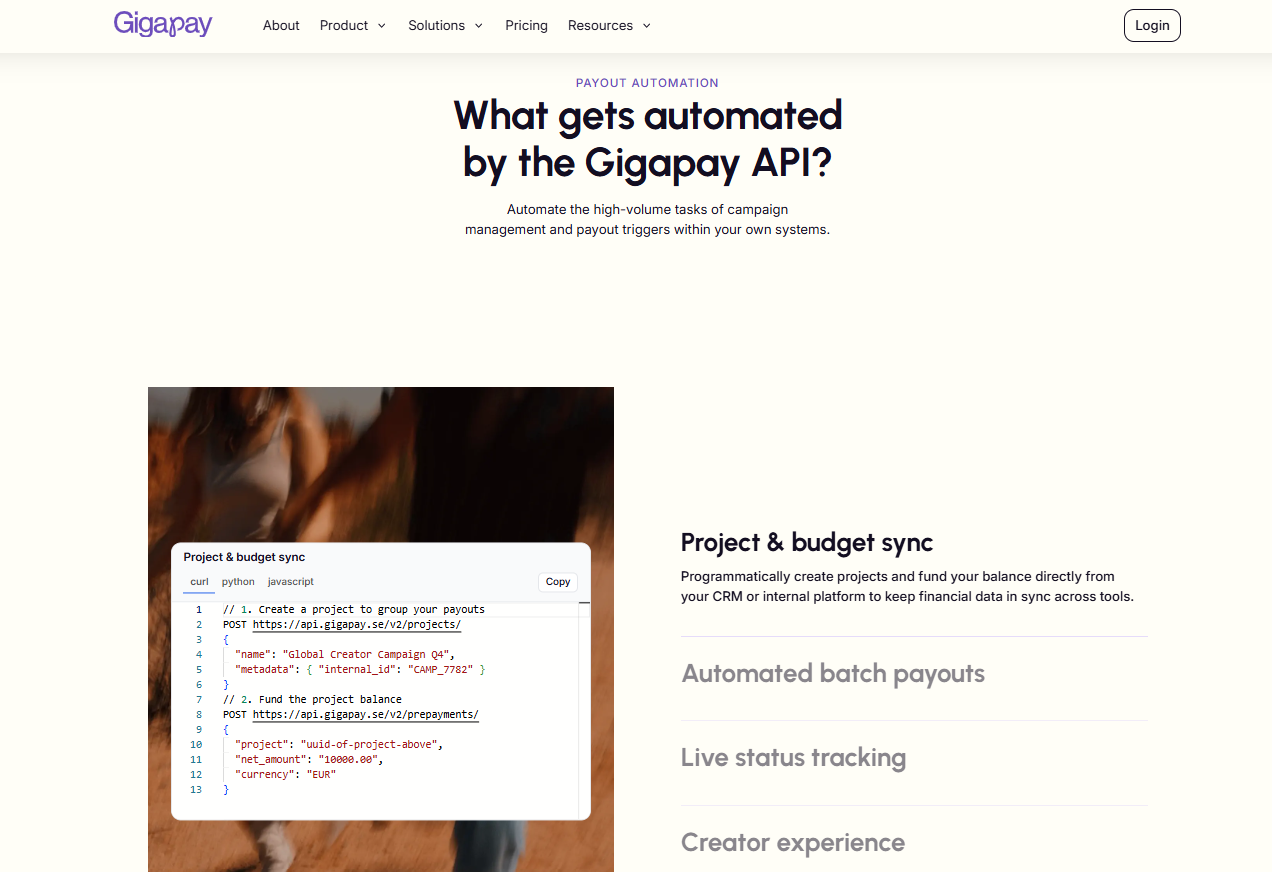
For integration, the platform works through CSV batch uploads for marketing teams or a REST API that embeds into existing dashboards and affiliate platforms, with full integration typically taking two to five days. Gigapay is ISO 27001 certified and GDPR compliant, which answers the two questions IT and legal ask first.
Creator Payment Models Compared: In-House, PSPs, AP Tools, and Merchant of Record
Procurement teams evaluating creator tail spend typically weigh four models, and each fails or succeeds on a different dimension.
The distinction that matters most sits between the last two rows. AP automation tools process payments to vendors you still own the relationship with, so every creator remains your vendor, your data collection problem, and your reporting obligation. A merchant of record changes who the vendor is. That difference is why the ERP ends up with one record instead of 300, and why the compliance surface shrinks instead of just getting better organized.
Agencies deserve a mention as a fifth option, since they absorb creator payments inside a managed service. They solve the workload but at premium service fees, with limited transparency into spend, and they scale headcount rather than process.
Brands moving influencer marketing in-house usually discover that payments and compliance were the hardest part of what the agency was actually doing for them.
KPIs Procurement Teams Should Track for Creator Tail Spend
Creator tail spend stays controlled only when procurement measures it with the same discipline as any strategic category. These eight KPIs cover cost, speed, and risk, with realistic targets based on published benchmarks and Gigapay customer data.
Two of these deserve a comment:
- Spend under management is the KPI that exposes maverick behavior fastest, because marketing teams route around any process that slows them down, and the gap shows up here first.
- Creator payment cycle time is the KPI the CMO cares about, so reporting it alongside cost metrics keeps marketing invested in the consolidated channel instead of treating it as another procurement constraint.
Cost Breakdown: Manual Creator Payments vs. Consolidated Payouts in 2026
The business case for consolidating creator tail spend comes down to one comparison: what 600 collaborations per year cost through fragmented vendor records versus through one payout vendor.
The annual saving in this scenario is roughly €93,000, a 67% reduction, before counting the value of the 780 recovered admin hours. Those hours matter because they belong to finance staff and creator ops managers whose fully loaded time costs €40 to €70 per hour in the UK, DACH, and Nordic markets, and who were hired to close books and run campaigns rather than chase tax IDs.
On pricing structure, Gigapay charges a SaaS subscription plus a percentage admin fee per payout, with no per-creator seat pricing. The Base plan starts at €279 per month with a 4.9% admin fee, and the Enterprise tier applies volume-based discounts for organizations paying out more than €1.8 million per year, with a dedicated customer success manager and unlimited API usage included.
For a procurement evaluation, that structure means costs scale with actual payout volume rather than with vendor count, which is precisely the opposite of how tail spend costs normally behave.
Conclusion
Gigapay gives procurement teams what tail spend management promises and rarely delivers: hundreds of creator vendors consolidated into one vendor, one contract, and one invoice, with compliance verified before any money moves.
Influencer payments carry every marker of tail spend, from the inverted value-to-workload ratio to the fragmented vendor base and the unmonitored compliance exposure, and in 2026 the category is too large for that to stay unmanaged.
The playbook is straightforward: map the spend, segment the payees, set one policy, and consolidate the tail under a merchant of record that turns 840 admin hours into 60.
Book a demo with Gigapay and see what your creator vendor list looks like as a single line in the ERP.
Read Next:
- 25 Due-Diligence Questions Procurement Should Ask a Creator Payment Vendor
- Influencer Platform RFP Template 2026: How Procurement Should Score Payment Ops, Compliance, and Liability
- Merchant of Record vs AP Automation vs PSP: Which Model Should Finance Choose for Creator Payouts in 2026?
FAQs:
1. What is tail spend in influencer marketing?
Tail spend in influencer marketing is the large volume of small, individually low-value payments to hundreds of creators that fall below procurement's strategic sourcing thresholds and therefore go unmanaged. It mirrors classic procurement tail spend, where roughly 20% of spend value generates 80% of supplier relationships and most of the administrative workload.
2. Why are influencer payments considered tail spend in 2026?
Influencer payments are considered tail spend in 2026 because brands increasingly run hundreds of small collaborations with nano and micro creators instead of a few large deals, creating a fragmented base of individual payees with low transaction values, high processing costs, and minimal procurement oversight.
3. How can procurement teams control long-tail creator vendors?
Procurement teams can control long-tail creator vendors by mapping all creator payments in spend data, segmenting payees by value and geography, setting one payment policy, and consolidating the tail under a single merchant of record that handles onboarding, KYC, invoicing, and tax reporting for every creator.
4. What is a merchant of record for influencer payments?
A merchant of record for influencer payments is a vendor, such as Gigapay, that purchases each creator's deliverable and resells it to the brand, becoming the formal contractual counterparty. The brand keeps one vendor record and receives one consolidated invoice, while creators onboard, invoice, and get paid through the merchant of record.
5. How much does manual influencer payment processing cost?
Manual influencer payment processing costs roughly €139,590 per year for a brand running 600 collaborations, consuming around 840 admin hours, according to Gigapay's ROI analysis. Industry benchmarks also put each manually processed invoice at $10 to $22, with error rates between 1% and 3% adding correction cycles on top.