.jpg)

US influencer marketing spend is forecast to reach $12.17 billion in 2026, according to Statista and eMarketer projections, and every euro of that budget ends in a payment to an individual creator that someone in your organization is legally accountable for.
Gigapay is the Merchant of Record for creator payouts, the vendor of record that becomes the legal counterparty to your creators and takes on the compliance, payouts, and support so your team doesn't have to.
As creator programs scale from dozens to thousands of collaborations, procurement teams are being asked to approve vendors in a category where the real risk sits in tax law, not in payment rails.
This checklist gives you the 25 questions that separate a vendor who moves money from a vendor who absorbs liability, plus the context to evaluate every answer you get back.
Key Takeaways
- Ask whether the vendor is a merchant of record or only a payment processor.
- Liability transfer, not payout speed, is the core due-diligence question in 2026.
- DAC7 fines reach €50,000 in Germany; confirm who files as principal.
- Verify security certifications, safeguarding structure, and creator onboarding without business registration.
- Score answers on total cost of ownership, not headline transaction fees.
Why Creator Payments Became a Procurement Category in 2026
Creator marketing professionalized faster than the infrastructure behind it. Roughly 8.6 million European creators now earn from their work, and brand budgets in the category have compounded at around 26% per year, yet most companies still pay creators the way they did in 2015: individual vendor setups, manual invoices, and ad-hoc tax checks.
The operational math breaks at scale. A brand running 600 creator collaborations per year spends roughly 840 admin hours and around €139,590 annually on the manual process, across vendor onboarding, invoice chasing, and error cycles. Each manual creator payment carries a true cost of €40 to €60 once you count the hours behind it.
That is why creator payments have moved from a marketing line item to a procurement category with its own vendor evaluation, and why the questions you ask now determine whether you consolidate hundreds of micro-vendors into one counterparty or inherit a tax exposure you can't see.
What Regulators Changed for Creator Payment Vendors in 2025 and 2026
Every payment to a creator is now a compliance event. The enforcement picture that shapes this checklist:
- Germany runs the hottest enforcement in Europe. Investigators in North Rhine-Westphalia opened criminal probes into roughly €300 million in suspected influencer tax evasion across about 200 proceedings, Hamburg is auditing 140 influencers, and the Künstlersozialkasse (KSK) is running out-of-cycle audits with retroactive reach and fines up to €50,000. The KSK levy sits at 4.9% for 2026 on creative payments above the €1,000 threshold.
- DAC7 turned platform data into audit fuel across the EU. Per-seller reporting failures cost SEK 2,500 to 12,500 in Sweden and around €200 per seller in Spain, with German DAC7 fines reaching €50,000.
- Spain requires IRPF withholding at 15% (7% for new professionals), Modelo 111/190 withholding filings, and Modelo 238 platform reporting.
- The UK made agencies and end-clients jointly liable for umbrella company PAYE from 6 April 2026, with HMRC treating employment status as an enforcement priority.
- France mandates written influencer contracts above €1,000 per advertiser per year and requires all companies to receive e-invoices from 1 September 2026.
A creator payment vendor either has answers to this landscape or leaves you holding it. The 25 questions below find out which.
How to Use This Creator Payment Vendor Due-Diligence Checklist
The questions are grouped into six categories: legal structure, tax and compliance, creator onboarding, payment operations, invoicing and finance integration, and vendor risk. Send them as a written questionnaire, then test the three or four answers that matter most to your risk profile in a live session.
- A credible vendor answers in specifics: named filings, named certifications, named references.
- A weak vendor answers in adjectives.
Legal Structure and Liability Questions to Ask a Creator Payment Vendor
1. Are you a merchant of record or a payment processor?
This is the question that defines the category. A payment processor moves money on your instruction and leaves every legal obligation with you. A merchant of record becomes the contractual counterparty to the creator, purchasing the creative deliverable and reselling it to you, which moves the associated administrative and reporting burden onto the vendor.
Stripe's own documentation states that users remain fully responsible for their obligations. Ask the vendor to state their model in writing.
2. Who is the legal counterparty to each creator we work with?
If the answer is "you are," the vendor is a rail. Under a merchant of record structure, the vendor contracts directly with the creator, which means your ERP shows one vendor entry instead of 300 individual creator records, and your legal exposure runs through one contract instead of hundreds.
3. Which obligations transfer to you, and which stay with us? Show us the service agreement clauses.
A serious vendor will point you to the exact sections. Be precise here: even under a merchant of record model, some obligations can remain with the client or the creator, such as Germany's KSK levy, which stays with the German company benefiting from the advertising work. Get the allocation in writing, clause by clause, and reject any vendor who answers this question with a marketing page.
4. Who files DAC7 reports for our creator payments, and in which member state?
DAC7 requires platform operators to collect seller data, verify it, and report income to the tax authority. The question to ask, in exactly these words: "Who files your DAC7 report in January, and who pays the fine if it's wrong?"
Gigapay files DAC7 reports to Skatteverket covering EU-resident creators paid through the platform. Many named competitors do not mention DAC7 anywhere in their public materials, which tells you where the liability lands.
5. If a tax authority audits our creator program tomorrow, how long would it take to produce the full paper trail?
Skatteverket runs targeted influencer reviews, and the German pension authority runs retroactive KSK audits reaching back five years. Ask the vendor to describe exactly what documentation exists per payment: contract, verified identity, tax ID, invoice, payment confirmation, and reporting record. Then ask how you export it.
Tax Reporting and Compliance Questions to Ask a Creator Payment Vendor
6. Which country-specific reporting obligations do you handle automatically?
Generic "we handle compliance" claims fail this question. Ask for the named filings: DAC7 across the EU, KU14 in Sweden, KSK data support in Germany, Modelo-series filings in Spain. Gigapay automates reporting across these regimes and maintains a country-by-country legal research database covering 93 markets, refreshed by its in-house legal team.
7. How do you support our KSK obligations in Germany?
The KSK levy is 4.9% for 2026 on creative payments above €1,000 per year, and it applies to German companies even when they hire international creators. The obligation legally sits with the client, so the right vendor answer is data support: a signed DPA, per-creator payment records with names, amounts, and work context, and threshold alerts when a creator crosses €1,000. A vendor who claims to "take care of KSK" entirely is overpromising; a vendor who has never heard of it is worse.
8. Can you operate in withholding jurisdictions like Spain?
Spain requires 15%/7% IRPF withholding, Modelo 111/190 filings, and RD 1619/2012 self-billing compliance. Poland applies 20% withholding on advertising payments to non-residents above thresholds.
Germany's §50a imposes 15.825% withholding on payments to foreign creators, with exemption certificates taking a year or more. Ask which withholding regimes the vendor supports operationally, not just theoretically.
9. How do you verify creator tax IDs and VAT numbers?
DAC7 makes seller verification a legal duty, not a nice-to-have. The vendor should validate tax identification numbers against country-specific formats across every market they serve and validate VAT numbers for registered creators. Ask what happens when a creator submits an invalid TIN: does the payment block, flag, or sail through?
10. How do you track regulatory change, and who is accountable for it?
The KSK rate changed for 2026. UK joint and several liability went live in April 2026. France's e-invoicing mandate lands in September 2026, and the EU Platform Work Directive follows in December 2026. Ask whether the vendor has in-house legal counsel, how often country research is refreshed, and how changes reach you before they reach an auditor.
Creator Onboarding and Verification Questions to Ask a Creator Payment Vendor
11. Can you pay creators who don't have a registered business?
This question decides whether your nano- and micro-influencer strategy works. Most AP tools and many payout platforms require a registered company or VAT number, which blocks the majority of smaller creators.
Gigapay pays individuals with no registered business and no VAT number, which is why Boozt tripled its collaborations without expanding its team after years of being blocked on exactly this point.
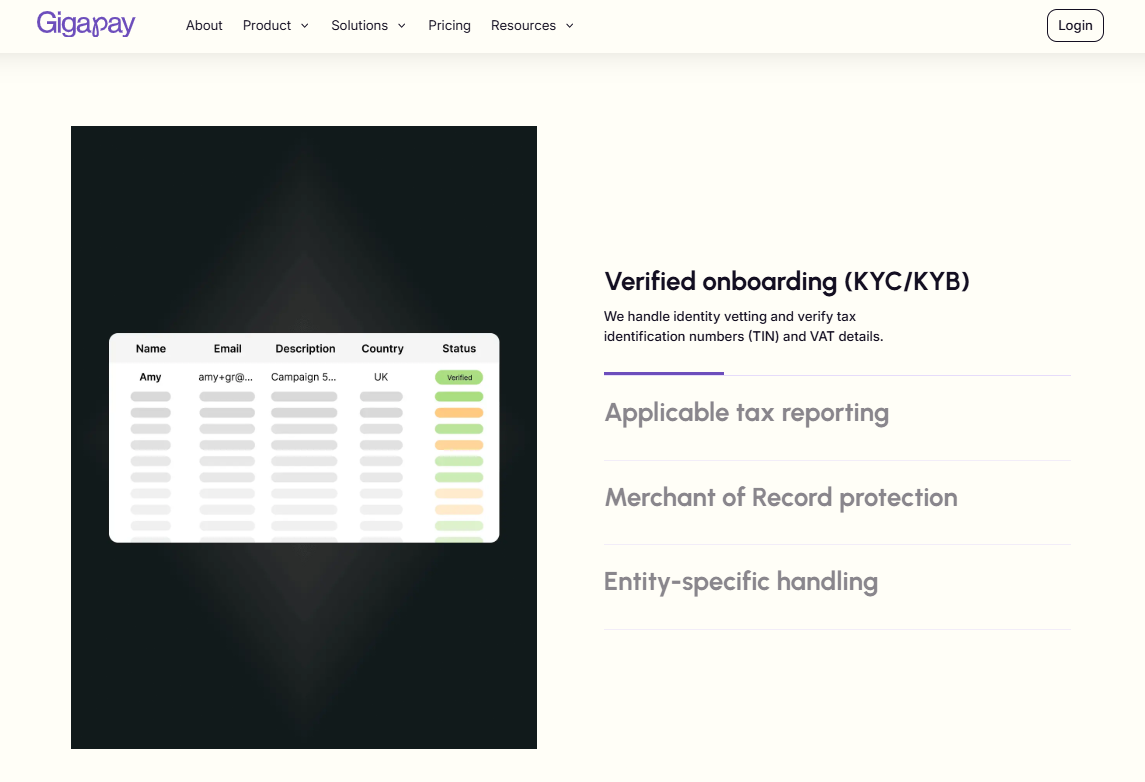
12. What KYC and KYB checks do you run on every creator?
Identity verification should cover individuals, sole traders, and companies, with the check completed before the first payment moves. Ask for the verification flow, average onboarding time, and completion rate. Vendor onboarding that takes minutes protects your campaign timelines; onboarding that takes days kills them.
13. How do you screen for sanctions and AML risk across markets?
The FATF grey list changes three times a year, and your creator roster can span 40+ countries. Ask how the vendor screens creators against sanctions lists, how they treat payments into higher-risk jurisdictions, and whether they maintain a country risk framework. A vendor who can't describe their AML posture is a vendor your bank will eventually ask you about.
14. What is the creator's experience, and can you prove they like it?
Creator experience is a compliance control: creators who trust the payment flow complete verification, submit correct data, and stay in your program. Ask for a satisfaction metric and support model.
Gigapay reports a creator NPS of 88, runs a dedicated human support team for creators, and offers EarlyPay, which gives creators early access to scheduled funds. Ask any vendor how many "where's my money?" messages your team will still receive.
Payment Operations Questions to Ask a Creator Payment Vendor
15. Which countries and currencies do you cover today, in production?
Ask for the live list, not the roadmap. Gigapay pays creators in 65+ countries and 50+ currencies, with funding accepted in USD, EUR, GBP, SEK, DKK, and NOK.
Then ask the harder version: in which of those countries can you pay an individual without a company, and in which do you file local reporting? Coverage claims without compliance depth are just correspondent banking.
16. Which payment rails do you use, and how fast do creators actually receive funds?
Local rails matter more than wire networks: SEPA Instant in the EU, Faster Payments in the UK, ACH in the US. Ask for the settlement time under normal conditions and the conditions attached. Gigapay pays creators instantly when accounts are pre-funded, and the platform is designed around pre-funding. Compare that against vendors whose standard payouts take one to two days with instant as a paid upsell.
17. How is client money held between funding and payout?
When a vendor holds your funds, procurement should ask where those funds sit, how they are safeguarded, and what happens in an insolvency scenario. Ask for the safeguarding structure in writing and for finance references from existing enterprise clients. A credible vendor sends the finance pack proactively.
18. Who pays the transaction fees, our company or the creator?
Fees quietly deducted from creator earnings damage your creator relationships and your negotiated rates. On Gigapay's current plans, clients cover the fees, so creators keep what they earn. Ask every vendor for a written fee schedule including FX margins, and ask specifically whether "instant" payouts cost the creator anything.
Invoicing and Finance Integration Questions to Ask a Creator Payment Vendor
19. How does consolidated invoicing work, and what does it do to our AP volume?
The vendor should convert hundreds of creator invoices into one invoice per campaign or batch. Gigapay's benchmark is an 80% reduction in invoice volume, and its consolidated model cuts roughly 70% of the invoices behind a typical agency deal. Ask what a month of invoicing looks like at your projected volume, with a sample invoice.
20. Do you support compliant self-billing on behalf of creators?
Most individual creators cannot produce a compliant invoice in your required format, in your required language, with correct VAT treatment. Self-billing automation generates the invoice on the creator's behalf and keeps the paper trail audit-ready. Confirm the vendor's self-billing is compliant per jurisdiction; Spain's RD 1619/2012, for example, sets specific self-billing rules.
21. How do we integrate: API, batch upload, and which platforms already run on you?
Both paths should exist: CSV batch upload for marketing teams and a REST API for engineering. Gigapay's API integration takes two to five days with sandbox and production environments, webhooks for workflow automation, and a live embedded integration with Kolsquare, where Gigapay is the exclusive payout partner. Ask for named platform integrations, not logos on a slide.
Security, Data, and Vendor Risk Questions to Ask a Creator Payment Vendor
22. Which security certifications do you hold, and can we see the certificates?
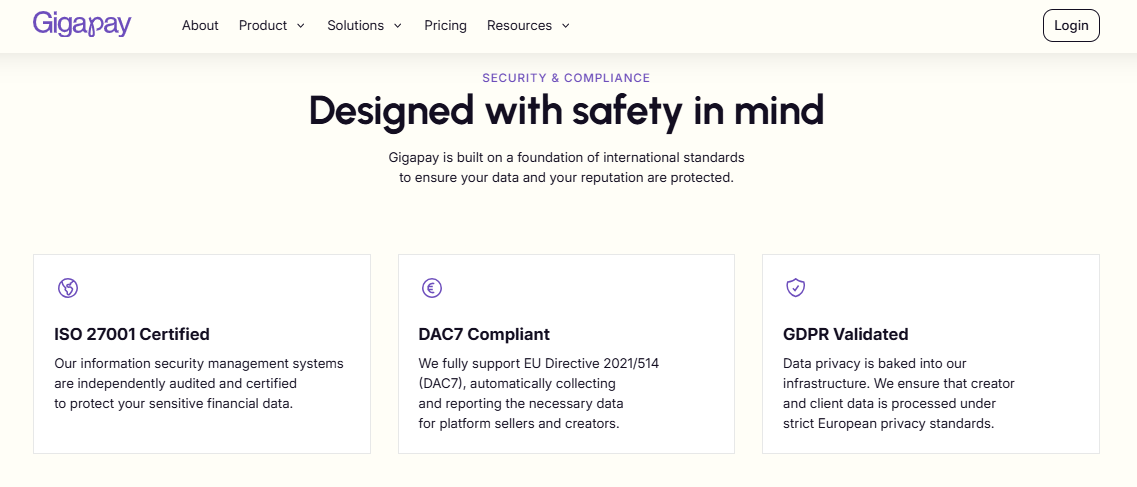
The baseline for a vendor processing payment and identity data is a certified information security management system. Gigapay is ISO 27001 certified. Ask for the certificate, its scope, and the date of the last audit, and ask how creator bank details and identity documents are stored and encrypted.
23. How do you handle personal data under GDPR, and will you sign our DPA?
A creator payment vendor processes names, tax IDs, bank details, and identity documents at scale. Confirm GDPR compliance, the data processing agreement terms, sub-processor list, data residency, and retention periods. In Germany, the DPA is also what enables KSK data sharing, so this question does double duty.
24. Will you complete our full vendor security questionnaire and evidence insurance coverage?
Ask for a completed SIG-Lite or equivalent, proof of insurance, and the DPA up front. Vendors serious about enterprise procurement maintain a due-diligence data room and enterprise questionnaire responses before you ask. Treat the speed and completeness of this response as a signal of operational maturity.
25. How financially stable are you, and who can we call as a reference?
You are consolidating regulatory exposure into one counterparty, so that counterparty's health matters. Ask about funding history, headcount, and payment volume.
Gigapay, founded in 2019 and headquartered in Stockholm with investors including Mastercard Lighthouse, has processed 105,000+ payouts totaling 911M SEK to creators in 40+ countries, with named references including The Goat Agency (WPPMedia). Compare that against vendors running on 16 people and no funding round since 2021.
Red Flags That Should Stop a Creator Payment Vendor Evaluation
Some answers end the conversation. Watch for these:
- No mention of DAC7, KSK, or KU14 anywhere in the vendor's materials or answers. Compliance depth you can't see is compliance depth that doesn't exist.
- "You remain responsible for all tax obligations" buried in the terms of a vendor selling you compliance. Read the service agreement, not the landing page.
- Creators must have a registered company. This silently excludes most nano and micro creators and pushes your teams back into manual workarounds.
- Fees deducted from creator earnings or instant payouts sold to creators as an upsell. Your brand carries the reputational cost.
- Guarantees against misclassification. Worker classification risk is real and jurisdiction-specific; a vendor promising blanket protection is overpromising. The credible answer describes the counterparty structure factually.
- No security certificate, no SIG response, no DPA within a reasonable timeframe. A vendor unprepared for procurement is unprepared for your auditors.
How to Score Creator Payment Vendor Answers on Total Cost of Ownership
The headline transaction fee is the least informative number in the evaluation. A DIY Stripe build runs around 0.7% to 1% in processing fees, then adds an estimated €80,000 to €250,000 in build cost plus permanent maintenance, and every compliance obligation stays with you.
Manual processing looks free until you price the €40 to €60 true cost per payment and roughly six hours of handling per creator payment.
Score vendors on four weighted dimensions instead:
Run the admin-hours math for your own volume. At 600 collaborations per year, the manual process costs roughly €139,590 and 840 hours; a consolidated vendor-of-record model brings that to around €46,350 and 60 hours. The fee line moves up; the total cost line drops by roughly two thirds.
Conclusion
Gigapay is the Merchant of Record for creator payouts, the single vendor of record that replaces hundreds of creator vendor setups with one contract, one invoice, and every creator paid fast and compliantly in 65+ markets.
The 25 questions in this checklist all test one underlying thing: whether a vendor moves money and generates paperwork, or becomes your counterparty and absorbs the liability that regulators from Skatteverket to the DRV are now actively enforcing.
Procurement teams that run this checklist consolidate risk, cut invoice volume by around 80%, and give marketing and finance the same answer at the same time.
Book a demo with Gigapay and put every one of these 25 questions to us directly.
Read Next:
- Influencer Platform RFP Template 2026: How Procurement Should Score Payment Ops, Compliance, and Liability
- Merchant of Record vs AP Automation vs PSP: Which Model Should Finance Choose for Creator Payouts in 2026?
- Influencer Marketing Accounting in 2026: GL Codes, Accruals, and Month-End Close for Creator Spend
FAQs:
1. What is the most important due-diligence question to ask a creator payment vendor in 2026?
The most important due-diligence question to ask a creator payment vendor in 2026 is whether the vendor operates as a merchant of record or as a payment processor, because that single answer determines whether tax reporting and legal counterparty obligations transfer to the vendor or stay with your company.
2. Who is responsible for DAC7 reporting when a company pays creators through a vendor?
The party responsible for DAC7 reporting when a company pays creators through a vendor depends on the vendor's legal model: a merchant of record like Gigapay files DAC7 reports as the platform operator, while payment rails such as Stripe or Wise leave the reporting obligation, and the per-seller fines, with the client.
3. What is a merchant of record for creator payments?
A merchant of record for creator payments is a vendor that becomes the legal counterparty to each creator, purchasing the creative deliverable and reselling it to the brand, so the brand holds one vendor contract and one invoice while the merchant of record takes on the compliance, payouts, and creator support.
4. How much does manual creator payment processing cost a company per year?
Manual creator payment processing costs a company running 600 collaborations per year roughly €139,590 and 840 admin hours annually, with each individual payment carrying a true cost of €40 to €60 once vendor onboarding, invoice handling, and error cycles are counted.
5. Which compliance certifications should a creator payment vendor have in 2026?
The compliance certifications a creator payment vendor should have in 2026 include ISO 27001 for information security and full GDPR compliance with a signed data processing agreement, alongside the operational ability to complete a SIG-Lite questionnaire and evidence insurance coverage during procurement review.
.jpg)
.jpg)
.jpg)