.jpg)

Micro- and nano-influencers will claim 45.5% of influencer marketing spending in 2026, according to eMarketer's Creator Economy 2026 report.
That single number explains why creator payouts became a finance problem: budgets are shifting from ten large creators to hundreds of small ones, and every one of them needs to be onboarded, verified, invoiced, and paid.
Gigapay is the Merchant of Record built for mass creator payouts, giving finance teams one vendor, one invoice, and compliance coverage across 65+ countries.
Finance leaders evaluating how to pay creators at scale in 2026 typically land on one of three models: a Merchant of Record (MoR), an AP automation platform, or a payment service provider (PSP). The three look similar in a demo and behave completely differently in an audit.
This article breaks down how each model works, what each one actually costs, how each handles tax compliance, and which one fits your creator program in 2026.
Key Takeaways
- A Merchant of Record becomes the legal counterparty, replacing hundreds of creator vendors with one.
- AP automation speeds up invoice processing but still leaves compliance liability with your company.
- PSPs move money efficiently and take no responsibility for tax reporting or classification.
- Manual creator payouts cost roughly €139,590 per year at 600 collaborations.
- Choose based on creator volume, geography, and who should carry compliance risk.
Why Creator Payouts Became a Finance Problem in 2026
The influencer marketing industry reached $32.55 billion in 2025, up from $24 billion in 2024, a 35.6% year-over-year jump, and US creator economy ad spend alone is forecast to reach $43.9 billion in 2026, according to the IAB. The money is real. The infrastructure behind it is not.
The structural shift is where the pain lives. 92% of marketers said they intend to work with both macro and micro influencers in 2026, and 58% plan to partner with nano influencers with under 5,000 followers. A campaign that once meant three contracts now means three hundred.
Each of those creators is a potential vendor record in your ERP, a tax ID to collect, an invoice to chase, and a cross-border payment to reconcile.
Gigapay's own 2024 research with Billion Dollar Boy, Meltwater, and The Influencer Marketing Factory found payment terms stretching to 120 days and enterprise procurement rules actively blocking collaborations with nano and micro creators.
- Marketing knows exactly who it wants to hire.
- Finance holds the payment while it chases missing tax documentation.
Both teams are doing their jobs, and the infrastructure between them makes both jobs harder.
How Creator Payment Volume Outgrew Traditional Finance Tools
Traditional AP processes were designed for a stable base of registered business suppliers: annual contracts, predictable invoices, VAT numbers on file. Creators break every one of those assumptions.
Most creators are individuals, not companies. Many have no VAT number and no registered business. They work across borders, invoice irregularly, and expect to be paid quickly. 48.7% of creators earn under $10,000 annually, which means a delayed €500 payment is not an accounting footnote to them. It is rent.
A brand running 600 collaborations a year through standard AP processes spends roughly 840 admin hours on creator payments: vendor onboarding, tax form collection, invoice matching, error cycles, and payment runs. That is the equivalent of half a full-time employee doing nothing but creator payment admin.
The question for 2026 is which model absorbs that work, and which model just reshuffles it.
What Is a Merchant of Record for Creator Payouts?
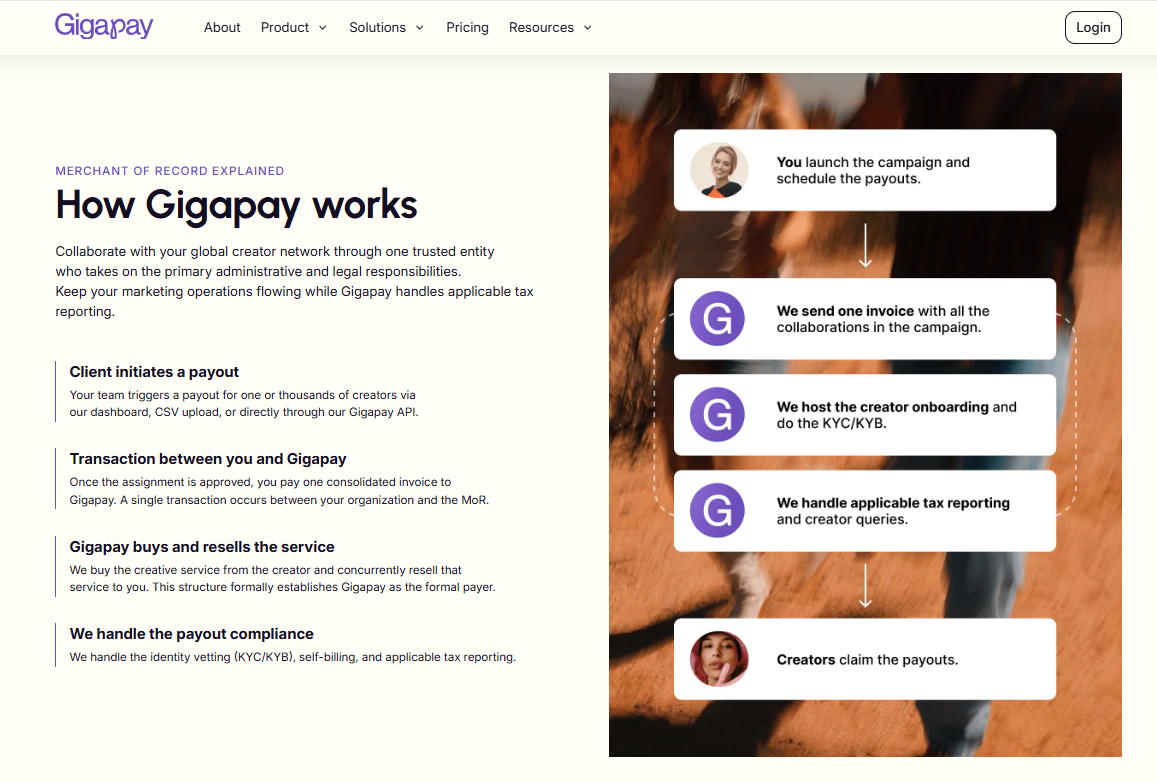
A Merchant of Record for creator payouts is a company that legally purchases the creator's deliverable and resells it to the brand, becoming the formal contractual counterparty on both sides. The brand contracts with one vendor. The MoR contracts with every creator.
How the Merchant of Record Model Works
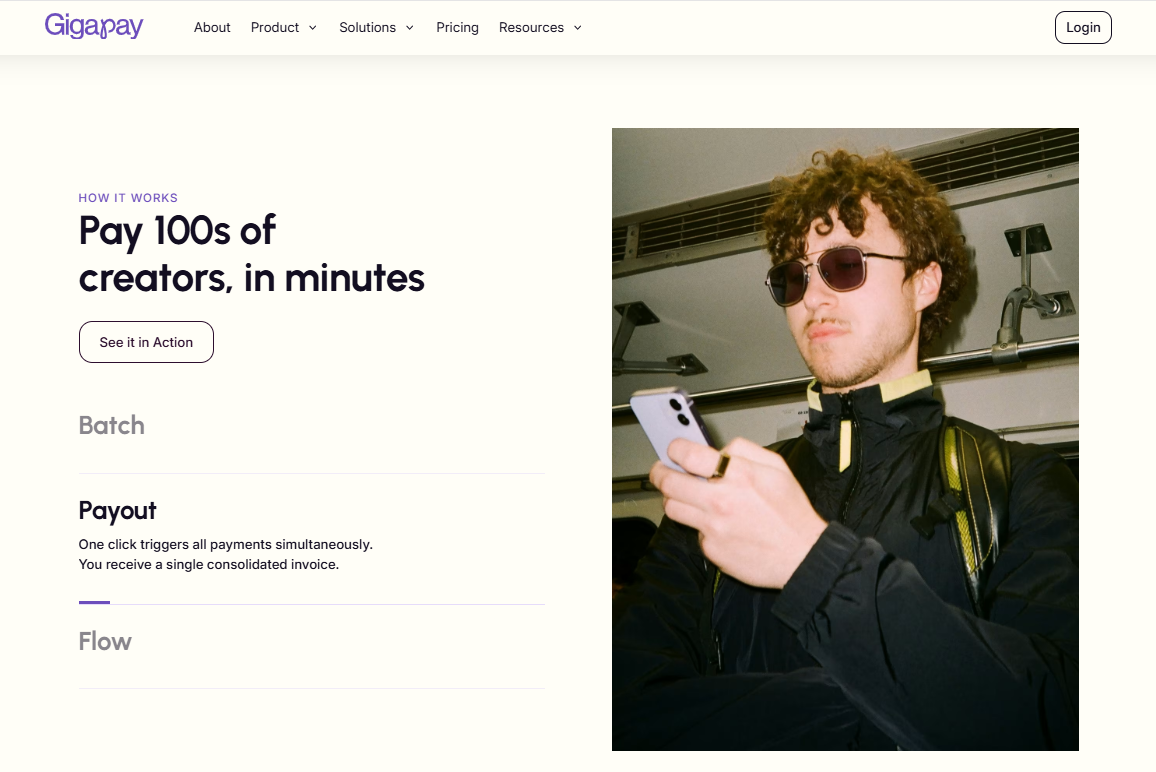
The mechanics are simple to describe. The brand uploads a payout batch via spreadsheet or API. The MoR onboards each creator with KYC identity verification and tax ID validation, generates self-billing invoices on the creator's behalf, pays each creator on local rails in their own currency, and sends the brand one consolidated invoice for the whole batch.
In Gigapay's version of this model, that means payouts to 65+ countries in 50+ currencies over local rails like SEPA Instant, Faster Payments, and ACH, with creators paid instantly once a payout is approved. Creators can onboard as individuals, sole traders, or companies, and no registered business or VAT number is required.
That last point matters more than it sounds: it is the difference between working with nano creators and being blocked from them by procurement policy.
What a Merchant of Record Does and Does Not Cover
Precision matters here, because "the MoR handles compliance" is often oversold in this category. In the MoR model, the provider takes over the administrative and legal responsibilities connected to purchasing the creator's deliverable: counterparty status, invoicing, identity verification, and tax reporting obligations such as DAC7 in the EU, KU14 for Sweden–Denmark reporting, and data support for Germany's KSK levy.
What an MoR generally does not do is withhold income tax or social security on the creator's behalf. Creators remain responsible for their own taxes in their own jurisdictions, and specific obligations like KSK reporting for German clients stay with the client, with the MoR supplying the collected data. A serious MoR will tell you this plainly. A finance team should ask.
What Is AP Automation for Creator Payments?
AP automation platforms digitize the accounts payable workflow: supplier onboarding portals, invoice capture and matching, approval routing, tax form collection, and mass payment execution. Tipalti is the best-known example in this category.
Where AP Automation Works Well
AP automation is genuinely strong for what it was built for: a large base of registered suppliers with recurring invoices. It reduces manual data entry, enforces approval workflows, collects W-9/W-8 forms at onboarding, and syncs cleanly with your ERP.
If your creator program looks like a supplier program, meaning mostly incorporated creators with agents, business entities, and predictable invoicing, AP automation performs well.
Where AP Automation Breaks Down for Creators
The model breaks on one structural fact: every creator is still your vendor. AP automation makes onboarding 300 creators faster, but you still onboard 300 creators. They still sit in your ERP as 300 vendor records. Your company still holds the counterparty relationship, which means your company still carries the classification risk, the tax reporting obligations across jurisdictions, and the audit exposure.
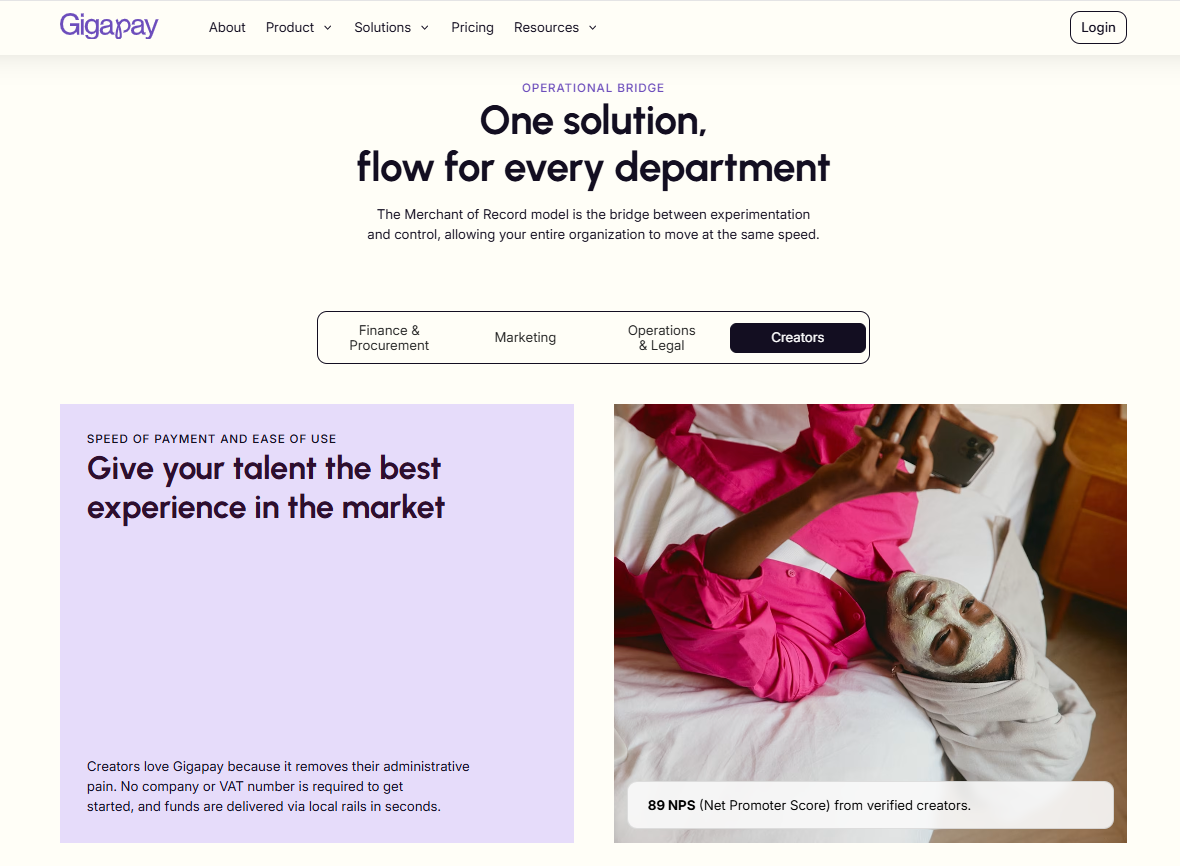
AP automation also assumes the supplier can behave like a supplier. A 19-year-old TikTok creator in Croatia without a registered business struggles with a supplier portal designed for invoicing companies. The tool automates the process without changing who is responsible for it.
What Is a PSP for Creator Payouts?
A payment service provider moves money. Stripe Connect, PayPal Payouts, and Wise are the common choices. You fund an account, submit payout instructions, and the PSP executes transfers to creators globally.
How PSPs Handle Creator Payments
PSPs are excellent at the payment layer: broad currency coverage, developer-friendly APIs, and competitive FX. For a marketplace or platform paying out its own users, PSP infrastructure is often the natural starting point, and the engineering teams love it.
The Compliance Gap in the PSP Model
A PSP is not a counterparty and does not want to be one. Contracts, invoicing, tax ID collection, DAC7 reporting, misclassification risk, and jurisdiction-specific levies all remain with you.
Worth noting: Gigapay is structured as a Merchant of Record and invoicing intermediary, not a PSP, precisely because moving money was never the hard part of creator payouts.
The hard part is everything wrapped around the money: who invoices whom, who reports what to which tax authority, and who answers when the auditor calls.
A brand that routes creator payments through a PSP has solved transfer speed and nothing else. Finance still builds the compliance machinery internally, or it operates without one.
Merchant of Record vs AP Automation vs PSP: Side-by-Side Comparison
What Each Payout Model Costs Finance Teams in 2026
Sticker price and total cost diverge sharply in this category, so it is worth walking through the actual numbers.
Manual or lightly automated creator payments cost far more than most finance teams have measured. For a brand running 600 creator collaborations per year, the fully loaded manual cost lands around €139,590 annually: roughly 840 admin hours across marketing and finance, vendor sprawl in the ERP, error and correction cycles, and payment delays that damage creator relationships.
The same volume through Gigapay’s MoR model runs approximately €46,350 per year, with admin time falling from 840 hours to around 60.
On pricing structure, the three models charge differently:
- A Merchant of Record like Gigapay charges a SaaS subscription plus a percentage admin fee per payout (Gigapay's Base plan is €279 per month plus 4.9% per payout, with volume discounts at Enterprise level from €1.8M+ in annual payouts).
- AP automation platforms typically charge platform fees plus per-transaction costs, and the internal cost of vendor management stays on your side of the ledger.
- PSPs charge the least per transaction, and everything the transaction fee does not cover becomes internal headcount.
The honest comparison is not fee versus fee. It is fee versus fee plus the 780 admin hours the cheaper option leaves on your desk. Consolidated invoicing alone cuts invoice volume by around 80% in the MoR model, which is the kind of number an AP team feels within the first quarter.
How Each Model Handles Tax Compliance and Reporting in 2026
Compliance is where the three models separate for good, because 2026 regulation is aimed directly at exactly this kind of payment flow.
DAC7 requires platform operators in the EU to report seller income to tax authorities, and it applies squarely to creator payouts. In the MoR model, the provider files these reports as the platform operator. In the AP automation and PSP models, the reporting analysis and the filing obligation sit with you.
Germany's Künstlersozialkasse (KSK) charges a levy on payments to creative freelancers, including influencers, and applies to German companies regardless of where the influencer is based. This one catches finance teams off guard constantly. An MoR structured as an intermediary supports the process by sharing collected creator data, while the German client reports and pays; a PSP gives you nothing here at all.
Then there is classification. European courts have been actively ruling on influencer employment status, and continuous or exclusive creator arrangements carry reclassification risk across most EU jurisdictions. Under AP automation and PSP models, your company is the direct counterparty in every one of those relationships.
Under an MoR, the contractual structure itself is designed around this problem, with each party complying with its own tax responsibilities and the MoR standing as the formal counterparty.
Add jurisdiction-level quirks, withholding tax exposure in countries without double taxation treaties, mandatory e-invoicing rollouts like Belgium's 2026 Peppol mandate, and FATF grey-list due diligence requirements, and the picture is clear: cross-border creator compliance is a full-time legal function. The real question is whether you want to build that function or buy it.
Which Payout Model Should Finance Choose in 2026?
The right answer depends on three variables: creator volume, geographic spread, and where you want compliance risk to sit.
Choose a PSP if you are a platform paying your own user base at massive scale, you have engineering resources, and you have (or will build) an in-house tax and compliance function. You are buying rails, and you know it.
Choose AP automation if your creator program is small and mostly incorporated: a few dozen registered creators or agencies, largely domestic, invoicing like normal suppliers. AP automation will make that workflow faster without changing its shape.
Choose a Merchant of Record if you run hundreds or thousands of creator collaborations a year, work across borders, and want nano and micro creators in your program without forcing them to register businesses first. This is the model built for the way influencer marketing actually works in 2026, where nearly half the spend goes to small creators and finance cannot onboard them one vendor record at a time.
The pattern from the field supports this:
- Boozt used Gigapay's MoR model to finally activate nano and micro influencers after years of being blocked, tripling collaborations without expanding the team.
- The Goat Agency (WPPMedia) reported significantly less time spent managing payments after implementation.
The common thread in both cases is volume: once collaborations pass a certain count, the counterparty structure matters more than the payment rail.
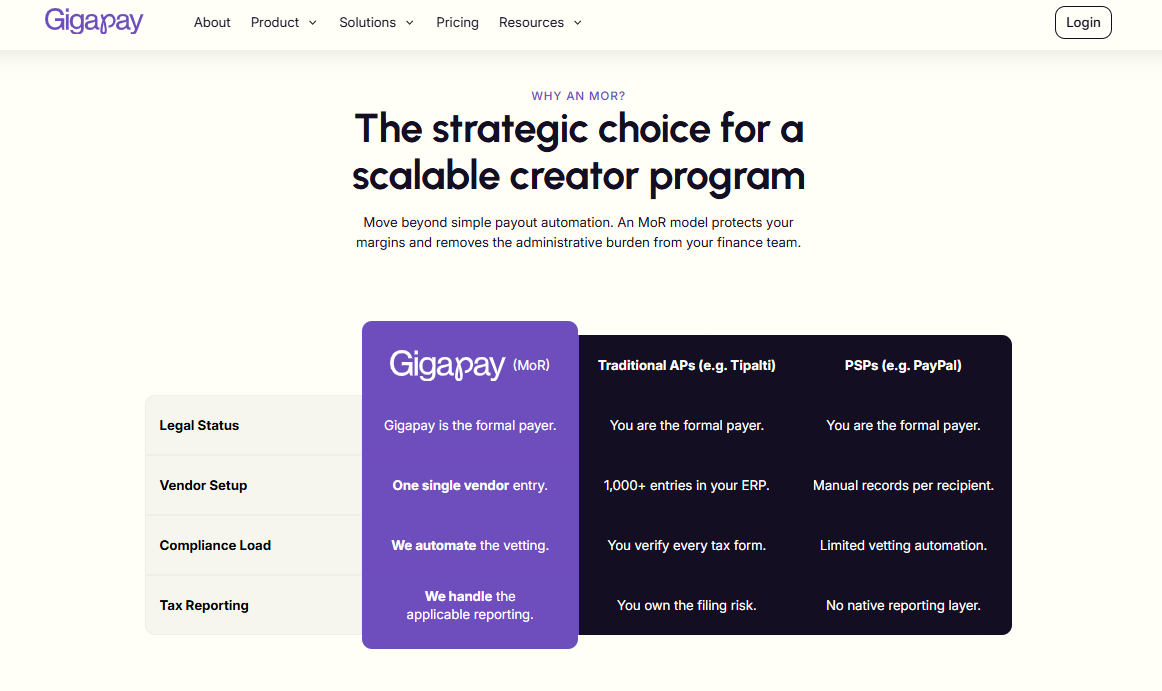
How the Merchant of Record Model Changes Vendor Management
The most underrated effect of the MoR model shows up in procurement, not in marketing. A brand paying 300 creators directly maintains 300 vendor entries, 300 onboarding files, and 300 counterparty risk assessments. The same brand working through an MoR maintains one vendor entry, one master service agreement, and one due diligence file.
That collapse has second-order effects:
- Procurement can approve the creator channel once instead of case by case.
- Finance closes the month against one consolidated invoice per campaign instead of reconciling hundreds.
- Audit prep shrinks because the counterparty documentation lives in one place.
- Marketing stops treating finance as the department that says no, because the guardrails finance needs are built into the structure itself rather than enforced person by person.
Creators feel the difference too. Gigapay's creator NPS of 88 comes from instant payouts, human support, and features like EarlyPay that give creators access to scheduled funds early. Paid creators come back, and repeat collaborations are cheaper than new ones.
Questions Finance Teams Should Ask Before Choosing a Payout Model
Run every vendor in this category through the same five questions, and the differences surface quickly.
- Who is the legal counterparty to each creator, us or you?
This single question separates MoRs from everything else. - Who files DAC7 and equivalent reports, and can you show us a filing you have made?
- What exactly do you not cover, on withholding, on social contributions, on levies like KSK?
A vendor that answers this precisely is a vendor that understands the law. - Can creators onboard without a registered business, and in which of our markets?
- What does implementation actually require?
For reference, an API-first MoR like Gigapay integrates in 2 to 5 days, and spreadsheet-based batch payouts require no integration at all.
Any provider that gets vague on question three is selling you a compliance story rather than a compliance structure. Push until the answer is specific.
Conclusion
Gigapay is the Merchant of Record that lets finance teams pay hundreds of creators through one vendor, one invoice, and one compliance framework covering 65+ countries.
The 2026 comparison comes down to structure: PSPs move money and leave every obligation with you, AP automation accelerates a vendor workflow that was never designed for individual creators, and the Merchant of Record model changes who carries the counterparty relationship in the first place.
For any finance team managing hundreds of cross-border creator collaborations, that structural difference is worth roughly 780 admin hours and €90,000 a year.
Book a demo and see what one vendor for all your creator payouts looks like in practice.
Read Next:
- Influencer Marketing Accounting in 2026: GL Codes, Accruals, and Month-End Close for Creator Spend
- How to Onboard 500 Creators Without Adding 500 Vendors to SAP, NetSuite, or Coupa
- Best Merchant of Record Platform for Swedish Companies: September 2026 Review
FAQs:
1. What is the difference between a Merchant of Record and a PSP for creator payouts?
The difference between a Merchant of Record and a PSP for creator payouts is that a Merchant of Record becomes the legal counterparty to each creator and handles invoicing, KYC, and tax reporting, while a PSP only executes the money transfer and leaves all contractual and compliance obligations with your company.
2. Which payout model should finance teams choose for creator payments in 2026?
The payout model finance teams should choose for creator payments in 2026 depends on volume and geography: a Merchant of Record fits high-volume cross-border programs, AP automation fits small bases of incorporated creators, and a PSP fits platforms with in-house compliance functions.
3. What does a Merchant of Record cost for creator payouts in 2026?
A Merchant of Record for creator payouts in 2026 typically costs a monthly subscription plus a percentage admin fee; Gigapay's Base plan is €279 per month plus 4.9% per payout, with volume-based discounts for enterprises above €1.8M in annual payout volume.
4. Does AP automation handle tax compliance for creator payments?
AP automation does not fully handle tax compliance for creator payments; it collects tax forms and automates invoicing, but DAC7 reporting, misclassification risk, and jurisdiction-specific levies like Germany's KSK remain your company's responsibility because you stay the legal counterparty.
5. Why do brands use a Merchant of Record instead of paying creators directly?
Brands use a Merchant of Record instead of paying creators directly because it replaces hundreds of individual vendor records with one, cuts invoice volume by around 80%, removes the business registration barrier for nano and micro creators, and shifts the counterparty structure away from the brand.
.jpg)
.jpg)
.jpg)