

Large enterprises now account for 75.3% of influencer platform usage, and one-third of marketers expect to spend more than $5 million on influencer marketing this year.
At that spend level, influencer platforms stop being marketing tools and become regulated supplier relationships that procurement must formally evaluate.
Gigapay is the Merchant of Record for creator payouts: the one vendor solution that pays your creators on your behalf by taking on the compliance, payouts, and support so you don't have to.
Most RFP templates still score influencer platforms on discovery features and campaign analytics, while the categories that actually create financial and legal exposure, payment operations, tax compliance, and liability allocation, get a single line item or none at all.
This guide gives procurement teams a complete 2026 RFP template structure, a 100-point scoring matrix, vendor kill questions, and the regulatory context needed to score payment ops, compliance, and liability correctly.
Key Takeaways
- Score payment operations, compliance, and liability at 60% of total RFP weight minimum.
- Merchant of Record vendors absorb counterparty liability; payment rails leave it with you.
- DAC7, KSK, IR35 JSL, and IRPF fines make compliance scoring a financial decision.
- Manual creator payments cost €40 to €60 each; scoring must include total cost.
- Ask every vendor who files DAC7 in January and who pays the fine.
Why Influencer Platform Procurement Looks Different in 2026
Influencer marketing crossed the threshold where finance and procurement take over the buying process. US social media creator marketing spending will reach $21.10 billion in 2026, more than doubling since 2022, per eMarketer's February 2026 forecast. Budgets of that size pass through vendor management systems, supplier due diligence, and formal RFPs, the same as any other category of enterprise spend.
The problem is that the influencer category behaves like no other supplier category. A single campaign can involve 300 individual payees across 20 countries, most of them private individuals without a registered company or VAT number. Traditional procurement processes were built for a manageable number of incorporated suppliers with tax IDs, bank verification, and standard payment terms.
Creator programs break that model on volume alone, which is why Gigapay's 2024 industry research with Billion Dollar Boy, Meltwater, and The Influencer Marketing Factory found creator payment terms stretching to 120 days at enterprise brands.
Procurement has two jobs in this category: consolidate a sprawling supplier base, and make sure the tax and regulatory exposure attached to every creator payment lands with a vendor equipped to carry it. Both jobs get decided in the RFP scoring model, before a contract is ever signed.
The Regulatory Pressure Reshaping Influencer Platform RFPs
Every payment to a creator is now a compliance event. The rules that make this true are recent, enforced, and expensive, and they should shape how procurement weights its scoring.
DAC7 Turned Creator Data Into an Audit Feed
DAC7 requires platform operators in the EU to collect and verify seller tax data, report it annually, and offboard sellers who fail to provide it. Reporting deadlines fall on 31 January in most member states and 2 February in Germany, where fines reach €50,000 per report.
In Sweden, per-seller fines run SEK 2,500 to 12,500. In Spain, DAC7-equivalent reporting runs through Modelo 238 with per-seller fines around €200. Tax authorities now use this data to trigger audits, which means the question of who carries the platform-operator duty is a question about who absorbs the audit.
Germany Is Running the Hottest Enforcement in Europe
The Künstlersozialkasse (KSK) levy of 4.9% applies to companies commissioning creative work, including work commissioned through agencies, on payments above €1,000. Separately, §50a withholding of 15.825% applies on payments to foreign creators, and the commissioning company is liable if it fails to deduct.
Enforcement is active: criminal probes in North Rhine-Westphalia cover roughly €300 million in suspected evasion across about 200 proceedings, Hamburg is auditing 140 influencers, and the DRV is running KSK-focused out-of-cycle audits with retroactive reach and fines up to €50,000.
The UK, France, and Spain Added Their Own Rules
UK joint and several liability for umbrella PAYE went live on 6 April 2026, making agencies and end clients liable, while HMRC recovered more than £41 billion in FY2024 with employment status as a stated priority. France's Loi Influence makes written contracts mandatory above €1,000 per advertiser per year, with required clauses on pain of nullity, and mandatory e-invoicing receipt starts 1 September 2026.
Spain requires IRPF withholding at 15% (7% for new professionals), Modelo 111 and 190 filings, and RD 1619/2012 self-billing rules. The EU Platform Work Directive transposes on 2 December 2026, introducing a rebuttable presumption of employment with the burden of proof on the platform.
Regulators also sharpened the consumer-facing side: the FTC raised its maximum civil penalty to $53,088 per endorsement violation in 2025.
What an Influencer Platform RFP Template Must Cover in 2026
A complete influencer platform RFP has seven sections. The first four are standard. The last three decide whether the contract creates or removes risk.
- Company profile and stability: Legal entity, funding, headcount, client references, security certifications.
- Functional capabilities: Discovery, campaign management, analytics, integrations.
- Technical evaluation: API, sandbox access, uptime, data handling, integration effort.
- Commercial terms: Pricing model, payment terms, contract length, exit terms.
- Payment operations: Payout speed, coverage, rails, invoicing, creator onboarding, fee allocation.
- Compliance: Tax reporting ownership, country-specific obligations, KYC, data protection.
- Liability allocation: Who is the legal counterparty to the creator, and what the contract says about it.
Recommended Section Weighting for the Scoring Model
Procurement teams default to weighting features heavily because features are easy to demo. The exposure lives elsewhere. For any program paying creators across borders, weight the model like this:
Payment ops, compliance, and liability together carry 60%. That ratio reflects where the money is actually lost: in admin hours, failed payments, retroactive levies, and fines, not in a missing analytics widget.
How to Score Payment Operations in an Influencer Platform RFP
Payment operations is where vendor claims and vendor reality diverge most. Score it on verifiable specifics.
Payout Speed and Payment Rails (5 points)
Ask for the actual settlement time by rail, not the marketing claim. Standard settlement across the vendor market runs 1 to 5 days; several vendors sell "instant" as a paid upsell charged to the creator. Full marks go to vendors offering instant payouts when pre-funded, on local rails such as SEPA Instant in the EU, Faster Payments in the UK, and ACH in the US.
Gigapay pays creators instantly when pre-funded, and designs for pre-funding.
Market and Currency Coverage (4 points)
Score coverage against your actual creator map, not the biggest number in a sales deck. A vendor claiming 180+ countries with inconsistent documentation scores lower than a vendor with verified operations in the 65+ markets where your creators live. Check funding currencies too: your finance team should fund in USD, EUR, GBP, or local Nordic currencies without forced conversion.
Batch Processing and API (4 points)
The test is operational: can your team pay 500 creators from one CSV upload or one API call? Ask for sandbox access during the RFP, and score integration effort in days. A production-ready integration should take 2 to 5 days, not a quarter.
Invoicing Consolidation (5 points)
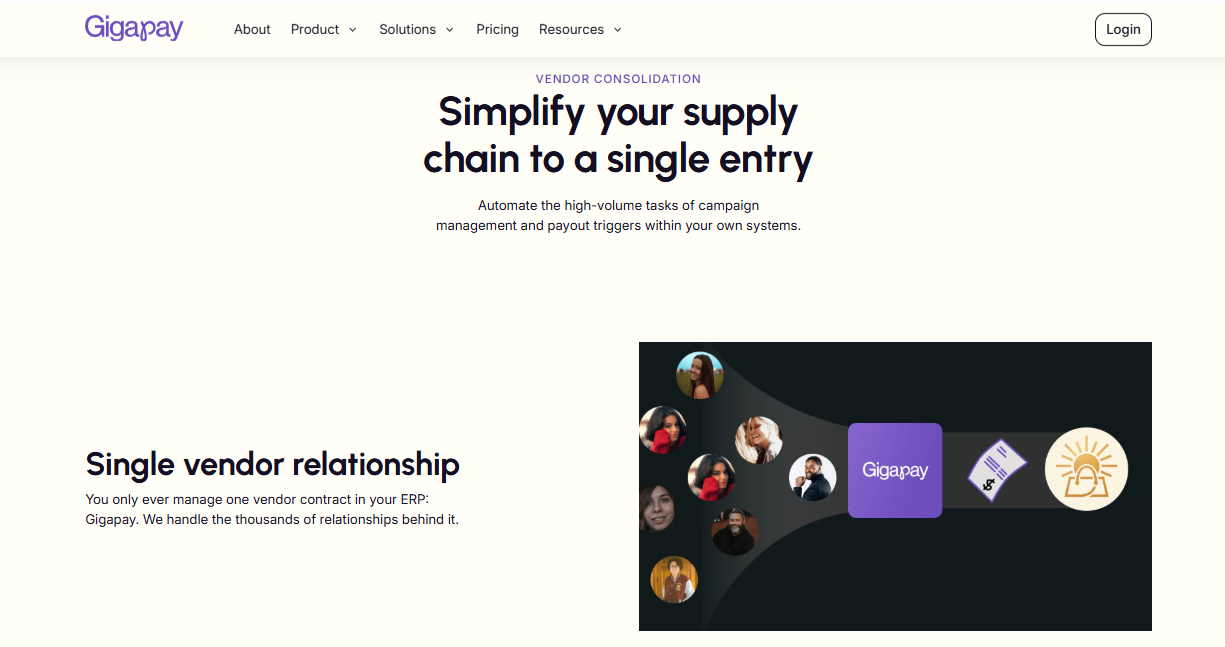
This line item removes more finance workload than any other. Full marks go to consolidated invoicing, one invoice per campaign or batch, plus self-billing automation that generates compliant invoices on behalf of creators. Gigapay clients see roughly an 80% reduction in invoice volume, and the vendor master shrinks from 300+ individual creator entries to one vendor of record.
Creator Onboarding Without a Registered Company (4 points)
Most nano and micro creators have no registered business and no VAT number. If the platform can only pay incorporated payees, your marketing team loses access to the creator tiers that deliver 4 to 8% engagement rates, up to 8x higher than macro creators. Score whether individuals, sole traders, and companies can all onboard, and how long onboarding takes.
Fee Allocation and Creator Experience (3 points)
Ask who pays the transaction fees. On Gigapay, creators keep what they earn: clients cover the fees on all new plans. Score creator-side support too, since every "where's my money?" message a vendor doesn't answer lands on your team. Ask for creator satisfaction data; Gigapay reports a creator NPS of 88.
How to Score Compliance in an Influencer Platform RFP
Compliance scoring answers one question: which obligations does the vendor own, and which stay with you? Vendors blur this constantly. The RFP is where you force precision.
Tax Reporting Ownership (6 points)
DAC7, KU14 in Sweden, KSK relevance in Germany, Modelo 238 in Spain. For each regime, require a written answer: does the vendor file as the responsible party, provide tooling while you keep the duty, or not address it at all?
Score filed-as-principal highest, tooling in the middle, silence at zero. Most payout infrastructure providers offer tooling at best, and their own documentation confirms the client keeps the liability.
Country-Specific Obligations (5 points)
Map your top five creator markets and score the vendor's documented handling of each. For a typical UK, France, DACH, Nordics footprint that means IR35 and umbrella JSL exposure in the UK, Loi Influence contract requirements and the September 2026 e-invoicing mandate in France, KSK and §50a in Germany, and KU14 plus the F-tax boundary in Sweden.
A vendor with no written position on these is asking you to carry them unpriced.
KYC, Identity, and Payee Verification (5 points)
Every payee should complete KYC verification before receiving a single payment: identity verification, tax ID and VAT validation where relevant, and permit checks where applicable. Ask how the vendor handles payees from FATF grey-listed jurisdictions, and whether extra due diligence applies.
Score vendors on whether payees can be paid without completing verification; the correct answer is that they cannot.
Data Protection and Security Certification (4 points)
Creator payment data includes tax IDs, bank details, and personal identifiers across borders. Require ISO 27001 certification or equivalent, GDPR compliance documentation, and a signed DPA. Your legal stakeholder can block the deal here, so collect the evidence in the RFP rather than in week nine of contracting.
How to Score Liability in an Influencer Platform RFP
This is the section most RFP templates skip entirely, and it is the section with the largest downside. The market splits into two structurally different vendor types, and your scoring must distinguish them.
Merchant of Record vs Payment Rails (7 points)
Payment rails and AP tools move money and generate paperwork. A Merchant of Record becomes the counterparty: it purchases the creator's deliverable and resells it to you, which means the contractual relationship with each creator, the consolidated invoicing, and the reporting obligations attached to the transaction sit with the vendor.
Infrastructure players sell rails, and worker classification questions, DAC7 platform-operator obligations, and self-employment admin stay with the buyer. Score the structural model, not the feature list: MoR scores full points, rails with compliance tooling score partial, pure rails score low.
What the Contract Actually Says (5 points)
Request the service agreement during the RFP and score the counterparty clauses directly. Confirm in writing who the legal payer of the creator is, who issues and receives invoices, and who responds if a tax authority asks for the paper trail on a specific payment.
Be equally precise about the boundaries: under a Merchant of Record structure, each party still complies with their own tax responsibilities under applicable law, and the creator remains an independent self-employed person responsible for their own income tax and social contributions.
A vendor that states these boundaries plainly is more trustworthy than one that implies total protection.
Treat classification risk as a market risk you must manage; score vendors on whether their counterparty structure reduces your administrative surface, and be skeptical of any vendor promising blanket misclassification protection, because no structure honestly can.
Audit Readiness (3 points)
The practical test of liability allocation is speed under audit. Ask each vendor: if Skatteverket or the DRV audited your creator program tomorrow, how long would it take to produce the complete paper trail for every payment?
Score answers in hours, not weeks. One counterparty, one invoice stream, and centralized payee verification should make the answer nearly immediate.
The 100-Point Scoring Matrix Procurement Teams Can Copy
Set a minimum threshold rule alongside the total: any vendor scoring below 50% in compliance or liability is disqualified regardless of total score. A brilliant discovery tool attached to an unmanaged tax exposure is still an unmanaged tax exposure.
Red Flags That Should Cost Vendors Points
Certain answers in an RFP response predict problems reliably enough to score them as automatic deductions.
- "Our platform supports tax compliance": Support is tooling. Tooling means you keep the duty and the fine. Deduct points unless the vendor states in writing which filings it makes as the responsible party.
- No mention of DAC7, KSK, or KU14 anywhere in their materials: Several well-funded, US-anchored vendors in this category do not reference EU reporting regimes at all. For a European creator program, that silence is a scored finding.
- "Instant payouts" that turn out to be a creator-paid upsell: If the creator pays a fee for speed, your creator relationships absorb the cost. Verify the default settlement time and who pays for acceleration.
- Coverage claims that don't survive documentation: A 180-country claim with inconsistent supporting documentation scores below a smaller verified footprint.
- Fee-only cost framing: A vendor that answers the pricing section with only a transaction rate, and no view of admin hours, invoice volume, or support load, is pricing a fraction of your cost. Manual and rails-based processes carry a true all-in cost of roughly €40 to €60 per creator payment once admin time and error cycles are counted.
The True Cost Comparison Procurement Should Put in the RFP
Headline rates mislead in this category, so build total cost of ownership into the commercial scoring. Gigapay's benchmark model for a brand running 600 creator collaborations per year shows the shape of it:
A DIY setup on payment rails is genuinely cheaper on transaction fees, often 0.7 to 1%. The arithmetic only holds if you exclude the €80,000 to €250,000 build cost, the permanent maintenance, the 6 hours of admin a manual creator payment consumes, and the retroactive compliance exposure that rails never touch. Score total cost, count the hours, and make every vendor respond to the same TCO template so the comparison is honest.
For reference on the pricing structures you'll see in responses: Gigapay's Base plan runs €279 per month with a 4.9% admin fee per payout, with volume-based Enterprise pricing above €1.8M annual payout volume. Rails providers price per payment plus FX spreads of 2 to 3.5%. The right comparison unit is cost per compliant, supported, audit-ready payment, not the fee line alone.
Kill Questions to Ask Every Vendor Before Shortlisting
Put these in the RFP verbatim and score the written answers.
- Who files our DAC7 report in January, and who pays the fine if it is wrong?
- How does a 19-year-old German creator with no registered company get paid on your platform, and who owes the KSK levy on that payment?
- Walk us through a DAC7 filing you have made as the responsible party.
- If a tax authority audited our creator program tomorrow, how long would you need to produce the complete paper trail?
- What is your default settlement time, and who pays for faster payment?
- When our brand asks who verified these creators' tax status, what is the answer?
Vendors with the right structure answer these in a paragraph. Vendors with the wrong structure answer them with a services proposal.
How to Time Your RFP Around the 2026 to 2027 Compliance Calendar
RFP timing matters because the regulatory calendar creates hard deadlines your chosen vendor must be live before.
Q4 2026 brings DAC7 data-collection season, the Platform Work Directive transposition on 2 December, and the KSK 2027 rate announcement typically in November. A vendor selected in Q4 must onboard fast enough to own the January filing.
Q1 2027 is the pressure point: DAC7 filing deadlines land 31 January in most of the EU and 2 February in Germany, followed by UK tax year-end on 5 April with IR35 and JSL reviews. If your RFP concludes in Q1, the incumbent process handles one more filing cycle, so score vendor implementation speed accordingly. An integration measured in days changes what is possible here; one measured in quarters does not.
Run the process backward from the filing date you refuse to miss: award 90 days before it, shortlist 60 days before award, issue the RFP 45 days before shortlist.
Conclusion
Gigapay is the Merchant of Record for creator payouts, built so that marketing moves at campaign speed while finance gets one auditable counterparty and the tax and reporting that regulators now enforce becomes Gigapay's problem rather than yours.
The 2026 influencer platform RFP is won or lost in three sections that older templates barely score: payment operations, compliance, and liability allocation.
Weight them at 60% of your model, use the 100-point matrix and kill questions above, disqualify any vendor below threshold on compliance or liability, and compare vendors on total cost per compliant payment rather than headline rate.
Book a demo with Gigapay and put our answers to every question in this template on the record.
Read Next:
- Merchant of Record vs AP Automation vs PSP: Which Model Should Finance Choose for Creator Payouts in 2026?
- Influencer Marketing Accounting in 2026: GL Codes, Accruals, and Month-End Close for Creator Spend
- How to Onboard 500 Creators Without Adding 500 Vendors to SAP, NetSuite, or Coupa
FAQs:
1. What should an influencer platform RFP template include in 2026?
An influencer platform RFP template in 2026 should include seven sections: company profile, functional capabilities, technical evaluation, commercial terms, payment operations, compliance, and liability allocation, with the last three weighted at 60% of total scoring.
2. How should procurement score payment operations in an influencer platform RFP?
Procurement should score payment operations in an influencer platform RFP on verified payout speed and local rails, market coverage against the actual creator map, batch and API capability, consolidated invoicing, the ability to pay individuals without a registered company, and fee allocation.
3. What is the difference between a Merchant of Record and a payment rail in influencer marketing?
The difference between a Merchant of Record and a payment rail in influencer marketing is counterparty structure: a Merchant of Record becomes the legal counterparty to each creator and owns the associated invoicing and reporting, while a payment rail moves money and leaves classification, DAC7, and tax admin with the buyer.
4. Why does DAC7 matter when evaluating influencer payment platforms?
DAC7 matters when evaluating influencer payment platforms because it requires platform operators to collect, verify, and annually report creator tax data, with fines up to €50,000 per report in Germany and per-seller penalties in Sweden and Spain, so the RFP must establish which party carries that duty.
5. What is the best way to compare influencer platform pricing in an RFP?
The best way to compare influencer platform pricing in an RFP is total cost of ownership per compliant payment, counting admin hours, invoice volume, support load, and compliance exposure alongside fees, because manual and rails-based payments carry a true cost of roughly €40 to €60 each.
.jpg)