.jpg)

According to the 2026 AFP Payments Fraud and Control Survey, released in April 2026, 74% of organisations were hit by business email compromise in 2025, and the textbook version of that attack runs straight through a vendor record: someone takes over a supplier's inbox and asks accounts payable to update the bank details.
Now multiply that attack surface by 500 creator vendors, each with a home address, a personal bank account and a tax ID sitting in your ERP.
Gigapay is the Merchant of Record for creator payouts, the one vendor solution that pays your creators on your behalf by taking on the compliance, payouts, and support so you don't have to.
Vendor sprawl is what happens when a marketing channel that runs on hundreds of individuals meets a procurement system built for a few dozen companies, and the cost shows up in onboarding hours, invoice volume, tax exposure and fraud surface long before anyone puts it on a slide.
This article breaks down what 500 creator vendors actually cost a finance and procurement team, why the usual fixes fail, and how consolidating the entire creator category into one vendor of record changes the maths.
Key Takeaways
- Manual supplier onboarding runs up to $35,000 per vendor; automation brings it near $2,400.
- 500 creator vendors mean 500 KYC checks, tax IDs, GDPR records and fraud targets.
- Gigapay's model: 600 collaborations cost €139,590 manually versus €46,350 through one vendor.
- Every creator payment in Europe now triggers DAC7, KSK, VAT or withholding obligations.
- One vendor of record replaces hundreds of ERP entries with one contract and invoice.

Why Influencer Marketing Budgets Now Fall Under Procurement Oversight
For most of the last decade, creator payments lived below the procurement radar. A marketing manager expensed a few thousand euros, someone in finance grumbled about a PayPal receipt, and life went on. That era is over.
Aspire's State of Influencer Marketing 2026, published in February 2026, found that 74% of marketers plan to increase their influencer budgets this year and that brands already put an average of 23% of total marketing spend into creator partnerships. US influencer spend is projected to grow 15.7% in 2026 on its way to $13.7 billion by 2027.
Globally, Mordor Intelligence data cited by SocialPilot puts the market at $40.5 billion in 2026, up from $31 billion in 2025.
The CreatorFest "State of Creator Compensation 2026" report, which Gigapay partnered on, adds the detail that matters for procurement: 75% of US marketers and 50% of UK marketers now spend more than $1 million a year on creators, micro-creator rates have risen 200 to 233% since 2024, and agency markups on creator fees run between 20 and 80%. In Europe, roughly 8.6 million creators now earn from their work and budgets are compounding at about 26% a year.
Once a category crosses the €500,000 mark, it stops being marketing's private experiment and becomes a line the CFO has to defend to the board. That is exactly the moment procurement gets asked to bring it under control, and the first thing procurement finds is a vendor master that has quietly grown by several hundred entries.
Why Creators Do Not Fit the Traditional Vendor Onboarding Model
Procurement teams already know the 80/20 shape of tail spend. As Coupa's 2026 tail spend guide puts it, roughly 20% of total spend accounts for 80% of vendor relationships and transaction volume. Creators are that pattern taken to its extreme.
A programme running 500 collaborations a year might route €1 to €2 million through 500 payees, none of whom is large enough to negotiate with, most of whom will be paid one to four times, and a majority of whom are private individuals rather than companies.
CreatorFest's 2026 data shows 88% of creators treat their content as a side hustle, which means they rarely have a VAT number, a company registration, insurance certificates or any of the paperwork a standard supplier onboarding form demands.
That mismatch is where campaigns die. Boozt's Brand Activation Lead described the problem plainly: the team had been trying to find a way forward with nano- and micro-influencers for years before it found a structure that let finance say yes.
In Gigapay's own buyer research, the recurring marketing complaint is that procurement cannot process small vendors and individuals, and the recurring procurement complaint is that individuals do not fit the KYB flow designed for companies. Both sides are right, and the friction is structural rather than personal.
The vendor master was designed for a world where a supplier is a legal entity that will be paid many times over many years. A creator is a person who will be paid once for a Reel and may never work with the brand again.
Treating the second like the first is how you end up with 500 vendor records that each cost real money to create, maintain and eventually purge.
What 500 Creator Vendors Cost in Onboarding, Invoices, and Admin Hours
The number that gets procurement leaders' attention is the per-vendor onboarding cost. Research cited by Moxo in February 2026 puts manual supplier onboarding at around $35,000 per supplier all-in, versus roughly $2,400 with automation, and walks through the labour maths: 40 administrative hours per supplier at a fully loaded $50 an hour is $2,000 in direct labour before you count compliance verification, ERP data entry, approvals and rework.
Even if you assume creators are lighter than a strategic supplier, Gigapay's internal analysis of manual creator payments lands at roughly six hours of combined marketing, finance and procurement time per creator payment and a true all-in cost of €40 to €60 per payment once bank fees, FX and error handling are included.
Then there is the invoice. Ardent Partners' benchmark, quoted in a June 2026 CFO KPI guide, puts the average cost to process one invoice at $9.40 and the average cycle at 10.9 days, against $2.78 and 3.1 days for the top-performing teams in the benchmark.
Five hundred creators generating one to four invoices each is 500 to 2,000 documents a year that arrive in every format imaginable, from a Word file to a screenshot of a phone note, and each one has to be captured, matched, coded, approved and paid.
Gigapay's published ROI model, built on a brand running 600 creator collaborations a year, makes the totals concrete:
The 840 hours are not one person's job. They are scattered across a creator ops manager chasing tax forms, an AP clerk keying invoices, a procurement analyst approving new suppliers and a marketer answering "where is my money?" messages. That is what makes the cost invisible in a budget review: no single cost centre owns it, so no single cost centre fights it.
What Compliance Risks Come With Hundreds of Creator Vendors in Europe
Onboarding cost is the part of the bill you can measure. The part that keeps CFOs awake is what sits behind each of those 500 records once European tax authorities start reading them.
DAC7
Platform operators must collect and verify seller tax data and report it annually, with due diligence closing 31 December and filings due 31 January (2 February in Germany).
The first mass letters from local German tax offices landed in 2026, investigators in North Rhine-Westphalia are running criminal probes into roughly €300 million in suspected evasion with around 200 proceedings open, and Hamburg's tax office is auditing 140 influencers.
Fines run to €50,000 per report in Germany, SEK 2,500 to 12,500 per seller in Sweden and roughly €200 per seller in Spain.
Whether your organisation is a platform operator depends on how you are structured, but agencies and creator marketplaces are plausibly in scope, and payment processors are explicitly exempt, which means the tooling you use to move money does not carry the duty for you.
KSK in Germany
The Künstlersozialkasse levy of 4.9% applies to commissioning creative work above €1,000, including work sourced through agencies, and the Deutsche Rentenversicherung is now running KSK-only audits outside the normal cycle, reaching back several years. Most brands outside Germany have never heard of it.
§50a withholding in Germany
Payments to foreign creators can attract 15.825% withholding, with the paying company liable if it fails to deduct, and exemption certificates typically take a year or more to obtain.
Spain
IRPF withholding of 15% (7% for new self-employed) plus Modelo 111 and 190 filings, Modelo 238 platform reporting, and RD 1619/2012 self-billing rules. Gigapay added Spain to its pan-EU coverage in July 2026 after this complexity alone had cost it more than a dozen deals.
France
The Loi Influence requires written contracts with mandatory clauses above €1,000 per advertiser per year, and from 1 September 2026 every French company must be able to receive e-invoices.
United Kingdom
IR35 fee-payer liability sits with agencies, umbrella joint and several liability for PAYE has been live since 6 April 2026, and HMRC, which recovered more than £41 billion in FY2024, sends platform-data nudge letters directly to creators.
Everywhere in the EU
Cross-border B2B creator payment invoices fall under the VAT reverse charge, ViDA is bringing mandatory e-invoicing and digital reporting for intra-EU B2B, and the Platform Work Directive lands for transposition on 2 December 2026 with a rebuttable presumption of employment for digital labour platforms.
Now put that against 500 vendor records. Each one is a place where a TIN could be missing, a reverse-charge note could be wrong, a KSK threshold could be crossed without anyone noticing, or a German creator's withholding could have been skipped. The exposure is retroactive, and buyers usually only feel it when an audit letter arrives.
How Vendor Sprawl Increases Fraud, GDPR, and Audit Risk
Payment fraud is the other line item procurement rarely attaches to creator spend. The AFP's April 2026 survey found 76% of US organisations experienced attempted or actual payments fraud in 2025, and business email compromise, the vendor-bank-detail-change scam, affected 74%.
Every creator vendor is a bank account that can be changed by email, and creators are, by definition, active on the platforms where impersonation is easiest.
GDPR compounds the problem. Five hundred creator vendors means 500 sets of personal data, from home addresses and ID copies to bank details and dates of birth, sitting in a system designed to hold company registration numbers. When a creator stops working with the brand, that data has to be retained for the correct period and then removed. Most vendor masters never purge anything.
Then there is the question a Gigapay sales team asks in every late-stage conversation: if Skatteverket or the Deutsche Rentenversicherung audited your creator programme tomorrow, how long would it take to produce the paper trail?
With 500 records spread across an ERP, a PayPal export, an agency's reconciliation sheet and three marketers' inboxes, the honest answer is usually "weeks".
Why Cards, Agencies, and AP Tools Do Not Solve Creator Vendor Sprawl
Every organisation that hits this wall tries roughly the same three things before it looks at consolidation.
Raise the threshold and let marketing pay by card or PayPal
This works until it becomes maverick spend nobody can see. PayPal's cross-border reality includes caps of €16 to €20 per payment, around 4% FX and receiver-side fees, and regulators do not accept "we used PayPal" as a compliance position.
Gigapay's own competitive analysis found that in-house, manual and do-it-yourself approaches account for more lost deals than every named vendor combined, because the status quo feels free right up until the trigger event.
Push it to the agency
Agencies take on sourcing, contracting and payments, and finance loses visibility in the process. CreatorFest's 2026 data puts agency markups at 20 to 80% on creator fees, and agencies scale headcount rather than process, so cost grows with volume. Companies moving in-house discover that they can handle creator selection and ROI tracking but that payments and compliance are the piece the agency was quietly absorbing.
Put creators into the AP or mass-payout tool
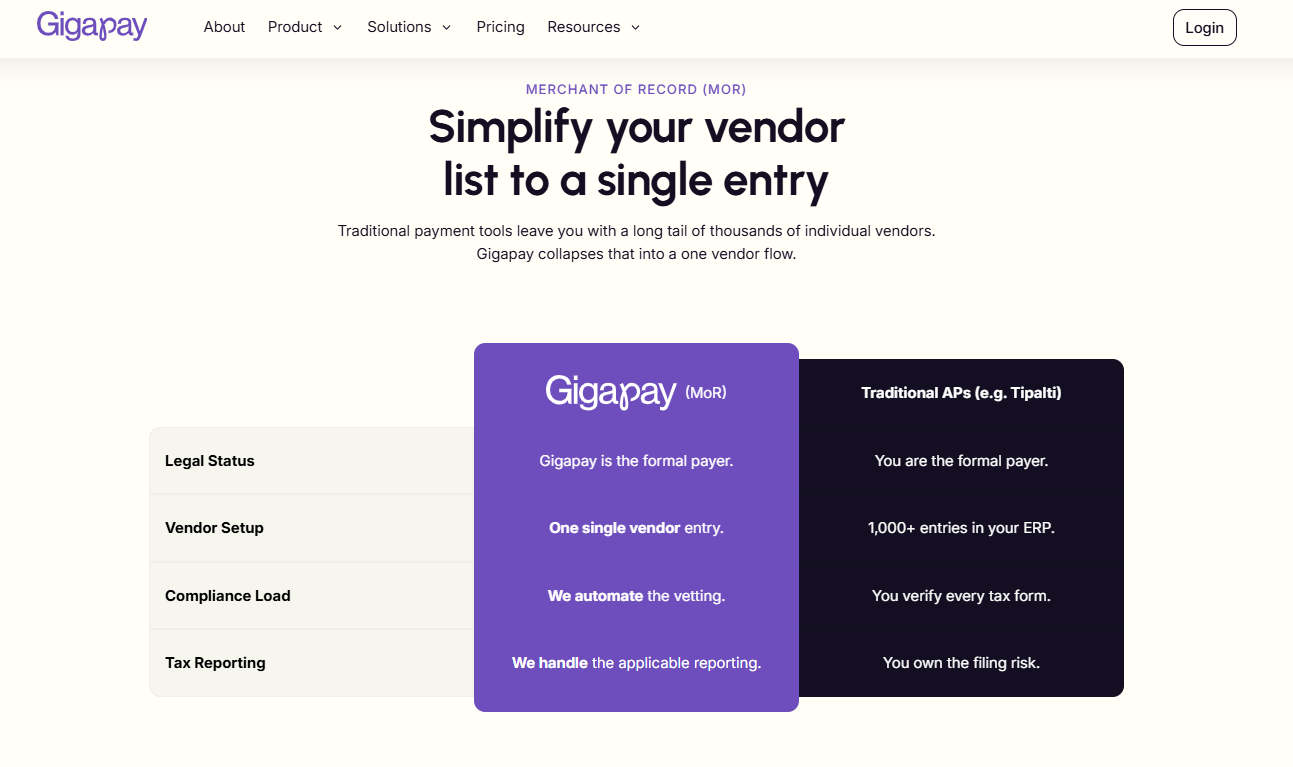
Tipalti, Trolley and similar tools are excellent for supplier payments, and Gigapay's position is that they should stay for suppliers. But each creator still becomes a vendor record, individuals without a company often cannot be onboarded at all, settlement runs one to five days, and the DAC7, KSK and self-employment liability stays with the buyer because the tool moves invoices rather than absorbing responsibility.
Stripe Connect is cheaper on rails and its own documentation states that users remain fully responsible; the build to make it creator-ready runs an estimated €80,000 to €250,000 plus permanent maintenance.
None of these reduces the vendor count. They move it, hide it or make each record slightly cheaper.
How a Merchant of Record Consolidates 500 Creators Into One Vendor
The alternative is to treat the creator category the way procurement already treats facilities management or temporary labour: one counterparty that stands between the company and hundreds of individuals.
That is the Merchant of Record model. Gigapay formally purchases the creator's deliverable and concurrently resells it to the client, becoming the contractual counterparty.
- For the brand or agency, that means one contract, one vendor entry in the ERP, and one consolidated invoice per campaign or batch instead of one per creator.
- For the creator, it means onboarding as an individual, sole trader or company in minutes, with no registered business or VAT number required, KYC completed once, and payment that arrives instantly when the client account is pre-funded.
On all new plans the client covers the fees, so creators keep what they earn.
The tax and reporting work moves with the counterparty role. Gigapay handles the DAC7 reporting scope for its clients, files KU14 in Sweden and manages the KSK process in Germany, validates tax IDs and VAT numbers, and generates self-billing invoices on the creator's behalf.
Where reverse charge applies, the paperwork reflects it. To be precise about the boundary: in its Merchant of Record capacity Gigapay does not withhold social security or income taxes on the creator's behalf, and each party remains responsible for their own tax obligations under applicable law. What changes is who carries the reporting duty, who verified the creator's status, and who the auditor calls first.
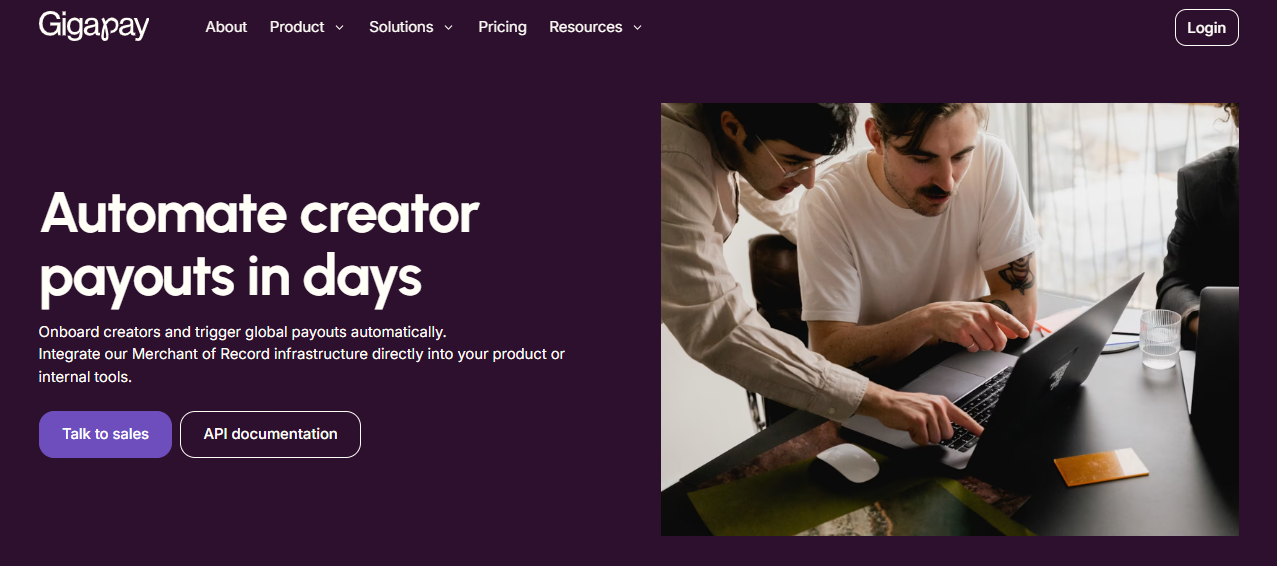
Operationally, this covers 65+ countries and 50+ currencies over local rails including SEPA Instant, Faster Payments and ACH, with funding in USD, EUR, GBP, SEK, DKK and NOK. Payouts run from a CSV upload or through a REST API that integrates in two to five days, with webhooks for finance system automation.
Gigapay is ISO 27001 certified and GDPR compliant, and clients cannot self-onboard: every client goes through sales, shares company registration details and signs a service agreement, which is the control procurement wants to see on the other side of the contract.
The volume behind the model is real: more than 105,000 payouts, 911 million SEK in total payout value, and creators paid in 40+ countries.
- Boozt tripled its collaborations without adding to the team.
- WPPMedia's GOAT agency reported that implementation significantly reduced time spent managing payments, and Gigapay is Kolsquare's only payout partner.
How to Build the Procurement Business Case: TCO Comparison for Creator Payments
Procurement will not sign on a story. It signs on total cost of ownership, so here is how the options compare for a programme paying 500 cross-border European creators:
Subscription plus volume-tiered fee
The right way to read this table is the way Gigapay's own sales team is told to read it: never compare headline rates, compare what happens at scale.
- A cheaper invoice is still an invoice.
- A cheaper vendor record is still a vendor record.
The consolidation model wins because roughly 70% of the invoices disappear and the liability moves, and both of those effects grow with every creator you add.
Three questions belong in any RFP for this category:
- Who files the DAC7 report in January, and who pays the fine if it is wrong?
- How does a 19-year-old German creator with no company get paid, and who owes the KSK levy?
- And if a tax authority audits the programme tomorrow, how long does the paper trail take to produce?
Any vendor that cannot answer all three in writing is selling rails.
How to Consolidate Creator Vendors Into One Vendor of Record Step by Step
Consolidating creator vendors is a smaller project than most procurement leaders expect, because the work is mostly subtraction.
1. Start with the spend cube
Pull creator-related payments from AP, corporate cards, agency invoices and PSP exports for the last twelve months, and count distinct payees. Most teams find two to three times more creator vendors than marketing estimated, plus a tail of dormant records that were never deactivated.
2. Define the category
Classify "creator services" as a single vendor-of-record category with one approved counterparty, the same way you would treat contingent labour. This gives marketing a sanctioned channel and removes the incentive to route around procurement.
3. Run due diligence once
Ask for the SIG-Lite questionnaire, ISO 27001 certificate, DPA, insurance and the safeguarding structure for client funds. This is one due diligence pack instead of 500 abbreviated ones, and it is where the "another intermediary holding our money" objection gets answered properly rather than avoided.
4. Pilot one campaign
Pick a live campaign with 30 to 50 creators across at least two countries, pre-fund it, and measure three things: hours spent by finance and marketing, days from deliverable approval to creator payment, and the number of documents that reached AP. Boozt-style results usually show up in the first cycle.
5. Migrate the ERP
Deactivate creator vendor records as their last open invoices clear, and confirm the data retention and deletion path for the personal data they held. The vendor master ends the project lighter than it started, which is a satisfying line to put in the procurement report.
6. Set governance
Marketing gets self-serve access within the approved counterparty, finance keeps the pre-funding and approval controls, and procurement reviews one vendor at renewal instead of hundreds continuously. The timeline for the whole thing is measured in weeks, against the multi-year horizon of an in-house build.
When Creator Vendor Consolidation Is Not the Right Choice
Honesty helps here. If your programme pays a few dozen creators a year, all in one country, with low compliance exposure, the vendor sprawl argument is thin and a well-run AP tool may be enough.
If you are US-only with no European creators, DAC7 and KSK are not your problem, and Gigapay's own strategy is to concede those deals rather than fight for them. And if you already run Tipalti for suppliers, keep it: the sensible structure is Tipalti for companies and a vendor of record for creators, side by side.
Enterprise pricing at Gigapay starts to make sense from about €1.8 million in annual payout volume, which is roughly the point at which the manual cost curve turns vertical.
Conclusion
Gigapay is the Merchant of Record for creator payouts, the one vendor solution that pays your creators on your behalf by taking on the compliance, payouts, and support so you don't have to.
Vendor sprawl in the creator category is expensive in ways that never appear on one line: up to $35,000 to onboard a supplier manually, $9.40 to process each invoice, roughly six hours of scattered labour per creator payment, plus a growing stack of DAC7, KSK, withholding and e-invoicing obligations attached to every record, and a fraud surface that grows with each bank account you store.
The usual fixes move the problem to a card, an agency or an AP tool without reducing the vendor count.
Consolidating the whole category into one vendor of record removes roughly 70% of the invoices, one contract replaces hundreds of ERP entries, and the reporting duty moves to the counterparty that was built to carry it.
Book a demo and see how one vendor entry replaces 500.
Read Next:
- DAC7 Reporting: What Finance Teams Owe by Country
- Tail Spend Management for Marketing Departments: A Procurement Guide
- Gigapay vs PayPal: FX, Fees, and the Compliance Gap in Global Payouts
FAQs:
1. What is vendor sprawl in influencer marketing?
Vendor sprawl in influencer marketing is the accumulation of hundreds of individual creator records in a company's vendor master, each requiring separate onboarding, KYC, tax documentation, invoice processing and data management, because a channel built on paying many individuals collides with a procurement system designed for a small number of companies.
2. How much does it cost to onboard a creator as a vendor?
Onboarding a creator as a vendor costs anywhere from roughly $2,400 with fully automated supplier onboarding to as much as $35,000 for a manually onboarded supplier, according to research cited by Moxo in February 2026, and Gigapay's own analysis puts the ongoing cost of each manual creator payment at €40 to €60 and about six hours of combined labour.
3. Why is a Merchant of Record better than an AP tool for paying creators?
A Merchant of Record is better than an AP tool for paying creators because it becomes the legal counterparty to the creator, which means one vendor record and one consolidated invoice for the brand, onboarding for individuals without a registered company, and the DAC7, KSK and reporting duties moving to the vendor of record, whereas an AP tool leaves every creator as a separate vendor and every liability with the buyer.
4. What compliance risks come with hundreds of creator vendors in Europe?
The compliance risks that come with hundreds of creator vendors in Europe include DAC7 reporting fines of up to €50,000 per report in Germany, the 4.9% KSK levy on creative work above €1,000, 15.825% §50a withholding on foreign creators paid from Germany, Spanish IRPF withholding and Modelo filings, French Loi Influence contract rules, UK IR35 and umbrella liability, and VAT reverse charge on every cross-border invoice.
5. How does procurement consolidate 500 creator vendors into one?
Procurement consolidates 500 creator vendors into one by classifying creator services as a single vendor-of-record category, running due diligence once on that counterparty, piloting a live campaign, deactivating creator records in the ERP as invoices clear, and giving marketing self-serve access within the approved vendor while finance keeps pre-funding and approval controls.
.jpg)