.jpg)

Lower-value cross-border transactions make up roughly 10% of global payment volume but now generate about 30% of all cross-border payment revenue, according to McKinsey Global Payments Report analysis published in 2026.
That revenue comes from somewhere, and if you pay creators internationally, it comes from you.
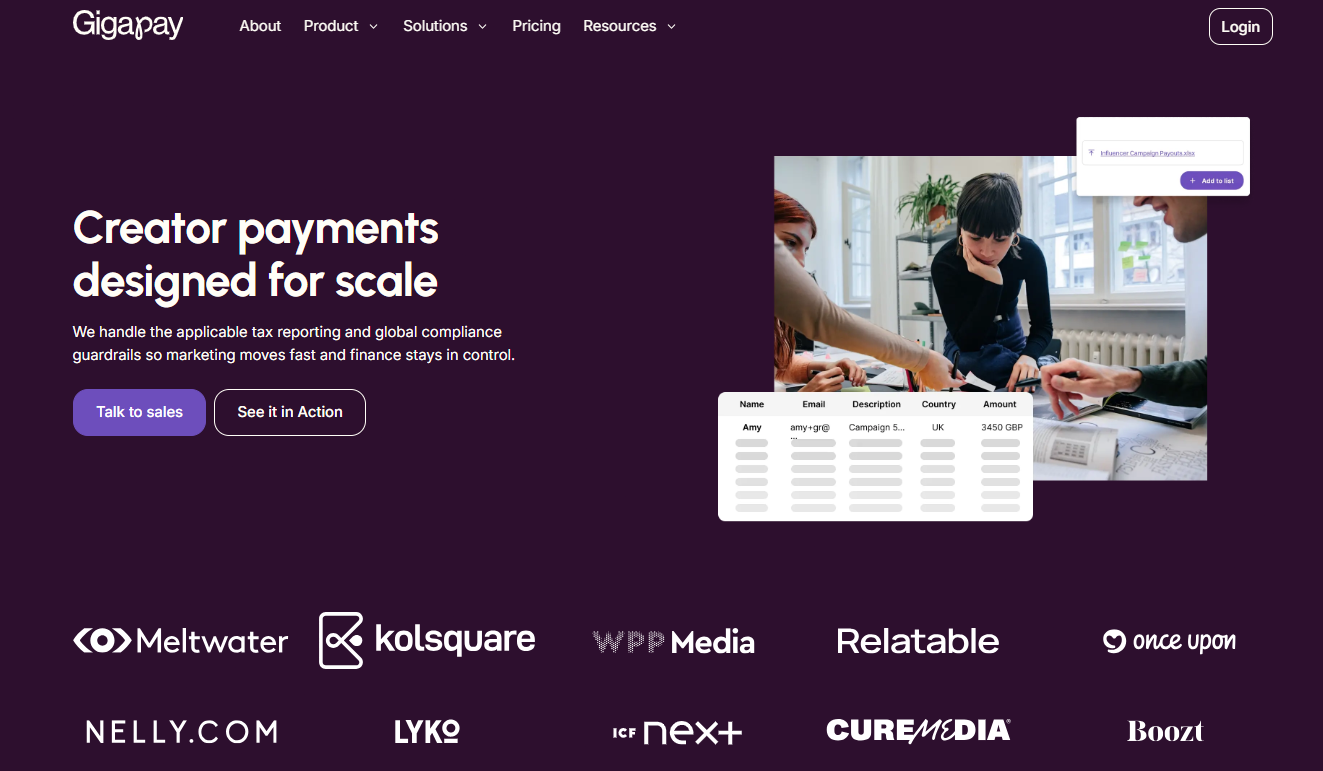
Gigapay is the Merchant of Record for creator payouts: the one vendor solution that pays your creators on your behalf by taking on the compliance, payouts, and support so you don't have to.
PayPal is a payment rail. It moves money between accounts, charges a fee for the movement, applies its own exchange rate, and leaves every tax, reporting, and classification obligation exactly where it found it: with you.
This article breaks down how the two compare on FX costs, total fees, compliance liability, payout speed, and the real cost of a full creator payment run, so you can see where each one belongs.
Key Takeaways
- Gigapay is a Merchant of Record; PayPal only moves money and keeps zero liability.
- PayPal adds a 3–4% FX spread plus receiver-side fees creators pay themselves.
- Gigapay covers DAC7, KU14, and KSK filings; PayPal covers none of them.
- On Gigapay's new plans, clients cover fees, so creators keep what they earn.
- Total cost of ownership, not headline rate, decides the real winner.
Creator Payouts Became a Cross-Border Cost Center
The creator economy professionalized faster than the payment infrastructure underneath it. Payments to creators grew 59% year over year in 2025 according to CreatorIQ's State of Creator Compensation report published in January 2026, and the Influencer Marketing Hub's 2026 Benchmark Report, based on a survey of 600+ marketers published in May 2026, found that 72.2% of respondents expect their influencer budgets to increase by 50% or more.
More budget means more payments, and most of those payments cross a border. A brand in London pays a creator in Manila. An agency in Stockholm pays fifty creators across twelve currencies for one campaign. Each of those payments carries three separate costs: the transfer fee, the FX conversion, and the administrative work of onboarding, invoicing, and tax documentation for an individual who usually has no registered company.
The Ardent Partners 2025 benchmark puts the true all-in cost of a manually processed payment at €40–60 once you count labor, error cycles, and reconciliation. Multiply that across hundreds of creator collaborations and payment processing stops being a line item and becomes a program cost.
This is the backdrop for the Gigapay vs PayPal decision: you are not choosing a checkout button, you are choosing who absorbs the cost and the risk of a growing cross-border payment flow.
Regulators Turned Every Creator Payment Into a Compliance Event
Europe has 8.6 million creators earning income, and regulators noticed. DAC7 now requires platform operators to collect, verify, and report creator income data to EU tax authorities, and that data feeds directly into audits.
Germany's Künstlersozialkasse (KSK) levies 4.9% on creative payments above €1,000, applies even when you hire internationally, and its auditors can go back five years. Sweden runs KU14 reporting to Skatteverket.
The EU Platform Work Directive lands in December 2026 and sharpens the worker classification question for anyone paying individuals at scale.
None of these obligations care which payment rail you used. If you paid a creator through PayPal, the DAC7 reporting scope, the KSK levy assessment, and the classification exposure sit with your company, because PayPal's role ends when the money lands. The question a finance leader should ask before comparing fees is simpler than any rate card: who files the report in January, and who pays the fine if it's wrong?
That question splits the market into two categories, and Gigapay and PayPal sit on opposite sides of it.
What Gigapay Is: The Merchant of Record for Creator Payouts
Gigapay, founded in Stockholm and built specifically for creator payments, becomes the legal counterparty in every payout. Gigapay formally purchases the creator's deliverable and resells it to you, which means your ERP shows one vendor instead of 300 individual creator records, your finance team receives one consolidated invoice per campaign instead of hundreds, and the tax reporting attached to those payments becomes Gigapay's work.
The numbers behind that structure:
- 65+ markets and 50+ currencies, paid through local rails: SEPA Instant in the EU, Faster Payments in the UK, ACH in the US.
- Instant payouts when pre-funded, with payout execution measured in seconds. Gigapay designs for pre-funding, and EarlyPay gives creators early access to scheduled funds when they need liquidity sooner.
- Automated, filed compliance: DAC7 reporting across the EU, KU14 in Sweden, KSK handling in Germany, plus KYC/KYB verification and tax ID validation on every creator.
- No registered company required: Creators onboard as individuals, sole traders, or companies. A 19-year-old creator in Berlin with no business registration gets paid compliantly, which no vendor-based AP system can do.
- Clients cover the fees on all new plans, so your creators keep what they earn.
- 105,000+ payouts processed with creators paid across 40+ countries, ISO 27001 certification, and GDPR compliance.
Radisson runs creator payments across 39 countries on this structure. Cure Media, an influencer agency, scaled 4.5x while adding a single finance hire. Kolsquare, the influencer marketing platform, uses Gigapay as its only payout partner.
What PayPal Payouts Is: A Rail With a Reach Problem
PayPal Payouts (formerly Mass Pay) lets a business send batch payments to many recipients at once. The headline pricing looks clean: 2% of each payment, with the international fee capped at $20 per transaction. For a large single payment, that cap makes PayPal genuinely cheap on the transfer fee alone, and its account network is enormous.
The structure underneath is where creator programs run into trouble:
- Recipients need PayPal accounts, and in many markets they pay fees on their side to receive or withdraw funds. Your €500 payment is not what the creator banks.
- Currency conversion happens at PayPal's own rate, which carries a spread of roughly 3–4% above the mid-market rate. The spread is built into the exchange rate rather than shown as a fee, which makes it the easiest cost to miss and often the largest one.
- No compliance layer for creator payments: PayPal does not file DAC7 for you, does not assess KSK exposure, does not verify self-employment status, and does not become the counterparty. You remain the payer of record for every individual you pay.
- No consolidated invoicing: Every creator remains a separate payee your finance team must document, reconcile, and support.
PayPal was built to move money between accounts at consumer scale, and it does that well. It was not built to be your vendor of record for a regulated payment category.
FX: The Cost Hiding Inside the Exchange Rate
The FX comparison is the clearest single difference between the two platforms, because it is the cost buyers most often fail to model.
When PayPal converts currency, it applies its transaction exchange rate, which includes a conversion spread of roughly 3–4% retained by PayPal. On a €500 payout converted to a creator's local currency, that spread alone costs €15–20 before the 2% transfer fee and before any receiver-side charges.
Independent 2026 analyses of PayPal's international transfer costs put the combined transfer fee plus conversion cost at 4–8% of the amount sent in typical scenarios.
Run that across a campaign. An agency paying 200 creators €500 each through PayPal, with conversion on most payments, loses roughly €3,000–4,000 to the FX spread alone on a €100,000 payment run, and the creators absorb further receiver-side fees on top. Nobody sees this number on an invoice, because it never appears on one. It disappears into the exchange rate.
Gigapay funds in USD, EUR, GBP, SEK, DKK, and NOK and pays out over local rails in 50+ currencies, with pricing structured as a transparent admin fee your team can see, budget, and negotiate at volume.
The cost of paying creators sits on one line of one invoice instead of being scattered across 200 individually converted transactions at a rate you never agreed to.
For a finance team, the difference is not only the amount. It is the auditability. A visible fee can be forecast and challenged. A spread inside an exchange rate cannot.
Fees: Why the Headline Rate Comparison Misleads
Put the two rate cards side by side and PayPal appears to win: 2% capped at $20 against Gigapay's €279 per month plus a 4.9% admin fee on the Base plan. That comparison fails because the two numbers buy different things.
PayPal's 2% buys a money transfer. Everything else stays with you: the FX spread of 3–4%, the receiver-side fees your creators eat, the vendor onboarding and invoice processing for every individual creator at a true cost of €40–60 per manually handled payment, the creator support inbox, and the entirety of the compliance workload and liability.
Gigapay's fee buys the payment plus the back office plus the liability transfer. Consolidated invoicing cuts invoice volume by roughly 80%. DAC7, KU14, and KSK obligations move to Gigapay as the counterparty. Creator support moves to Gigapay's team. Creators keep what they earn because clients cover the fees on all new plans.
Here is what that looks like for a brand running 600 creator collaborations per year:
The 4.9% headline is the most expensive-looking number in the comparison and the cheapest thing in the table, because it is the only fee in the market that removes the other rows.
The Compliance Gap: Who Is the Payer of Record?
This is the gap the article's title refers to, and it is not a feature difference. It is a difference in legal structure.
With PayPal, your company pays each creator directly. You are the payer of record. If DAC7 reporting applies to your model, you compile and file it. If a German creator's payments trip the KSK threshold, the levy assessment lands on you, with a five-year look-back. If Skatteverket or Deutsche Rentenversicherung audits your creator program, your team produces the paper trail, creator by creator, payment by payment. PayPal's terms make it a payment service provider, nothing more.
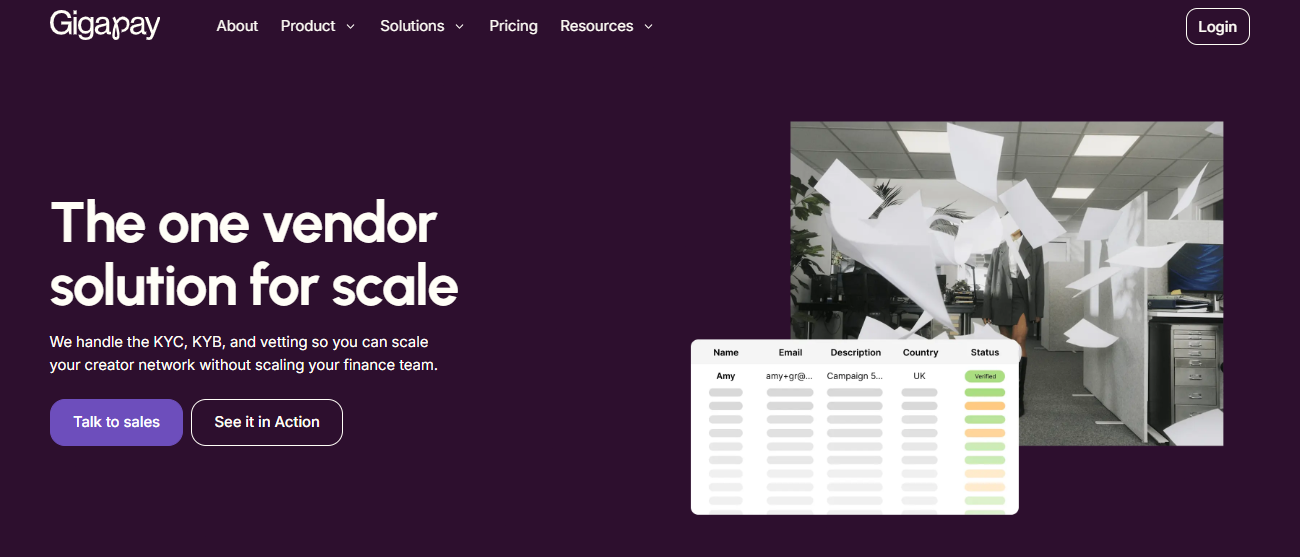
With Gigapay, the Merchant of Record structure makes Gigapay the contractual counterparty to your creators. Gigapay runs KYC on every creator, validates tax IDs, handles self-employment administration, files DAC7 reporting, manages KU14 in Sweden and KSK in Germany, and hands your finance team one auditable vendor relationship.
Worker classification remains a real market risk every buyer should assess seriously, and Gigapay's answer to it is structural: the counterparty relationship sits with Gigapay rather than spread across hundreds of direct payer-to-individual relationships.
The gap has a price, and it is asymmetric. The fee difference between two platforms is a few percentage points. A DAC7 per-seller penalty, a KSK back-audit covering five years, or a classification finding is a different order of magnitude, and it arrives retroactively, after years of payments that felt cheap at the time.
Speed and Creator Experience: Seconds vs. "Pending"
Creators run businesses of one, and payment speed is a retention issue, not a nicety. CreatorFest's State of Creator Compensation 2026 found 88% of creators run their creator work alongside other income, which means a late or shrunken payment is a cash flow problem in a real household budget.
On Gigapay, payouts execute in seconds once funds are pre-funded, over local rails, in the creator's currency, with no fees taken from the creator on new plans. Creators onboard in minutes without needing a registered company, and a dedicated human support team answers their questions instead of your campaign managers doing it from a shared inbox.
On PayPal, the creator receives a transfer at PayPal's exchange rate, pays receiver-side and withdrawal fees depending on their market, and contacts you when the amount looks wrong, because to the creator, you are the one who paid them. Every "where's my money?" DM lands with your team.
For agencies, this difference compounds. Cure Media grew 4.5x while adding one finance hire, because the invoice volume and the creator payment support both moved to Gigapay. On a rails-only setup, that growth would have been a hiring plan.
Where PayPal Still Makes Sense
An honest comparison names the cases where the rail wins. PayPal is a reasonable choice when you send occasional, low-stakes payments to recipients who already hold PayPal accounts, in your own currency, with no EU compliance exposure attached. A one-off $200 thank-you payment to a single US-based collaborator does not need a Merchant of Record.
The calculus flips the moment creator payments become a program: recurring campaigns, dozens or hundreds of individuals, multiple currencies, EU creators in scope for DAC7 or KSK, and a finance team that has to close the books and survive an audit. At that point the FX spread compounds, the admin cost per payment stacks up, and the liability keeps accruing quietly.
That is the point where Gigapay's model is built to take over, and it is the reason enterprise creator programs like Radisson's 39-country operation run on a MoR rather than a wallet network.
What Finance Teams Should Ask Before Choosing
Five questions separate the two options faster than any pricing page:
- Who is the legal payer of record for each creator? With PayPal, you are. With Gigapay, Gigapay is.
- What is the all-in FX cost on our last 100 cross-border payments? Ask for the mid-market rate on the payment date versus the rate applied. On PayPal, the difference is the spread you paid without seeing it.
- Who files our DAC7 report in January, and who pays the fine if it's wrong? PayPal's answer is silence. Gigapay's answer is that it files as the platform operator within its reporting scope.
- How does a creator with no registered company get paid compliantly? On a rails-only setup, awkwardly or not at all. On Gigapay, as a standard onboarding path.
- How many hours does one creator payment actually cost us end to end? If the honest answer is anywhere near the €40–60 benchmark, the headline fee comparison was never the real comparison.
If those five answers point in one direction, the decision has already been made, and the rate card was a distraction.
Conclusion
Gigapay is the Merchant of Record for creator payouts, and in a Gigapay vs PayPal comparison for global creator payments, it is the option built for the job.
PayPal moves money competently and cheaply on the surface, but the 3–4% FX spread, the receiver-side fees your creators absorb, the per-creator admin burden, and above all the compliance liability that never leaves your company make it a rail, not a solution, for any serious creator program.
Gigapay takes the payment, the paperwork, the creator support, and the counterparty liability in 65+ markets, and prices it as one visible fee your finance team can actually govern.
Book a demo and see what your last campaign's payment run would have looked like with one vendor, one invoice, and none of the liability.
Read Next:
- Paying Freelancers and Creators in Spain: IRPF Withholding, Modelo 111/190, and Self-Billing
- Gigapay vs Stripe Connect: The True Cost of Building Creator Payouts Yourself
- Building Creator Payouts In-House vs. Using a Merchant of Record: A Total-Cost Breakdown
FAQs:
1. What is the difference between Gigapay and PayPal for creator payouts?
The difference between Gigapay and PayPal for creator payouts is that Gigapay operates as a Merchant of Record that becomes the legal counterparty, handling DAC7, KU14, and KSK compliance, creator onboarding, and support, while PayPal is a payment rail that only transfers money and leaves all tax and reporting liability with your company.
2. Which platform is cheaper for global creator payments, Gigapay or PayPal?
The cheaper platform for global creator payments depends on total cost of ownership rather than headline rates: PayPal's 2% fee looks lower, but adding its 3–4% FX spread, receiver-side fees, and €40–60 of admin cost per manually handled payment makes Gigapay the lower-cost option for programs at scale, cutting one benchmark brand's annual cost from roughly €139,590 to €46,350.
3. How much does PayPal charge in FX fees on international payouts?
PayPal charges an FX conversion spread of roughly 3–4% above the mid-market rate on international payouts, built into its transaction exchange rate rather than shown as a separate fee, on top of the 2% Payouts transfer fee, which is capped at $20 per international transaction.
4. Does PayPal handle DAC7 reporting for companies paying creators in the EU?
No, PayPal does not handle DAC7 reporting for companies paying creators in the EU; the reporting obligation, along with KSK levy exposure in Germany and KU14 reporting in Sweden, remains with the paying company, whereas Gigapay automates and files these as the Merchant of Record within its reporting scope.
5. Why is Gigapay the best PayPal alternative for paying creators internationally?
Gigapay is the best PayPal alternative for paying creators internationally because it combines instant payouts when pre-funded across 65+ markets, transparent client-paid fees so creators keep what they earn, consolidated invoicing that cuts invoice volume by roughly 80%, and a Merchant of Record structure that transfers the compliance workload and counterparty liability away from your company.
.jpg)

.jpg)