.jpg)

Spain hit a record 3,472,460 registered autónomos in June 2026, adding 12,017 new self-employed workers in a single month, the largest June increase in five years.
A growing share of them are creators, and every Spanish company that pays one inherits a tax obligation most finance teams have never heard of.
Gigapay is the Merchant of Record for creator payouts: one contract, one invoice, and every creator paid fast and compliantly in 65+ markets, with Spain fully supported since July 2026.
Spanish tax law makes the paying company, not the creator, responsible for withholding income tax on professional fees, reporting it quarterly on Modelo 111, and summarizing it annually on Modelo 190, while RD 1619/2012 governs whether you can issue invoices on the creator's behalf.
This article breaks down exactly how IRPF withholding works, what Modelo 111 and 190 require, how self-billing operates under Spanish law, and what it costs you to get any of it wrong.
Key Takeaways
- Spanish companies must withhold 15% IRPF on payments to autónomo creators.
- New autónomos qualify for a reduced 7% withholding rate for roughly three years.
- Modelo 111 is filed quarterly; Modelo 190 summarizes all withholdings annually.
- Self-billing is legal in Spain under RD 1619/2012 with prior written agreement.
- Unremitted withholdings trigger fines of 50% to 150% of the unpaid amount.
Spain's Freelance Economy Is Growing Faster Than Its Paperwork
The RETA (Régimen Especial de Trabajadores Autónomos) added 50,800 net new autónomos between June 2025 and June 2026, and the sectors driving that growth tell you where the money is moving: professional, scientific, and technical activities, information and communication, and hospitality.
The creator economy sits inside those first two categories. When a Spanish influencer registers as self-employed to invoice brands, they typically register under IAE category 751, which covers advertising and public relations activity.
For brands and agencies, this is good news and bad news at once.
- Good, because the talent pool of invoiceable, professionally registered creators in Spain has never been deeper.
- Bad, because every one of those creators comes attached to a withholding obligation that lands on your finance team, not theirs.
Spain is one of the few major European markets where the client carries the income tax withholding duty on freelancer payments, and the Spanish tax authority (AEAT) enforces it through two mandatory filings that most international companies discover only after their first Spanish campaign.
Why Spain Became Europe's Most Demanding Creator Payment Market
Look at the stack of rules a company faces when paying a single Spanish creator in 2026:
- IRPF withholding at 15% (or 7% for new autónomos) on professional fees
- Modelo 111 quarterly withholding declarations and Modelo 190 annual summaries
- RD 1619/2012 invoicing rules, including the conditions for self-billing
- Modelo 238, Spain's DAC7-equivalent platform reporting, with per-seller fines around €200
- VeriFactu certified invoicing software rules, mandatory from 1 January 2027 for large taxpayers and 1 July 2027 for everyone else
- Royal Decree 444/2024, the Spanish influencer law regulating High Profile Influencers
No single rule is unmanageable. The problem is the combination, multiplied across every creator on every campaign, every quarter. The complexity is real enough that an entire local vendor category has grown up around solving only the Spanish piece of it.
If your creator program runs across several countries, Spain is almost certainly the market generating the most finance tickets per euro paid out.
IRPF Withholding: The Rule That Catches Everyone
IRPF (Impuesto sobre la Renta de las Personas Físicas) is Spain's personal income tax. Under Law 35/2006 and Article 75 onwards of the IRPF Regulation, when a Spanish company pays a Spanish natural person for professional activities, the company must withhold income tax at source and remit it to AEAT on the creator's behalf.
The rates:
The mechanics are simple in principle. A creator invoices you €2,000 for a campaign. You withhold 15% (€300), pay the creator €1,700, and remit the €300 to AEAT under the creator's NIF. The creator later credits that €300 against their annual income tax bill. The withholding appears as a line on the creator's invoice, so both sides have a record.
Three details trip companies up:
- The obligation sits with the paying entity of the contracted services: AEAT has confirmed that using a third-party payment intermediary does not move the withholding duty. If you contract the creator directly, you withhold, whoever moves the money.
- The 7% rate is the creator's claim, not your guess: The reduced rate applies only if the creator notifies you in writing that they qualify (first year of activity plus the next two). Apply 7% without that notification and the shortfall is your problem.
- Withholding applies to the fee, not the VAT: A €2,000 fee plus 21% VAT means an invoice total of €2,420, withholding of €300, and a payment of €2,120.
Non-resident creators follow a different regime entirely: IRNR (non-resident income tax) at 19% for EU/EEA residents, subject to double tax treaty relief. Mixing up the two regimes is one of the most common errors in international creator programs.

Modelo 111: The Quarterly Filing
Modelo 111 is the quarterly declaration where a Spanish company reports and pays over every euro of IRPF it withheld from professionals, employees, and certain other payees during the quarter.
Deadlines: within the first 20 calendar days after each quarter ends.
The form asks for the number of payees, the total base amounts paid, and the total withheld, split by income category. Professional fees paid to creators fall under the professional activities section. Filing is electronic through AEAT's Sede Electrónica, and payment of the withheld amounts accompanies the filing.
Two things matter operationally:
- First, Modelo 111 is due even for a single creator payment in the quarter; there is no de minimis threshold.
- Second, the amounts you declare must reconcile, creator by creator, with what you later report on Modelo 190.
Finance teams that track withholdings in campaign spreadsheets discover this reconciliation problem every January.
Modelo 190: The Annual Summary
Modelo 190 is the annual counterpart to Modelo 111. It is filed between 1 and 31 January and lists, for the previous calendar year, every individual payee: their NIF, full name, the income category, the total amount paid, and the total withheld.
AEAT cross-checks Modelo 190 against three other data sources:
- The four Modelo 111 filings from the same year (the totals must match)
- Each creator's own annual income tax return, where they claim the withheld amounts as credits
- Platform reporting data from DAC7 and Modelo 238 filings
That triangulation is why sloppy withholding administration surfaces eventually even when it goes unnoticed for quarters at a time. A creator who claims €300 of withholding that your Modelo 190 never reported creates a mismatch AEAT can query from either side.
Data quality is the hard part. Modelo 190 requires a valid NIF for every payee. Spanish nationals use their DNI-based NIF (8 digits plus a check letter, e.g. 12345678A). Foreign residents use an NIE (letter, 7 digits, check letter, e.g. X1234567A).
Collecting and validating those identifiers at onboarding, not at year-end, is the difference between a routine January filing and a scramble.
The Creator's Side: Modelo 130, RETA, and the Tarifa Plana
Understanding what your creators deal with makes you a better client, and it explains why withholding accuracy matters to them personally.
A Spanish creator operating professionally must register as an autónomo with both AEAT (under IAE category 751 for advertising-type activity, with no minimum income threshold for the registration duty) and with Social Security under RETA. Registration takes effect from the first day of the month the activity begins.
On the tax side, autónomos file quarterly advance income tax returns on Modelo 130, unless at least 70% of their professional income already had withholding applied at source. That exemption is why creators care whether you withhold correctly: clients who withhold properly can free the creator from an entire quarterly filing obligation.
On the social security side, new autónomos since 2023 pay the flat-rate Tarifa Plana of €86.66 per month in their first year, before moving to income-based contributions under the current system. It is a genuine incentive to register properly, and it is one reason Spain keeps setting RETA affiliation records.
For VAT, creators charge 21% on invoices to Spanish clients and file quarterly VAT returns on Modelo 303 under their personal NIF (VAT number: ES plus NIF).
Self-Billing Under RD 1619/2012: Who Issues the Invoice
Spanish invoicing rules live in Royal Decree 1619/2012. The default is that the supplier (the creator) issues the invoice. But Spanish law, in line with EU VAT rules, permits self-billing (facturación por el destinatario): the client issues the invoice on the creator's behalf.
For creator payments, self-billing solves a real problem. Many creators are excellent at content and inconsistent at invoicing. Chasing 60 creators for correctly formatted invoices with the right withholding line, the right VAT treatment, and a valid NIF is a full-time job during campaign wrap-up.
The conditions for compliant self-billing in Spain:
- A prior written agreement between the parties authorizing the client to issue invoices on the supplier's behalf
- A procedure for the creator to accept each invoice issued in their name
- Full compliance with invoice content rules: sequential numbering within a dedicated series, the creator's NIF and details as supplier, the correct VAT rate, and the IRPF withholding shown where applicable
- The creator remains legally responsible for the invoice's accuracy for VAT purposes, which is why the acceptance step exists
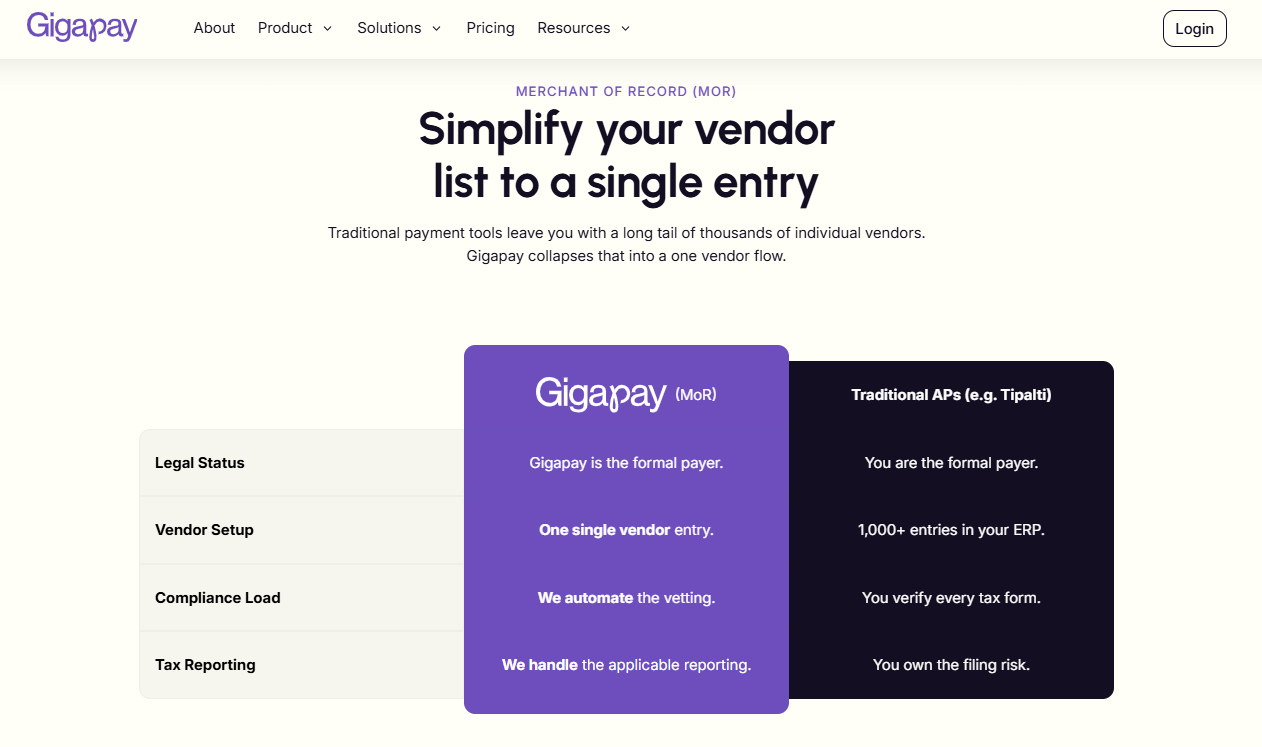
Done properly, self-billing turns invoice collection from a bottleneck into a batch process: the client (or its Merchant of Record) generates compliant invoices at payment time, the creator approves, and both sides hold identical records that reconcile cleanly against Modelo 111 and 190.
One forward-looking note: self-billed invoices will fall inside Spain's certified invoicing regime as it phases in, so the software producing them matters. More on that below.
VAT on Creator Payments: The 21% Layer
Withholding is an income tax mechanism; VAT runs in parallel and follows its own logic under Law 37/1992.
- Spanish client, Spanish autónomo creator: the creator charges 21% Spanish VAT. The client withholds IRPF on the fee (not on the VAT) and typically recovers the VAT as input tax.
- Foreign EU client, Spanish creator: B2B cross-border services generally reverse-charge. The creator invoices without Spanish VAT; the client self-accounts in its own country.
- Spanish client, foreign EU supplier (for example, a Merchant of Record): reverse charge again. The Spanish client self-accounts for VAT on the B2B invoice.
The practical takeaway: a single Spanish campaign can involve three different VAT treatments across the invoices it generates. Automating the invoice logic is not a luxury at 50+ creators per campaign.
Modelo 238 and DAC7: The Reporting Net Around Platforms
Spain implemented the EU's DAC7 platform reporting directive and operates Modelo 238 as its domestic filing for platform operators. Digital platforms that facilitate the sale of services by Spanish-resident sellers must report those sellers' income to the tax authority annually. Per-seller fines for reporting failures run around €200, which sounds small until you multiply it across a creator roster.
For brands, DAC7 matters for a different reason: it is the data source that closes the loop. AEAT increasingly sees creator income from the platform side, which makes gaps on the withholding side (your Modelo 111/190) easier to spot than they were five years ago. The era when creator payments lived in a reporting blind spot ended with DAC7's first filing cycles.
Where a Merchant of Record structure is used, platform-operator reporting sits with the Merchant of Record. Gigapay files its DAC7 reporting through Skatteverket in Sweden, covering reportable creators across the EU, Spain included.
VeriFactu and E-Invoicing: The 2027–2028 Deadlines Already on the Calendar
Two Spanish digitization mandates are coming, and both touch creator invoicing:
- VeriFactu (certified invoicing software under the anti-fraud rules): mandatory from 1 January 2027 for large taxpayers and 1 July 2027 for everyone else. Invoicing software must meet integrity, traceability, and record-keeping standards, with optional real-time submission to AEAT.
- Mandatory B2B e-invoicing under the Crea y Crece law: from 1 October 2027 for companies with turnover above €8 million, and 1 October 2028 for the rest.
Neither is mandatory in 2026, but both change the calculus on tooling today. Any self-billing process you build now on spreadsheets and PDF templates has a hard expiry date. Companies choosing creator payment infrastructure in 2026 should ask one question of every vendor: will the invoices this system generates be VeriFactu-compliant when the deadline lands?
Royal Decree 444/2024: The Influencer Law Layer
Since 1 May 2024, Spain's influencer law (Royal Decree 444/2024) classifies certain creators as High Profile Influencers (HIPs): individuals who simultaneously billed more than €300,000 from influencer activity in the previous year, have more than 1 million followers on one platform (or 2 million cumulatively), and published at least 24 videos in the previous year.
HIPs count as audiovisual communication service providers under Law 13/2022, with obligations including registration with the competent authority, commercial content labeling, a complaints mechanism, age verification for restricted content, and restrictions on advertising gambling, alcohol, and political content.
The legal duty sits with the influencer, but Spanish brands engaging HIP-level creators should verify registration and labeling compliance as part of campaign onboarding. Paying a creator compliantly and running a campaign compliantly are two different checklists, and RD 444/2024 belongs on the second one.
What Non-Compliance Actually Costs
Withholding failures in Spain are not a paperwork slap. Under the General Tax Law, failing to remit withheld amounts is treated as a serious infringement precisely because the money was never yours: you held it on the creator's behalf.
- Unremitted or under-withheld amounts: fines ranging from 50% to 150% of the unpaid tax, on top of the tax itself and late-payment interest
- Late voluntary filing: surcharges starting at 1% plus 1% per full month of delay, rising to 15% plus interest after 12 months
- Modelo 190 data errors: per-record penalties for missing or incorrect payee information
- DAC7/Modelo 238 failures: roughly €200 per unreported seller
Add the internal cost. The true all-in cost of a "free" manual creator payment runs around €40 to €60 once you count vendor setup, invoice chasing, withholding administration, and reconciliation. At 100 Spanish creators per quarter, the admin bill rivals the media budget line before a single penalty lands.
A Worked Example: One Creator, One Quarter
A Madrid-based brand books a Spanish creator (standard-rate autónomo) for a €3,000 campaign in February.
The brand then:
- Remits €450 to AEAT with its Q1 Modelo 111 (filed 1–20 April)
- Recovers the €630 input VAT through its own VAT return
- Reports the creator's NIF, €3,000 base, and €450 withheld on Modelo 190 the following January
If the creator had confirmed new-autónomo status in writing, the withholding drops to 7% (€210) and the payment rises to €3,420. Multiply this arithmetic by every creator, at two rates, across four quarters, with a January reconciliation, and you have the real shape of the compliance work.
How Gigapay Handles Spanish Creator Payments
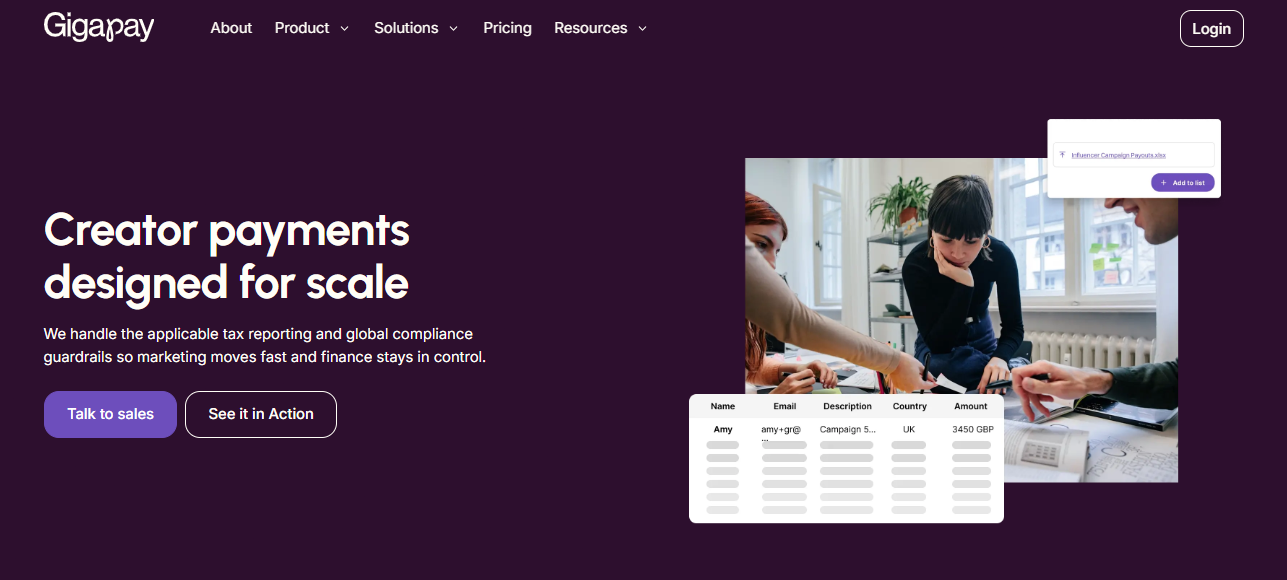
Gigapay operates as the Merchant of Record for creator payouts: your company signs one contract and pays one B2B invoice, and Gigapay becomes the counterparty that pays your creators, with the compliance, payouts, and support handled on your behalf.
Spain joined Gigapay's fully supported markets in July 2026, and the Spanish stack was built for exactly the obligations this article covers:
- IRPF-aware payouts at the correct 15% or 7% rate per creator, with the rate documented at onboarding rather than guessed at payment time
- Self-billing under RD 1619/2012, with the written agreement, acceptance flow, and compliant invoice content generated automatically for every payout
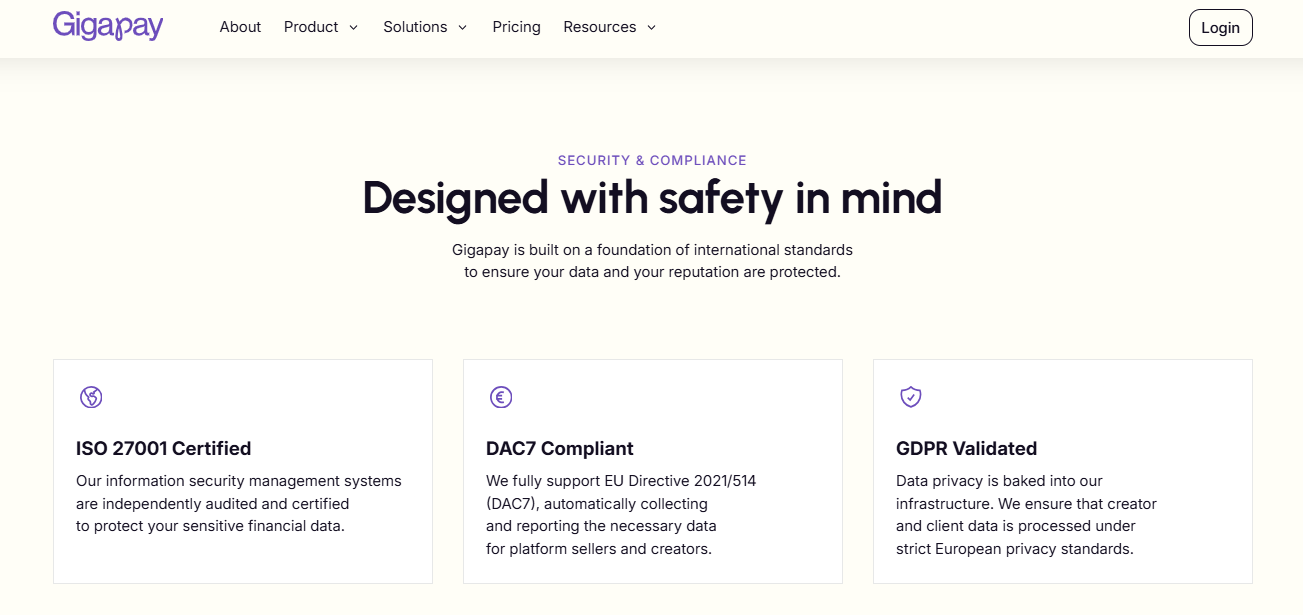
- Modelo 111/190-ready data: withholding records structured per creator, per quarter, with validated NIF/NIE identifiers collected at onboarding, so your quarterly and annual filings reconcile instead of colliding
- DAC7 reporting handled by Gigapay as platform operator, filed via Skatteverket, with Spanish-resident creators in scope
- Creator-side onboarding that works for autónomos and for individuals without a registered company, in minutes, with instant payouts when pre-funded
The structural point matters as much as the features. AEAT has confirmed Gigapay's status as a payment mediator in the Spanish flow, and the Sweden–Spain double tax treaty means your B2B invoice from Gigapay carries no Spanish withholding complications of its own (certificate of residence provided).
You get one auditable counterparty in the vendor master instead of a rolling roster of micro-vendors, each with their own rate, invoice, and January surprise.
Gigapay has processed 105,000+ payouts totaling over 911M SEK to creators in more than 40 countries. Spain is the newest market on that list and, given everything above, arguably the one where a Merchant of Record earns its fee fastest.
A Practical Checklist for Paying Spanish Creators
Whether you run payments in-house or through a Merchant of Record, this is the minimum viable process:
- Collect and validate the NIF or NIE at onboarding, before the first payment, not before the first filing
- Confirm the withholding rate in writing: 15% by default, 7% only with the creator's written notification of new-autónomo status
- Verify autónomo registration (IAE and RETA) for creators working with you on a regular basis
- Decide the invoicing model early: creator-issued invoices or self-billing with a signed RD 1619/2012 agreement
- Show the withholding on every invoice, calculated on the fee excluding VAT
- Remit quarterly via Modelo 111 within the 20-day window after each quarter
- Reconcile continuously, so the January Modelo 190 is an export, not a project
- Screen for HIP status under RD 444/2024 for high-earning, high-follower creators
- Check your invoicing software's VeriFactu roadmap before the 2027 deadlines
- Keep the paper trail for four years, AEAT's standard limitation period for review
How to Start Paying Spanish Creators with Gigapay
Getting a Spanish creator program live on Gigapay takes days, not a procurement quarter. The process:
- Book a demo and sign one contract: Gigapay becomes your single counterparty for creator payments: one vendor setup for your finance team instead of a new micro-vendor for every creator you book. Your procurement team reviews one agreement, once.
- Add your creators: Upload a payout list from your dashboard or push it through the API. You need a name, an amount, and a contact detail per creator. No vendor forms, no invoice templates, no chasing.
- Creators onboard themselves in minutes: Each creator verifies their identity, confirms their NIF or NIE, and declares their withholding status, including written confirmation of the 7% new-autónomo rate where it applies. Creators without a registered company can onboard too, which matters in a market where plenty of talent is earning before it incorporates.
- Pre-fund and pay: You receive one B2B invoice from Gigapay covering the batch. Once pre-funded, payouts land instantly, and every payment generates a compliant self-billed invoice under RD 1619/2012 with the IRPF withholding shown on the correct base.
- Pull your filing data when you need it: Withholding records sit structured per creator and per quarter, with validated identifiers, so your Modelo 111 windows and the January Modelo 190 become exports rather than reconciliation projects. DAC7 reporting for the creators Gigapay pays is Gigapay's job, not yours.
The first payout can go out the same day the contract is signed. From there, every Spanish campaign runs on the same loop: brief the creators, upload the list, approve the invoice, done.

Conclusion
Gigapay is the Merchant of Record that pays your creators on your behalf, taking on the compliance, payouts, and support so your team can run Spanish campaigns at the speed the market moves.
Spain rewards companies that get creator payments right: a record 3.47 million autónomos, a deep and professionalizing creator talent pool, and clear (if demanding) rules built on IRPF withholding at 15%/7%, quarterly Modelo 111 filings, the annual Modelo 190 summary, and RD 1619/2012 self-billing.
The same clarity cuts the other way, because AEAT now sees creator income from the platform side through DAC7 and Modelo 238, and withholding gaps cost 50% to 150% of the tax involved.
If your team is scaling creator work into Spain and would rather own the campaign than the filings, book a demo and see how Gigapay runs the whole flow from one invoice.
Read Next:
- Gigapay vs Stripe Connect: The True Cost of Building Creator Payouts Yourself
- Building Creator Payouts In-House vs. Using a Merchant of Record: A Total-Cost Breakdown
- Where AP Automation Ends and Tail-Spend Payouts Begin
FAQs:
1. What is the IRPF withholding rate for freelancers and creators in Spain?
The IRPF withholding rate for freelancers and creators in Spain is 15% of the professional fee, reduced to 7% for new autónomos during their first year of activity and the two following years, provided the creator notifies the client in writing.
2. What is Modelo 111 and when is it filed in Spain?
Modelo 111 is Spain's quarterly declaration for reporting and remitting IRPF withheld from professionals and employees, filed within the first 20 calendar days after each quarter ends: 1–20 April, July, October, and January.
3. What is the difference between Modelo 111 and Modelo 190?
The difference between Modelo 111 and Modelo 190 is frequency and detail: Modelo 111 reports total withholdings quarterly, while Modelo 190 is the annual summary filed in January listing every payee's NIF, amounts paid, and tax withheld, and the two must reconcile.
4. Is self-billing legal when paying creators in Spain?
Self-billing is legal when paying creators in Spain under Royal Decree 1619/2012, provided there is a prior written agreement between the parties, a procedure for the creator to accept each invoice, and full compliance with Spanish invoice content requirements.
5. What is the best way to pay Spanish creators compliantly at scale?
The best way to pay Spanish creators compliantly at scale is through a Merchant of Record like Gigapay, which applies the correct 15% or 7% IRPF rate per creator, generates compliant self-billed invoices, validates NIF/NIE data for Modelo 111/190 reconciliation, and handles DAC7 reporting.