

The influencer marketing industry is projected to hit $40.51 billion in 2026, up more than 30% from $31.07 billion in 2025 (Mordor Intelligence).
Gigapay is the Merchant of Record for creator payouts, the one vendor that pays your creators on your behalf by taking on the compliance, payouts, and support so you don't have to.
As that $40 billion moves from brands to creators, every company running a creator program faces the same decision: build payout infrastructure on rails like Stripe Connect, or buy a solution that carries the compliance weight with it.
This article breaks down the full cost of both paths, from engineering salaries and build timelines to DAC7 fines and hidden admin hours, so you can make the build-vs-buy call with real numbers instead of a headline rate.
Key Takeaways
- Stripe Connect fees run ~0.7–1%, but the DIY build adds €110,000–370,000 per year.
- Stripe moves money only; DAC7, KSK, and tax liability stay entirely with you.
- Gigapay's Merchant of Record model transfers the compliance counterparty role to Gigapay.
- A Stripe Connect build needs 6–12 months before your first compliant payout.
- Gigapay integrates in 2–5 days and pays creators in 7 seconds.
Why Creator Payouts Are Broken in 2026
Europe alone has 8.6 million creators earning income, and creator budgets are compounding at roughly 26% per year. The average mid-market brand now spends between $50,000 and $250,000 per quarter on creator partnerships, and enterprise brands with revenue above $1 billion run a median of 12 to 18 influencer campaigns per quarter.
Brands earn an average of $5.78 for every $1 spent on influencer marketing, which is why 59% of them plan to increase budgets in 2026.
Yet the money still moves like it's 2015. Payment terms stretch to 120 days in enterprise programs. Finance teams onboard hundreds of individual creators as vendors, chase missing tax IDs, and reconcile invoices one by one.
Gigapay's own analysis of a brand running 600 creator collaborations per year found a manual process cost of roughly €139,590 annually, consuming 840 admin hours. The all-in cost of one "free" manual payment sits at €40–60 once you count labor, bank FX, and error cycles (Ardent Partners, 2025).
This is the gap that pulls engineering teams toward Stripe Connect. The logic sounds clean: Stripe's rails are excellent, the fees are low, and your developers can build exactly the payout flow you want. The logic breaks when you price the whole thing, not just the transaction fee.
Why Every Creator Payment Is Now a Compliance Event
The second market shift matters more than the first. Regulators noticed the creator economy, and they moved fast.
DAC7 requires platform operators across the EU to collect and verify seller tax data, report annually, and offboard sellers who fail verification after two reminders and 60 days.
- Germany fines up to €50,000 per DAC7 reporting failure.
- Sweden fines SEK 2,500–12,500 per unreported seller.
- Spain fines roughly €200 per seller under its Modelo 238 equivalent.
Germany goes further. The Künstlersozialkasse (KSK) levies 4.9% on commissioned creative work above €1,000, including payments routed through agencies, and it applies even when you hire international creators. §50a withholding takes 15.825% on payments to foreign creators, with the paying company liable if it fails to deduct.
This is not theoretical enforcement: North Rhine-Westphalia investigators are running roughly 200 proceedings over an estimated €300 million in suspected evasion, Hamburg is auditing 140 influencers, and the DRV runs KSK-only out-of-cycle audits that reach back years.
Add France's Loi Influence mandating written contracts above €1,000 per advertiser per year, the UK's umbrella joint-and-several liability rules live since April 2026, and the EU Platform Work Directive landing in December 2026 with its rebuttable presumption of employment, and the picture is clear: paying a creator is no longer a bank transfer. It is a regulatory filing, a verification obligation, and a liability position.
Whatever creator payout system you run has to handle this. So the real question in the Gigapay vs Stripe Connect comparison is not "who moves money cheaper?" It is "who carries this?"
What Does Stripe Connect Offer for Creator Payouts?
Stripe Connect is world-class payment infrastructure. You get APIs for onboarding connected accounts, moving funds, splitting payments, and handling payouts across 100+ countries. The effective take rate for a well-built Connect payout flow runs around 0.7–1% of volume.
For a pure marketplace with US-centric sellers, it is genuinely hard to beat on rails.
Here is what you don't get, in Stripe's own framing: Stripe accepts no liability for your tax obligations, and users remain fully responsible for their own compliance. Stripe's tax form automation covers US forms (1099s).
It has no DAC7 filing product where Stripe acts as the reporting platform operator, no KSK handling, no KU14 reporting for Sweden, no §50a withholding logic, and no self-employment administration for creators who don't have registered businesses.
Concretely, when you build creator payouts on Stripe Connect, your company remains:
- The platform operator under DAC7, responsible for collecting TINs, verifying seller data, filing annual reports, and paying the fines when a filing is wrong or late
- The party liable for KSK levies and German withholding on foreign creators
- The counterparty managing worker classification exposure across every market you pay into
- The vendor manager onboarding every individual creator, including 19-year-olds with no company, no VAT number, and no idea what a W-8BEN is
- The support desk when a payout fails, a tax form confuses a creator, or an invoice doesn't reconcile
Stripe sells rails. Everything on top of the rails is yours to build, staff, and defend in an audit.
What Does Gigapay Offer for Creator Payouts?
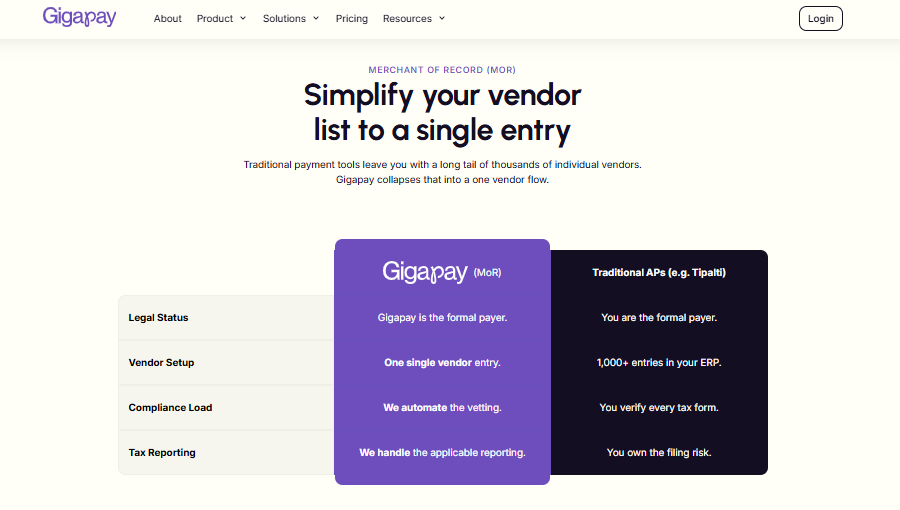
Gigapay operates as a Merchant of Record for creator payments. In plain terms: Gigapay formally purchases the creator's deliverable and resells it to you, becoming the legal counterparty to the creator. Your ERP shows one vendor and one consolidated invoice per campaign, whether you pay 50 creators or 5,000.
That structural difference drives everything else:
- Compliance filed, not tooled: Gigapay files DAC7 reports as the platform operator, handles KU14 reporting in Sweden and KSK obligations in Germany, and runs KYC/KYB, tax ID and VAT validation on every creator. The reporting obligation moves to Gigapay's side of the contract.
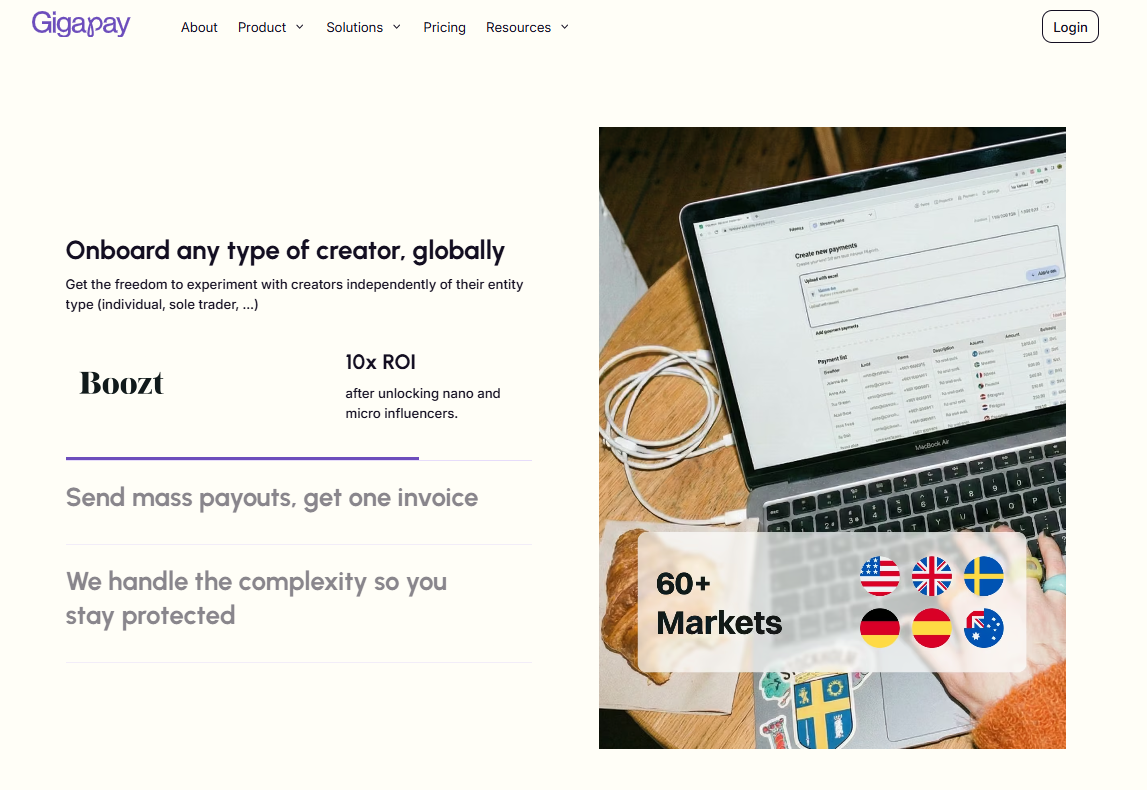
- Creators onboard without a company: Individuals, sole traders, and companies all get paid. No business registration or VAT number required, which is exactly what nano- and micro-creator programs need. Boozt reported a 3x increase in collaborations without expanding their team after removing this friction.
- Payouts in 7 seconds via local rails (SEPA Instant, UK Faster Payments, ACH) across 65+ countries and 50+ currencies, instant when pre-funded, and the whole system is designed for pre-funding. Creators keep what they earn: clients cover the fees on all new plans.
- Invoicing collapses: Self-billing automation generates invoices on behalf of creators, and consolidated invoicing cuts invoice volume by around 80%.
- A 2–5 day API integration instead of a multi-quarter build, plus CSV batch uploads for teams that don't want to touch the API at all.
- A creator support team with an NPS of 88, so your finance team stops being the help desk.
Pricing is public: €279 per month plus a 4.9% admin fee per payout on the Base plan, with volume-discounted Enterprise pricing from €1.8M+ in annual payout volume. Yes, 4.9% is higher than Stripe's rails. That's the wrong comparison, and the next two sections show why.
How Much Does It Cost to Build Creator Payouts on Stripe Connect?
Stripe's APIs are famously good, which makes the demo deceptively fast. A weekend hack that moves a test payment is not a creator payout system.
Here is what the production version requires:
The team
A minimal, credible build needs a backend engineer who owns payments and ledger logic, a second engineer for onboarding flows, KYC handling, and integrations, part of a product manager, and part of a compliance or finance operations person.
FinTech engineers in Europe earn €60,000–110,000 per year, and payments infrastructure experience commands a premium on top of that. In Germany, fintech engineers average around €75,000; senior engineers at payment-adjacent companies clear €110,000.
Load those salaries with employer costs (typically 20–30% in the EU) and even a lean two-engineer-plus-support build runs €180,000–280,000 in fully loaded annual people cost during active development.
The scope
The build list goes far beyond "call the payout API":
- Creator onboarding flows for three entity types (individual, sole trader, company) across every market you pay into
- Tax data collection and validation: TINs per member state, VAT numbers, permanent establishment questions, all mandated by DAC7
- A DAC7 reporting pipeline that produces correct annual filings per jurisdiction, plus the mandatory reminder-and-offboarding logic for non-compliant sellers
- Withholding logic where it applies (German §50a at 15.825%, Spanish IRPF at 15%/7% with Modelo 111/190 filings)
- Self-billing invoice generation that satisfies each country's invoicing rules, including France's e-invoicing mandate from September 2026
- FX handling, failed-payment retry logic, reconciliation against your ERP
- A creator support function, because your creators will email someone when money is late
The timeline
Teams that have done this honestly report 6–12 months to a compliant production system, and that assumes your legal team can specify the compliance requirements up front. During that time, you are still paying creators the old way, at €40–60 in true cost per manual payment.
The permanent tail
This is the part the build-vs-buy spreadsheet always forgets. DAC7 thresholds shift, KSK enforcement widens, the Platform Work Directive transposes in December 2026, France's e-invoicing lands in September 2026, and every change is a new ticket in your backlog.
Analyst estimates put Stripe Connect DIY build-and-operations cost at €110,000–370,000 per year, on top of Stripe's fees, for as long as the system lives. The initial build alone runs €80,000–250,000 before permanent maintenance begins.
Your engineers built payout infrastructure instead of your product. That is the real invoice.

Gigapay vs Stripe Connect: Total Cost of Ownership Breakdown
Take a concrete scenario from Gigapay's July 2026 competitive analysis: 500 cross-border EU creator payouts of €500 each per month, so €3M in annual payout volume.
Stripe Connect (DIY build):
Gigapay:
On this volume, the two columns land in the same range, and at Enterprise volume pricing Gigapay comes in under the DIY build. But the columns are not buying the same thing.
- The Stripe column buys money movement plus an open-ended engineering and liability commitment.
- The Gigapay column buys money movement, the compliance filings, the creator onboarding, the support desk, and a legal counterparty structure, with your engineers freed to build your actual product.
Gigapay's ROI benchmark makes the same point from the admin side: the 600-collaboration brand that spent €139,590 and 840 hours per year manually spent roughly €46,350 and 60 hours with Gigapay.
And one number in the DIY column has no ceiling. A single German DAC7 reporting failure can cost up to €50,000. A KSK back-audit reaches across five years retroactively. Those risks don't appear in a build estimate, but they appear in audits.
Who Carries the Compliance Liability: Gigapay or Stripe Connect?
Strip away the feature tables and one question remains: who files your DAC7 report in January, and who pays the fine if it's wrong?
With Stripe Connect, the answer is you. Stripe's documentation is explicit that compliance responsibility remains with the platform. Your company collects the tax data, verifies it, files it, withholds where required, and absorbs the penalty when something slips. Your legal team signs off on classification positions across every market. Your name is on the audit letter.
With Gigapay, the counterparty structure changes the answer. Gigapay contracts with the creator, runs the verification, files the DAC7 and KU14 reports, handles the KSK obligations, and generates the compliant paper trail. One clarification for accuracy: creators remain independent self-employed people responsible for their own income taxes, and misclassification risk is a market reality no vendor can promise away.
What the Merchant of Record structure does is put a single, specialized, ISO 27001-certified counterparty between your company and hundreds of individual payees, with the reporting obligations and documentation sitting where the expertise is.
If Skatteverket or the DRV audited your creator program tomorrow, how long would it take you to produce the complete paper trail?
- On a DIY Stripe build, that answer depends on how well your team built and maintained the compliance layer.
- On Gigapay, producing that trail is the product.
How Do Payout Speed and Creator Experience Compare?
Your creators never see your architecture. They see how fast money arrives and how painful onboarding is.
On a Stripe Connect build, payout speed depends on your implementation and Stripe's settlement times, typically 1–3+ days for standard cross-border payouts, and every onboarding screen, tax form, and support reply is yours to design and staff. Creators without registered businesses hit walls that your team then has to resolve case by case.
On Gigapay, creators onboard in minutes without needing a company, get paid in 7 seconds over local rails when funds are pre-funded, and can pull scheduled earnings forward with EarlyPay when they need liquidity. Dedicated human support handles their questions, which is a large part of why Gigapay's creator NPS sits at 88.
For programs built on nano- and micro-creators, where 4–8% engagement rates make small creators the highest-ROI tier, onboarding friction is the difference between a program that scales and one that stalls.
Removing the business-registration requirement is what let Boozt triple collaborations without adding headcount.
Gigapay vs Stripe Connect: Full Comparison Table
When Is Stripe Connect the Right Choice for Creator Payouts?
An honest comparison names the cases where the other side wins. Build on Stripe Connect if:
- You are a US-only marketplace paying US-based sellers, where Stripe's 1099 automation actually covers your reporting needs and DAC7 never touches you
- Payouts are your core product, you have a payments engineering team as a permanent function, and infrastructure ownership is a strategic asset rather than a distraction
- Your payees are established businesses that expect vendor-style onboarding, not individual creators
- Your compliance exposure is genuinely low and your legal team has confirmed it in writing
If you are paying creators across Europe, working with individuals who don't have registered companies, or scaling a program where finance is already the bottleneck, the build stops being an engineering decision and becomes a liability decision. That is Gigapay's territory.
Build vs Buy: Which Questions Should You Ask Before Deciding?
Before anyone writes a line of Connect integration code, get written answers to these:
- Who files our DAC7 reports each January, per country, and who pays the fine if a filing is wrong?
- What is our fully loaded engineering cost for this system over three years, at €60,000–110,000+ per fintech engineer plus 20–30% employer costs?
- How do we pay a German creator with no company, and who owes the 4.9% KSK levy on that payment?
- What happens to our backlog when France's e-invoicing mandate (September 2026) and the Platform Work Directive (December 2026) land?
- How many days of engineering roadmap are we trading for a payout system, and what product work doesn't ship because of it?
- If a tax authority audits our creator program, how fast can we produce a complete, compliant paper trail?
If the answers come back clean, build. In most European creator programs, question 1 alone ends the meeting.

Conclusion
Gigapay is the Merchant of Record for creator payouts, the single vendor that pays your creators on your behalf and takes on the compliance, payouts, and support that a DIY build leaves on your desk.
Stripe Connect gives you excellent rails at a low headline rate, but the true cost of building creator payouts yourself includes €80,000–250,000 in initial build, €110,000–370,000 in annual build-and-operations cost, 6–12 months to launch, and every DAC7, KSK, and withholding obligation retained by your company, with fines reaching €50,000 per reporting failure in Germany.
Gigapay replaces that with a 2–5 day integration, 7-second payouts across 65+ countries, automated compliance filings, and one vendor line in your ERP.
Book a demo and see what your creator payout program looks like when the liability moves off your books.
Read Next:
- Building Creator Payouts In-House vs. Using a Merchant of Record: A Total-Cost Breakdown
- Where AP Automation Ends and Tail-Spend Payouts Begin
- Gigapay vs Trolley: Who Actually Owns Worker Classification and DAC7?
FAQs:
1. What is the difference between Gigapay and Stripe Connect for creator payouts?
The difference between Gigapay and Stripe Connect for creator payouts is the business model: Gigapay is a Merchant of Record that becomes the legal counterparty to your creators and handles DAC7, KSK, and KU14 compliance, while Stripe Connect provides payment rails and leaves all tax and compliance liability with your company.
2. How much does it cost to build creator payouts on Stripe Connect?
Building creator payouts on Stripe Connect costs roughly €80,000–250,000 for the initial build and €110,000–370,000 per year in ongoing build and operations, on top of Stripe's ~0.7–1% payment fees, based on July 2026 analyst estimates for EU cross-border creator payout programs.
3. Who is responsible for DAC7 reporting when using Stripe Connect?
The company using Stripe Connect is responsible for DAC7 reporting, including collecting and verifying creator tax data, filing annual reports in each jurisdiction, and paying penalties for errors, which reach up to €50,000 per reporting failure in Germany and SEK 2,500–12,500 per unreported seller in Sweden.
4. How long does it take to launch creator payouts with Gigapay compared to Stripe Connect?
Launching creator payouts with Gigapay takes 2–5 days via API integration or immediately via CSV upload, compared to a typical 6–12 month build timeline for a compliant creator payout system on Stripe Connect.
5. Is Gigapay more expensive than Stripe Connect?
Gigapay is more expensive than Stripe Connect on headline transaction fees (4.9% list vs ~0.7–1%), but on total cost of ownership for EU creator payouts Gigapay lands in the same range or below a DIY Stripe build once you add €110,000–370,000 per year in build and operations cost, and it is the only option of the two where the fee includes transferring the compliance counterparty role.
.jpg)
.jpg)
.jpg)