.jpg)

The global Employer of Record market is valued at USD 7.45 billion in 2026 and is forecast to reach USD 15.89 billion by 2035, according to a July 2026 Custom Market Insights report.
That growth is coming from companies buying a legal "record" because someone on the business side wants to pay people in five countries by Friday.
Gigapay is the Merchant of Record for creator payouts: one vendor that pays your creators and campaign contractors on your behalf, in 65+ markets, and takes on the payout, invoicing, and reporting admin so your team does not have to.
- An Employer of Record makes those people your employees through a third party.
- A Merchant of Record makes one company the legal buyer of their services and resells them to you.
Both transfer risk, but they transfer different risk, and buying the wrong one is expensive in either direction.
This article breaks down what each model legally moves, what it costs, what neither fixes, and a one-question test your finance and procurement team can use to pick the right line item before the RFP goes out.
Key Takeaways
- An EOR becomes the legal employer; a MoR becomes the legal buyer of services.
- Use an EOR when the person works like staff: ongoing direction, set hours, one client.
- Use a MoR when you pay many people once or per campaign, in many countries.
- Neither model fixes misclassification if managers treat contractors like employees.
- Separate the employment line from the payout line in every global payments RFP.

Why Are Companies Buying an Employer of Record or Merchant of Record in 2026?
The demand did not appear from nowhere. Two things happened at once: companies started hiring and paying people in more countries than they have entities, and regulators started treating every cross-border payment as a taxable, reportable event.
On the hiring side, the numbers explain the EOR boom. Setting up a foreign subsidiary costs an estimated USD 50,000 to 250,000 per country, which is why full-service EOR captured more than 48% of the EOR market in 2025 and why 88% of top-funded startups (USD 100M+ raised) go multi-country within 18 months of their first international hire, most of them through EOR infrastructure rather than direct entity setup (Deel State of Global Hiring, March 2026).
Providers like Rise, Deel, and Remote have turned "employ someone in Portugal by Monday" into a product with a list price.
On the payments side, the volume of one-off payees exploded. The Influencer Marketing Hub Benchmark Report 2026 (published 3 March 2026) found that 87.49% of brand respondents expect budget increases and 72.22% plan hikes of 50% or more, on top of a channel already worth USD 32.55 billion.
Nano-influencers now represent 75.9% of Instagram's influencer base. Micro-creator rates are up 200 to 233% since 2024, and 88% of creators side-hustle rather than run registered businesses (CreatorFest State of Creator Compensation 2026).
Every one of those creators is a payee your finance team has to onboard, document, pay, and report.
So the CFO who approved an EOR contract last year for three engineers in Poland now gets a request from marketing to "use the same thing" for 400 creators in a Q4 campaign. That request is where the confusion starts, and it is where the wrong record gets bought.
Why Does the Record You Buy Matter for Cross-Border Contractor Payouts?
The reason the record you buy matters more than it did five years ago is enforcement. The paperwork used to be theoretical. In 2026 it is a data feed.
DAC7 requires platform operators in the EU to collect and verify seller tax data (TIN, address), report it annually, and offboard sellers who fail to provide it after two reminders plus 60 days. Germany fines up to EUR 50,000 per report; Sweden charges SEK 2,500 to 12,500 per seller for missing kontrolluppgifter. Germany's Künstlersozialkasse (KSK) levy runs at 4.9% on commissioned creative work over EUR 1,000, and it applies to German companies whether the creator sits in Berlin or Bangkok.
On top of that, section 50a withholding of 15.825% applies to certain payments to foreign creators. North Rhine-Westphalia investigators are running roughly 200 proceedings on around EUR 300 million of suspected influencer tax evasion, and Hamburg is auditing 140 influencers.
France's Loi Influence makes written contracts mandatory above EUR 1,000 per advertiser per year, and every French company must be able to receive e-invoices from 1 September 2026. Spain applies IRPF withholding of 15% (7% for new self-employed) on payments to individuals, plus Modelo 111/190 filings.
The UK made agencies and end clients jointly and severally liable for umbrella-company PAYE from 6 April 2026, and HMRC recovered over GBP 41 billion in FY2024 with employment status as a stated priority. The EU Platform Work Directive, which creates a rebuttable presumption of employment with the burden of proof on the platform, has a transposition deadline of 2 December 2026.
Read that list again from a procurement chair:
- Some of those rules bite on employers.
- Some bite on whoever is the contractual buyer of a service.
- Some bite on platform operators.
The record you buy determines which of those bites land on you, and which land on your vendor. That is the whole question this article answers.
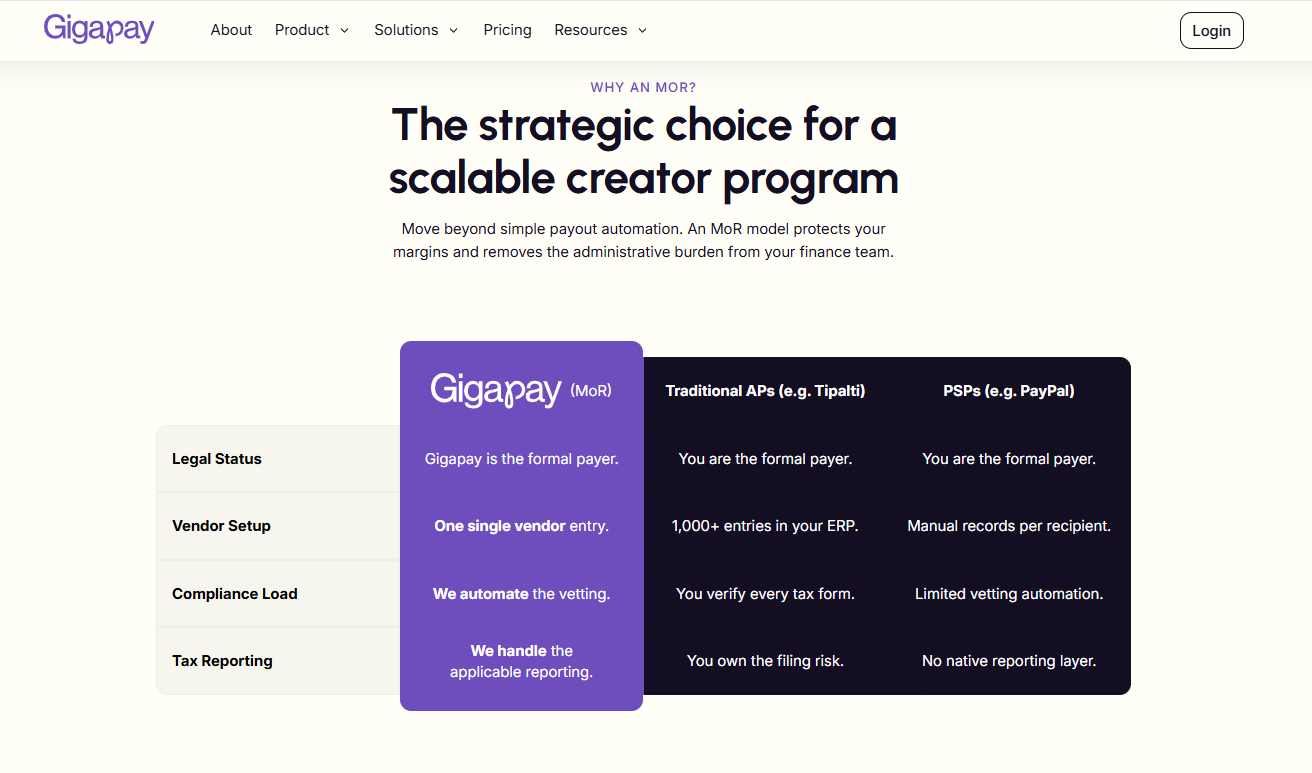
What Is an Employer of Record and What Risk Does It Transfer?
An Employer of Record becomes the legal employer of the worker in a country where you do not have an entity. The EOR signs the employment contract, runs payroll, withholds income tax and social contributions, administers statutory benefits, handles termination rules and notice periods, and carries the employment liability in that jurisdiction.
You direct the work day to day. The EOR is the name on the payslip.
Use it when the person is going to work like staff: ongoing direction, set hours, one client, a laptop you issued, a Slack account, a manager who reviews their performance. In that situation the person already looks like an employee, and an EOR turns that reality into a compliant structure instead of a misclassification risk.
The economics of an EOR are the economics of employment:
- Rise lists its EOR at USD 399 per month.
- Deel at USD 599 per employee.
- Remote at USD 599 on annual billing (USD 699 month-to-month).
- Multiplier from USD 400.
- Oyster HR at USD 699.
- Papaya Global at USD 650 to 770.
Negotiated rates fall to USD 400 to 450 at 20+ headcount. On top of the platform fee you pay the salary plus 13 to 40% employer taxes and statutory benefits depending on country, a one-month salary deposit per hire before onboarding, an FX spread on cross-border payroll, and typically a 10 to 15% administration markup on supplemental benefits.
Real all-in cost runs 15 to 40% higher than the list fee. That is a good deal when the person is staff. It is a strange deal when the person is a creator posting three Reels in October.
What Is a Merchant of Record and What Risk Does It Transfer?
A Merchant of Record becomes the contractual counterparty for remuneration.
- The MoR buys the service from the payee and resells it to you.
- You receive one invoice from one vendor.
- The payee is onboarded, identity-verified, paid, and documented by the MoR.
- You keep the brief, the creative relationship, and the approval of the deliverable.
- You do not put 400 individuals on the vendor master.
Because the payee invoices the MoR rather than you, several things change on your side of the ledger. Your AP team processes one supplier. Your procurement team runs one KYB. Your ERP holds one vendor record instead of hundreds. In cross-border cases the reverse-charge VAT mechanism generally applies on the payee's invoice to the MoR, which removes a common source of invoice rejection.
Reporting obligations that attach to the party paying the individual, such as DAC7 platform reporting where the MoR is the operator, sit with the MoR. Withholding and social contributions remain the payee's own obligation as an independent self-employed person, and each party complies with its own tax responsibilities under applicable law.
Gigapay is this model for high-volume, low-value services payees: campaign contractors, affiliates, streamers, UGC creators, and similar one-off or batch work. Brands and agencies upload a CSV or call the API, Gigapay pays each creator through local rails (SEPA Instant, Faster Payments, ACH), consolidates the campaign into a single invoice, and handles KYC, tax ID validation, and the applicable reporting (DAC7 in the EU, KU14 for Denmark).
Creators can onboard as individuals, sole traders, or companies, and no registered business or VAT number is required, which is the difference between working with nano-creators and not working with them at all.
Payouts are instant when the account is pre-funded, and on all new plans the client covers the fees, so creators keep what they earn.
Employer of Record vs Merchant of Record vs AP Automation vs PSP: How Do They Compare?
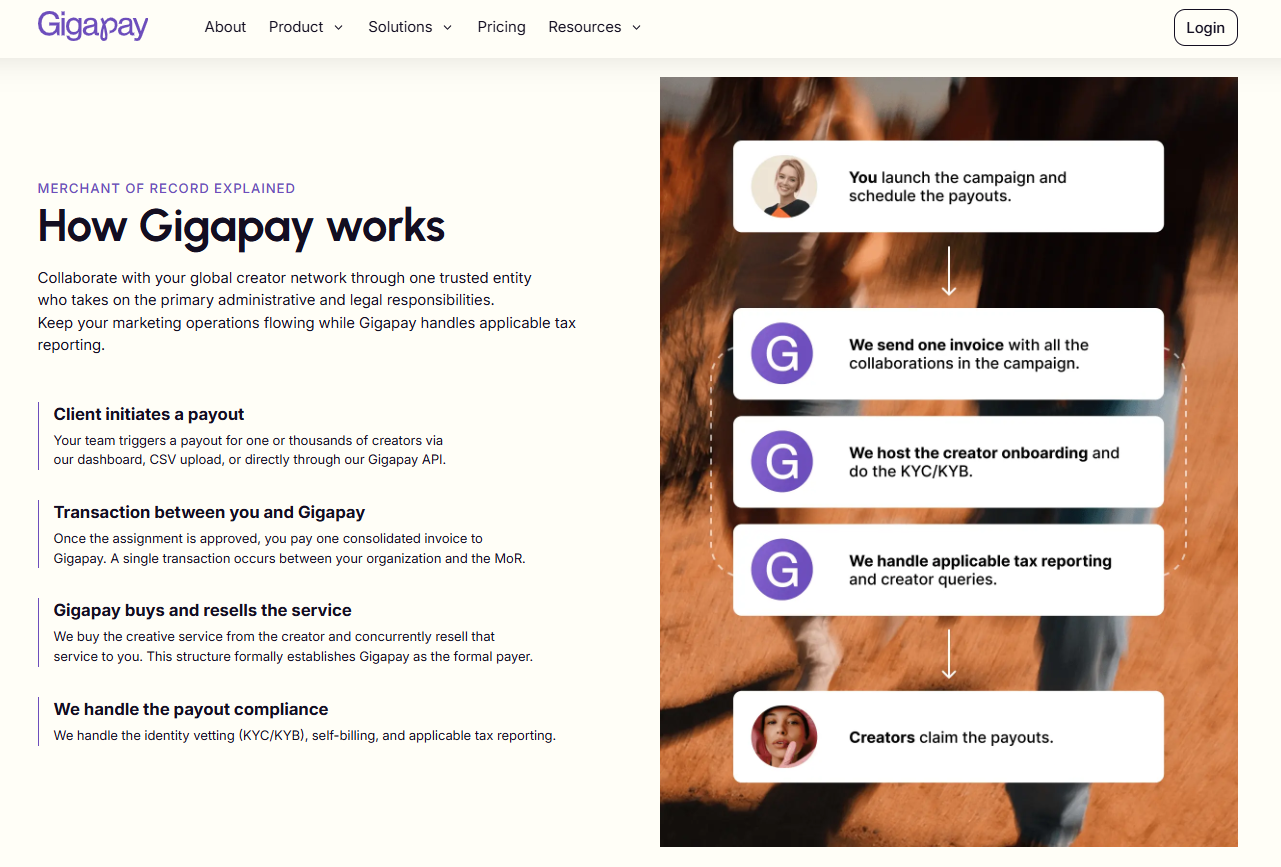
Procurement usually meets four tools at once when someone asks for "global contractor payments." Only two of them transfer legal role. The other two move money or paper and leave you as the legal buyer.
The rails players say this themselves:
- Stripe's own documentation states that users remain fully responsible for their compliance obligations.
- Tipalti processes invoices from registered suppliers efficiently and can coexist with a MoR, but it does not absorb liability or onboard a 19-year-old German creator with no company.
Those are good products for the job they do. They are the wrong answer to "who is the legal payer of these 400 people?"
How Much Does an Employer of Record vs Merchant of Record Cost for Contractor Payouts?
Numbers make the decision obvious. Take a brand running 600 creator collaborations a year, the case Gigapay uses in its ROI modelling.
Under a manual, in-house process, that program costs roughly EUR 139,590 a year: about 840 admin hours across marketing, finance, and procurement, plus vendor sprawl and error cycles. Ardent Partners (2025) puts the true all-in cost of a manually processed AP payment at around USD 60, and creator payments typically consume around six hours of combined admin time each once you count onboarding, invoice chasing, and support DMs.
Under a Merchant of Record model, the same 600 collaborations cost roughly EUR 46,350 a year and around 60 admin hours, with 300+ ERP vendor records collapsing to one. Gigapay's consolidated invoicing cuts the number of invoices behind a campaign by roughly 70%, and the creator-support load leaves with them.
Under an Employer of Record model, the math breaks before you get to compliance. Even if only 100 of those 600 creators were on an EOR at the market rate of USD 599 per person per month, that is USD 59,900 per month in platform fees alone, before salary, employer taxes, deposits, and FX.
Deel's Contractor of Record product, priced at USD 325 per contractor per month, and standard contractor management at USD 49 per contractor per month, are cheaper but still assume a persistent, monthly relationship with each individual, which a per-campaign creator program does not have.
The lesson finance teams take from this table is the one we would put in the first meeting: never compare the vendor fee. Compare total cost of ownership, hours, and who holds the liability. On headline rate a MoR looks more expensive than a rail; on all-in cost for EU cross-border creator payouts it sits mid-pack, and it is the only option in the set where the fee buys a change of legal counterparty.
How Do You Decide Between an Employer of Record and a Merchant of Record?
Ask one question before you write anything into an RFP: would we be comfortable putting this person on payroll if an auditor called tomorrow?
If the answer is yes, or if the person already looks like an employee, buy an EOR. They have a manager, they have hours, they use your equipment, they have no other clients, and they have been with you for eighteen months.
An EOR gives that relationship the legal structure it already has in practice. A payout MoR will not fix misclassification, and it should never be sold as if it does.
If the answer is no, and you are paying many people once or per campaign, you do not want 400 vendor codes and 400 invoices. You want a MoR. A creator who posts a sponsored Reel for a Q4 launch, an affiliate who earns commission on last month's clicks, a streamer paid per event, a UGC creator paid per asset: none of these people is going to appear on your headcount plan, and none of them should be paid through an employment structure.
Putting them on an EOR overpays and, worse, creates an employment relationship you did not mean to create, with notice periods and statutory obligations attached.
Some teams need both. An agency might have five in-house editors abroad on an EOR and 2,000 creators a year on a MoR. Those are two lines in the budget and two vendors in the ERP, and that is fine. The failure mode is trying to force one record to do both jobs.
What Do an Employer of Record and a Merchant of Record Not Fix?
Say this in the first meeting, because it saves the last one: classification is decided by how your managers actually treat people, and no record you buy overrides that.
Regulators examine the reality of the working relationship, and the label in the contract is irrelevant to them. If your campaign lead is setting a creator's daily schedule, dictating exact wording, requiring exclusivity, and paying a fixed monthly retainer for open-ended availability, that person may be an employee in the eyes of the local authority regardless of whether a MoR paid them.
The Austrian, Belgian, and Bulgarian legal notes in Gigapay's own expansion research all flag the same thing: continuous or exclusive arrangements raise reclassification risk, and the buyer should avoid them.
The exposure is real money:
- In the United States, total misclassification exposure commonly runs USD 15,000 to 100,000+ per worker once you stack IRS back taxes, DOL penalties, state fines, and back pay, and California charges USD 5,000 to 25,000 per willfully misclassified worker under Labor Code Section 226.8.
- In the UK, IR35 makes the fee-payer liable, and the April 2026 umbrella rules extend joint liability to agencies and end clients.
- In the EU, the Platform Work Directive flips the burden of proof onto the platform from December 2026.
A MoR reduces your admin surface, moves the counterparty relationship, and gives you a clean paper trail per payee. It does not turn a de facto employee into a contractor. An EOR gives you a compliant employment structure. It does not tell you which of your 400 creators should have been employees in the first place. That judgment is yours, and it should be made per relationship, in writing, before payment.
What Are the Alternatives to an Employer of Record or Merchant of Record?
Buyers meet three hybrids that sit between EOR and MoR, and each is worth naming so it does not get confused for either.
1. Contractor of Record (COR)
Deel and others sell a COR at around USD 325 per contractor per month. The provider signs the contractor agreement, runs classification checks, and pays the individual, which is closer to a MoR than an EOR, but it is priced and structured for a persistent monthly contractor, not for 400 one-off campaign payees.
Ask any COR vendor how they handle a payee who invoices once and never again.
2. Umbrella companies
In the UK and Nordics, umbrella and self-employment umbrella structures employ or invoice on behalf of the worker. They matter because the April 2026 UK joint-and-several liability rules now reach the agencies and end clients that use them. If an umbrella is in your supply chain, your legal team needs to know exactly who is the employer and who is the fee-payer.
3. Agencies paying creators for you
Many brands let the influencer agency handle payouts. That works until scale, when the agency's finance team is carrying hundreds of creator invoices per client, and until an audit, when the brand discovers it has no paper trail of who verified those creators' tax status.
Agencies such as The Goat Agency (WPPMedia) moved creator payouts to a MoR precisely to make payments faster while keeping the compliance documentation intact.
How Should Procurement Write an RFP for Global Contractor Payments?
If procurement is writing an RFP for "global contractor payments," split it into two lines before it goes out.
1. Employment
Scope it as "individuals who will work under our direction, on an ongoing basis, in countries where we have no entity." Score vendors on employment coverage per country, payroll accuracy, statutory benefit administration, termination handling, deposit and FX terms, and per-employee-per-month cost at your headcount tier. This is where Rise, Deel, Remote, Papaya, Multiplier, and Oyster compete.
2. Payout
Scope it as "individuals and small businesses we pay per deliverable, per campaign, or per commission, in high volume, across markets." Score vendors on legal role (does the vendor become the counterparty, or do we stay the legal buyer?), ability to pay individuals without a registered company, KYC and tax ID validation, reporting scope (DAC7, KU14, and any market-specific filings, confirmed in writing per country), invoice consolidation, payout speed, and total cost of ownership including your own admin hours. This is where a MoR competes against AP automation, rails, and the in-house status quo.
Three questions belong in every payout RFP, and they will separate the answers fast:
- Who files the DAC7 report in January, and who pays the fine if it is wrong?
- How does a creator with no company and no VAT number get paid, and who owes any applicable levy?
- If the tax authority audited this creator program tomorrow, how long would it take to produce the paper trail per payee?
What Does a Merchant of Record Contract Actually Cover?
The single most important due-diligence step on a MoR is reading the service agreement's liability clause, because "Merchant of Record" is used loosely in vendor marketing and the scope varies.
A well-structured MoR takes over the purchase and resale of the deliverable, so it is the formal counterparty to the payee and the single supplier to you. It takes on payee onboarding, identity verification, tax ID and VAT validation, self-billing or invoice handling, and the reporting that attaches to the operator or payer role.
Gigapay's service agreement, for example, is explicit that in its MoR capacity it is not responsible for withholding or paying the payee's social security or income taxes; the payee is an independent self-employed person responsible for their own direct and indirect taxes, VAT if applicable, and social contributions. Where a local rule attaches to the commissioning company itself, such as Germany's KSK levy for German-based clients, the MoR acts as an intermediary and shares the collected data so your team can report and pay.
That is a defined slice, and it is a large one. It is also the honest one. Any vendor that promises full tax immunity, or "misclassification protection," across 65 markets is describing a product that does not exist. Ask for the clause, ask for the country-by-country scope, and ask for the SIG-Lite or equivalent security and insurance pack. A vendor confident in its model will hand all three over before you ask twice.

Conclusion
Gigapay is the Merchant of Record for creator payouts, the one vendor that becomes the legal buyer of your creators' and campaign contractors' services so your team gets one invoice, one counterparty, and payees paid and reported in 65+ markets.
The choice between an Employer of Record and a Merchant of Record comes down to what the person's work actually looks like: ongoing, directed, single-client work belongs on an EOR, and high-volume, per-campaign, per-deliverable work belongs on a MoR.
Neither record repairs a classification decision your managers get wrong, and the cheapest way to avoid an expensive mistake is to write the employment line and the payout line separately before the RFP leaves the building.
If the payout line is the one your finance team is drowning in, book a demo with Gigapay and see your first campaign paid from one invoice.
Read Next:
- Vendor Sprawl: The Procurement Case Against 500 Creator Vendors
- DAC7 Reporting: What Finance Teams Owe by Country
- Tail Spend Management for Marketing Departments: A Procurement Guide
FAQs:
1. What is the difference between an employer of record and a merchant of record for contractor payouts?
The difference between an employer of record and a merchant of record for contractor payouts is the legal role each takes: an employer of record becomes the legal employer of the worker and runs payroll, withholding, and statutory benefits, while a merchant of record becomes the legal buyer of the contractor's service, resells it to you, and handles onboarding, payout, invoicing, and reporting without creating an employment relationship.
2. When should a company use an employer of record instead of a merchant of record?
A company should use an employer of record instead of a merchant of record when the person will work like staff, meaning ongoing direction, set hours, a single client, and company-issued equipment, because that relationship already looks like employment and needs an employment structure, whereas per-campaign or one-off contractors, creators, and affiliates fit a merchant of record.
3. Can you use an employer of record for campaign contractors and creators?
You can use an employer of record for campaign contractors and creators, but you will overpay, typically USD 599 per person per month before salary and employer taxes, and you will create employment relationships, notice periods, and statutory obligations you did not intend, so a merchant of record is the fit for batch or per-campaign payees.
4. Does a merchant of record take on employment or misclassification risk?
A merchant of record does not take on employment or misclassification risk; it takes on payout, invoicing, payee onboarding and verification, and a defined slice of reporting compliance set out in its contract, while classification remains determined by how your managers actually treat the worker.
5. Where does Gigapay sit between an employer of record and merchant of record?
Gigapay sits firmly on the merchant of record side: it is the Merchant of Record for creator payouts, one vendor with one invoice per campaign across 65+ markets, and it is not an employer of record, so it is the right line for high-volume creator, affiliate, and campaign contractor payments rather than for ongoing staff abroad.

.jpg)
.jpg)