.jpg)

76% of organisations experienced attempted or actual payments fraud in 2025, and 74% were hit by business email compromise, the scheme where someone impersonates a vendor and asks you to update bank details, according to the 2026 AFP Payments Fraud and Control Survey published in April 2026.
Every vendor record in your ERP is one more bank-detail change request you have to verify.
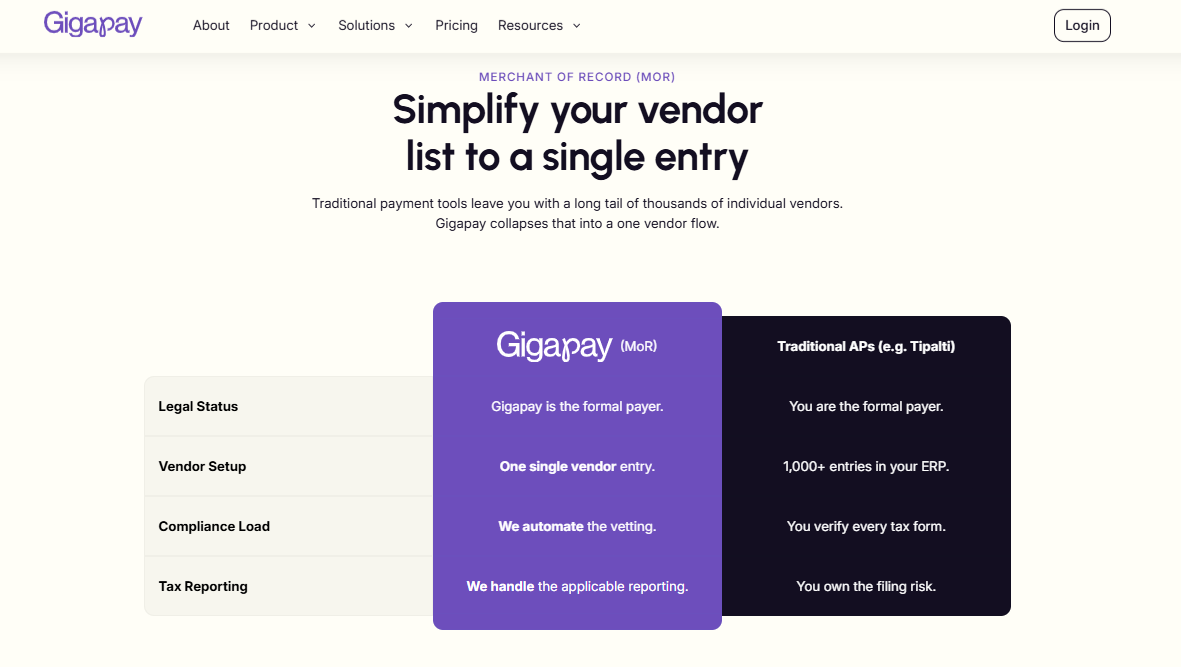
Gigapay is the Merchant of Record for creator payouts: one vendor that pays your creators on your behalf and takes the compliance, payouts, and support with it, so finance never has to open 300 vendor records for 300 people.
AP automation software was built for suppliers who send invoices, and it does that job well. The stack starts to fail when the "supplier" is several hundred individuals who will never raise a compliant invoice in your entity's language.
This article breaks down what AP automation software is good at, where it breaks when payees are people, what 2026 compliance rules the software will not file for you, and the six RFP questions finance should demand before signing anything.
Key Takeaways
- AP automation software is built for supplier invoices, not hundreds of individual payees.
- A vendor record per creator multiplies fraud checks, tax forms, and year-end filings.
- Manual creator payments cost around €40–60 each, excluding compliance exposure.
- Demand a legal buyer, self-billing, and one consolidated invoice in every RFP.
- Keep Tipalti for suppliers; use a Merchant of Record for the people bucket.
Why Controllers Are Searching for AP Automation Software in 2026
"AP automation software" pulls roughly 4,400 searches a month across the US and UK, and "accounts payable software comparison" another 3,900, according to 2026 keyword data. Those are in-market searches. A controller typing either phrase is usually three to six months away from a signed contract and is building a scorecard right now.
The reason the searches keep growing is that the benchmark gap keeps widening.
Ardent Partners' State of ePayables research, the most cited benchmark in the category, puts the average fully loaded cost of processing a single invoice at $9.40 to $10.89 depending on the edition, against $2.78 for best-in-class teams.
Cycle time tells the same story: 9.2 days on average against 3.1 days for the top quartile. Around 73–75% of AP departments now use some form of automation, yet only 22% have reached a best-in-class touchless rate above 75%. Most teams have bought something. Few have finished.
That gap is the whole sales pitch for Tipalti, BILL, Stampli, Medius, Coupa, and the dozen other platforms that show up when you search. The pitch is correct for the invoices it was designed for. The problem starts when finance assumes the same software will absorb a completely different kind of payee.
What the 2026 Accounts Payable Benchmarks Actually Measure
Every AP benchmark you will read this year measures one workflow: a known supplier sends an invoice, the system captures it, matches it to a purchase order and a goods receipt, routes it for approval, checks for duplicates, and pays it on Net 30 through an ERP-synced payment run.
Cost per invoice, days to process, straight-through rate, exception rate, early-payment discount capture. All of it assumes the counterparty is a business that already exists in your vendor master and knows how to invoice you.
That assumption holds for your packaging supplier and your cloud provider. It does not hold for the creator marketing line, which is now one of the fastest-growing cost lines in a consumer brand's P&L.
The global influencer marketing market reached roughly $32.55 billion in 2025 according to the Influencer Marketing Hub benchmark, and its 2026 report, published in March 2026, found that 87% of brand respondents expect budget increases this year.
CreatorFest's State of Creator Compensation 2026 research, which Gigapay partners on, found that 75% of US and 50% of UK marketers now spend more than $1 million a year on creators, and that micro-creator rates have risen 200–233% since 2024.
So the money is large and growing. What the AP benchmarks miss is the shape of it. A €1 million creator budget does not arrive as 40 supplier invoices. It arrives as 300 to 1,000 payments to individuals, most of whom are side-hustling (88% of creators, per the same CreatorFest data), many of whom have no registered company and no VAT number, and none of whom fit a three-way match.
What AP Automation Software Does Well for Supplier Invoices
Before the critique, the credit. If your problem is a pile of PDFs from real suppliers, AP automation software is the right purchase and you should buy it.
The category is good at invoice capture, where OCR and newer AI models now read structured and unstructured invoices with straight-through rates of 35% or more for top performers.
- It is good at GL coding and approval routing, which Ardent's respondents named as the main bottleneck in 41% of AP departments.
- It is good at duplicate-invoice detection, where AI-assisted matching reportedly catches 98% of duplicates against roughly 70% for rules-based checks.
- It is good at ERP sync with NetSuite, SAP, Dynamics, and Oracle. It is good at paying a known vendor on agreed terms and posting the entry cleanly.
Tipalti, BILL, Stampli, and whatever your ERP partner already certified will do all of that for your suppliers. The Gigapay position on this is explicit: we do not replace AP automation for real suppliers. Keep it.
Where AP Automation Software Breaks When Payees Are People
The failure is structural, and it shows up in five places at once.
Vendor Master Bloat: One Record per Creator
AP automation software treats every payee as a vendor. That is the data model. Tipalti onboards payees as ERP vendors; Trolley does the same.
- For suppliers, that is correct.
- For creators, it means a brand doing 600 collaborations a year ends up with 300 or more individual vendor records, each with its own onboarding form, bank verification, tax form, sanctions screening, and annual review.
Gigapay's own analysis of that 600-collaboration brand puts the manual process at roughly 840 admin hours and €139,590 a year. With a single vendor of record, the same volume drops to around 60 hours and €46,350. The ERP goes from 300 vendor entries to one.
The Invoice That Never Arrives
A three-way match needs an invoice. A 19-year-old creator in Hamburg with no company and no VAT registration does not send one, or sends a Word document with no legal entity, no invoice number, and the wrong currency. Your capture tool reads it. Your controller still has to reject it.
Creator ops then spends a week chasing, and the creator learns that working with your brand means waiting. Gigapay's 2024 State of Influencer Payments research with Billion Dollar Boy, Meltwater, and others documented payment terms stretching to 120 days for exactly this reason.
Tax Forms the Software Collects but You Still Own
AP platforms will collect a W-9 or W-8 and generate 1099-NEC and 1042-S forms for US-connected payees. That is useful. It does not change who the filer is. You are still the payer of record, so the IRS penalty sits with you: $60 to $340 per form for late or incorrect 1099s in the 2026 filing year, $680 per form with no annual cap for intentional disregard.
In the EU the software typically offers nothing at all for DAC7, the German KSK levy, Swedish KU14 reporting, or Spanish IRPF withholding, and the liability for each of those sits with whichever entity is the legal buyer. Read that last clause again, because it is the whole article.
Bank-Detail Fraud Scales with Vendor Count
The AFP survey data at the top of this piece is a per-vendor problem. Every vendor record is one more email that can say "we've changed banks." Vendor email compromise accounted for roughly 61% of all BEC in one 2026 enterprise dataset, and employees engaged with 44% of the vendor-compromise emails they read.
Good AP software adds callback verification and positive pay, which helps. It does not shrink the attack surface. Three hundred creator records are three hundred attack surfaces.
Payee Support Lands on Your Finance Team
When a supplier's payment is late, their AR team emails your AP team and it gets sorted. When a creator's payment is late, the creator DMs the marketing manager, who forwards it to finance, who opens the ERP, who cannot find the record because the creator onboarded under a display name.
Creator ops managers in our target accounts describe this as hours a week on "where's my money?" messages. AP automation software has no creator-facing support layer because it was never meant to have one.
The Hidden Cost of 300 Creator Vendor Records in the ERP
Finance teams tend to underprice this because the cost never appears on one line. Here is the arithmetic as we see it in deals.
Ardent Partners' 2025 benchmarks, which Gigapay's competitive research uses, put the true all-in cost of a manual payment at around €40–60 once you count onboarding, invoice handling, bank verification, FX, reconciliation, and error cycles.
Gigapay's deal data puts the labour at roughly six hours per creator payment when the process is manual end to end. At 600 payments a year that is 3,600 hours, or nearly two full-time AP specialists.
A mid-market AP specialist in the UK, Germany, or the Nordics costs roughly €40,000–55,000 fully loaded, so the headcount alone runs €80,000–110,000 before software.
Then add the exposure:
- In Germany, the KSK levy of 4.9% applies to creative commissions above €1,000, it applies to foreign creators, and the Deutsche Rentenversicherung audits retroactively across five years with fines up to €50,000.
- North Rhine-Westphalia investigators have opened roughly 200 proceedings over an estimated €300 million in suspected influencer tax evasion, and Hamburg is auditing 140 influencers.
- Sweden's DAC7 kontrolluppgifter carries fines of SEK 2,500–12,500 per seller.
- Spain's DAC7-equivalent fines run around €200 per seller.
None of this is paid by Tipalti.
This is the trap of "a faster version of the mess": AP automation makes each of the 300 vendor records cheaper to process, while the number of records, the number of tax forms, and the number of fraud checks stay exactly the same.
The 2026 Compliance Calendar AP Automation Software Will Not File for You
Finance buying AP software this quarter should hold it against the actual calendar, because the dates are fixed and the software's scope is not.
DAC7 Reporting Deadline, 31 January 2027
Platforms and intermediaries that facilitate creator income must collect and verify seller tax data, offboard sellers who fail to provide it after two reminders and 60 days, and report annually. Germany's deadline is 2 February, with per-report fines up to €50,000, and tax authorities are already feeding DAC7 data into audits.
Tipalti and Trolley offer DAC7 tooling but leave the platform-operator liability with the client. Stripe's own documentation says it accepts no liability and users remain fully responsible. Gigapay files DAC7 reports with Skatteverket as the counterparty.
US 1099-NEC Under the New $2,000 Threshold
The One Big Beautiful Bill Act raised the 1099-NEC reporting threshold from $600 to $2,000 for payments made in 2026, reported in early 2027. Fewer forms, same per-form penalty structure. If your AP platform generates the forms, you are still the filer.
Germany: KSK 4.9% and §50a Withholding at 15.825%
The KSK levy applies to brands and agencies commissioning creative work, including through "Vermarkter" intermediaries, and the 2027 rate is typically announced in November. Separately, §50a withholding of 15.825% applies on certain payments to foreign creators, and the commissioning company is liable if it does not deduct.
Exemption certificates take a year or more. Ask your AP vendor which box in their UI handles §50a. There is not one.
France: Mandatory E-Invoicing Receipt From 1 September 2026
Every French company must be able to receive e-invoices from 1 September 2026, and the Loi Influence already requires written contracts for creator deals above €1,000 per advertiser per year. French finance teams are consuming their entire 2026 on this project. Three hundred creator invoices that do not conform is a September problem.
UK: Umbrella Joint and Several Liability Since 6 April 2026
Agencies and end clients are now jointly liable for umbrella PAYE, IR35 fee-payer liability continues, and HMRC is sending platform-data nudge letters to creators and recovered £41 billion-plus in FY2024. The UK has also proposed capping payment terms from 60 to 45 days.
EU Platform Work Directive Transposition, 2 December 2026
The directive introduces a rebuttable presumption of employment with the burden of proof on the platform, and creator marketplaces are plausibly in scope. Misclassification is a live market risk for any buyer running continuous, exclusive creator arrangements through a vendor record.
ViDA, VAT Reverse Charge, and VeriFactu
Cross-border B2B creator invoices already trigger reverse-charge self-assessment by the buyer under Article 44. ViDA brings mandatory e-invoicing and digital reporting for intra-EU B2B from 2030, Spain's VeriFactu rules govern invoicing software today, and Belgium's Peppol mandate has been in full enforcement since April 2026.
Each of those is one more reason not to hold 300 individuals as VAT counterparties in your own ledger.
Six RFP Questions Finance Should Demand When Payees Are People
If the payees in scope include creators, affiliates, streamers, or any other group of individuals, add these six questions to the scorecard. They work against any vendor, including us.
1. Who Is the Legal Buyer on the Payment?
If the answer is "you," every other question below becomes your problem and the software is a productivity layer on top of it. If the answer is "we are, as Merchant of Record," the vendor is purchasing the creator's deliverable and reselling it to you, which means one contract, one counterparty, and the tax and reporting duties moving with it. Vendor of record is the term procurement will recognise.
2. Can We Avoid a Vendor Record per Person?
Ask for the vendor-master count after go-live. The right answer for a 400-creator programme is one. If the answer is 400 records "but onboarding is automated," you are buying the faster mess.
3. Who Collects and Stores Tax Forms, and Who Files Year-End Returns?
Separate "collects" from "files." Most AP platforms collect. Very few file as principal, and none of the major infrastructure players file DAC7, KU14, or KSK for you. Ask the vendor to walk you through a DAC7 filing they have made in their own name. If they cannot, write it down.
4. Self-Billing: Can the System Issue the Payee Document?
Self-billing means the buyer issues the invoice on the payee's behalf under a prior written agreement, which removes invoice chasing entirely. It is permitted across most of the EU, the UK, Canada, and Australia with conditions, and prohibited in a handful of markets such as Bosnia and Herzegovina, Argentina, and Chile.
Ask whether the vendor's self-billing is real, per-country, and legally reviewed, because a system that still needs the creator to upload an invoice has not solved the invoice problem.
5. Who Handles Payee Support When the Payment Is Late?
Ask who the creator emails, in what language, and what the response SLA is. If the answer routes back to your marketing manager, your finance team has inherited a support desk.
6. What Does the Audit Pack Look Like?
The right shape is one counterparty, one invoice per batch, and payee-level evidence underneath: KYC, tax status, self-billed document, payout confirmation, and reporting reference. When Skatteverket or the DRV asks tomorrow, the time to produce that pack should be minutes.
If the vendor cannot answer questions 2 through 6, you are buying a faster version of the mess.
AP Automation Software vs Merchant of Record: Side-by-Side for Finance
The two categories coexist. The table shows why they are not substitutes.
Payout speed deserves one clarification. Gigapay pays instantly when the account is pre-funded, and we design for pre-funding; EarlyPay gives creators a bridge on the creator side. We do not claim instant by default.
How to Score AP Automation Software for a Mixed Payee Base
Most mid-market and enterprise finance teams have both payee types, so the practical scorecard has two lanes.
- For the supplier lane, score the usual criteria: capture accuracy, touchless rate, ERP certification, approval workflow depth, duplicate detection, discount capture, and total cost per invoice against the $2.78 best-in-class benchmark. Tipalti, BILL, Stampli, Medius, and Coupa all compete here and any of them can win.
- For the people lane, add two columns that are almost never in the template: "legal buyer" and "vendor-master count after go-live." Then weight the six RFP questions above. Most AP platforms will score well on payment rails and poorly on the liability line, and that is fine, because the liability line is not what they sell. The mistake is scoring only one lane and assuming the winner covers both.
- A useful sanity check before the vendor calls: count how many of last year's payees had no registered company, how many invoices you rejected or re-requested, how many bank-detail changes you verified, and how many year-end forms you filed. If those numbers are in the hundreds, you have two procurement categories, not one.
Where Gigapay Sits Next to Tipalti, BILL, and Stampli
Gigapay sits as the layer for the payees AP does not want in the ERP. We are not a replacement for AP automation on real suppliers, and the honest battle-card line we give our own sales team is "coexist, not rip out." Tipalti for suppliers, Gigapay for creators.
In practice it works like this:
- Marketing or partnerships still runs the brief and picks the creators.
- They upload a spreadsheet or call the API, with integration typically taking two to five days.
- Gigapay onboards each creator as an individual, sole trader, or company with KYC and tax ID validation, issues the self-billed document where permitted, pays through SEPA Instant, Faster Payments, ACH, and other local rails across 65+ markets and 50+ currencies, and handles the creator's "where's my money?" questions.
- Finance receives one vendor, one contract, and one consolidated invoice per batch, with the payee-level evidence underneath.
Invoice volume falls by around 70%. DAC7, KU14, and KSK reporting move to us.
The Goat Agency, part of WPPMedia, described it as payments becoming easier and faster while ensuring compliance with taxes and benefits, and Boozt tripled collaborations without expanding the team after years of being unable to work with nano and micro creators.
The scale is real: more than 105,000 payouts and 911 million SEK in total payment volume to creators in 40+ countries, with Spain added in July 2026 within the same pan-EU setup. ISO 27001 certified, GDPR compliant, and on all new plans the client covers the fees so creators keep what they earn.
We already wrote the procurement case against holding hundreds of creator vendors. This is the AP-software version of the same argument.
How Finance Teams Run AP Automation and Gigapay Together
A clean operating model has three steps and no duplicate work.
1. Segment payees at the source
Anything with a PO, a goods receipt, and a registered counterparty goes to the AP platform. Anything that is a person delivering creative work goes to Gigapay. Procurement writes the rule once.
2. Keep one vendor record for the creator category.
Gigapay is the vendor, the batch invoice is the AP document, and your existing AP software captures and routes that single invoice like any other supplier invoice. The three-way match becomes: campaign brief, deliverables sign-off, consolidated invoice.
Always route creator questions to Gigapay support and keep marketing out of the payment loop. The campaign team sees payout status; it does not field DMs.
3. Build the audit pack once a quarter rather than once a crisis
One counterparty, one invoice per batch, payee-level KYC and tax status underneath, reporting references for DAC7 and the national schemes. When the letter arrives, the pack already exists.
Conclusion
Gigapay is the Merchant of Record for creator payouts, the one vendor that pays your creators on your behalf and takes the compliance, payouts, and support with it.
AP automation software remains the right answer for supplier invoices, and the 2026 benchmarks show why: best-in-class teams process at $2.78 per invoice in 3.1 days.
The same software becomes a faster version of the mess when the payee is 300 people without invoices, because it leaves you as legal buyer, leaves a vendor record per person, leaves the tax forms and year-end filings with you, and leaves creator support on your marketing team.
If AP is comparing software this quarter, add "legal buyer" and "vendor-master count" to the scorecard, keep your AP platform for suppliers, and book a demo to see how Gigapay handles the people-payee bucket.
Read Next:
- Employer of Record vs Merchant of Record: Which Risk Transfer Fits Contractor Payouts?
- Vendor Sprawl: The Procurement Case Against 500 Creator Vendors
- DAC7 Reporting: What Finance Teams Owe by Country
FAQs:
1. What is the best AP automation software for paying creators and influencers in 2026?
The best AP automation software for paying creators and influencers in 2026 is your existing AP platform for suppliers combined with a Merchant of Record such as Gigapay for the individual payees, because AP tools like Tipalti, BILL, and Stampli leave you as legal buyer with a vendor record per creator while a Merchant of Record gives finance one vendor and one invoice.
2. Should we rip out Tipalti if we pay hundreds of creators?
You should not rip out Tipalti if you pay hundreds of creators; you should keep it for real suppliers and stop using it as your only answer for 400 campaign payees, because it onboards each payee as an ERP vendor and does not absorb DAC7, KSK, or KU14 liability.
3. Is a Merchant of Record for creator payouts the same as payroll?
A Merchant of Record for creator payouts is not the same as payroll, because payroll is for employees while a Merchant of Record purchases an independent creator's deliverable and resells it to the brand as the legal counterparty, with its own tax reporting and self-billing.
4. What does a Merchant of Record invoice look like for a creator campaign?
A Merchant of Record invoice for a creator campaign looks like one consolidated bill per batch from a single vendor, with payee-level detail such as KYC, tax status, and self-billed documents sitting in the backup rather than arriving as 400 separate AP invoices.
5. What should finance demand from AP automation software when payees are people, not suppliers?
Finance should demand six things from AP automation software when payees are people: a clear answer on who the legal buyer is, no vendor record per person, a named filer for tax forms and year-end returns, real self-billing, a payee support desk, and an audit pack with one counterparty and payee-level evidence underneath.

.jpg)
.jpg)