.jpg)

Global influencer marketing spend is projected to hit $40.51 billion in 2026, up more than 30% from $31.07 billion in 2025, according to Mordor Intelligence.
Gigapay is the Merchant of Record for creator payouts: the one vendor solution that pays your creators on your behalf by taking on the compliance, payouts, and support so you don't have to.
Behind that $40 billion sits a procurement problem almost nobody planned for, because a creator program of 200 people in 40 countries behaves exactly like classic tail spend: hundreds of tiny suppliers, each too small for a proper vendor process, collectively expensive enough to distort your P&L.
This article breaks down what that tail spend actually costs in hours, fees, and compliance exposure, and what the finance teams who solved it did differently.
Key Takeaways
- Manual cross-border creator payments cost €40–60 each in true processing cost.
- 200 creators in 40 countries can mean 200 vendor records and 40 rulebooks.
- DAC7 fines reach €50,000 per report in Germany; penalties apply per seller.
- Consolidated invoicing through one vendor of record cuts invoice volume by up to 80%.
- A Merchant of Record absorbs tax reporting and payout liability; payment rails do not.
The Creator Economy Grew Up Faster Than the Payment Infrastructure Behind It
Europe now has roughly 8.6 million creators earning money from content, and brand budgets for creator work have been compounding at around 26% per year. The CreatorFest State of Creator Compensation 2026 report found that 75% of US marketers and 50% of UK marketers now spend over $1 million per year on influencer marketing, and that rates for micro creators have risen 200–233% since 2024.
HubSpot's State of Marketing data puts influencer marketing adoption at 86% of marketers in 2025, up from 80% in 2023.
The spending professionalized. The way the money moves did not. Most brands still pay creators the way they paid the occasional freelance photographer in 2015: an invoice arrives (or doesn't), someone in finance sets up a new vendor, someone chases a missing tax ID, and the payment lands whenever the next AP run happens to fall.
That process was tolerable at 10 creators per year. At 200 creators across 40 countries, it becomes the single largest source of operational drag in the marketing function, and increasingly the largest unmanaged compliance exposure in the finance function.
Regulators noticed before most finance teams did. DAC7 data now feeds tax audits across the EU, German investigators are running criminal probes into roughly €300 million of suspected influencer tax evasion, and the EU Platform Work Directive transposes on 2 December 2026. Every payment to a creator is now a compliance event.
What "Tail Spend" Means When Your Suppliers Are People
Procurement teams have a name for the long list of small suppliers that nobody manages strategically: tail spend. The classic pattern holds that around 80% of a company's suppliers account for roughly 20% of its spend, and that this tail generates a disproportionate share of transaction cost, maverick buying, and compliance risk because each individual supplier is too small to justify proper onboarding, negotiation, or oversight.
A creator program is a tail spent in its purest form. Consider the numbers for a typical mid-size program:
- 200 creators, average payment €500, quarterly campaign cycles
- Annual payout volume: roughly €400,000
- Individual supplier value: €2,000 per year on average
No procurement team on earth runs a strategic sourcing process for a €2,000-per-year supplier. So each creator gets the minimum-viable treatment: a rushed vendor form, a bank detail pasted into an email, a tax status nobody verified.
Multiply the minimum-viable treatment by 200, then spread it across 40 tax jurisdictions, and you have built the most expensive kind of spend a company can have: high transaction volume, low individual value, zero centralized control.
There is one crucial difference from ordinary tail spend. Office supplies do not have feelings, deadlines, or 400,000 followers. Creators do.
- When a stationery vendor gets paid in 90 days, nothing happens.
- When a creator gets paid in 90 days, they tell other creators, decline your next brief, and sometimes tell their audience.
Gigapay's 2024 research with Billion Dollar Boy, Meltwater, and The Influencer Marketing Factory found payment terms stretching to 120 days in parts of the market, and identified slow payment as a direct barrier to working with the nano and micro creators who now deliver the best engagement rates.
The Math of Paying 200 Creators in 40 Countries
Start with the cost of a single manual cross-border payment. Ardent Partners' 2025 benchmark puts the true all-in cost of a manually processed payment at €40–60 once you count AP labor, error handling, approval cycles, and bank charges.
Internal analyses of creator programs put the time cost at roughly 6 hours per creator payment when you include onboarding, invoice collection, tax documentation, payment execution, and the inevitable "where's my money?" follow-up.
Now run the program:
Gigapay's published ROI model for a brand running 600 creator collaborations per year found a manual process cost of roughly €139,590 annually, driven by 840 admin hours, vendor sprawl, and error cycles. The same program running through one vendor of record came out at roughly €46,350 with about 60 admin hours.
Scale that down to a 200-creator program and the manual overhead still lands in the tens of thousands of euros per year before a single compliance fine or a single lost creator relationship enters the calculation.
The processing cost is the visible part. The invisible part is what 40 countries does to the risk profile.
40 Countries Means 40 Rulebooks
Cross-border is where the tail-spend problem stops being an efficiency issue and becomes a liability issue. A sample of what "we pay creators in 40 countries" actually obligates you to know in 2026:
1. European Union (all member states)
DAC7 requires platform operators to collect and verify seller tax data, report annually, and offboard sellers who fail to respond after two reminders plus 60 days. Germany fines up to €50,000 per report. Sweden fines SEK 2,500–12,500 per seller. Spain's DAC7-equivalent (Modelo 238) carries per-seller fines of roughly €200. The penalties compound per creator, which is precisely the wrong structure for a program with 200 of them.
2. Germany
The Künstlersozialkasse levy sits at 4.9% for 2026 on payments to self-employed creatives above €1,000 per calendar year, and it applies even when the creator lives abroad. Deutsche Rentenversicherung is running KSK-only out-of-cycle audits that reach back five years, Hamburg's tax office is auditing 140 influencers, and §50a withholding of 15.825% applies to foreign creators, with the paying company liable if it fails to deduct.
3. France
The Loi Influence makes written contracts mandatory above €1,000 per advertiser per year, with required clauses on pain of nullity, and from 1 September 2026 every French company must be able to receive e-invoices.
4. United Kingdom
IR35 fee-payer liability sits with agencies, umbrella joint-and-several liability went live on 6 April 2026, and HMRC is sending platform-data nudge letters directly to creators. HMRC recovered over £41 billion in FY2024 with employment status listed as a priority.
5. Spain
IRPF withholding at 15% (7% for new professionals), Modelo 111 and 190 filings, RD 1619/2012 self-billing rules, and VeriFactu invoicing-software requirements.
6. Sweden
KU14 reporting, the F-tax boundary, and Skatteverket running targeted influencer reviews, with gifted products taxable at market value.
That is six countries out of forty. Each of the remaining thirty-four adds its own withholding rates, treaty positions, self-employment tests, and invoicing rules. No marketing team can hold this, and no finance team signed up for it.
Anthropologically, what happens in most companies is simpler and worse: nobody holds it, and the exposure accumulates silently until a trigger event, which is why in-house manual processing accounts for more competitive losses in Gigapay's CRM than every named payment vendor combined. The status quo works right up until an auditor asks for the paper trail.
Where the Money Leaks: FX, Fees, and Failed Payments
The compliance layer sits on top of a rails layer that leaks money on its own. Paying 200 creators in 40 countries through consumer-grade or general-purpose tools produces predictable losses:
- Cross-border transfer fees: PayPal's cross-border reality includes per-payment caps that reach €16–20 in some corridors, plus receiver-side fees that come out of the creator's pocket. On a €300 micro-creator payment, the creator can lose a meaningful share of their fee before it arrives.
- FX spreads: Currency conversion at 2–4% is common across consumer rails. On €400,000 of annual payout volume spread across 25 currencies, FX alone can quietly consume €8,000–16,000 per year, and the loss is invisible because it never appears as a line item.
- Failed and returned payments: Wrong IBAN formats, name mismatches, intermediary bank rejections. Every failed cross-border payment restarts the 6-hour cycle and delays a creator who has already delivered the work.
- The float trap: Agencies feel a second-order version: clients pay on 60–90 day terms while creators expect payment on delivery, so the agency finances the gap from working capital, and every new client makes the gap wider.
Local payment rails change the physics. SEPA Instant in the EU, Faster Payments in the UK, and ACH in the US deliver funds in seconds rather than days, without correspondent-bank fee chains.
Gigapay routes payouts through these local rails across 65+ countries and 50+ currencies, with payouts landing in as little as 7 seconds when accounts are pre-funded, and clients cover the fees on all new plans, so creators keep what they earn.
The Vendor Master Problem: 200 Suppliers Your ERP Was Never Built For
Ask a finance leader what 200 creators look like from inside the ERP and the answer is uncomfortable: 200 vendor records, each requiring bank verification, tax documentation, and sanctions screening, most of them used once or twice per year, many belonging to individuals with no registered company at all.
That last point matters more than it sounds. A large share of nano and micro creators, the tier whose rates rose 200–233% since 2024 precisely because they perform, operate as private individuals without a VAT number or registered business. Standard AP systems and supplier-payment platforms are built for companies.
Tipalti onboards suppliers; it has no good answer for a 19-year-old German creator with no company, and no answer at all for who owes the KSK levy on her fee.
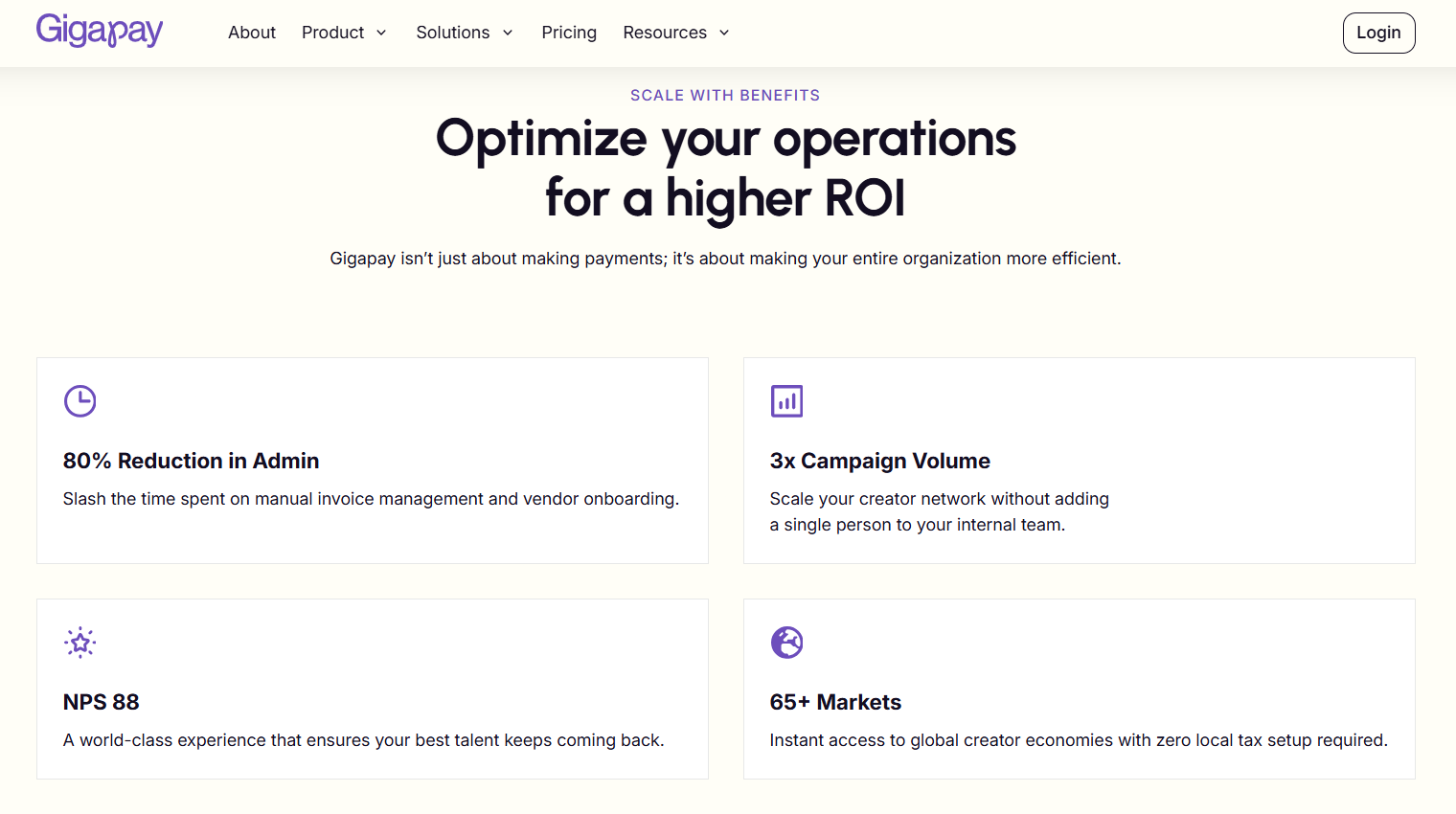
Boozt's brand activation team described this exact wall: they had been trying to find a way to work with nano and micro influencers for years, and vendor onboarding was the thing blocking it. After moving to one vendor of record, they tripled collaborations without expanding the team.
The procurement view is the cleanest way to state the fix. Supplier consolidation for the creator category means hundreds of vendor setups become one vendor of record: one contract, one counterparty in the vendor master, one consolidated invoice per campaign instead of up to 800 individual creator invoices per year.
Gigapay's consolidated invoicing cuts invoice volume by up to 80%, and the Radisson case shows the model holding at enterprise scale across 39 countries.
What Creators Earn, and Why Late Payment Costs You the Roster
Tail-spend logic tempts companies to treat small payments as low-stakes. Creator economics say the opposite. CreatorFest's 2026 data shows 88% of creators still run their creator work as a side hustle, and Gigapay's Nordic research found 59% of creators earning less than €1,000 per month even though 67% create content full or part-time.
A €500 payment that a brand books as a rounding error is often a meaningful share of that creator's monthly income.
Rates themselves have professionalized quickly. Micro-creator rates are up 200–233% since 2024, agency markups on creator fees run 20–80%, and typical 2026 market rates put a mid-tier Instagram creator at several thousand euros per sponsored post, with nano creators in the €100–500 range per deliverable.
Brands earn an average of $5.78 for every $1 spent on influencer marketing, which makes the creator roster a revenue asset, and payment experience is now a retention lever for that asset.
The mechanism is simple. Creators talk to each other, compare brands, and prioritize the ones that pay fast and cleanly. A program that pays in 7 seconds after approval competes for talent differently than one that pays in 90 days after an invoice chase.
Gigapay's creator NPS of 88 exists because the creator side of the payment got treated as a product, with EarlyPay giving creators instant access to scheduled funds and a dedicated human support team absorbing the "where's my money?" messages that would otherwise land on your campaign managers.
How a Merchant of Record Collapses the Tail
Payment rails and AP tools move money and generate paperwork. A Merchant of Record becomes the counterparty and absorbs the liability. That structural difference is what dissolves the tail-spend problem rather than just automating it.
Here is how the model works in practice. Gigapay formally purchases each creator's deliverable and concurrently resells it to you, which makes Gigapay the legal counterparty to the creator. From your side, 200 creator relationships become one supplier relationship:
- One vendor record in your ERP instead of 200+, with one contract and one KYB process for procurement.
- One consolidated invoice per campaign or batch instead of hundreds of individual creator invoices, with self-billing automation generating compliant invoices on behalf of creators who would never produce one themselves.
- Tax reporting handled as Gigapay's obligation, including DAC7 across the EU, KU14 in Sweden, and KSK reporting scope in Germany, with KYC, tax ID validation, and self-employment status checks built into creator onboarding.
- No business registration required from creators, which reopens the entire nano and micro tier that vendor forms were blocking.
- Payouts in 65+ countries and 50+ currencies through local rails, instant when pre-funded, with clients covering fees on all new plans.
- An API with a 2–5 day integration for platforms and teams that want payouts embedded in their own tooling, or a CSV upload for teams that want to send a batch from a spreadsheet.
One caveat belongs in any honest breakdown: a Merchant of Record structure transfers the payment counterparty and the associated reporting, and each party still complies with their own tax responsibilities under applicable law.
Misclassification risk is a real market risk that regulators are actively enforcing, and the counterparty structure is a factual answer to how payments are papered, described here as it works rather than as a blanket guarantee.
The proof at volume: Gigapay has processed 105,000+ payouts totaling 911 million SEK, to creators in more than 40 countries. One platform client came to Gigapay mid-crisis with DAC7 obligations across 42 countries it could not meet; the rescue worked because the reporting obligation moved to a counterparty built to carry it.
The Numbers Side by Side: Manual vs One Vendor of Record
For a program near the 200-creator, 40-country mark, the comparison looks like this:
On headline rate, a spreadsheet and a bank transfer look free. On all-in cost, the manual process is the most expensive option on the market, and it is the only one where the compliance exposure is retroactive: DAC7 penalties apply per seller, KSK audits reach back five years, and withholding failures surface years after the payments that caused them.

Conclusion
Gigapay is the Merchant of Record for creator payouts, the one vendor solution that pays your creators on your behalf by taking on the compliance, payouts, and support so you don't have to.
Paying 200 creators in 40 countries is a tail-spend problem with a compliance multiplier: 800 small payments a year, each costing €40–60 to process manually, spread across dozens of rulebooks where the fines apply per creator and the audits reach back years.
Consolidating that tail into one vendor of record turns 200 supplier relationships into one contract, cuts invoice volume by up to 80%, moves the tax reporting to a counterparty built to carry it, and pays every creator through local rails in seconds.
If your creator program has outgrown the spreadsheet, book a demo and see what one payout batch across 40 countries looks like when it takes minutes instead of a quarter.
Read Next:
- Paying Creators in Germany: What the KSK Artists' Social Insurance Levy Costs You
- Why Spain Breaks Most Creator-Payout Setups (and How to Fix It)
- DAC7 Explained for Finance Teams: What Platform Operators Owe, and When
FAQs:
1. What is a cross-border tail-spend problem in creator marketing?
A cross-border tail-spend problem in creator marketing is the accumulation of hundreds of small creator payments across many countries, where each payment is too small for strategic vendor management but collectively generates high processing costs of €40–60 per manual payment, hundreds of vendor records, and per-creator compliance obligations in every jurisdiction involved.
2. How much does it cost to pay 200 creators manually across 40 countries?
The cost to pay 200 creators manually across 40 countries runs to roughly €32,000–48,000 per year in processing alone, based on €40–60 true cost per payment across 800 annual payments, before adding FX spreads of 2–4%, cross-border transfer fees, admin time of around 6 hours per creator payment, and any compliance penalties.
3. What is the best way to pay creators in multiple countries compliantly in 2026?
The best way to pay creators in multiple countries compliantly in 2026 is through a Merchant of Record for creator payouts such as Gigapay, which becomes the legal counterparty to each creator, handles DAC7 and local tax reporting, pays creators through local rails in 65+ countries, and consolidates hundreds of creator invoices into one per campaign.
4. What are the DAC7 penalties for failing to report creator payments?
The DAC7 penalties for failing to report creator payments reach €50,000 per report in Germany, SEK 2,500–12,500 per seller in Sweden, and roughly €200 per seller under Spain's Modelo 238, and because the penalties apply per seller or per report, exposure scales directly with the number of creators in a program.
5. Why do brands consolidate creator payments under one vendor of record?
Brands consolidate creator payments under one vendor of record because it replaces hundreds of individual vendor setups with a single counterparty in the ERP, cuts invoice volume by up to 80%, transfers tax reporting obligations to the vendor of record, reduces admin from around 840 hours to around 60 hours per year at scale, and pays creators in seconds rather than months.
.jpg)
.jpg)