.jpg)

In March 2026, the Association of National Advertisers published its first formal study of influencer marketing agency compensation and found that only 51% of marketers had full clarity into what their agencies pay influencers on their behalf. The other half are funding campaigns at scale without knowing where a substantial share of the money actually lands.
Gigapay is the one-vendor creator payout platform that closes that gap. The company acts as Merchant of Record for brands, agencies, and creator platforms, absorbing the tax liability, the onboarding paperwork, and the cross-border payment admin so marketing can keep moving and finance keeps full visibility into every euro out.
Lumanu helped pioneer this category and is a respected name in US creator payments. The market in 2026 looks nothing like the market Lumanu was originally built for, with global influencer spend sitting at roughly $32.6 billion, EU reporting rules tightening every quarter, and creator volumes per brand running into the thousands.
This review walks through the strongest Lumanu alternatives for influencer payments in 2026, what each one is good at, and where Gigapay outperforms across payout speed, global compliance, and creator experience.
Key Takeaways
- The best Lumanu alternative in 2026 is Gigapay, with instant payouts and full EU compliance.
- Gigapay assumes Merchant of Record liability across 65+ countries and 50+ currencies.
- Lumanu standard payouts take one to two days; Gigapay pays creators instantly.
- Gigapay automates DAC7, KSK, and KU14 reporting that US-built platforms typically miss.
- Creator NPS for Gigapay is 88, with no business registration required to onboard.
Why Brands Are Looking Beyond Lumanu in 2026
Lumanu built its name in the US creator economy as a payments and whitelisting platform. It positions itself as Merchant of Record for creator payments, handling onboarding, compliance, and payouts for brands, agencies, and platforms.
The product is strong on what it was designed for. Same-currency US payouts move cleanly. The whitelisting feature has fans across paid social teams. Reviewers generally like the interface.
Three things have changed since Lumanu first launched, and they are the reasons brands now evaluate alternatives.
1. Regulatory complexity outside the US
DAC7 in the EU, KU14 in Sweden, and Künstlersozialkasse in Germany all require specific reporting flows that most US-built platforms layer in after the fact. KSK alone applies a 4.9% levy on creative payments above €1,000, even when the creator is hired internationally, and brands operating in Germany without an automated KSK process are accumulating quiet liability.
2. Payout speed expectations
Lumanu's standard payments via local bank networks typically take one to two days, with Instant Pay via VISA Direct available for an extra fee. In 2026, with creators running on tight cash cycles and brands trying to lock in talent across time zones, day-or-two settlement is no longer a competitive position.
3. Scale
Brands that used to run 50 creator partnerships a year now run hundreds. Some run thousands. Once a payments platform stops being a back-office tool and starts being the operational backbone of a marketing program, every minute of admin friction multiplies.
What to Look For in a Lumanu Alternative
A platform earns the right to replace Lumanu in your stack by getting six things right.
Payout speed
Same-day is the floor. Instant is the bar. Anything that requires "expedite" as a paid upgrade is treating speed as a feature instead of the baseline.
Merchant of Record coverage
Money movement is not the same as tax liability transfer. A real MoR contractually becomes the counterparty so your ERP shows one vendor instead of three hundred, and so 1099-equivalent reporting is automated rather than chased.
Compliance breadth
US 1099 and W-8/W-9 handling is table stakes. The question for 2026 is whether the platform automates DAC7 reporting across the EU, KSK in Germany, KU14 in Sweden, the new UAE influencer permit rules, and the patchwork of local tax reporting obligations that show up in any global program.
Creator onboarding friction
Nano and micro creators are the volume of modern influencer programs. Micro-influencers with 10,000 to 100,000 followers deliver 60% higher engagement rates than mega-influencers at roughly one-tenth the cost per post. If your payment platform forces them to register a business or fill in twelve fields before they can get paid, you lose them.
API and integration depth
A platform that only works through a dashboard is a platform that doesn't scale. The strongest alternatives offer a documented REST API, webhooks, and a sandbox environment so they sit inside affiliate networks, agency CRMs, and brand-side influencer platforms.
Pricing that scales sensibly
SaaS plus a transaction fee is the cleanest model. Per-seat pricing falls apart the moment creator volume jumps. Custom enterprise quotes are fine, but the entry tier should be transparent.
The Best Lumanu Alternatives for Influencer Payments in 2026
1. Gigapay: Best Overall Alternative to Lumanu
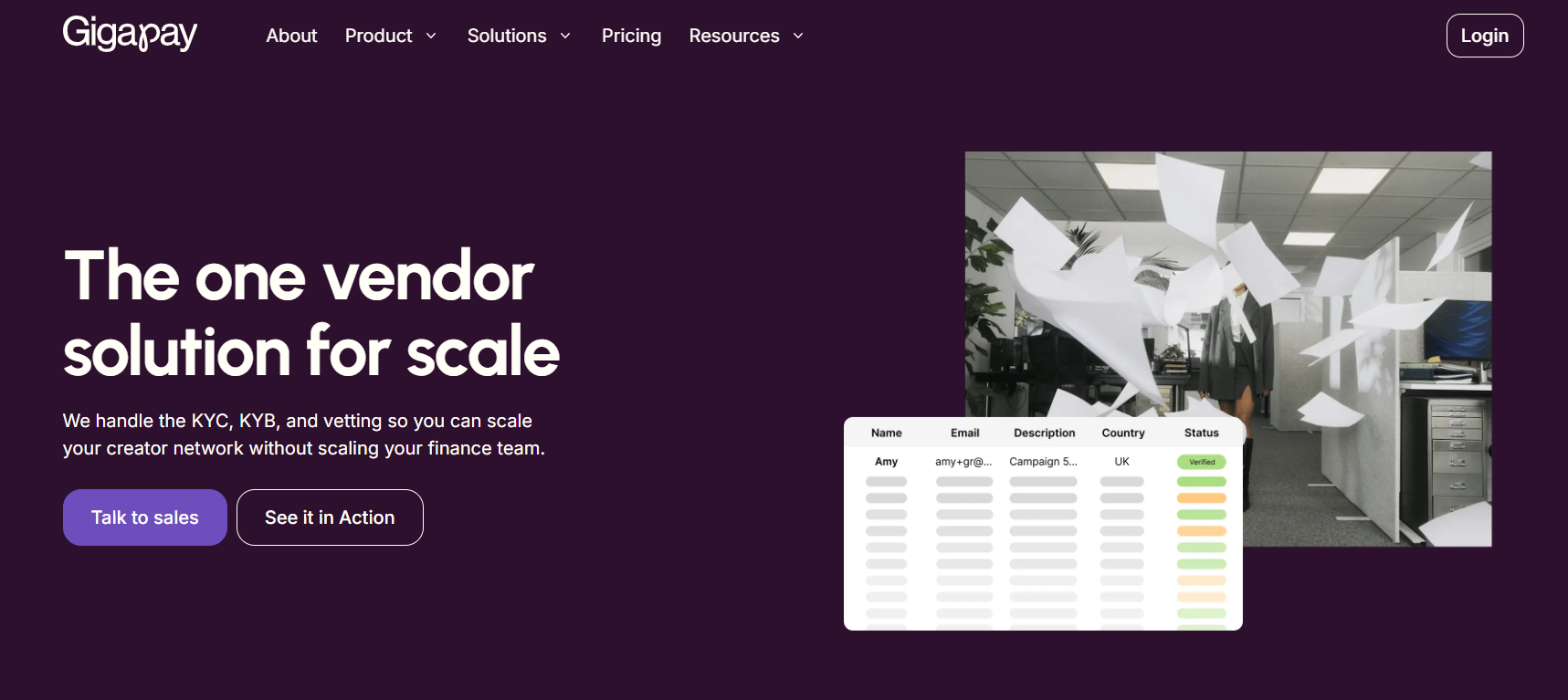
Gigapay was founded in Stockholm in 2019 and built its core proposition around the European regulatory complexity that US-first platforms only partially cover. Gigapay operates as Merchant of Record, which under our service agreement means we formally purchase the creator's deliverable and concurrently resell it to the brand, becoming the contractual counterparty.
What changes in practical terms:
- One vendor in your ERP instead of three hundred individual creator records.
- One consolidated invoice per campaign or batch instead of an inbox full of PDFs.
- Automated DAC7, KSK, and KU14 reporting handled by the platform.
- Instant payouts via local rails: SEPA Instant in the EU, Faster Payments in the UK, ACH in the US.
- 65+ countries, 50+ currencies, with funding accepted in USD, EUR, GBP, SEK, DKK, and NOK.
- A creator NPS of 88, supported by a dedicated human creator-support team and the EarlyPay liquidity feature.
- A REST API, sandbox, webhooks, and full integration in two to five days.
- ISO 27001 certification and GDPR compliance baked into the infrastructure.
The most consistent feedback from agencies and brands switching from US-centric platforms is that the European compliance work disappears.
Boozt's Brand Activation Lead, Christina Oliosi, has said Gigapay enabled the nano and micro creator collaborations the brand had been trying to make work for years. The Goat Agency moved to Gigapay for the time saved on payment management while compliance stayed intact.
The lines where the choice typically tips toward Gigapay over Lumanu are payout speed and European regulatory coverage. Standard local-rail payouts on Lumanu take one to two days, while Gigapay settles instantly on those same rails.
Lumanu's reporting work is built around US 1099, W-8, and W-9 flows, while Gigapay automates DAC7 across the EU, KSK in Germany, and KU14 in Sweden inside the platform itself. The creator-side onboarding flow is built around global nano and micro talent who do not need to register a business to get paid.
2. Tipalti
Tipalti is the heavyweight in mass payables. It is built for accounts payable teams running large supplier programs across procurement, marketplaces, and partner networks. The platform handles W-9, W-8, and self-billing flows competently, supports payments to most countries, and offers strong AP-side automation.
The trade-off is orientation. Tipalti is a finance-team tool first, with onboarding built for vendors who already have a tax ID and a registered business entity. That is exactly the part of the creator economy where most of the volume sits in 2026, and where any friction translates directly into lost collaborations.
Tipalti also operates as a payments and AP platform rather than a Merchant of Record, which keeps the tax liability on the brand's side and leaves the creator-program-specific reporting work like DAC7, KSK, and KU14 for someone else to handle.
That gap is the reason creator-economy teams running global programs typically choose Gigapay instead, where the MoR contract, the individual-creator onboarding flow, and the EU regulatory automation come in one package.
3. Stripe Connect
Stripe Connect is the platform-builder's choice. It is excellent if you are an engineering-heavy team building your own creator marketplace and want fine-grained control over money movement, KYC handling, and account types. The API is well documented and the developer experience is one of the best in payments.
What Stripe Connect provides is payment infrastructure rather than an influencer payments product. Compliance work, tax reporting at scale, creator support, EU-specific reporting like DAC7 and KSK, and the consolidated-invoice model brands want from a vendor of record all sit on the building team. That is a multi-quarter engineering project and a real ongoing operational cost.
Teams that decide the build is not the right place to spend their roadmap usually land on Gigapay, where the MoR contracting, the EU regulatory automation, and the creator-experience layer come pre-built and integrate in two to five days.
4. PayPal Payouts
PayPal Payouts is the option teams reach for when they are early in their creator program. Creators recognize the brand, the API is straightforward, and for small volumes in a small number of countries it does a perfectly adequate job.
The model stops working once the program scales internationally. PayPal is a payment processor, not a Merchant of Record, which means the tax liability stays on the brand and the reporting work scales linearly with creator count.
FX fees on cross-border payouts add up quickly, creator-side fees frustrate the people the program is trying to keep happy, and there is no consolidated invoicing into the brand's ERP. DAC7 and KSK automation sit entirely outside what PayPal does.
Once a creator program crosses a few dozen monthly collaborations or starts spanning the EU, the operational case for moving to a creator-specialist Merchant of Record like Gigapay is straightforward.
5. Wise
Wise is the FX-first choice. The exchange rates are excellent, the API is solid, and the payout speed on local rails is competitive. For a finance team paying a handful of international suppliers, Wise is a quiet, reliable tool.
The gap for influencer programs is the same one that shows up with PayPal. Wise moves money efficiently, but it does not become the tax counterparty, does not automate DAC7 or KSK reporting, does not collapse the vendor sprawl in the ERP, and does not own the creator-side experience the way a creator-specialist platform does.
Brands that have outgrown Wise as a creator payment tool usually move to Gigapay because the entire layer above payment processing comes built in: the MoR contract, the EU regulatory automation, the creator onboarding, and the single invoice line in the books regardless of creator volume.
Side-by-Side: Gigapay vs Lumanu vs the Rest
Why Gigapay Wins on the Cases Lumanu Was Not Built For
Lumanu and Gigapay sit in the same category, and there are programs where Lumanu is a perfectly good choice. If you are a US brand, paying mostly US creators, and your finance team's biggest concern is 1099 filing season, Lumanu does that job well.
The cases where Gigapay separates are the ones where the problem is bigger than US payouts.
- A European brand paying creators across fifteen countries needs DAC7 reporting done automatically, not added later.
- A German subsidiary working with creators above the €1,000 threshold needs Künstlersozialkasse handled in the background, not flagged for the finance team to research.
- A Nordic-headquartered company paying Swedish creators needs KU14 reporting baked into the platform rather than handled offline.
Agencies running global creator programs for clients across regions need the same payment vendor to work cleanly whether the campaign is in Stockholm, Stuttgart, São Paulo, or San Francisco. WPPMedia's GOAT team and Boozt are running this kind of program today on Gigapay because the answer to "does this also handle the creator in Berlin under KSK rules" is yes by default.
Creator experience also matters more than it used to. 86% of US marketers plan to work with influencers in 2026, and the people who actually deliver the campaign are nano and micro creators who are not running a registered business.
Gigapay lets them onboard as individuals, get paid instantly, and access early liquidity without a fee penalty. That is why our creator NPS sits at 88.

Conclusion
Gigapay is the one-vendor creator payouts platform built for the way influencer marketing actually runs in 2026: at scale, across borders, with EU regulatory pressure that did not exist when most of the competition was designed.
This review covered the strongest Lumanu alternatives currently in the market. Tipalti is the right answer if you are running a finance-led mass-payables program.
Stripe Connect is the right answer if you are an engineering team building a marketplace. PayPal Payouts and Wise are reasonable starting points at low volume. Lumanu itself remains a solid US-centric option.
Gigapay is the answer when the program is global, the regulatory surface is wide, the creator base is mostly nano and micro, and the marketing and finance teams have stopped arguing about whose problem the admin is.
Book a demo with Gigapay and see your first creator payouts go out instantly on the same day you sign.
Read Next:
- Which Influencer Management Platform Should Nordic Companies Use in 2026?
- How Gigapay Powers Meltwater's Influencer Marketing Solution
- How to Manage Vendor Onboarding with Gigapay
FAQs:
1. What is the best Lumanu alternative for influencer payments in 2026?
The best Lumanu alternative for influencer payments in 2026 is Gigapay, which combines Merchant of Record coverage with instant payouts across 65+ countries and automated EU regulatory reporting that US-built platforms typically do not handle.
2. How does Gigapay compare to Lumanu for global creator payouts?
Gigapay compares to Lumanu by paying creators instantly through local rails like SEPA Instant, Faster Payments, and ACH, where Lumanu's standard payouts take one to two days, and by automating EU-specific reporting such as DAC7, KSK, and KU14 that Lumanu's US-first design does not natively cover.
3. Why do brands switch from Lumanu to Gigapay?
Brands switch from Lumanu to Gigapay when their creator programs go global and they need a single vendor that handles EU compliance automatically, transfers tax liability through the MoR model, and pays nano and micro creators instantly without requiring them to register a business.
4. Is Gigapay a true Merchant of Record like Lumanu?
Yes, Gigapay is a true Merchant of Record like Lumanu, contractually purchasing the creator's deliverable and reselling it to the brand client so the brand sees one vendor in the ERP, one consolidated invoice per campaign, and a single counterparty for tax and reporting purposes.
5. What is the difference between Gigapay, Tipalti, and Stripe Connect?
The difference between Gigapay, Tipalti, and Stripe Connect is that Gigapay is a creator-economy Merchant of Record with EU regulatory automation built in, Tipalti is a finance-team accounts payable platform without MoR coverage, and Stripe Connect is raw payment infrastructure that requires you to build the compliance and vendor-of-record layers yourself.
.jpg)