

51% of publishers say payment issues have a moderate to significant impact on their business, according to the APMA (October 2026).
Affiliate networks should not become every publisher's legal counterparty, because each direct contract adds an invoice, a tax record and a reporting question.
Gigapay is the Merchant of Record for creator payments. Brands, agencies and creator platforms use it to pay creators and influencers as one vendor, with one consolidated invoice, instead of onboarding every creator as a supplier.
This guide breaks down the legal, tax, invoicing and compliance load, and how a Merchant of Record changes it.
Key Takeaways
- Contracting every publisher directly makes the network their payer, invoice issuer and record-keeper.
- UK self-billing needs a signed agreement with each supplier, usually lasting 12 months.
- UK platform operators face penalties of up to £5,000 for a late report.
- Tradedoubler ran 300,000+ active publishers on a 22.2% gross margin in 2025.
- With a Merchant of Record, the network holds one supplier record instead of thousands.

How Large Are Affiliate Publisher Payouts in 2026?
Affiliate networks now pay very large publisher bases, and every publisher is a payee. Awin lists 1 million publishers and 30,000 advertisers, and says it generated £1.2 billion for publishers in its last financial year (Awin, About us, accessed November 2026).
Tradedoubler reported 300,000+ active publishers, 3,000+ brands and 90+ countries in its 2025 Annual Report (April 2026). UK brands invested £1.8 billion in affiliate and partner marketing in 2025, according to the APMA's State of the Affiliate Nation report (May 2026).
| Metric | Figure | Source |
|---|---|---|
| Publishers on Awin | 1 million | Awin, About us (accessed November 2026) |
| Revenue generated for Awin publishers, last financial year | £1.2 billion | Awin, About us (accessed November 2026) |
| Active publishers at Tradedoubler | 300,000+ | Tradedoubler Annual Report 2025 (April 2026) |
| Tradedoubler revenue, 2025 | SEK 2,222 million | Tradedoubler Year-End Report 2025 (February 2026) |
| Tradedoubler gross margin, 2025 | 22.2% | Tradedoubler Year-End Report 2025 (February 2026) |
| UK affiliate and partner spend, 2025 | £1.8 billion, up 7.3% | APMA, State of the Affiliate Nation (May 2026) |
| UK revenue driven by affiliate, 2025 | £20.7 billion | APMA, State of the Affiliate Nation (May 2026) |
Scroll sideways to see all columns
For your finance team, each of those publishers is a possible supplier record, invoice and tax file.
Why Are Publisher Payments Under More Pressure in 2026?
Publisher payments are under more pressure because publishers now treat late payment as a growth problem, and networks are tightening their own rules in response.
Since 1 October 2026, impact.com has suspended brand accounts once an invoice is more than 40 days overdue, down from 60 days (APMA, October 2026).
What publishers say they would do with faster payment
| Publisher response | Share | Source |
|---|---|---|
| Payment issues have a moderate to significant business impact | 51% | APMA (October 2026) |
| Would increase spend or acquisition activity with better cash flow | 39% | APMA (October 2026) |
| Would expand into new verticals or regions | 31% | APMA (October 2026) |
| Would launch or scale new content | 29% | APMA (October 2026) |
Scroll sideways to see all columns
How networks manage the timing gap
Awin pays publishers on the 1st and the 15th of each month, with a £20 minimum payment. Its payment pages also describe "amber" and "red" advertiser statuses, where publishers are paid only after Awin receives the advertiser's payment (Awin, accessed November 2026).
For your network, the publisher chases the party named on the contract when money is late, whoever caused the delay.
What Does It Mean to Be a Publisher's Legal Counterparty?
Being a publisher's legal counterparty means the network signs the contract in its own name, receives the publisher's services and pays for them. Four jobs follow from that position.
| Job | What the network takes on |
|---|---|
| 1Contracting party | The network owns the terms, every change to them, every dispute and every termination. |
| 2Invoice party | The network receives an invoice for each payment, or raises one for the publisher through self-billing. |
| 3Payer | The network holds bank and tax details, executes each payment and documents it. |
| 4Record-keeper | The network stores agreements, invoices and tax IDs, and answers the reporting questions that attach to a payer or a platform. |
Scroll sideways to see all columns
Large networks show how this works in practice. Awin told publishers that all EU-based publishers are contracted with AWIN AG from 1 January 2021 (Awin, publisher tax details update). One entity then carries those four jobs for every EU publisher on the network.
For your legal team, the counterparty question decides which entity appears on every contract, invoice and payment record.
Publisher Self-Billing Rules: What Invoicing Every Publisher Requires
Most publishers do not send invoices, so the network raises them. Awin describes the self-billing invoice it raises to pay commission, and says publishers typically receive automatic payments without submitting invoices (Awin Partner Success Center, accessed November 2026).
What UK self-billing rules require
HMRC's guidance on self-billing arrangements sets conditions for the customer that issues the invoices (GOV.UK, accessed November 2026):
| What HMRC’s self-billing rules require | |
|---|---|
| ✓ | A signed self-billing agreement with each supplier before the first invoice. |
| ✓ | An expiry date on each agreement, usually 12 months, with a review at the end. |
| ✓ | Records of the name, address and VAT number of every self-billed supplier. |
| ✓ | A new agreement when a supplier changes its VAT registration number. |
| ✓ | No VAT on invoices to suppliers that are not VAT registered. |
Without these records, the self-billed invoices are not valid VAT invoices.
Source: HMRC, VAT: self-billing arrangements (GOV.UK, accessed November 2026)
Scroll sideways to see all columns
HMRC also states that without these records the self-billed invoices are not valid VAT invoices.
What EU self-billing rules require
Article 224 of the EU VAT Directive (Council Directive 2006/112/EC) allows customer-issued invoices where a prior agreement exists and each invoice goes through an acceptance procedure. Each Member State sets its own terms for those agreements.
How VAT treatment changes by publisher
Awin's help pages say UK and German publishers have VAT shown on self-billing invoices, while other publishers' invoices exclude VAT under the reverse charge. Publishers with Turkish tax residency issue their own invoice to Awin, and publishers in Mexico submit a CFDI invoice (Awin Partner Success Center, accessed November 2026).
For your accounts payable team, one payment run can contain several invoicing regimes, and each one needs its own evidence.
Publisher Tax Details: What a Network Must Collect From Every Publisher
A network that pays publishers directly needs tax details from each one before the first payment. Awin's public tax details form shows the scope: tax residency, business type, an address that matches tax authority records and a tax number (Awin Partner Success Center, accessed November 2026).
| Publisher location | What Awin’s public help pages ask for |
|---|---|
| EU country, VAT registered | VAT ID |
| Outside the US and Germany, not VAT registered | Local tax number |
| United Kingdom | UK VAT ID where registered; VAT shown on invoices |
| United States | W-9 form; Awin issues a 1099-NEC each year |
| Turkey | Publisher issues its own invoice against a payment notification |
| Mexico | CFDI invoice in a required format |
Source: Awin Partner Success Center (accessed November 2026)
Scroll sideways to see all columns
The US threshold changed in 2026
The IRS reporting threshold for Form 1099-NEC is $2,000 for payments made in 2026, up from $600 for payments made before 2026 (IRS, 2026). A network paying US publishers has to track each payee's annual total against the new figure.
For your operations team, every new market adds a row to this table and a new check at onboarding.
Does an Affiliate Network Have to Report Publishers Under DAC7?
An affiliate network has to report publishers under DAC7 only if it is a reporting platform operator, and that depends on how the network is set up. The points below are general information from official sources.
What DAC7 requires
DAC7, Council Directive (EU) 2021/514, places the reporting obligation on platform operators and covers personal services, the sale of goods and certain rentals, according to the European Commission. Operators report seller identification data and the total amount paid or credited to each seller, once a year. DAC7 has applied since 1 January 2023 and creates no new tax.
What the UK rules say
The UK reporting rules for digital platforms have applied since 1 January 2024. HMRC says a platform connects sellers to customers and holds, or can get, the amount paid to sellers. HMRC also says sites that only redirect users elsewhere are not platforms (GOV.UK, updated 21 July 2026).
What the penalties look like
| Jurisdiction | Penalty | Source |
|---|---|---|
| UK | Up to £5,000 for a late report | HMRC International Exchange of Information Manual, IEIM905110 |
| UK | Up to £5,000, then up to £600 a day, for failing to provide information to HMRC | Platform Operators (Due Diligence and Reporting Requirements) Regulations 2023, regulation 13 |
| Germany | Fines of up to €50,000 | Section 25, Plattformen-Steuertransparenzgesetz |
General information, not tax or legal advice.
Scroll sideways to see all columns
HMRC published a new penalties factsheet for platform operators, CC/FS98, on 16 October 2026. A network that contracts with publishers, calculates their earnings and pays them should ask its tax adviser where it stands. This is general information, not tax or legal advice.
Which Rule Changes Affect Publisher Invoicing Between 2026 and 2030?
Seven dated changes affect how a network documents publisher payments between 2026 and 2030.
| Date | Rule | What changes | Source |
|---|---|---|---|
| 1 January 2026 | Belgium B2B e-invoicing | Mandatory B2B e-invoicing begins | Grant Thornton (July 2026) |
| 1 January 2026 | US Form 1099-NEC | Threshold rises from $600 to $2,000 | IRS (2026) |
| 1 September 2026 | France e-invoicing | First phase goes live | VATupdate (September 2026) |
| 2 December 2026 | EU Platform Work Directive | Member States’ transposition deadline | Directive (EU) 2024/2831 |
| 31 January each year | DAC7 and UK platform reports | Annual report for the previous calendar year | European Commission; HMRC |
| 1 January 2027 | Germany e-invoicing | Businesses with turnover above €800,000 must issue e-invoices; all businesses from 1 January 2028 | Taxually (November 2026) |
| 1 July 2030 | EU VAT in the Digital Age | E-invoicing and digital reporting for intra-EU B2B transactions | Taxually (November 2026) |
Scroll sideways to see all columns
National mandates differ on whether they cover cross-border invoices and self-billing, according to VATupdate (2026). Whether the Platform Work Directive reaches an affiliate network depends on how that network organises work, which is a question for its lawyers.
For your roadmap, each date is a change to invoice formats, data fields or filings that someone in the network must own.
How Much Does Direct Publisher Contracting Cost a Network?
Direct publisher contracting costs a network recurring hours, specialist salaries and a share of a thin margin. The example below is an illustration with stated assumptions, not a benchmark.
Worked example: 5,000 active publishers paid monthly
| Task | Assumption | Volume per year | Hours per year |
|---|---|---|---|
| Self-billed invoices issued | One per publisher per month | 60,000 | Automated |
| Invoice corrections and queries | 2% of invoices, 15 minutes each | 1,200 | 300 |
| Self-billing agreement reviews | One per publisher, 5 minutes each | 5,000 | 417 |
| Tax detail checks for new publishers | 1,000 new publishers, 10 minutes each | 1,000 | 167 |
| Total manual time | 884 |
At 1,650 working hours a year, 884 hours is about half of one full-time role.
Scroll sideways to see all columns
At 1,650 working hours a year, 884 hours is about half of one full-time role.
What the team costs
| Role | Typical London salary | Source |
|---|---|---|
| Accounts payable clerk or senior clerk | £38,000 | Hays UK Salary & Recruiting Trends 2026 |
| Accounts payable manager | £53,000 | Hays UK Salary & Recruiting Trends 2026 |
| UK tax manager, in-house, outside the FTSE 100 and 250 | £80,000 | Hays UK Salary & Recruiting Trends 2026 |
| VAT manager, in-house, outside the FTSE 100 and 250 | £95,000 | Hays UK Salary & Recruiting Trends 2026 |
| Financial controller, SME | £120,000 | Hays UK Salary & Recruiting Trends 2026 |
Scroll sideways to see all columns
Why the margin matters
Tradedoubler reported gross profit of SEK 493 million on revenue of SEK 2,222 million in 2025, a 22.2% gross margin (Tradedoubler Year-End Report, February 2026). Every SEK 100 of revenue left SEK 22.20 to fund staff, technology and compliance.
For your business case, count the specialist roles and the dated rule changes, because the clerical hours are the smaller part.
Direct Contracting vs Payout Rails vs Merchant of Record
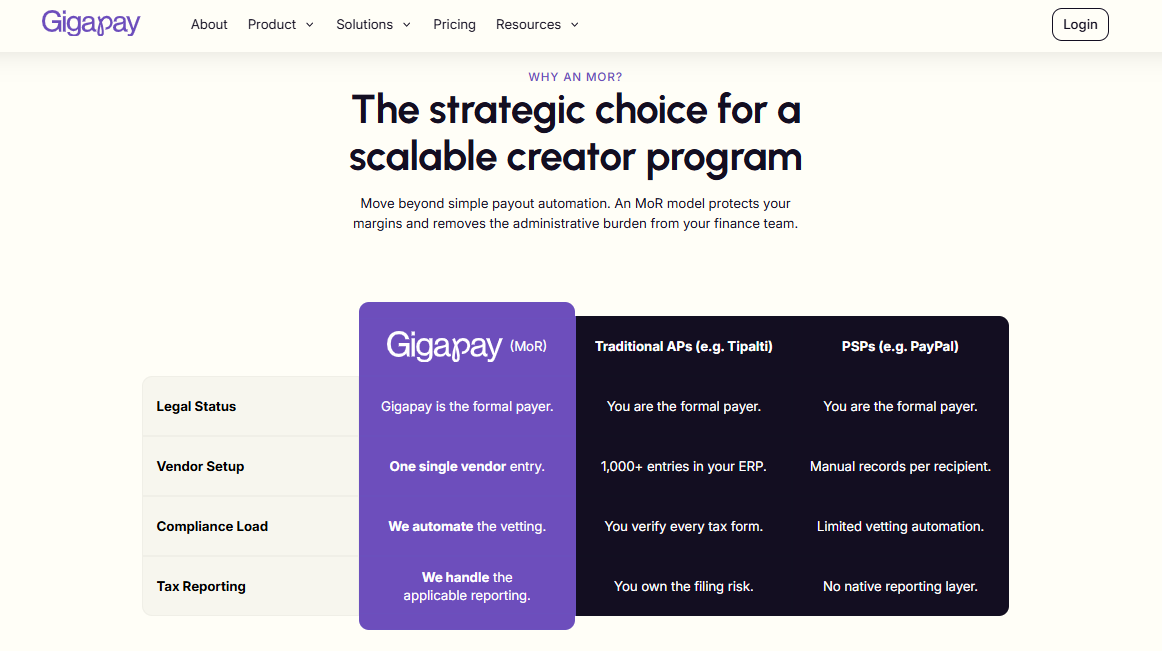
Networks have three models for paying publishers, and they differ on one point: who the publisher's counterparty is.
| Question | Direct contracting | Payout rails | Merchant of Record |
|---|---|---|---|
| Who contracts with the publisher for the paid services? | The network | The network | The Merchant of Record |
| Who is the payer? | The network | The network, using the provider’s rails | The Merchant of Record |
| Who raises or receives publisher invoices? | The network | The network | The Merchant of Record |
| Supplier records in the network’s ledger | One per publisher | One per publisher | One |
| Invoices the network books for publisher costs | One per publisher per run | One per publisher per run | One consolidated invoice per batch |
| Who sets programme rules and manages the publisher relationship? | The network | The network | The network |
Scroll sideways to see all columns
Payout rails improve how money moves, and the network remains the contracting party and payer.
A Merchant of Record buys the publisher's services in its own name and for its own account and resells them to the network. The network keeps its programme rules, tracking and publisher relationships.
For your shortlist, decide on the counterparty model first, because it sets what every other tool has to do.
How Gigapay Works as Merchant of Record for Affiliate Networks
With Gigapay, the network is the client and Gigapay is the creator's counterparty and payer. A network's individual publishers and creators are the creators in the steps below.
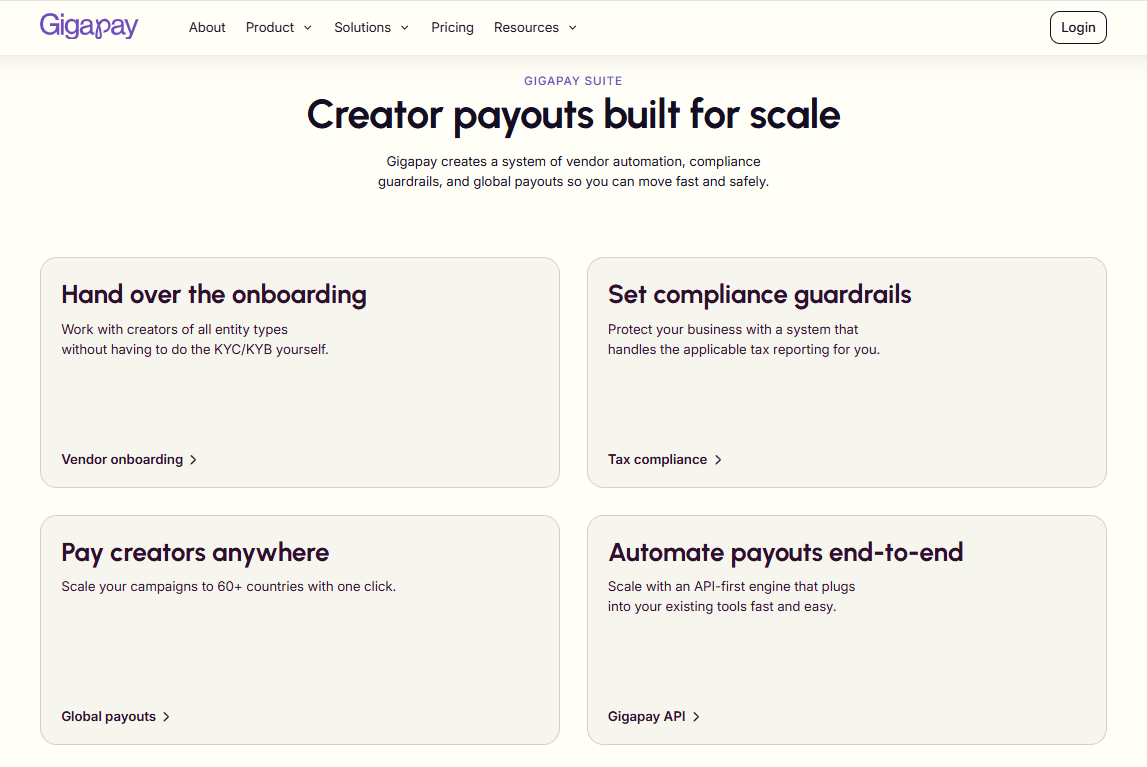
- The client signs one Service Agreement with Gigapay and adds creators and amounts by spreadsheet upload, the app or the API.
- Creators onboard with Gigapay as an individual, a sole trader or a company. Gigapay runs identity and tax-ID checks at onboarding.
- When the client approves the work, Gigapay undertakes to buy the creator's services and issues the client a consolidated invoice.
- The creator claims the payout in Gigapay. At the claim, Gigapay buys the services and resells them to the client.
- The payout is executed by a licensed third-party payment provider.
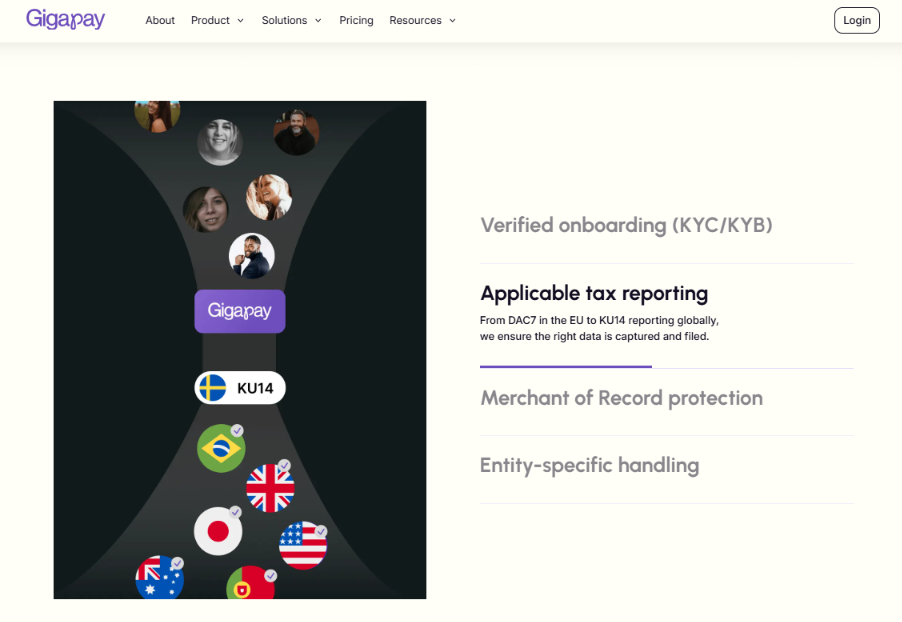
- Gigapay reports the payment to Skatteverket, the Swedish Tax Agency, which shares it with the creator's home tax authority.
What the network's finance team keeps
The client has one vendor record and receives one consolidated invoice per batch or campaign. The client keeps Gigapay's invoice, the contract and proof of payment. The client's VAT is on Gigapay's invoice, not on a creator invoice, because the creator supplies Gigapay.
Onboarding and paperwork
Creators onboard as individuals, sole traders or companies. No registered company or VAT number is needed, and onboarding takes ca 10 minutes. Gigapay handles the paperwork for every payout. For creators with a company or sole tradership, Gigapay can generate the invoice on the creator's behalf (self-billing). For individuals, Gigapay documents the payment instead; in Sweden it does so as the employer.
Tax and reporting
For the creator's fee we're the payer, not you: we pay them and report the payment. Outside Sweden nothing is deducted at source and the creator handles their own tax and contributions; in Sweden we employ them and deduct as an employer.
Gigapay is the creator's counterparty and payer, so obligations that depend on being the payer stop attaching to you. Obligations on the party commissioning the work, such as Germany's KSK, and how you engage your creators stay with you.
Gigapay files DAC7 as the platform operator with Skatteverket. For German clients, Gigapay collects and shares the creator data needed to handle KSK obligations correctly.
API, currencies and payout speed
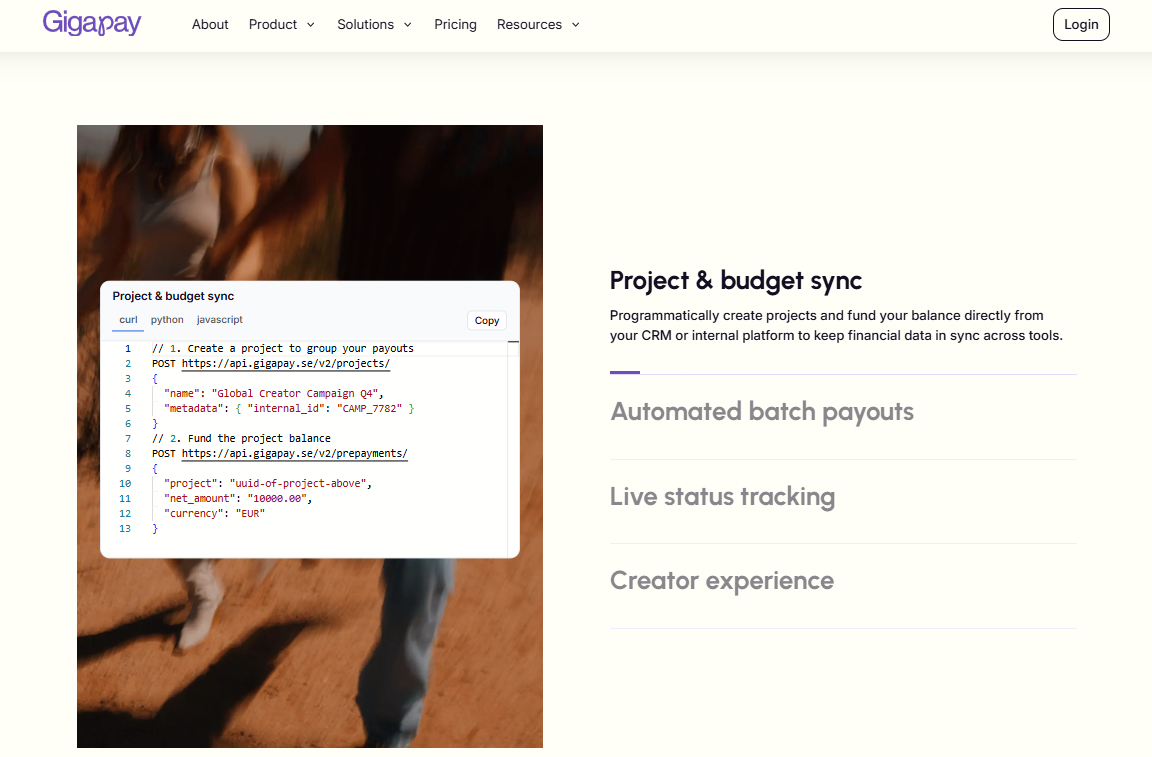
Clients and platforms can integrate payouts through the Gigapay API in a week. Gigapay pays in 50+ currencies, and payouts arrive in seconds to a few banking days, depending on country and payout method. See the Supported Markets page for coverage and the pricing page for pricing.
Proof from affiliate and creator platforms
Adrecord, a partner marketing platform, integrated payouts through Gigapay's API. 95% of its users preferred Gigapay over the previous payout partner, according to the Adrecord case study (Gigapay, March 2024). Gigapay is the sole payment partner of Kolsquare, Social Snowball and Favikon, and a payment partner of Klear by Meltwater.
Pros and Cons of the Gigapay Merchant of Record Approach
The Gigapay approach has five advantages and two limits for an affiliate network.
| Pros | Cons |
|---|---|
|
|
Scroll sideways to see all columns
For your evaluation, weigh the two limits against the number of publisher contracts, invoices and tax files the network holds today.
Which Publishers Should a Network Still Contract Directly?
A network does not need one model for every publisher. The long tail creates most of the records, while a few large partners create most of the negotiation.
| Publisher type | Typical profile | Model that usually fits | Why |
|---|---|---|---|
| Individual creators and influencers | No company or VAT number, small monthly earnings | Merchant of Record | Onboarding as an individual, with paperwork per payout |
| Sole-trader content publishers | One person, several programmes, several countries | Merchant of Record | One counterparty across markets |
| Small publisher companies | Registered company, modest volumes | Merchant of Record or direct | Depends on volume and invoicing needs |
| Large media houses | Own finance team, negotiated terms, own invoices | Direct contract | Bespoke commercial terms |
| Cashback, coupon and technology partners | High volumes, complex commercial models | Direct contract | Terms often go beyond a standard payout |
Scroll sideways to see all columns
Sort last year's publishers by number of payments and support queries to find where direct contracting costs the most per pound paid.
For your commercial team, a split model keeps negotiated partners close and takes the long tail out of the supplier ledger.
How to Move Publisher Payouts to a Merchant of Record: 6 Steps
A network can move payouts in stages, starting with one publisher segment and one market.
- Map your payees. Count active publishers by country, entity type and annual earnings.
- Choose the first segment. Start with individual creators and sole traders, where onboarding friction is highest.
- Review your publisher terms. Ask your lawyers to update the terms so they match the new contracting and payment flow.
- Integrate payouts. Connect approved commission amounts to the provider by API or file upload.
- Run one cycle in parallel. Pay one segment through the new model for one month and reconcile it against the old process.
- Roll out by market. Add segments and countries once finance and publisher support are comfortable.
Ask every provider to confirm in writing who the publisher's counterparty is and who files platform reports.
For your project plan, the publisher terms review usually takes longer than the integration, so start it first.
Conclusion
Gigapay is the Merchant of Record for creator payments.
A network that contracts every publisher directly becomes the contracting party, invoice issuer, payer and record-keeper for each one. Self-billing agreements, tax details, platform reporting and e-invoicing mandates all land on that role, and most of the volume comes from the long tail of small publishers and creators.
Book a demo to see how your network can pay creators and publishers with Gigapay as the counterparty.
Read Next:
- Top 7 Trolley Alternatives for Creator and Affiliate Payouts (2027 Review)
- PayPal and Wise Batch Payouts vs a Merchant of Record: The True Cost per Creator in 2026
- How Adrecord Boosted User Experience with Gigapay
FAQs:
1. Why should affiliate networks not become every publisher's legal counterparty?
Affiliate networks should not become every publisher's legal counterparty because each direct contract makes the network the payer, invoice issuer and record-keeper for that publisher. With thousands of publishers, that means thousands of self-billing agreements, tax records and supplier accounts, funded from a thin network margin.
2. What does legal counterparty mean in affiliate publisher payments?
Legal counterparty in affiliate publisher payments means the entity that contracts with the publisher in its own name, receives the publisher's services and pays for them. That entity appears on the contract, the invoice and the payment record, and it answers the tax and reporting questions tied to the payer.
3. Do affiliate networks have to report publisher payments under DAC7?
Affiliate networks have to report publisher payments under DAC7 only if they are reporting platform operators, which depends on how the network is set up. DAC7, Council Directive (EU) 2021/514, places the reporting obligation on platform operators. This is general information, not tax advice.
4. What is self-billing in affiliate publisher payments?
Self-billing in affiliate publisher payments is an arrangement where the network issues the invoice for the publisher's commission in place of the publisher. HMRC guidance requires a signed agreement with each supplier, usually lasting 12 months, and records of each supplier's name, address and VAT number.
5. What is the best way for affiliate networks to pay publishers without contracting each one?
The best way for affiliate networks to pay publishers without contracting each one is a Merchant of Record model, where the provider is the counterparty and payer. Gigapay is the Merchant of Record for creator payments, and clients and platforms can integrate payouts through the Gigapay API in a week.