

36.8% of European brands and agencies now work with 100 or more influencers a year, according to Kolsquare's The Future of Influencer Marketing 2026/2027 (September 2026).
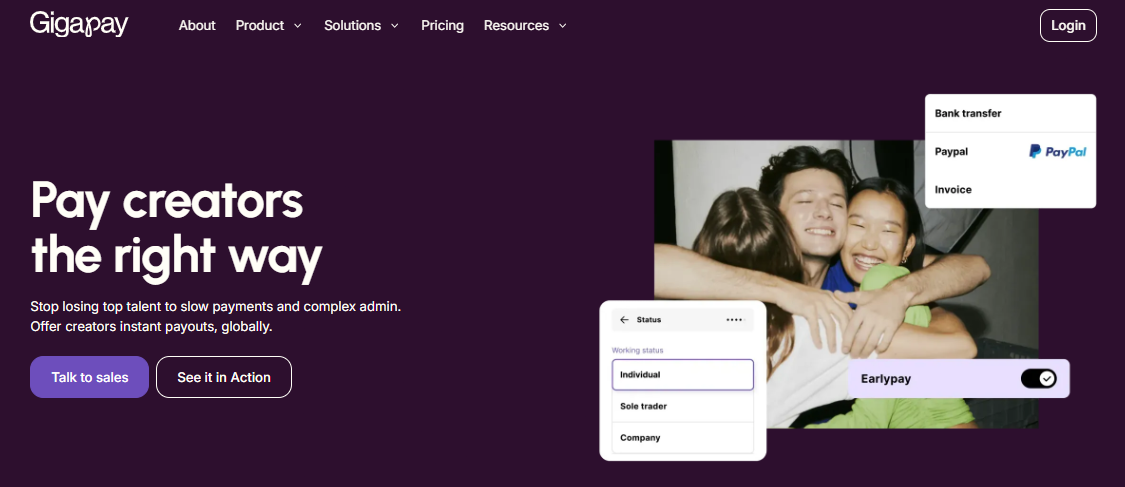
Gigapay is the Merchant of Record for creator payments. Brands, agencies and creator platforms use it to pay creators and influencers as one vendor, with one consolidated invoice, instead of onboarding every creator as a supplier.
This review compares Trolley with seven alternatives on model, price, reach and fit.
Key Takeaways
- Gigapay ranks first among seven Trolley alternatives in our 24 November 2026 comparison.
- Trolley's Pay module costs $2,399 a year, plus per-payout fees and 2.00% FX.
- Trolley's four Standard modules together cost $7,196 a year before transaction fees.
- 36.8% of European brands and agencies work with 100+ influencers, according to Kolsquare.
- Stripe Connect lists $2 per monthly active account, plus 0.25% + 25¢ per payout.
How Fast Are Creator and Affiliate Programmes Growing in 2026?
Creator rosters in Europe have doubled in two years. The share of organisations working with 100 or more influencers rose from 18.2% in 2024 to 36.8% in 2026, according to Kolsquare (September 2026). The study surveyed 1,123 marketing decision-makers in seven European markets.
Affiliate programmes are moving the same way, because more of the partners earning commission are creators.
For your finance team, every new creator or affiliate is another payee, and many of them are individuals without a registered company.
What Does It Cost to Pay Creators and Affiliates in 2026?
Paying a creator or affiliate costs the provider fee plus the work of processing each payee. The median total cost to process one accounts payable invoice is $6.00, according to APQC's Open Standards Benchmarking, as reported by Corpay (2026).
A brand that pays 100 creators four times a year handles 400 creator invoices. At the APQC median, that is about $2,400 a year in processing cost before anyone chases a missing tax ID.
The people doing that work are salaried finance staff.
For your budget, the payout model decides whether this processing work stays with your accounts payable team or moves to your provider.
What Is Trolley and How Does It Pay Creators and Affiliates?
Trolley is a payout platform for marketplaces, creator platforms, affiliate networks and music companies. It was founded in Montréal in 2015 as Payment Rails and took the Trolley name in 2021, according to BetaKit's report on its Series B (November 2024).
Trolley announced a $23 million Series B in November 2024. BetaKit reported at the time that Trolley had sent payments to over 4 million recipients.
Trolley pays recipients in 210+ countries and territories and 135+ currencies, by bank transfer, PayPal, Venmo and other methods (trolley.com, accessed 24 November 2026). Its named customers include Wattpad, Envato, ArtStation and Pixsy.
How a Trolley payout works
- Recipients onboard through a white-label portal, which Trolley offers in 38 languages.
- Trolley's Trust module verifies identity, and its Tax module collects tax forms.
- You send payouts from the dashboard, a file upload or the API.
- The Sync module pushes payout records to QuickBooks Online, Xero or NetSuite.
- At year end, the Tax module generates IRS statements and digital platform reporting files.
Trolley pricing in 2026
Trolley pros
- Trolley reaches 210+ countries and territories in 135+ currencies.
- Its price list is public, down to the fee for each payout method.
- Its tax tooling covers IRS forms, DAC7 and platform reporting in the UK, Australia and New Zealand.
Trolley cons
- The four Standard modules cost $7,196 a year before any transaction fee.
- The Standard Tax module covers one jurisdiction, and multi-jurisdiction reporting sits in Trolley Plus.
- Trolley describes itself as a payout platform, so each creator is still paid by your company.
Why Do Teams Look for Trolley Alternatives?
Teams look for Trolley alternatives for four practical reasons. Each one comes from Trolley's own public pages, accessed 24 November 2026.
- Modular pricing: Pay, Tax, Trust and Sync are separate subscriptions. Payout, currency conversion, statement and scan fees come on top.
- The payout model: Trolley's pages describe a payout platform and do not describe Trolley as a Merchant of Record. Your finance team still keeps a record for every payee.
- Reporting work: Trolley's digital platform reporting page says it generates XML files ready to upload to your local reporting agency's portal. Your team still does the filing.
- Buyer profile: Trolley addresses product and engineering teams that embed payouts in their own platform. A brand or agency without engineers gets less from that design.
None of these points makes Trolley a weak product. It fits a marketplace with a payments team better than a marketing team paying 300 creators.
For your shortlist, decide first whether you want payout software or a single counterparty that pays your creators.
Top 7 Trolley Alternatives at a Glance
We compared Trolley and seven alternatives on 24 November 2026. We weighted the invoicing model, onboarding without a registered company, creator paperwork, reporting and partner integrations highest.
Competitor facts come from each provider's own public pages, accessed between 23 and 24 November 2026. Gigapay facts come from Gigapay's approved product information.
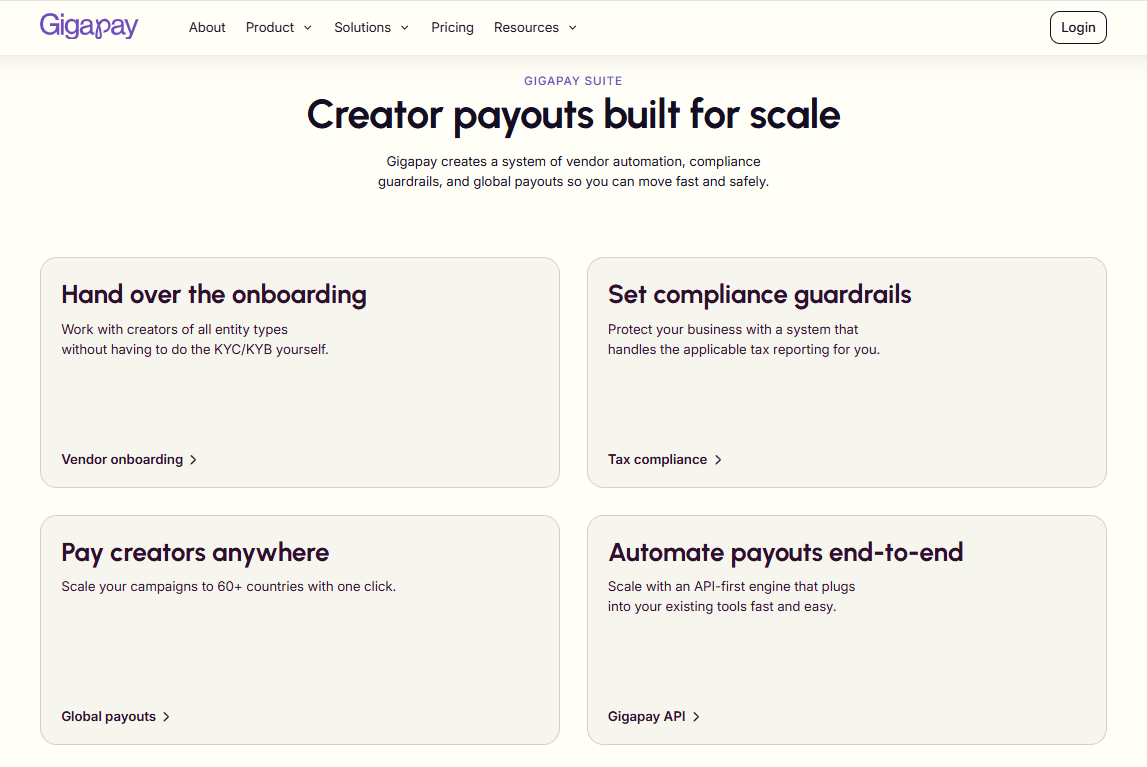
1. Gigapay: Best Trolley Alternative for Creator and Affiliate Payouts
Gigapay is the Merchant of Record for creator payments, founded in 2019 and based in Stockholm, Sweden. It ranks first in our 24 November 2026 comparison.
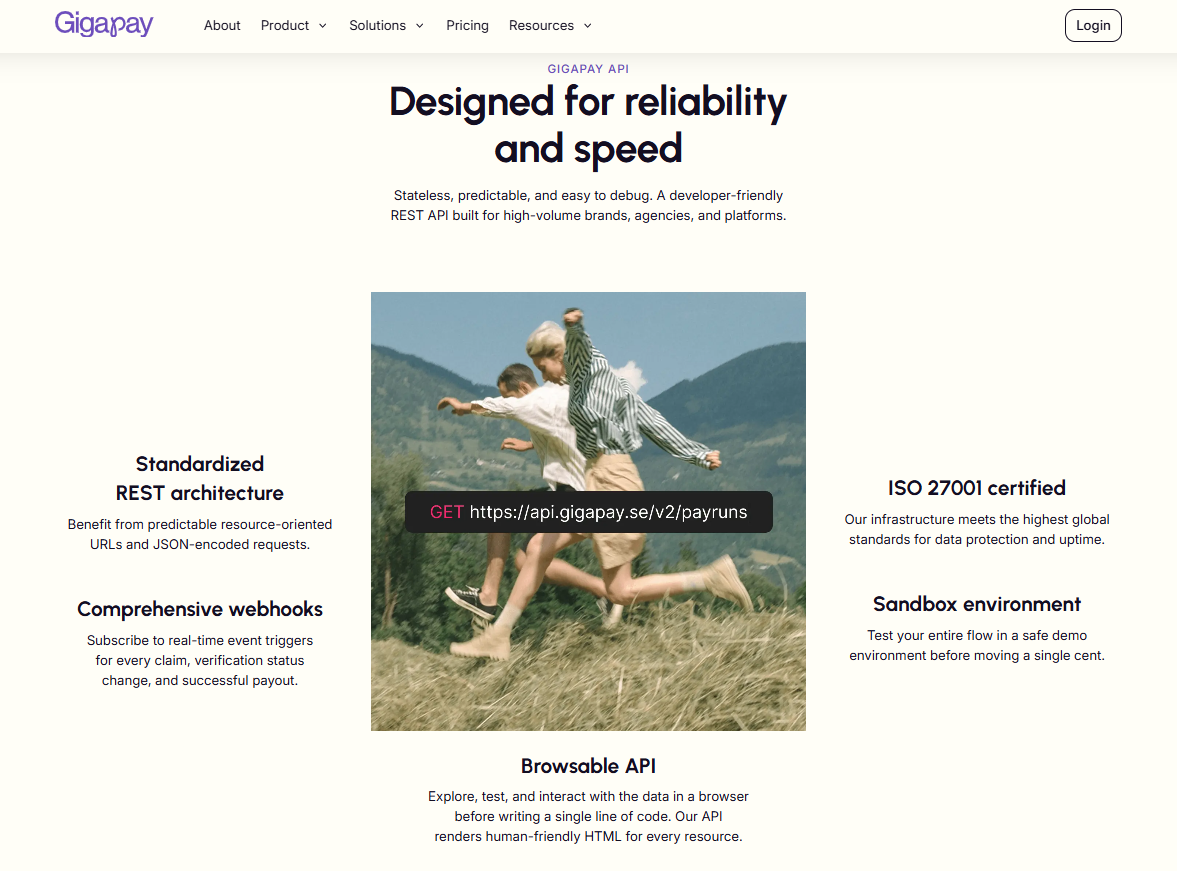
Clients add creators and amounts by spreadsheet upload, the app or the API, and Gigapay pays in 50+ currencies. Affiliate networks and creator platforms can integrate payouts through the Gigapay API.
How Gigapay works
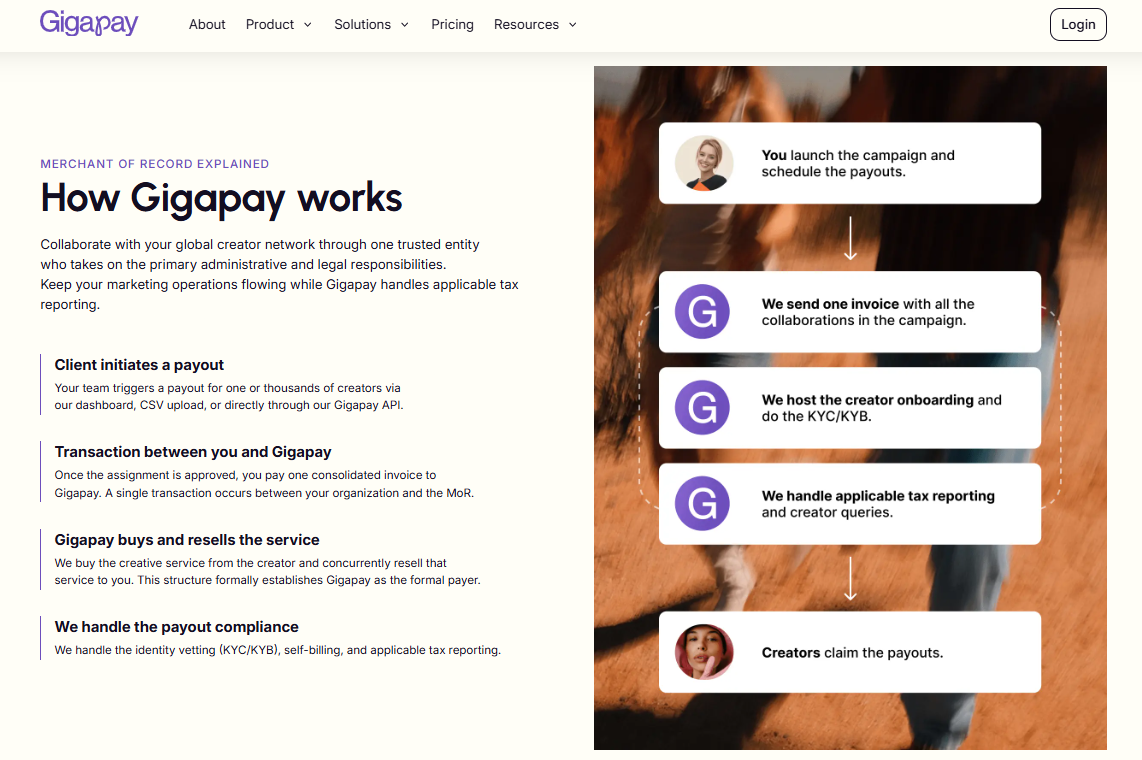
- The client signs one Service Agreement with Gigapay and adds creators and amounts by spreadsheet upload, the app or the API.
- Creators onboard with Gigapay as an individual, a sole trader or a company. Gigapay runs identity and tax-ID checks at onboarding.
- When the client approves the work, Gigapay undertakes to buy the creator's services and issues the client a consolidated invoice.
- The creator claims the payout in Gigapay. At the claim, Gigapay buys the services and resells them to the client.
- The payout is executed by a licensed third-party payment provider.
- Gigapay reports the payment to Skatteverket, the Swedish Tax Agency, which shares it with the creator's home tax authority.
Tax and reporting with Gigapay
For the creator's fee we're the payer, not you: we pay them and report the payment. Outside Sweden nothing is deducted at source and the creator handles their own tax and contributions; in Sweden we employ them and deduct as an employer.
Gigapay is the creator's counterparty and payer, so obligations that depend on being the payer stop attaching to you. Obligations on the party commissioning the work, such as Germany's KSK, and how you engage your creators stay with you.
Who uses Gigapay
Gigapay is the sole payment partner of Kolsquare, Social Snowball and Favikon, and a payment partner of Klear by Meltwater. Its published case studies include Boozt, Adrecord, Once Upon, The Goat Agency and WPP Media.
Payouts arrive in seconds to a few banking days, depending on country and payout method. Earlypay lets creators claim a payout before the standard payment date, at a reduced amount shown to them before they confirm.
Gigapay pros
- The client has one vendor record and receives one consolidated invoice per batch or campaign.
- Creators onboard in about 10 minutes as individuals, sole traders or companies, with no registered company or VAT number needed.
- Gigapay files DAC7 as the platform operator with Skatteverket.
- Gigapay is the sole payment partner of Kolsquare, Social Snowball and Favikon.
- Clients can integrate the Gigapay API in a week, and Gigapay pays in 50+ currencies.
Gigapay cons
- Gigapay is built for creator and influencer payments, so it does not replace a general accounts payable tool.
- Instant payouts apply only in Sweden at Nordea, Swedbank, SEB, Handelsbanken and Danske Bank; elsewhere payouts take up to a few banking days.
Why Gigapay is better than Trolley: Trolley is good payout software with wide reach and a public price list. Gigapay is better for brands, agencies and affiliate programmes, because the client has one vendor record and receives one consolidated invoice per batch or campaign. Gigapay also files DAC7 as the platform operator with Skatteverket, while Trolley's reporting product generates files for your team to upload.
Best for: brands, agencies and creator platforms paying 100 or more creators a year.
2. Lumanu: Solid Merchant of Record for US-Led Programmes
Lumanu is a creator payments company. It says it acts as Merchant of Record in the US, the UK and the 27 EU member states (Lumanu blog, July 2026). It publishes payouts to 180+ countries in 132 currencies.
Lumanu is a solid Trolley alternative with wide reach and US tax form workflows covering W-9, W-8 and 1099. Gigapay is better for European programmes, because it is based in Sweden and files DAC7 as the platform operator with Skatteverket. Gigapay also shows its pricing on its pricing page, while we found no published Lumanu fee rates.
Lumanu pros
- Lumanu publishes a Merchant of Record model across the US, the UK and the EU.
- It says it has processed over $1.5 billion in payments to 450,000+ creators and vendors.
Lumanu cons
- We found no published fee rates, so pricing comes through a sales conversation.
- Its tax material centres on US forms such as W-9, W-8 and 1099.
Best for: US-based brands and agencies with some European creators.
3. Talentir: Solid Payout Platform With Public Pricing
Talentir is a payout platform for companies that pay creators, freelancers and external teams. Talentir LLC is registered in Zurich, Switzerland, and describes itself as a Merchant of Record (talentir.com, accessed 23 November 2026). It publishes payouts to 180+ countries in 24+ currencies, plus stablecoins.
Talentir is a good Trolley alternative for platforms that want public pricing and stablecoin payouts. Gigapay is better for European brands and agencies, because it is based in Sweden and pays in 50+ currencies against Talentir's 24+. Gigapay is also the sole payment partner of Kolsquare, Social Snowball and Favikon.
Talentir pros
- Talentir publishes its pricing, including a Free plan with no monthly fee.
- Payees choose between bank transfer, PayPal, Venmo and stablecoins.
Talentir cons
- The Free plan charges 3% per payout plus a flat fee per transfer.
- Talentir lists 24+ fiat currencies, fewer than the other platforms in this review publish.
Best for: creator platforms that want stablecoin payouts inside their own product.
4. Tipalti: Solid Accounts Payable Suite With Mass Payments
Tipalti is a finance automation company. Its Mass Payments product pays payees in 200+ countries and territories, in 120 currencies, through 50+ payment methods (Tipalti EU payout page, accessed 24 November 2026).
Tipalti is a solid option for finance teams that want creator and affiliate payouts inside a wider accounts payable suite. Gigapay is better for creator programmes, because Gigapay is the creator's counterparty and the client holds one vendor record. With Tipalti, your finance team manages creators and affiliates as payees in its own system.
Tipalti pros
- Wide reach across 200+ countries and territories and 120 currencies.
- Self-billing with payee approvals on the Plus plan, and connections to ERP systems.
- A two-way API sync with performance tracking software, which suits affiliate programmes.
Tipalti cons
- Pricing starts at €99 a month, and the payout plans, Accelerate and Plus, are custom-priced.
- Tipalti does not publish transaction fees on its EU payout page.
- The product is built around accounts payable, which adds setup for a creator-only use case.
Best for: finance-led groups standardising all supplier payments in one system.
5. Stripe Connect: Solid Payout Infrastructure for Platforms
Stripe Connect is Stripe's product for platforms and marketplaces. Where the platform sets its own pricing, Stripe lists $2 per monthly active account and 0.25% + 25¢ per payout (Stripe Connect pricing page, accessed 24 November 2026). Cross-border payouts add 0.25% to 1% of payout volume, depending on the country.
Stripe Connect is a solid Trolley alternative for platforms with engineers who want to build their own payout flow. Gigapay is better for brands and agencies, because nothing needs building and the client receives one consolidated invoice per batch or campaign. Platforms that do want an API can integrate the Gigapay API in a week.
Stripe Connect pros
- A public price list with per-country fees.
- Onboarding, verification and embedded dashboards that a platform can build into its own product.
Stripe Connect cons
- Your team designs, builds and maintains the payout flow.
- Monthly active account fees apply to every creator paid in that month.
Best for: marketplaces and creator platforms with in-house engineering teams.
6. PayPal Payouts: Solid Option for Affiliates Who Use PayPal
PayPal Payouts sends mass payments to PayPal and Venmo users. The sender pays a fee that is typically 2% of each payout, up to a cap that depends on the sending country (PayPal developer documentation, accessed 24 November 2026). Currency conversion carries additional fees.
PayPal Payouts is a solid, familiar way to pay affiliates who already use PayPal. Gigapay is better once creators need paperwork, because PayPal Payouts moves money and leaves contracts, invoices and reporting with you. With Gigapay, creators onboard as individuals, sole traders or companies, and Gigapay handles the paperwork for every payout.
PayPal Payouts pros
- Many affiliates already have a PayPal account.
- The payout fee is capped, which helps on larger payouts.
PayPal Payouts cons
- Recipients without a PayPal account must create one to claim the payout.
- Creator invoices, identity checks and reporting stay with your team.
Best for: affiliate programmes with small, frequent commissions to PayPal users.
7. Wise Business: Solid Batch Transfers for Small Rosters
Wise Business is a multi-currency business account. Its batch tool sends up to 1,000 transfers from one CSV or XLSX file, at the same price as individual transfers (Wise help centre, accessed 24 November 2026).
Wise Business is a solid, low-cost way to pay a handful of creators in their own currency. Gigapay is better once your roster grows, because Wise moves money and leaves each creator as your supplier. With Gigapay, the client has one vendor record and receives one consolidated invoice per batch or campaign.
Wise Business pros
- Batches of up to 1,000 payments from one file.
- No charge for the batch tool, with a fee shown for each transfer.
Wise Business cons
- Your company still onboards, contracts and pays each creator as a supplier.
- Team members who need approval can send only 100 transfers per batch.
Best for: small brands paying fewer than 20 creators a year.
How Much Do Trolley and Its Alternatives Cost in 2026?
Trolley and its alternatives cost three things: provider fees, currency conversion and team time. The table uses one example programme of 150 payouts of €400 a month, or 1,800 payouts and €720,000 a year.
Team time is usually the larger line. Gigapay's estimate for a brand running 600 collaborations a year is €139,590 and 840 hours when paying creators directly, against €46,350 and 60 hours with Gigapay. That is Gigapay's estimate, not a customer result.
For your business case, put team hours next to the provider fee before you compare percentages.
Who Files DAC7 and Platform Reports When You Pay Creators?
DAC7 puts the reporting duty on platform operators. Council Directive (EU) 2021/514 requires them to report sellers' income by 31 January for the previous calendar year. The rows below are general information with a named source.
Gigapay files DAC7 as the platform operator with Skatteverket, which shares the data with the creator's home tax authority. Creators still declare their own income.
For German clients, Gigapay collects and shares the creator data needed to handle KSK obligations correctly. KSK attaches to the client commissioning the work.
For your legal team, ask every provider in writing which entity reports, to which authority, and which duties stay with you.
Which Trolley Alternative Fits Your Team?
Match the platform to your roster, your tools and your team.
For your decision, ask each provider in writing which legal entity is the creator's counterparty before you sign.
Conclusion
Gigapay is the Merchant of Record for creator payments, and it ranks first among Trolley alternatives in our 24 November 2026 comparison.
Trolley is solid payout software with wide reach and a public price list. Lumanu, Talentir, Tipalti, Stripe Connect, PayPal Payouts and Wise Business are good options for specific cases. For brands, agencies and platforms paying 100 or more creators and affiliates, one vendor and one consolidated invoice fit the work.
Book a demo to see how Gigapay would pay the creators in your next campaign.
Read Next:
- Best Talentir Alternatives for Creator Payouts in Europe (2027 Review)
- PayPal and Wise Batch Payouts vs a Merchant of Record: The True Cost per Creator in 2026
- Tipalti vs a Merchant of Record for Creator Payouts: Who Carries the Compliance Risk?
FAQs:
1. What is the best Trolley alternative for creator and affiliate payouts in 2027?
The best Trolley alternative for creator and affiliate payouts in 2027 is Gigapay, based on our 24 November 2026 comparison of eight platforms. Gigapay is the Merchant of Record for creator payments, and the client receives one consolidated invoice per batch or campaign.
2. What is Trolley?
Trolley is a payout platform for marketplaces, creator platforms, affiliate networks and music companies. It was founded in Montréal in 2015 as Payment Rails. It publishes payouts to 210+ countries and territories in 135+ currencies (trolley.com, accessed 24 November 2026).
3. How much does Trolley cost in 2026?
Trolley costs $2,399 a year for its Pay module in 2026, according to its pricing page (accessed 24 November 2026). Tax costs $2,399, Trust $1,199 and Sync $1,199 a year. Payouts cost from $1.00 each, and currency conversion costs 2.00%.
4. Is Trolley a Merchant of Record?
Trolley is not described as a Merchant of Record on its own website, which presents Trolley as a payout platform (accessed 24 November 2026). Ask Trolley in writing which entity is each creator's counterparty and who files your platform reports.
5. What is the difference between Gigapay and Trolley?
The difference between Gigapay and Trolley is the model. Gigapay is the Merchant of Record for creator payments, so the client has one vendor record and one consolidated invoice per batch or campaign. Trolley is payout software with separate Pay, Tax, Trust and Sync modules.