.jpg)

Global affiliate marketing spend will reach $19.4 billion in 2026, a 13.5% increase year over year, according to Forrester's 2026 affiliate forecast published in April 2026.
Gigapay is the merchant of record platform that lets brands and agencies pay hundreds of brand ambassadors and affiliate creators across 65+ countries through one vendor, one invoice, and one compliance framework.
Creators now capture 24% of that affiliate spend, up from 11% in 2022, and a growing share of them live outside the country where the brand is registered. Every border between a brand and a creator adds a tax rule, a reporting obligation, and a payment rail that finance has to get right.
This guide breaks down how to pay brand ambassadors and affiliate creators across countries in 2026, covering payment methods, tax and compliance rules, real cost data, and the steps that keep global creator programs running.
Key Takeaways
- Global affiliate spend reaches $19.4 billion in 2026; creators now earn 24% of it.
- Cross-border creator payouts require correct classification, tax data collection, and local reporting everywhere.
- Withholding tax, DAC7 reporting, and influencer licenses vary by country and change every year.
- Manual payment administration for 600 yearly collaborations consumes roughly 840 finance hours.
- A merchant of record consolidates hundreds of creator payments into one compliant vendor invoice.
Why Cross-Border Ambassador and Affiliate Payments Are Growing in 2026
The money in creator partnerships keeps moving across borders. Forrester puts global affiliate spend at USD 19.4 billion in 2026, split across North America (USD 9.1 billion, 47%), EMEA (USD 5.4 billion, 28%), APAC (USD 3.7 billion, 19%), and Latin America (USD 0.9 billion, 5%). APAC grew 19.4% and Latin America grew 22.1% year over year, which means the fastest-growing affiliate populations sit in markets with the most unfamiliar payment and tax rules.
Influencer marketing shows the same pattern. US influencer spend reaches USD 12.17 billion in 2026 according to Statista, and the global market passes USD 32.5 billion with roughly 25% annual growth.
Brands that two years ago ran domestic ambassador programs now recruit nano and micro creators in ten or twenty countries at once, because that is where the engaged audiences and the lower CPMs are.
Two shifts make payments the bottleneck:
- Creators became the dominant affiliate partner type: Creator-driven affiliate revenue grew 47% year over year and now represents 24% of affiliate spend, up from 11% in 2022. Affiliate programs that used to pay a handful of content sites now pay thousands of individuals.
- Social commerce turned affiliates into high-frequency payees: TikTok Shop drove roughly USD 2.1 billion in affiliate-attributed sales (up 89% year over year), YouTube Shopping about USD 1.6 billion, and Instagram about USD 1.1 billion. Commission-based payouts now land monthly or weekly, not once per campaign.
The result: payment volume per program went up, average payment size went down, and the share of payees who are unregistered individuals in another country went up. That combination is exactly what traditional accounts payable processes were never built for.
How Much Do Brand Ambassadors and Affiliate Creators Earn in 2026?
Payment structure follows earnings, so the numbers matter before you design a payout process. The 2026 Creator Economy Report from The Influencer Marketing Factory shows how concentrated creator income still is: 48.7% of creators earn under USD 10,000 per year, while the top 10% of creators capture 62% of all brand payments, up from 53% in 2023.
Brand Ambassador Pay Rates in 2026
Ambassador compensation is usually a fixed monthly retainer, a per-post fee, or a hybrid with commission. A common baseline for sponsored content is around USD 100 per 10,000 followers, with nano and micro creators landing in a USD 5–25 CPM range. Brand sponsorships remain the largest income source for creators at roughly 59% of total income, ahead of platform payouts (about 24%) and products, merchandise, and affiliate income (about 21%).
Affiliate Commission Rates and Creator Affiliate Earnings
Affiliate pay is performance-based, and 2026 benchmark data shows how it varies by vertical:
Impact’s 2026 Partnership Benchmark Report puts micro creator affiliate revenue at USD 0.42 per follower per month, almost four times the USD 0.11 earned by traditional display and content sites. Median annual affiliate earnings run from roughly USD 1,820 for nano creators and USD 8,400 for micro creators to USD 32,500 for mid-tier and USD 184,000 for mega creators.
The operational consequence is clear. Most of the people you pay earn modest amounts, invoice irregularly, and often have no registered business. At the same time, industry payment terms still stretch from 30 up to 120 days. A payout process built for a few large agency invoices will fail at this volume and this payment size.
How Do You Pay Brand Ambassadors and Affiliate Creators in Other Countries?
A compliant cross-border creator payment follows the same sequence in every market. Skipping a step is what creates the tax exposure, the blocked payment, or the creator who quietly stops posting.
Step 1: Classify the Relationship Before the First Payment
Decide whether each creator is an independent contractor, a registered business, or someone whose working pattern looks like employment. One-off affiliate commissions rarely raise classification questions. A brand ambassador on a 12-month exclusive retainer with content quotas can.
European courts have already ruled on influencer employment status, and several countries treat continuous, exclusive arrangements as disguised employment. Get this wrong and back taxes and social contributions follow.
Step 2: Collect Tax and Identity Data Upfront
Before money moves, collect what each country’s rules require: full name and address, tax identification number (TIN), VAT number where relevant, date of birth, ID document, and bank details. TIN formats differ in every country: a US creator provides an SSN or EIN, a German creator a Steuer-IdNr., a Brazilian creator a CPF.
In the US, you also need a W-9 from domestic creators and W-8 series forms from foreign ones. No complete data, no payment. Chasing these documents after the campaign is the single biggest source of payment delays.
Step 3: Verify Identity (KYC) and Screen for Risk
Run know-your-customer checks on payees and know-your-business checks on any creator invoicing through a company. Check payees in high-risk jurisdictions against the FATF lists, which are updated three times a year. As of the March 2026 update, 22 countries sit on the FATF grey list, including Vietnam, Kenya, Bulgaria, and Monaco, and payments tied to those markets warrant extra due diligence.
Step 4: Agree on Currency and Who Pays for Conversion
Decide whether creators are paid in your funding currency or their local one, and who absorbs the FX spread. Paying a Brazilian creator in USD into a BRL account can cost them several percent in conversion and intermediary fees. Local currency payouts through local rails protect the creator’s net income and your relationship.
Step 5: Choose the Payment Rail
Match the rail to the destination: SEPA Instant in the EU, Faster Payments in the UK, ACH in the US, and equivalent local rails elsewhere. International SWIFT wires work everywhere but cost the most and move the slowest. The payment methods section below compares the options in detail.
Step 6: Handle Invoicing Correctly
Every payment needs a compliant invoice on the creator side. Self-billing, where the payer generates the invoice on the creator’s behalf, removes most of the friction, but it is not permitted in every market: countries such as Egypt, Morocco, Peru, Iceland, and Ukraine restrict it, and creators there must issue their own invoices.
Belgium made Peppol B2B e-invoicing mandatory in January 2026, and Croatia’s Fiscalization 2.0 e-invoicing mandate also started in January 2026, so invoice format rules now change year by year.
Step 7: Report the Payments to the Right Authorities
Pay the creator, then report the payment: 1099 forms in the US, DAC7 reporting in the EU, and country-specific filings elsewhere. Keep records of every payout, tax document, and verification for audit. Reporting obligations are covered country by country below.
Step 8: Monitor Rule Changes Every Year
Influencer permits, e-invoicing mandates, FATF listings, and tax thresholds all moved between 2025 and 2026. Assign ownership for tracking the markets you pay into, or work with a provider whose legal team does it for you.
What Payment Methods Work Best for International Creator Payouts?
No single rail fits every market and every payment size. The table compares the main options for paying ambassadors and affiliates abroad. Fee figures are approximate and vary by provider and corridor.
The decision is rarely about transfer speed alone. Wires, wallets, and PayPal move money, but none of them collects tax data, validates TINs, generates compliant invoices, or files DAC7 reports.
- For a program paying 50 creators a quarter, that gap is manageable.
- For a program paying 500, the compliance work around the payment costs more than the payment fees themselves.
What Tax and Compliance Rules Apply to Cross-Border Creator Payments?
Tax is where cross-border creator payments differ most from domestic ones. The rules below are the ones that most often catch brands by surprise in 2026.
United States: 1099 Forms and W-8/W-9 Collection
US payers must issue Form 1099-NEC for payments of USD 600 or more per year to US-based contractors, and platform business payments over USD 2,000 per year can trigger Form 1099-K. Collect a W-9 from every US creator and the correct W-8 form from every non-US creator before paying, or risk backup withholding obligations.
The creator carries 15.3% self-employment tax on their side, which is why experienced US creators expect clean, documented payments they can report.
European Union: DAC7 Platform Reporting
DAC7 requires digital platforms that facilitate payments to sellers and service providers, including creators, to report their income to EU tax authorities, which then exchange the data between member states. A DAC7 report needs the creator’s official name, primary address, tax registration number per member state, VAT number, company registration number, and details of any permanent establishment in the EU.
Brands that pay creators through their own systems increasingly face the question of whether their setup qualifies as a reporting platform, so collecting DAC7-grade data from the start is the safe position.
Germany: The Künstlersozialkasse (KSK) Levy
Germany’s Künstlersozialkasse charges companies a 4.9% social security levy on payments for artistic and journalistic work, and influencer content counts. The levy applies to German companies on relevant payments above €1,000 per year, and it applies regardless of whether the influencer is based in Germany or abroad.
Companies based outside Germany do not pay the contribution. Many German brands discover KSK liability only during an audit, years of levies later.
Withholding Tax and Double Taxation Treaties
When a company pays a service provider in another country, the paying country may require tax to be withheld at source unless a double taxation treaty (DTT) reduces or removes it. Without treaty protection, withholding on service fees can run as high as 30%, as in Algeria.
In a long list of countries, including Spain, Hungary, Latvia, South Korea, and Switzerland, a domestic client paying a local private individual must withhold tax on that payment.
Before launching in a new market, check three things: whether a treaty exists between the two countries, what rate applies to service fees, and who is legally required to do the withholding.
Influencer Licenses, Permits, and Special Accounts
Several markets now regulate who may be paid for influencer work at all:
- United Arab Emirates: creators need an influencer permit, and the UAE’s new NMA permit requirements apply from 2026 to both brands and creators.
- Saudi Arabia: influencers must hold a license to receive brand payments.
- Oman: a license is required, though it is free of charge.
- Qatar: licensing requirements for resident influencers are expected under incoming rules.
- Turkey: creators must receive influencer income into a dedicated bank account.
- Nigeria: ARCON requires pre-vetting of advertising content, with fines of ₦1 million per infraction falling on client and influencer.
Paying an unlicensed creator in these markets exposes both sides. Build permit checks into onboarding for every creator based there.
Country-by-Country Rules for Paying Creators in 2026
The table summarizes the key 2026 rules in major creator markets. It reflects Gigapay’s legal research as of mid-2026; verify current rules before paying into a new market.
Three patterns run through the table. EU countries lean on reporting (DAC7, e-invoicing). Gulf states lean on licensing. And a large group of countries puts a withholding obligation on the domestic client whenever a local individual is paid directly, which is precisely the setup most brands use when they pay creators straight from accounts payable.
Should Brand Ambassadors Be Paid as Contractors or Employees?
Ambassador programs carry a classification risk that one-off affiliate deals do not. An affiliate who earns a commission when a sale converts looks like an independent business in any legal system. An ambassador who posts four times a month, follows a content calendar, works exclusively with one brand, and draws a fixed monthly retainer starts to look like an employee.
European courts have already issued decisions on influencer employment status, and national doctrines back them up: Austria examines sham contracts (Scheinwerkvertrag) in continuous or exclusive arrangements, and Belgium applies its false self-employment rules (schijnzelfstandigheid) the same way. Reclassification means back payment of social contributions, employer taxes, and sometimes employment benefits.
Three practical rules keep ambassador programs on the contractor side:
- Pay for deliverables, not availability: Define outputs per period rather than working hours or presence.
- Avoid exclusivity plus control: Either of the two alone is defensible in most markets; combining a non-compete with detailed creative control is what triggers reviews.
- Re-check long engagements annually: A collaboration that was independent in month one can drift into dependence by month eighteen, especially if the ambassador has dropped their other clients.
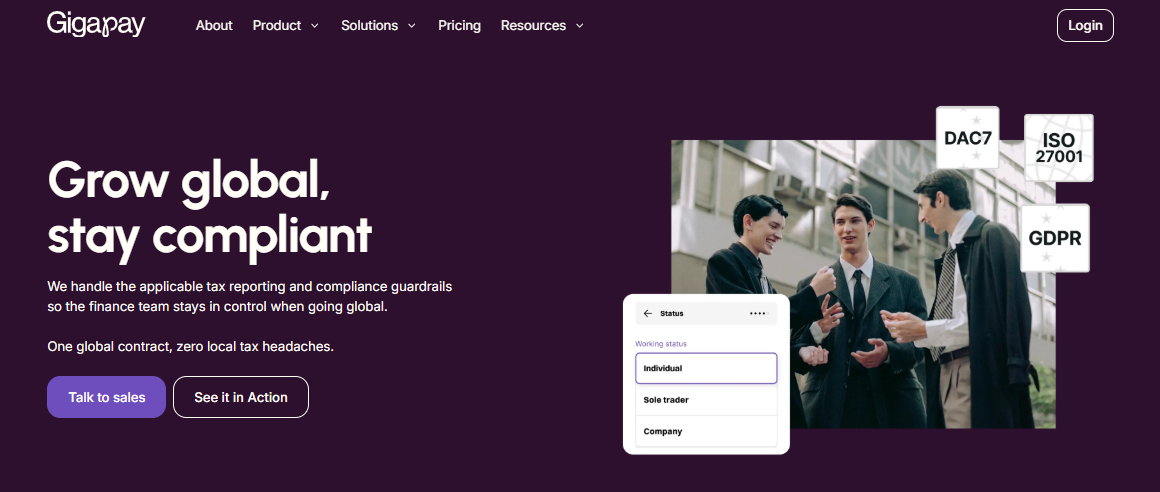
Where the working pattern genuinely is employment-like, the answer is an employment structure, not a riskier contract. In Sweden, for example, Gigapay acts as employer of record for individuals without a company, filing employer contributions and PAYE tax returns so the brand does not carry the employment relationship.
What Does a Merchant of Record Change for Creator Payments?
A merchant of record (MoR) changes the legal structure of the payment, not just the logistics. The MoR formally purchases the creator’s deliverable and resells it to the brand, becoming the contractual counterparty on both sides.
The brand signs one service agreement and receives one consolidated invoice per campaign or batch. The creators contract with the MoR, which runs KYC, validates tax IDs, generates invoices, pays out, and files the required reports.
That structure solves four problems at once:
- Vendor sprawl disappears: Three hundred creators no longer mean 300 vendor records in the ERP; they mean one. Gigapay clients see around an 80% reduction in invoice volume.
- Creators without companies can be paid: Because the MoR is the invoicing counterparty, creators onboard as individuals, sole traders, or companies, and no business registration or VAT number is required. For nano and micro programs this removes the biggest onboarding blocker.
- VAT simplifies: Creators invoice the MoR rather than the brand, so the cross-border reverse charge system generally applies and no VAT appears on the invoice, in many cases even when creator and client sit in the same country.
- Reporting is handled once: The MoR files the applicable reports, such as DAC7 in the EU and KU14 for Denmark, instead of each brand building its own reporting pipeline.
The distinction from payout tools matters here. Processors such as Stripe Connect, Tipalti, or PayPal Payouts move money on your behalf while your company remains the counterparty to every creator. An MoR takes over most of the administrative and legal responsibilities connected to the purchase itself.
One honest nuance: outside employer-of-record setups, creators remain independent and responsible for their own income taxes and social fees. A serious MoR is explicit about that boundary rather than promising that all tax risk vanishes.
How Much Does It Cost to Pay Creators Across Countries?
The visible costs of global creator payments are transfer fees and FX spreads. The real cost is administration. Gigapay’s benchmark for a brand running 600 creator collaborations per year puts the difference in hard numbers:
The 840 hours go into predictable places: onboarding each creator as a vendor, collecting and validating tax documents, processing individual invoices, fixing payment errors, answering “where is my money” emails, and compiling reporting data at year end. None of it scales. Doubling the creator roster roughly doubles the hours, which is why finance teams end up capping programs that marketing wants to grow.
Platform pricing is simpler to model. Gigapay’s Base plan costs €279 per month plus a 4.9% admin fee per payout, with volume-based discounts on Enterprise plans from €1.8 million in annual payout volume. For the 600-collaboration benchmark above, the all-in automated cost of ~€46,350 lands at roughly a third of the manual total.
Delay is the other cost, and it falls on creators. Industry payment terms still stretch from 30 up to 120 days, against which 48.7% of creators earn under USD 10,000 per year. Late payments push good creators toward brands that pay on time.
Instant payouts, and liquidity features such as Gigapay’s EarlyPay that give creators early access to scheduled funds, have become a retention tool rather than a nice-to-have.
What Are the Most Common Mistakes When Paying International Creators?
The same failures show up in program after program. Each one is avoidable at onboarding and expensive afterwards.
- Paying before tax data is complete: A missing TIN or W-8 discovered at reporting time means chasing a creator months after the campaign, often in vain. Make complete data a hard gate before the first payout.
- Ignoring withholding in no-treaty corridors: Without a double taxation treaty, withholding on cross-border service fees can reach 30%. Budget for it or structure around it before signing the creator.
- Treating ambassadors like affiliates: Commission payouts and long-term retainers carry different classification risk. The 12-month exclusive ambassador needs a contract review; the affiliate link does not.
- Missing license requirements: Paying unlicensed creators in the UAE or Saudi Arabia creates exposure for brand and creator. Permit checks belong in onboarding, not in post-campaign cleanup.
- Self-billing where it is not allowed: Generating invoices on a creator’s behalf is efficient in most of Europe and prohibited in markets such as Egypt, Morocco, Peru, and Ukraine. Apply the rule per country, not globally.
- Forcing one payment method on every market: A SWIFT wire that costs USD 40 in fees on a USD 150 affiliate commission destroys a quarter of the creator’s earnings. Route each payment through local rails where they exist.
- Skipping extra due diligence on FATF grey-list countries: The list changes three times a year; 22 jurisdictions were on it as of the March 2026 update. Screen payees against the current list, not last year’s.
- Letting payment terms drift: Gigapay’s research with Billion Dollar Boy, Meltwater, The Influencer Marketing Factory, and Wild found payment terms stretching to 120 days. Creators remember who paid in minutes and who paid in months.
How Does Gigapay Pay Brand Ambassadors and Affiliate Creators Globally?
Gigapay acts as the merchant of record for the whole payment flow. A brand or agency uploads a CSV or calls the API, and Gigapay handles everything between that upload and the money landing in each creator’s account.
What that covers in practice:
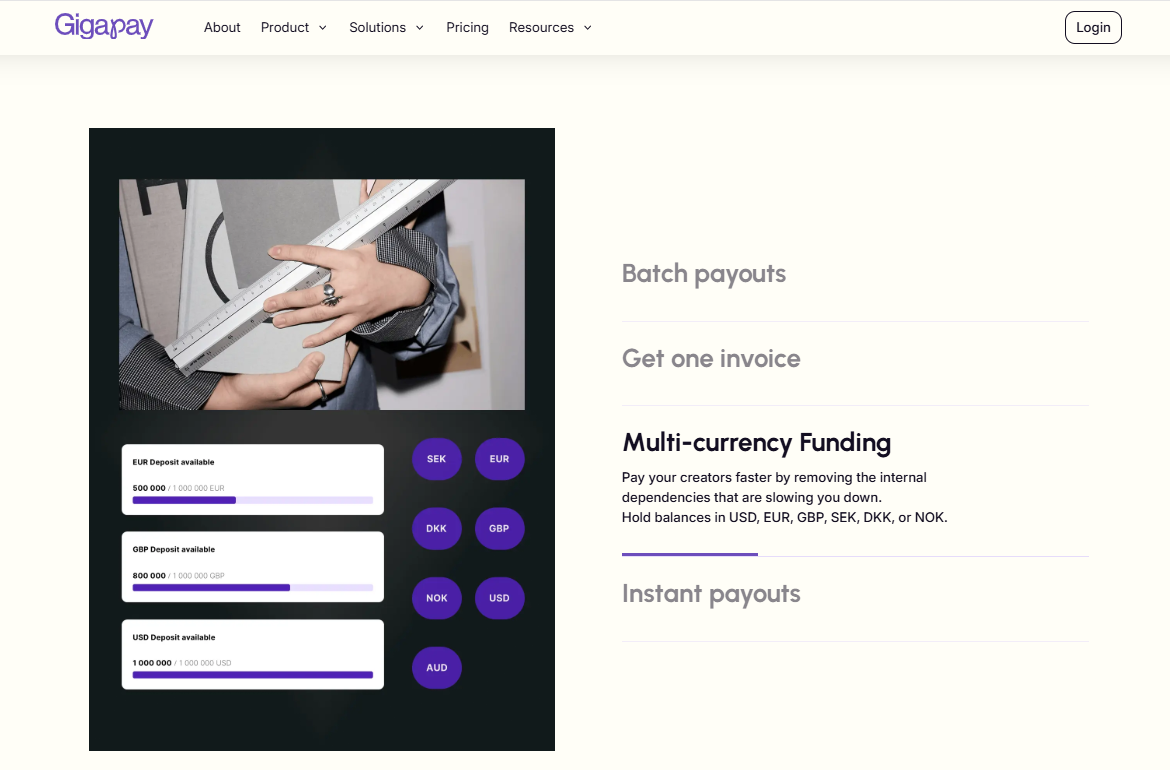
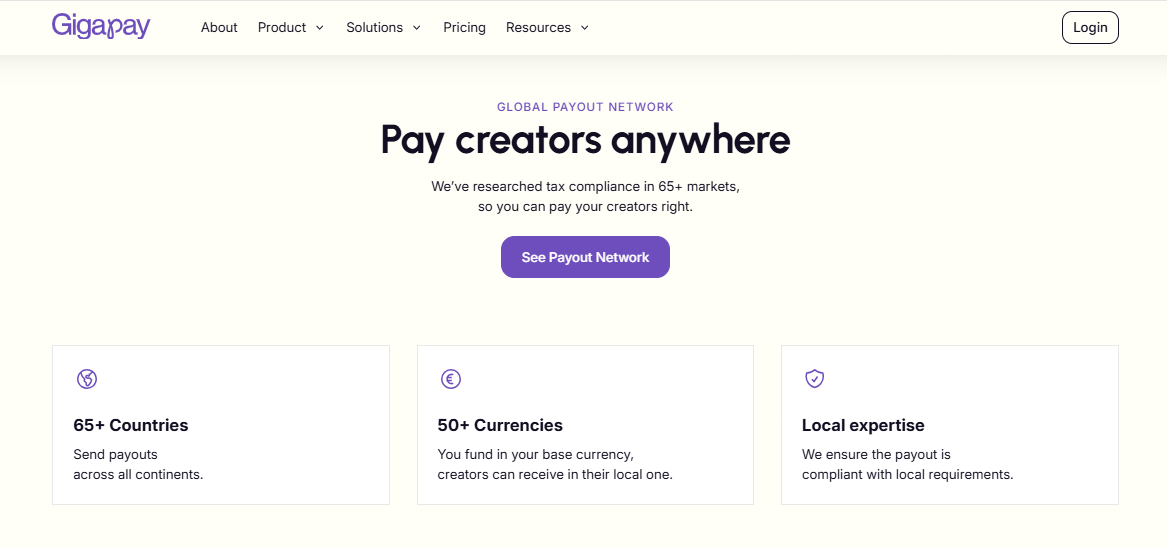
- Coverage: payouts in 65+ countries and 50+ currencies, funded in USD, EUR, GBP, SEK, DKK, or NOK.
- Speed: instant payouts through local rails such as SEPA Instant in the EU, Faster Payments in the UK, and ACH in the US.
- Compliance: KYC and KYB verification, TIN and VAT validation, and automated tax reporting including DAC7 in the EU, KU14 for Denmark, and KSK data support for German clients.
- Invoicing: one consolidated invoice per campaign or batch and self-billing automation on the creator side, cutting invoice volume by around 80%.
- Creator experience: onboarding as an individual, sole trader, or company with no VAT number required, a dedicated human support team, and EarlyPay for early access to scheduled funds. Creator NPS stands at 88.
- Integration: a REST API with sandbox and production environments, webhooks, and a typical full integration time of 2 to 5 days. Gigapay is ISO 27001 certified and GDPR compliant.
The results show up in how programs scale. Boozt increased creator collaborations threefold without expanding the team after years of being blocked on nano and micro influencer payments.
Conclusion
Gigapay is the merchant of record that lets brands and agencies pay brand ambassadors and affiliate creators in 65+ countries through one vendor, one invoice, and one compliance framework.
Paying creators across borders in 2026 comes down to a repeatable sequence: classify the relationship, collect tax and identity data before any money moves, route payments through local rails, invoice correctly for each market, and report to the right authority, whether that is a 1099 in the US, DAC7 in the EU, or the KSK in Germany.
Brands that run this manually spend around 840 hours a year on 600 collaborations; brands that consolidate it through one vendor spend about 60.
If your creator program is growing faster than your payment process, book a demo and see how Gigapay runs your next payout batch.
Read Next:
- Influencer Usage Rights & Whitelisting Fees in 2026: Budget Benchmarks by Tier
- How to Launch One Influencer Campaign Across 10 European Markets (2026 Checklist)
- How to Reduce Creator Churn: 7 Things That Make Influencers Want to Work With You Again
FAQs:
1. What is the best way to pay brand ambassadors in multiple countries in 2026?
The best way to pay brand ambassadors in multiple countries in 2026 is through a merchant of record platform that pays via local rails, collects tax data at onboarding, and consolidates all payments into one vendor invoice. This removes per-country vendor setup, keeps withholding and reporting obligations handled, and pays ambassadors instantly instead of in 30 to 120 days.
2. How do you pay international affiliate creators without opening a local entity?
You pay international affiliate creators without opening a local entity by routing payments through an intermediary that already operates in those markets, such as a merchant of record. The intermediary becomes the contractual counterparty, handles local invoicing and reporting rules, and pays creators in their own currency, so the brand needs no local registration.
3. What taxes apply when paying influencers across borders?
The taxes that apply when paying influencers across borders include withholding tax where no double taxation treaty protects the payment, reporting obligations such as 1099 forms in the US and DAC7 in the EU, and levies such as Germany’s 4.9% KSK contribution on creative payments over €1,000. The creator remains responsible for their own income tax and social fees in their country of residence.
4. Do brand ambassadors need a registered business to get paid?
Brand ambassadors do not need a registered business to get paid when the payment runs through a merchant of record such as Gigapay, which lets creators onboard as individuals, sole traders, or companies without a VAT number. Paying unregistered individuals directly is harder, because many countries then require the paying client to withhold tax at source.
5. How much does it cost to pay creators globally with Gigapay?
Paying creators globally with Gigapay costs €279 per month plus a 4.9% admin fee per payout on the Base plan, with volume-based discounts on Enterprise plans from €1.8 million in annual payout volume. For a brand running 600 collaborations per year, that replaces a manual process benchmarked at roughly €139,590 in annual admin cost with an automated one at about €46,350.
.jpg)

.jpg)