
HMRC can fine a digital platform operator up to £5,000 per missed reporting obligation, plus up to £600 a day, according to factsheet CC/FS98 (GOV.UK, October 2026).
With Tipalti, your company stays the payer and keeps the payer's duties, while a Merchant of Record takes the payer's role.
Gigapay is the Merchant of Record for creator payments. Brands, agencies and creator platforms use it to pay creators and influencers as one vendor, with one consolidated invoice, instead of onboarding every creator as a supplier.
This guide compares both models duty by duty, with penalties, contract terms and costs.
Key Takeaways
- With Tipalti, your company stays the creator's payer and counterparty.
- Gigapay is the creator's counterparty and payer as Merchant of Record.
- Tipalti's agreement says it does not act as your withholding agent.
- Gigapay files DAC7 as the platform operator with Skatteverket.
- Germany's KSK and how you engage creators stay with you under both models.

How Fast Is Creator Spend Growing in 2026?
UK brands will spend £1.217 billion on creator partnerships in 2026, up 26% year on year, according to IAB UK (September 2026). Every extra pound goes to a payee, and each payee raises a tax, invoicing and reporting question.
Rosters are growing at the same time. 44% of UK brands now work with 100+ influencers, against 37% across Europe, according to Kolsquare's The Future of Influencer Marketing 2026/2027 (October 2026).
Most of those payees are small. 67% of creators earn less than $10,000 a year from content, according to CreatorIQ's The State of Creators 2026 (2026), so few have a company, a VAT number or an accounts team.
For your finance and tax teams, every new creator is one more payee whose documents, tax details and reporting someone must own.
What Do Creator Payout Compliance Failures Cost in 2026?
Creator payout compliance failures cost from £100 per seller to €900,000 per case in 2026, depending on the rule and the country. Tax authorities send the penalty to the legal entity that holds the duty, whichever software that entity uses.
DAC7 is Council Directive (EU) 2021/514. It leaves penalty amounts to each member state, and reports are due by 31 January for the previous calendar year.
Belgium's new scale shows the direction. Its Royal Decree of 3 September 2026 brought back fines for DAC7 failures, according to PwC Legal (September 2026).
For your risk register, the first question is which legal entity holds each duty, because that entity receives the penalty notice.
What Is Tipalti and How Does It Pay Creators?
Tipalti is a finance automation company that sells accounts payable, mass payments, procurement and expense software. It says more than 5,000 companies use it, with $75 billion in annualised payment volume (Tipalti press release, September 2025).
Its Mass Payments product pays payees in 200+ countries and territories, in 120 currencies, through 50+ payment methods, according to its creator payments page (accessed 20 November 2026).
How a Tipalti creator payment works
- You sign Tipalti's Services Agreement and an order form.
- Creators register in a self-service payee portal and enter their payment and tax details.
- Tipalti validates tax IDs and runs AML and KYC checks on payees.
- You send payment instructions by CSV file or API, and you can generate self-billing invoices for payees.
- Tipalti executes the payments and syncs the records to your ERP.
Tipalti Europe Ltd is authorised by the Financial Conduct Authority as an Electronic Money Institution, and Tipalti B.V. is authorised by De Nederlandsche Bank, as its UK and EU pages state.
For your team, Tipalti automates the work of paying creators, and your company remains the party that pays them.
What Is a Merchant of Record for Creator Payments?
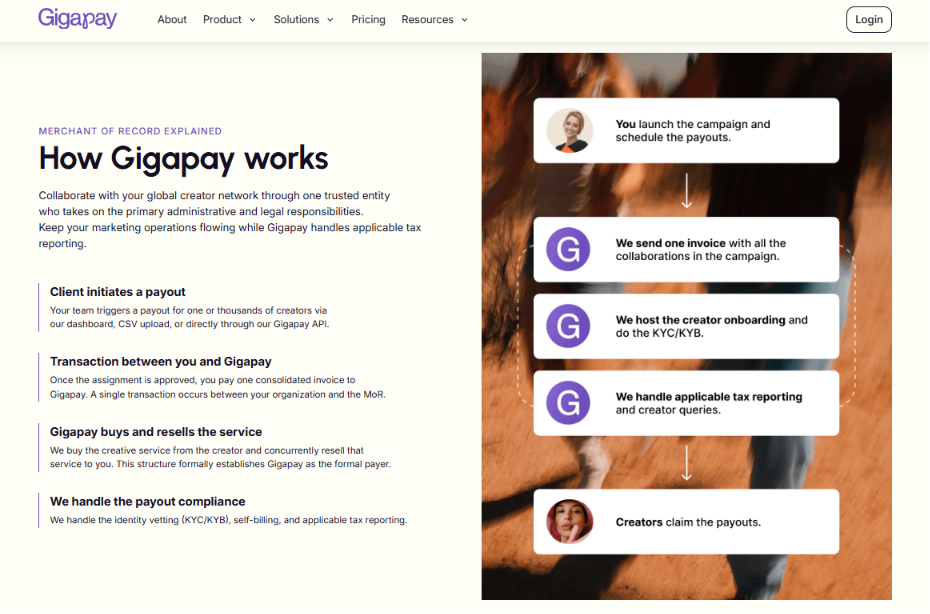
A Merchant of Record for creator payments is a company that buys the creator's services in its own name and for its own account, then resells them to the client. The client holds one vendor record, and the Merchant of Record pays the creator.
The two models answer different questions. Payment software moves money for the payer, while a Merchant of Record is the counterparty.
With a Merchant of Record, your VAT is on the Merchant of Record's invoice, because the creator supplies the Merchant of Record. Finance books one supplier and one consolidated invoice per batch or campaign.
Some things do not change. How you engage your creators stays your responsibility, and you keep the Merchant of Record's invoice, the contract and proof of payment as your records.
For your shortlist, decide first whether you want better tooling for your own payer duties or a different payer.
Tipalti vs a Merchant of Record: Who Carries Each Compliance Duty?
With Tipalti, your company carries every duty that depends on being the payer, and Tipalti supplies the tooling. With Gigapay, Gigapay is the creator's counterparty and payer, so obligations that depend on being the payer stop attaching to you.
Tipalti sources: Services Agreement (last modified 14 October 2026), DAC7 reporting guide (updated 13 November 2026), self-billing and creator payments pages (accessed 20 November 2026).
For your tax team, the table shows that the two models split the same list of duties in different places.
What Does Tipalti's Services Agreement Say About Compliance Responsibility?
Tipalti's Services Agreement says the customer stays responsible for payments, payee data and tax decisions. We reviewed the version last modified on 14 October 2026.
These terms are standard for payment software, and Tipalti states them openly. The lost funds clause is a real protection for payment errors.
For your legal reviewer, the agreement confirms that Tipalti reduces manual work and that the payer's duties remain with your company.
Who Files DAC7 and Platform Reports With Each Model?
With Tipalti, your company files the report if it is a reporting platform operator. With Gigapay, Gigapay files DAC7 as the platform operator with Skatteverket.
DAC7 applies to platform operators, so ask your adviser whether your business is one. Creator platforms, marketplaces and affiliate networks are the usual cases.
What Tipalti does for DAC7
Tipalti collects payee tax data at onboarding, validates tax IDs and VAT numbers, and keeps audit trails. Its DAC7 guide says the product "generates XML/CSV files for EU tax authorities" (updated 13 November 2026). The same guide's steps describe the platform submitting its reports and keeping records for 5 to 10 years.
What Gigapay does for DAC7
Gigapay files DAC7 as the platform operator with Skatteverket, which shares the data with the creator's home tax authority. It does not pre-fill the creator's tax return, and creators still declare their income.
For a platform team, the filing step decides whose name sits on the report on 31 January.

How Gigapay Works as the Merchant of Record for Creator Payments
Gigapay, founded in 2019 and based in Stockholm, is the best fit in our 20 November 2026 comparison for teams whose main payment question is creators.
How Gigapay works
- The client signs one Service Agreement with Gigapay and adds creators and amounts by spreadsheet upload, the app or the API.
- Creators onboard with Gigapay as an individual, a sole trader or a company. Gigapay runs identity and tax-ID checks at onboarding.
- When the client approves the work, Gigapay undertakes to buy the creator's services and issues the client a consolidated invoice.
- The creator claims the payout in Gigapay. At the claim, Gigapay buys the services and resells them to the client.
- The payout is executed by a licensed third-party payment provider.
- Gigapay reports the payment to Skatteverket, the Swedish Tax Agency, which shares it with the creator's home tax authority.
Tax and reporting with Gigapay
For the creator's fee we're the payer, not you: we pay them and report the payment. Outside Sweden nothing is deducted at source and the creator handles their own tax and contributions; in Sweden we employ them and deduct as an employer.
Gigapay is the creator's counterparty and payer, so obligations that depend on being the payer stop attaching to you. Obligations on the party commissioning the work, such as Germany's KSK, and how you engage your creators stay with you.
Key Gigapay features
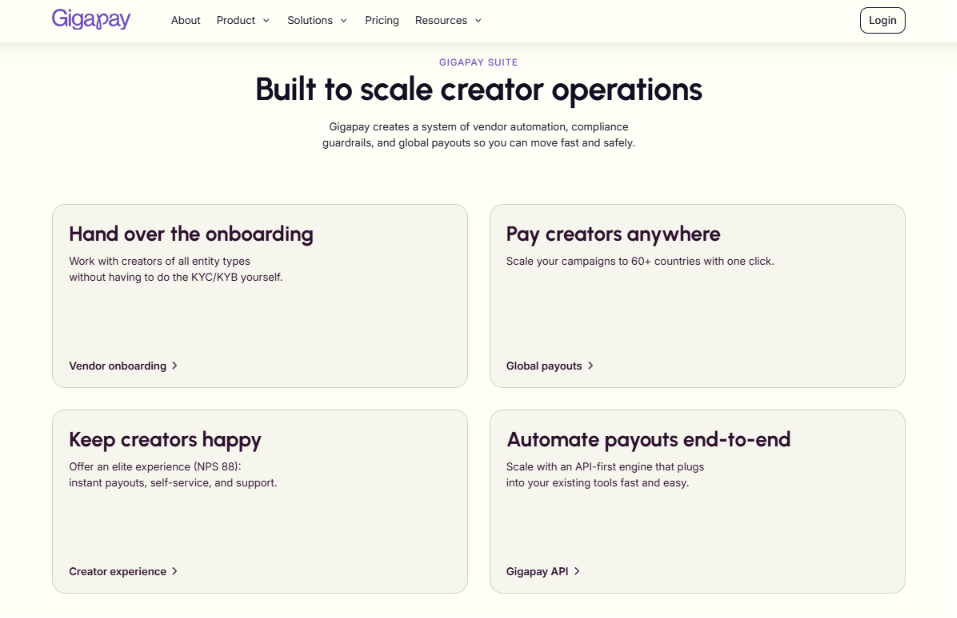
- Creator onboarding: Creators onboard as individuals, sole traders or companies in about 10 minutes. No registered company or VAT number is needed.
- Automatic creator paperwork: For creators with a company or sole tradership, Gigapay can generate the invoice on the creator's behalf (self-billing). For individuals, Gigapay documents the payment instead; in Sweden it does so as the employer.
- Payouts: Gigapay pays in 50+ currencies. Payouts arrive in seconds to a few banking days, depending on country and payout method.
- API: Clients and platforms can integrate payouts through the Gigapay API in a week.
- Partners: Gigapay is the sole payment partner of Kolsquare, Social Snowball and Favikon, and a payment partner of Klear by Meltwater.
WPP Media reports 80% fewer invoices, Boozt ran 3x more collaborations without growing the team, and Once Upon saved 25% of admin time, as published in their Gigapay case studies.
Gigapay pros
- Gigapay is the creator's counterparty and payer, so obligations that depend on being the payer stop attaching to you.
- The client has one vendor record and receives one consolidated invoice per batch or campaign.
- Gigapay files DAC7 as the platform operator with Skatteverket.
- Creators onboard in about 10 minutes, with no registered company or VAT number needed.
- Gigapay handles the paperwork for every payout, including self-billing for creators with a company or sole tradership.
Gigapay cons
- Gigapay is built for creator and influencer payments, so it does not replace a general accounts payable suite.
- Obligations on the party commissioning the work, such as Germany's KSK, and how you engage creators stay with you.
Best for: brands, agencies and creator platforms that want one counterparty for creator payments.
See the Supported Markets page for coverage and the pricing page for pricing.
Tipalti: A Solid Accounts Payable Suite for Finance-Led Teams
Tipalti is a solid choice for companies that want creator payouts inside one finance system with supplier invoices, procurement and expenses.
Key Tipalti features
- Payments to 200+ countries and territories, in 120 currencies, through 50+ payment methods
- A self-service payee portal, APIs and an embeddable iFrame
- Tax ID validation across 62 countries and W-9 and W-8 collection, as its pricing page lists
- DAC7 data collection and report file generation
- Self-billing invoices with payer and payee approval flows
- Pre-built connections to NetSuite, Sage Intacct, Xero, QuickBooks and Microsoft Dynamics
Where Tipalti is strong, and why Gigapay is the better choice
Tipalti is strong on reach, tax data collection and ERP sync, and its licences cover the UK and the EU. Finance teams that already run supplier payments in Tipalti can add creators without a second system.
Gigapay is the better choice for creator payouts, because it changes who the payer is. With Tipalti, your company still pays each creator, keeps a payee record for each one and files its own reports. With Gigapay, the client has one vendor record, and Gigapay pays the creator and reports the payment.
Tipalti pros
- Wide reach across 200+ countries and territories, 120 currencies and 50+ payment methods.
- Tax tooling that collects and validates payee data and generates DAC7 report files.
- One suite for accounts payable and mass payments, with ERP connections and no per-user fees.
Tipalti cons
- Your company stays the payer, so the payer's tax and reporting duties stay with you.
- Transaction fees are not published, and renewal fees can rise by up to the greater of 7% or CPI.
- The product is built around accounts payable, with one payee record for every creator.
Best for: finance-led companies and marketplaces that pay creators as one part of a wider accounts payable project, with an in-house tax team.
Tipalti vs Gigapay at a Glance (November 2026)
Gigapay leads on 5 of 9 scored criteria, Tipalti on 2, and 2 are even. For your decision, weight the counterparty row most, because it sets where every other compliance duty falls.
How Much Does Each Model Cost in 2026?
Tipalti publishes starting prices only. Mass Payments starts at £199 a month in the UK, €249 in the EU and $249 in the US, with transaction fees on top, according to its pricing pages (accessed 20 November 2026).
Vendr's 2026 buyer data puts Tipalti platform fees at $15,000 to $60,000 a year. That is a third-party estimate, not a Tipalti figure.
What in-house compliance work costs
With payment software, your own people still carry the payer's duties. Their salaries belong in the comparison.
Gigapay's estimate for a brand running 600 collaborations a year is €139,590 and 840 hours when paying creators directly, against €46,350 and 60 hours with Gigapay. This is Gigapay's estimate, not a customer result.
For your business case, add platform fees, transaction fees and staff time before you compare the two models.
Which Compliance Duties Stay With You Under Either Model?
Four duties stay with your company whichever model you choose. Neither Tipalti nor a Merchant of Record moves them.
- How you engage creators: Employment status and contract terms depend on your working relationship with each creator.
- Germany's KSK: KSK attaches to the German client commissioning the work. Gigapay collects and shares the creator data needed to handle KSK obligations correctly. The Tipalti pages we reviewed do not mention KSK.
- Your records: With Gigapay, you keep Gigapay's invoice, the contract and proof of payment. With Tipalti, you keep the records for every payee.
- Content rights: Your rights to use the content come directly from the creator, as agreed between you.
KSK shows why this matters. The levy is 4.9% of fees in 2026 and 5.0% from 1 January 2027, according to the German Federal Ministry of Labour and Social Affairs (July 2026). On €100,000 of creator fees, that is €4,900 in 2026 and €5,000 in 2027.
For your compliance plan, list these four duties separately, because no provider contract will take them.
Which Model Fits Your Creator Programme?
Match the model to who should be the payer and how your finance team wants to book creators.
5 questions to ask each provider in writing
- Who is the creator's counterparty and payer for each payment?
- Who files the DAC7 or platform report, and with which authority?
- Who produces the creator's invoice or payment document?
- Which duties stay with us, and where does the contract say so?
- How do fees change at renewal?
For your RFP, file each written answer with the contract, because it becomes your evidence in an audit.
Conclusion
Gigapay is the Merchant of Record for creator payments.
Tipalti is a solid finance suite that automates payee onboarding, tax data and payouts, and it leaves your company as the payer. A Merchant of Record changes the payer, so the duties that depend on being the payer sit with it, while KSK and how you engage creators stay with you.
Book a demo to see how Gigapay would pay the creators in your next campaign.
Read Next:
- Top 6 Creator Payment Platforms for Fashion Retailers in 2026
- From Seeding to Paid: How Beauty Brands Pay 200 Nano Creators per Launch (2026)
- Top 7 Creator Payment Platforms for Beauty and Skincare Brands in 2026
FAQs:
1. Who carries the compliance risk when you pay creators through Tipalti?
Your company carries the compliance risk when you pay creators through Tipalti, because it stays the payer. Tipalti's Services Agreement (October 2026) keeps the customer responsible for payments owed to payees and says Tipalti does not act as the customer's withholding agent.
2. Who carries the compliance risk with a Merchant of Record for creator payouts?
With a Merchant of Record for creator payouts, obligations that depend on being the payer sit with the Merchant of Record. Gigapay is the creator's counterparty and payer. Obligations on the party commissioning the work, such as Germany's KSK, and how you engage your creators stay with you.
3. Does Tipalti file DAC7 reports for its customers?
Tipalti does not describe filing DAC7 reports for its customers on the pages we reviewed in November 2026. Its DAC7 guide says Tipalti collects payee data and generates XML or CSV files, and its steps describe the platform submitting the report.
4. Is Tipalti a Merchant of Record for creator payments?
Tipalti is not described as a Merchant of Record for creator payments on the Tipalti pages we reviewed in November 2026. Tipalti describes itself as a finance automation platform, and its Services Agreement keeps the customer responsible for payments owed to payees.
5. What is the best way to pay creators and manage compliance risk in 2026?
The best way to pay creators and manage compliance risk in 2026 is through a Merchant of Record, based on our 20 November 2026 comparison. Gigapay is the creator's counterparty and payer, and the client has one vendor record and one consolidated invoice per batch or campaign.