
Beauty sales on TikTok are on track to reach $4 billion in 2026, according to McKinsey's State of Beauty (June 2026).
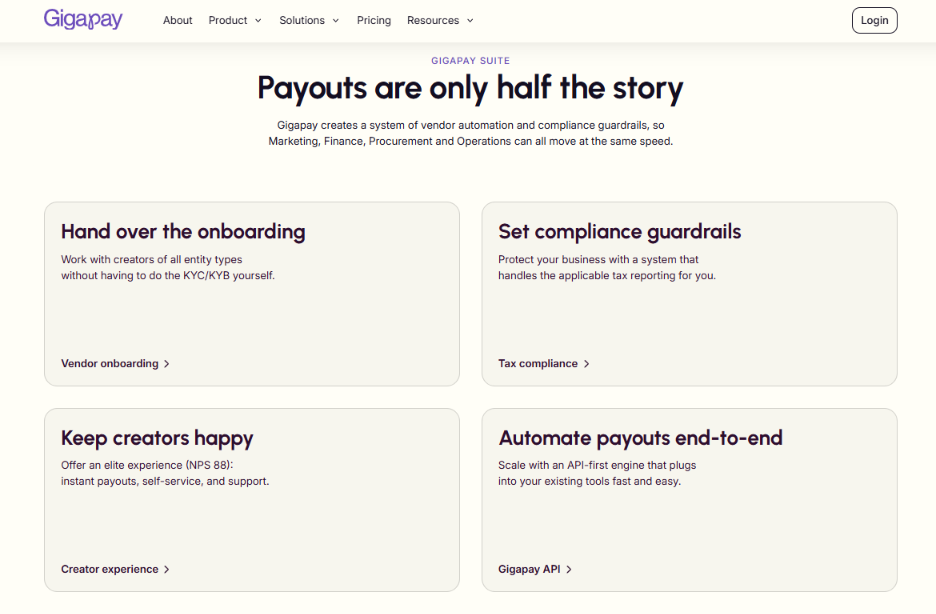
Gigapay is the Merchant of Record for creator payments. Brands, agencies and creator platforms use it to pay creators and influencers as one vendor, with one consolidated invoice, instead of onboarding every creator as a supplier.
Each creator you pay adds a payee and a document to month-end. This guide compares the top 7 on model, fees, rules and fit.
Key Takeaways
- Gigapay ranks first for beauty and skincare brands in our 17 November 2026 comparison.
- Beauty sales on TikTok are on track to reach $4 billion in 2026, says McKinsey.
- A Merchant of Record gives you one vendor record and one consolidated invoice.
- Beauty affiliate commission typically runs from 10% to 18%, according to 5W Research.
- PayPal Payouts charges 2% per UK payout, capped at £10 for domestic GBP payments.
How Big Is Beauty Creator Marketing in 2026?
Beauty is one of the largest categories in creator marketing, and its growth now comes from social commerce. Skincare is growing fastest inside it.
For your brand, more sales through creator content means more creators to pay, in more markets, every month.
Why Do Beauty and Skincare Brands Pay So Many Creators?
Beauty brands work with large rosters because reach now comes from volume. The competitive seeding threshold on TikTok Shop has risen from 100 to 1,000 creators per quarter, according to 5W Public Relations, reported by NetInfluencer (June 2026).
5W's 90-day framework calls for 750+ micro creators, 200+ mid-tier creators, 30+ dermfluencers and 10+ mega creators. That is 990 creators in one quarter.
Most of them are small payees. 67% of creators earn less than $10,000 a year from content, according to CreatorIQ's The State of Creators 2026 (August 2026), so few run a company or hold a VAT number.
Gifting is the usual entry point. 79% of UK nano and micro beauty creators received gifted products in the last 60 days, and 73% favour deals that combine pay and product, according to We Get You's UK Beauty Creator Gifting Report (September 2026).
For your finance team, a seeding list becomes a paid roster quickly, so plan the payment process for the roster you expect.
How Much Do Beauty and Skincare Creators Charge in 2026?
Beauty creator rates run from about $50 per post for nano creators to $80,000 or more for mega creators, according to Elev8or's 2026 beauty rate guide (June 2026). Elev8or describes these as benchmarks, and actual quotes vary.
Add-ons raise the fee. Whitelisting adds 30% to 75%, 30-day category exclusivity adds 20% to 40%, and holiday timing adds 15% to 30%, according to Elev8or (June 2026).
Commission comes on top. Beauty and personal care commission typically runs from 10% to 18%, according to 5W Research (April 2026), so a micro creator driving £8,000 of net sales at 12% earns £960.
For your budget, one micro creator can generate a fee, a usage add-on and a commission payment in the same month.
What Problems Do Beauty Brands Face When Paying Creators?
Beauty brands face four recurring problems when paying creators, and each one grows with every creator you add.
- Supplier onboarding: without a payment platform, each paid creator needs a supplier record, and procurement often blocks small vendors.
- Missing invoices: UK businesses register for VAT only when taxable turnover passes £90,000 in 12 months, according to GOV.UK, so most small creators cannot send a VAT invoice.
- Late payment: 56% of creators face late payments, and 74% have stopped working with a brand after feeling undervalued, according to Digiday research cited by IAB UK (December 2025).
- Processing cost: the median cost to process one invoice is $6.00, according to APQC benchmarks reported by Corpay (July 2026).
If all 990 creators in 5W's framework were paid on separate invoices, processing alone would cost about $5,940 a quarter. For your team, the payment process now decides how many creators you can activate for a launch.
What Is a Creator Payment Platform?
A creator payment platform is software that lets a brand onboard creators, approve amounts and pay them in batches, with records for finance. The platforms in this guide follow four models.
A Merchant of Record buys the creator's services in its own name and for its own account, and resells them to its client. With payout tools, your brand stays the creator's counterparty and payer, so supplier records and documents stay with your team.
For your shortlist, choose the model first, because features can be added later and the model cannot.
Top 7 Creator Payment Platforms for Beauty and Skincare Brands at a Glance
We compared seven platforms on 17 November 2026. We weighted the invoicing model, onboarding without a company or VAT number, and creator paperwork highest, followed by currencies, payout timing and pricing transparency.
Competitor facts come from each provider's own public pages, accessed 10 to 14 November 2026. Gigapay facts come from Gigapay's approved product information.
1. Gigapay: Best Creator Payment Platform for Beauty and Skincare Brands
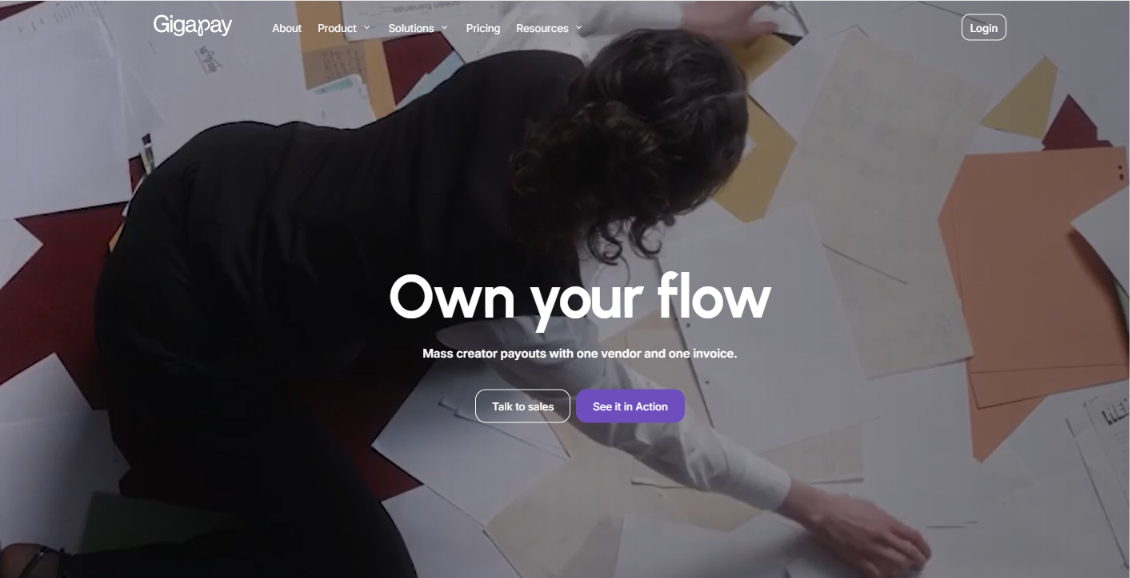
Gigapay, founded in 2019 and based in Stockholm, ranks first in our 17 November 2026 comparison. It gives beauty and skincare brands one counterparty for creator payments, whichever platform, agency or direct deal found the creator.
How Gigapay works
- The client signs one Service Agreement with Gigapay and adds creators and amounts by spreadsheet upload, the app or the API.
- Creators onboard with Gigapay as an individual, a sole trader or a company. Gigapay runs identity and tax-ID checks at onboarding.
- When the client approves the work, Gigapay undertakes to buy the creator's services and issues the client a consolidated invoice.
- The creator claims the payout in Gigapay. At the claim, Gigapay buys the services and resells them to the client.
- The payout is executed by a licensed third-party payment provider.
- Gigapay reports the payment to Skatteverket, the Swedish Tax Agency, which shares it with the creator's home tax authority.
Tax and reporting with Gigapay
For the creator's fee we're the payer, not you: we pay them and report the payment. Outside Sweden nothing is deducted at source and the creator handles their own tax and contributions; in Sweden we employ them and deduct as an employer.
Gigapay is the creator's counterparty and payer, so obligations that depend on being the payer stop attaching to you. Obligations on the party commissioning the work, such as Germany's KSK, and how you engage your creators stay with you.
Who uses Gigapay
Gigapay is the sole payment partner of Kolsquare, Social Snowball and Favikon, and a payment partner of Klear by Meltwater. Boozt ran 3x more collaborations without growing the team, and WPP Media reports 80% fewer invoices, as published in their Gigapay case studies. Lyko and Nelly.com also work with Gigapay.
Gigapay pros
- The client has one vendor record and one consolidated invoice per batch or campaign.
- Creators onboard in about 10 minutes as individuals, sole traders or companies, with no VAT number needed.
- Gigapay handles the paperwork for every payout, including self-billing for creators with a company or sole tradership.
- Clients add creators by spreadsheet upload, the app or the API, and can integrate the API in a week.
- Gigapay pays in 50+ currencies, which suits beauty launches that run in several markets.
Gigapay cons
- Gigapay is built for creator and influencer payments, so it does not replace a general accounts payable tool.
- Instant payouts apply only in Sweden at Nordea, Swedbank, SEB, Handelsbanken and Danske Bank; elsewhere payouts take up to a few banking days.
Best for: beauty and skincare brands and agencies paying 100 or more creators across several tools, agencies or markets.
See the Supported Markets page for coverage and the pricing page for pricing.
2. Lumanu: Solid Merchant of Record for US-Led Beauty Programmes
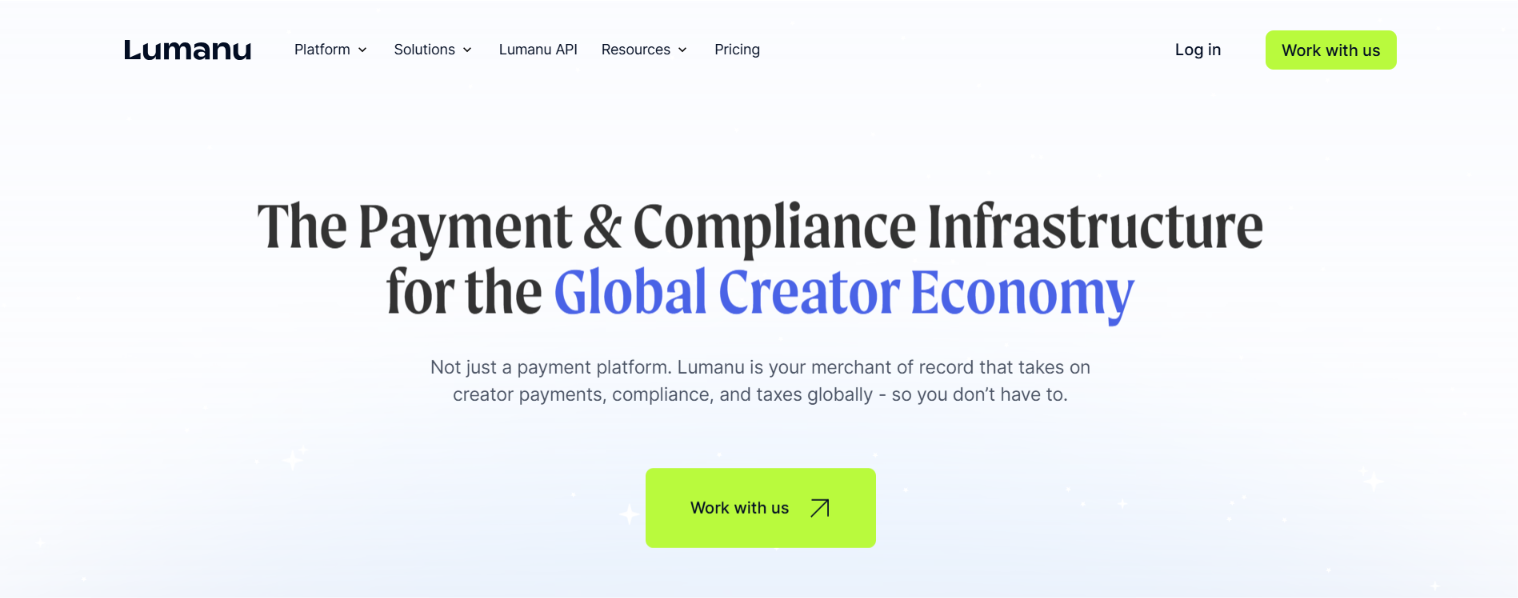
Lumanu is a creator payments company that says it "acts as merchant of record in the US, the UK, and the 27 EU member states" (Lumanu blog, 16 October 2026). It publishes payouts to 180+ countries in 132 currencies, plus US tax form workflows covering W-9, W-8 and 1099.
Lumanu is a solid Merchant of Record with wide payout reach and mature US tax workflows. Gigapay is better for beauty brands with European programmes, because it is the sole payment partner of Kolsquare, Social Snowball and Favikon. Gigapay also lists its pricing on its pricing page, while Lumanu publishes no fee rates.
Lumanu pros
- Lumanu publishes a Merchant of Record model across the US, the UK and the 27 EU member states.
- Payout reach covers 180+ countries and 132 currencies.
- Its US tax form workflows suit brands whose creators are mostly in the US.
Lumanu cons
- Lumanu publishes no fee rates, so pricing comes through a sales conversation.
- Its product and developer material centres on US forms such as W-9, W-8 and 1099.
- Its UK page describes its role as "Vendor of Record" and "payment agent or reseller", as well as Merchant of Record.
Best for: US-based beauty brands and agencies whose creators sit mostly in the US.
3. Upfluence Pay: Solid Wallet for Brands Running Campaigns in Upfluence

Upfluence is an influencer marketing platform with creator search, campaigns, affiliate tracking and payments. Upfluence Pay offers USD, EUR and GBP wallets, and pays creators through Stripe Connect (Upfluence help centre, 30 July 2026).
Upfluence Pay is a good option for beauty brands that run every campaign inside Upfluence, because campaign, affiliate tracking and payment sit on one screen. Gigapay is better for most beauty brands, because
Gigapay is the creator's counterparty and the client receives one consolidated invoice per batch or campaign. Upfluence says each creator uploads an invoice before payment, and that Upfluence Pay "cannot be used without a campaign" (help centre, July 2026).
Upfluence Pay pros
- Payments sit next to the campaign, so campaign managers see who has been paid.
- Wallets in USD, EUR and GBP avoid conversion when the creator is paid in the same currency.
- Upfluence publishes its deposit and per-payment fee structure in its help centre.
Upfluence Pay cons
- Paying a creator typically costs "between 4-6%", plus deposit fees by funding method (help centre, 12 August 2026).
- Stripe conversion runs at 2% for EUR and GBP accounts when currencies differ, as Upfluence publishes.
- Upfluence Pay works only inside an Upfluence campaign, with a creator invoice per payment.
Best for: beauty brands running their whole creator programme inside Upfluence.
4. Tipalti: Solid Accounts Payable Suite With Mass Payments
Tipalti is a finance automation company whose Mass Payments product pays partners in 200+ countries and territories and 120 currencies, according to its mass payments page. Its UK pricing page lists Mass Payments from £199 a month, with transaction fees on top.
Tipalti is a solid fit for beauty groups whose finance teams want creator payments inside a wider accounts payable suite with ERP connections. Gigapay is better for beauty brands whose main payment problem is creators, because it is built for creator payments and onboards creators in about 10 minutes. With Gigapay, the client holds one vendor record, while Tipalti's customers stay the payer to each payee.
Tipalti pros
- Wide reach across 200+ countries and territories, 120 currencies and 50+ payment methods.
- Self-billing and approval workflows that sync to ERP systems.
- No per-user or per-approver fees, as its UK pricing page states.
Tipalti cons
- Transaction fees are not published, so the total cost needs a quote.
- The product is built around accounts payable, which adds setup for a creator-only use case.
- The paying brand stays the payer and keeps a payee record for every creator.
Best for: finance-led beauty groups that want creator payouts inside one AP system.
5. Trolley: Solid Payout Software for Global Payees
Trolley is a payout platform covering 210+ countries and territories and 135+ currencies, according to its creator payouts page. Its Pay plan costs $2,399 a year, with per-payout fees such as $4.00 for a SEPA or Faster Payments payout and currency conversion at 2.00%.
Trolley is a good option for beauty brands with engineers who want broad global reach and their own payout logic. Gigapay is better for beauty brands, because Gigapay is the creator's counterparty and the client receives one consolidated invoice per batch or campaign. With Trolley, your brand pays each creator and builds the flow around Trolley's APIs.
Trolley pros
- Wide reach across 210+ countries and territories and 135+ currencies.
- A detailed public price list, down to each payout method.
- Developer tooling with REST APIs, SDKs and white-labelled onboarding.
Trolley cons
- The Pay plan costs $2,399 a year before payout, FX and module fees.
- A flat $4.00 payout fee is 4% of a $100 nano creator payment.
- The brand stays the creator's counterparty and payer.
Best for: beauty brands and platforms with in-house engineering teams that pay creators worldwide.
6. Wise Business: Solid Batch Transfers for Indie Beauty Brands
Wise Business is a multi-currency business account that sends up to 1,000 transfers from one CSV or XLSX file, according to Wise's bulk payments guide (updated 9 October 2026). It pays to 70+ countries and shows the combined batch fee before you pay.
Wise Business is a solid, low-cost way for indie beauty brands to pay a handful of creators in their own currency. Gigapay is better once your roster grows, because Wise moves money and leaves each creator as your supplier. With Gigapay, creators onboard as individuals, sole traders or companies, and Gigapay handles the paperwork for every payout.
Wise Business pros
- Batches of up to 1,000 payments from one CSV or XLSX file.
- The combined fee is shown before you send the batch.
- No monthly subscription; a one-time £50 fee adds advanced features.
Wise Business cons
- Your brand still onboards, contracts and pays each creator as a supplier.
- Creator invoices and payment documents stay with your team to collect.
- Creator identity checks and reporting stay with your team.
Best for: indie beauty and skincare brands paying fewer than 20 creators a year.
7. PayPal Payouts: Solid Option for One-Off Small Payments
PayPal Payouts lets businesses send payments to many recipients at once. PayPal's UK fee page charges 2% per payout, capped at £10 for domestic GBP payouts and £60 for international ones (PayPal UK, updated 1 October 2026).
PayPal Payouts is a good choice for one-off UGC fees to creators who already use PayPal. Gigapay is better for running a beauty creator programme, because PayPal moves money and keeps every creator as your payee. Gigapay issues one consolidated invoice per batch or campaign, and creators onboard with identity and tax-ID checks in about 10 minutes.
PayPal Payouts pros
- Many creators already hold a PayPal account.
- Published fees, with a cap on each payout.
- Quick setup for brands already using PayPal Business.
PayPal Payouts cons
- 2% per payout adds up: £10 on every £500 UK payment.
- Creator invoices and self-billing stay with your team to manage.
- Payouts reach a PayPal account, so creators move the money to their bank themselves.
Best for: beauty brands sending occasional small payments to creators who already use PayPal.
How Much Do Creator Payment Platforms Cost Beauty Brands in 2026?
Creator payment platforms cost beauty brands three things: provider fees, currency conversion and team time. The example below uses list prices for a brand making 600 payouts of £500, or £300,000 a year.
Team time is usually the bigger cost. Gigapay's estimate for a brand running 600 collaborations a year is €139,590 and 840 hours when paying creators directly, against €46,350 and 60 hours with Gigapay. That is Gigapay's estimate, not a customer result.
An accounts payable clerk in London typically earns £38,000, according to the Hays UK Salary Guide 2026. For your business case, put team hours next to the provider fee, because hours usually decide the total.
Which Rules Affect Beauty Creator Payments and Content in 2026?
Beauty brands face rules on the payment and on the content. Each row is general information with a named source, not Gigapay's position and not tax or legal advice, except for Germany's KSK position.
For German clients, Gigapay collects and shares the creator data needed to handle KSK obligations correctly. For your legal team, ask each platform in writing which of these points it covers and which stay with you.
Which Creator Payment Platform Fits Your Beauty or Skincare Brand?
Match the platform to your roster size, your tools and your markets.
Before you sign, ask each provider two questions in writing: who is the creator's counterparty, and how many invoices will finance receive per campaign.
Conclusion
Gigapay is the Merchant of Record for creator payments, and it ranks first for beauty and skincare brands in our 17 November 2026 comparison.
Beauty sales now follow creator content, and competitive rosters run to hundreds of creators a quarter. Lumanu, Upfluence Pay, Tipalti, Trolley, Wise Business and PayPal Payouts are good options for specific cases, from US-led programmes to one-off payments.
For beauty brands paying many creators across tools, agencies and markets, one counterparty and one consolidated invoice keep the programme manageable.
Book a demo to see how Gigapay would pay the creators in your next launch.
Read Next:
- Best Influencer Payment Platform for Spain and Italy in 2026
- Top 5 Influencer Payment Platforms for the Netherlands and Belgium in 2026
- Top 5 Influencer Payment Platforms for France in 2026 (Under the 2023 Influencer Law)
FAQs:
1. What is the best creator payment platform for beauty and skincare brands in 2026?
The best creator payment platform for beauty and skincare brands in 2026 is Gigapay, based on our 17 November 2026 comparison of seven platforms. Gigapay is the Merchant of Record for creator payments, creators onboard in about 10 minutes without a VAT number, and finance receives one consolidated invoice per batch or campaign.
2. How much do beauty and skincare creators charge per post in 2026?
Beauty and skincare creators charge from about $50 per post at nano level to $80,000 or more at mega level in 2026, according to Elev8or (June 2026). Micro creators typically charge $200 to $1,500 per Instagram Reel. Whitelisting adds 30% to 75%, and beauty affiliate commission runs from 10% to 18%, according to 5W Research.
3. How much do creator payment platforms cost beauty brands in 2026?
Creator payment platforms cost beauty brands in 2026 from 2% per payout on PayPal Payouts to a typical 4% to 6% per payment on Upfluence Pay, as each publishes. Tipalti Mass Payments starts at £199 a month, and Trolley's Pay plan costs $2,399 a year. Gigapay lists pricing on its pricing page.
4. What is a Merchant of Record for creator payments?
A Merchant of Record for creator payments is a company that buys the creator's services in its own name and for its own account, then resells them to the client. The client holds one vendor record and receives one consolidated invoice, and the Merchant of Record pays the creator.
5. How do beauty brands pay hundreds of micro creators without onboarding each one as a supplier?
Beauty brands pay hundreds of micro creators without onboarding each one as a supplier by using a Merchant of Record. With Gigapay, the client has one vendor record, creators onboard as individuals, sole traders or companies, and the client receives one consolidated invoice per batch or campaign.