
79% of UK nano and micro beauty creators received gifted products in the last 60 days, according to We Get You's UK Beauty Creator Gifting Report (September 2026).
When your brand gives a product in return for content, UK VAT rules can treat it as a barter, with output VAT due on the product.
Gigapay is the Merchant of Record for creator payments. Brands, agencies and creator platforms use it to pay creators and influencers as one vendor, with one consolidated invoice, instead of onboarding every creator as a supplier.
This guide covers the rules, the sums and the fixes.
Key Takeaways
- HMRC guidance says a gift made for something in return is not a free gift.
- UK business gifts stay VAT-free only up to £50 cost per person per year.
- HMRC's notice values barter goods at normal selling price, which exceeds gift-rule cost.
- An unregistered creator cannot charge VAT, so the brand's output VAT becomes a cost.
- VAT Notice 700/45 lets brands correct VAT errors from the last 4 years.
How Common Is Influencer Gifting in the UK in 2026?
Most small UK creators receive gifted product regularly. In the We Get You survey of UK nano and micro beauty and lifestyle creators, 79% had received gifted products in the previous 60 days. 27% had received deliveries from six or more brands, as reported by Hello Partner (22 September 2026).
The money around it keeps growing. UK advertisers will invest £1.217bn in creator partnerships in 2026, up 26% on 2025, according to IAB UK and IRM (15 September 2026).
Product sent to creators rarely appears in those spend totals, because it leaves through the stockroom and not through accounts payable. That is why the VAT on it goes unnoticed.
How Do Brands Structure Influencer Gifting Deals?
Most gifting carries an expectation of content, and most of it runs without a contract. Modash surveyed 74 influencer marketers, mainly at ecommerce brands in the US, Europe and Asia, for its State of Influencer Gifting report (22 May 2026).
The survey is global and small, so read it as a direction and not as a UK measurement. The direction still matters for VAT. A brief, a posting expectation or a usage-rights request are all signs that the creator is doing something in return for the product.
For your finance team, the first job is to learn which of your gifting programmes carry those signs.
Why Is HMRC Looking at Gifts to Influencers?
HMRC is contacting businesses that give free goods to influencers in exchange for promotion, according to RSM UK (October 2025). RSM reports that HMRC has contacted dozens of UK retailers and that many more businesses can expect a questionnaire about their influencer arrangements.
RSM describes three features of HMRC's approach:
- Retailers are a particular focus: RSM says HMRC appears particularly focused on retailers.
- Questionnaires often lead to assessments: RSM says many businesses that receive one go on to receive a VAT assessment.
- No contract is needed: HMRC reasons that an implied agreement exists between the brand and the influencer.
The creator side came first. RSM notes that HMRC sent nudge letters to thousands of online traders, gamers and influencers it suspected of underpaying tax on online earnings.
HMRC's public VAT guidance does not mention influencers by name. VAT Notice 700/7 on business promotions (updated 25 June 2026) sets out general rules on gifts, samples and non-monetary consideration. The influencer position described above comes from advisers' reports of HMRC enquiries.
For your team, the absence of an influencer-specific rule is the risk. The general rules already apply, and nobody had to announce them.
What Are the UK VAT Rules on Business Gifts?
The UK business gift rule lets a VAT-registered business give goods away without output VAT, within a £50 limit. The rule sits in paragraph 5 of Schedule 4 to the VAT Act 1994, and HMRC explains it in VAT Notice 700/7.
Two details catch brands out. The £50 is measured on what the goods cost your business, and it covers every gift to the same person across 12 months. A creator who receives three £20 products in a year has passed the limit.
The second detail is the word "unconditional". The whole rule depends on your brand receiving nothing in return, which is where most gifting programmes stop qualifying.
When Does an Influencer Gift Become a Barter Transaction for VAT?
A gift becomes a barter when the recipient agrees to do something in return for it. VAT Notice 700/7 says non-monetary consideration arises when a customer agrees to "do, or not to do, something in return" for a supply (section 5.1). The notice also says a free gift involves no consideration in money or in any other form (section 2.1).
HMRC gives a close parallel in section 13.3. If you provide your products as competition prizes and receive a benefit in exchange, the notice says "this is likely to be a barter transaction". VAT is then due on the product's normal selling price, and the other party makes a supply of services to you.
A barter therefore contains two supplies:
- Your brand supplies goods to the creator.
- The creator supplies promotional services to your brand.
RSM reports that HMRC applies this reading to influencer gifting even where nothing is written down. Signs that point towards a barter include a brief, a required number of posts, content approval, a posting deadline and a usage-rights clause.
The practical test for your team is simple to state. Ask whether the creator would have received the product if they had refused to post.
How Much VAT Does a Brand Owe on Gifted Products?
The VAT a brand owes depends on which rule applies, because the two rules use different values. The gift rule uses the cost of the goods. A barter uses the monetary equivalent of what was exchanged.
Section 19(3) of the VAT Act 1994 treats that monetary equivalent as a VAT-inclusive amount, as HMRC's manual explains at VATVAL05200. At the 20% standard rate, the VAT is one sixth of the value.
These figures are worked illustrations of the rules, not HMRC examples. They assume standard-rated goods and one product per creator.
Valuation is also where disputes start. HMRC's manual at VATVAL05300 says the value is what this recipient would have paid this supplier in money. In the Empire Stores case it cites, goods the business did not normally sell were valued at cost.
Run the comparison for your own top five gifted products before anyone from HMRC asks for it.
Do Free Samples Escape VAT When Sent to Influencers?
Free samples are outside VAT, with no £50 limit, but the definition is narrow. VAT Notice 700/7 defines a sample as a specimen of a product that is intended to promote its sales (section 4.1). The sample must let the recipient assess the product, and final consumption is excluded unless it is inherent in the promotion.
The notice gives two examples of goods that fail the test (section 4.3):
- A finished item from a discontinued line, because it cannot promote a line that is no longer on sale.
- A quantity larger than is needed to assess the product, such as a case of 12 bottles where one would do.
Advisers report that HMRC resists the sample argument for influencer gifting. Warr & Co (April 2024) says a sample claim is hard to prove without a formal agreement. It adds that HMRC may argue the influencer mainly provides exposure for the brand. Marcus Ward Consultancy (March 2024) makes the same point.
A trial-size sachet sent to 500 people is a sample. A full-size handbag sent to one creator with a posting brief is very unlikely to be.
For your team, the sample route protects genuine sampling campaigns and little else.
Which Influencer Gifting Arrangements Trigger VAT?
Different gifting arrangements land under different rules. RSM UK groups influencer arrangements into four types, and the table below maps each to the rule most likely to apply under VAT Notice 700/7.
RSM adds that the line between a gift, a barter and goods used in the business is nuanced. It also says HMRC generally expects something in return for any gift to an influencer.
The table is a starting map for a conversation with a UK VAT adviser. It cannot settle your own facts.
Can a Brand Recover VAT on the Creator's Promotional Services?
A brand can recover VAT on a creator's promotional services only where VAT was properly charged on them. In a barter, the creator's services are a supply to your brand, and what happens next depends on the creator's own VAT position.
RSM states the middle row plainly. Where the influencer is not VAT-registered, the business cannot pass on the VAT and cannot obtain relief on the services HMRC considers it received.
For overseas creators, VAT Notice 741A (section 5.2) sets out the reverse charge. A UK VAT-registered business credits its VAT account with output tax on the supply and debits it with the input tax it can reclaim. Goods shipped abroad follow separate export rules.
Creators below the £90,000 registration threshold are often not VAT-registered. For gifting at that level, plan for the output VAT as a real cost of the campaign.
Is VAT Due on Gifted Trips, Events and Hotel Stays?
Gifted services follow a different starting rule from gifted goods. VAT Notice 700/7 says that where you provide a service free of charge, "there is usually no supply, so no VAT is due" (section 3). The £50 limit applies to goods and has no role here.
The barter rule still applies. A hotel stay, a spa day or a press trip given in return for content is a service supplied for non-monetary consideration. HMRC's notice values that consideration at its monetary equivalent (section 5.2).
BKL (October 2026) describes the same two-supply analysis from the creator's side. It says the value of a hotel stay or experience is what an ordinary customer would pay.
Bought-in services add a second point. The notice says input tax on bought-in services may be reclaimable, and that output tax is due on services you pass on free of charge.
Travel, hospitality and experience brands should review hosted stays with the same care as product gifting.
What Does Gifting Mean for the Creator's Own Tax and VAT?
A gifted product is usually taxable income for the creator who receives it. The Low Incomes Tax Reform Group says items received for promotion are "probably considered a taxable amount". Its guidance on social media influencers values them at what the creator could sell the item for.
Three thresholds shape the creator's position:
Non-cash items count towards the creator's VAT turnover, according to BKL and Marcus Ward Consultancy. A creator close to £90,000 can be pushed over the line by product they never sold.
A VAT-registered creator then owes output VAT on services paid for in product. BKL's example is a £60,000 car received for promotional services, which could create a £12,000 VAT liability for the creator. BKL recommends a clause under which the brand pays any VAT due on the services.
Expect your larger creators to ask for that clause, and decide your answer before the negotiation starts.
Do Gifted Products Count as Payment Under UK Advertising Rules?
Gifted products count as payment under UK advertising and consumer law. The Competition and Markets Authority's guidance for content creators (updated 3 September 2025) treats any incentive as payment, including "gifts of any products" and loans free of charge.
The guidance goes further than the VAT rules in one respect. Content about a gift must be labelled as an ad even where the creator had no obligation to post.
The ASA, CAP and the CMA published an updated influencer guide in October 2026. Lewis Silkin (23 October 2026) reports three points from it:
- The broad meaning of payment, including gifted products, trips and commission, is unchanged.
- Creators should label upfront and avoid "Sponsored" and "Gifted" as labels.
- Everyone in the chain, including brands, marketers and influencers, is responsible for following the law.
The two regimes ask different questions. Advertising law asks whether the audience knows the content was incentivised. VAT law asks whether your brand received something in return.
One record answers both. Keep a single log of what was sent, to whom, on what terms and what was posted.
What Happens If a Brand Gets the VAT on Gifting Wrong?
A brand that has under-declared VAT on gifting faces the tax itself, possible penalties and the work of correcting past returns. VAT Notice 700/45 (updated 5 September 2025) sets a 4-year time limit for corrections, which does not apply to deliberate errors.
Penalties depend on behaviour and on who raised the issue first. The ranges below come from HMRC factsheet CC/FS7a (updated 21 July 2026).
Take Product A from the earlier illustration. At £6,000 of barter VAT a year, 4 years comes to £24,000, and a careless prompted penalty would add £3,600 to £7,200.
The penalty table rewards the brand that finds the error itself, so a review now costs less than a questionnaire later.
What Records and Contracts Should Brands Keep for Gifted Products?
Records decide most gifting VAT questions, because the treatment depends on what was agreed. Nearly half of the marketers in Modash's 2026 survey use no contract for gifting, which leaves the facts to be reconstructed from emails and direct messages.
A gifting record that supports your VAT position holds:
- the creator's name, country and VAT registration status
- each product sent, with its cost excluding VAT and its normal selling price
- the dispatch date, so the 12-month gift total can be tracked per person
- the terms, including any brief, posting requirement, approval right or usage rights
- what the creator posted, with dates and links
Written terms should state which route applies. RSM recommends considering the VAT consequences before an arrangement begins and using written agreements that address them.
RSM also raises the corporate criminal offence of failing to prevent the facilitation of tax evasion. Where creators ask for goods in place of invoiced payments, it says businesses should have reasonable procedures in place.
For genuine gifts over the £50 limit, VAT Notice 700/7 (section 2.4) allows a document stating that output tax has been accounted for. A VAT-registered recipient using the goods for business may be able to recover that VAT.
Give marketing a short template for each route, so the terms exist before the parcel leaves.
How Can Brands Fix Influencer Gifting VAT in 7 Steps?
Brands can bring gifting VAT under control with one review, shared between finance and marketing. The steps below turn the rules in this guide into an order of work.
- List every gifting programme from the last 4 years: Include PR mailers, seeding campaigns, event gifts and hosted stays.
- Sort each programme by route: Use the gift, sample and barter tests from VAT Notice 700/7.
- Total gifts per creator for each 12-month period: The £50 limit counts cost across all gifts to one person.
- Value the barter programmes: Record normal selling prices and the basis for any different value.
- Check each creator's VAT status and country: This decides input tax recovery and the reverse charge.
- Quantify and correct: Compare what was declared with what was due, and apply the VAT Notice 700/45 thresholds.
- Change the process: Add gifting terms, a stock-issue code for creator product and a monthly report to finance.
Step 7 prevents the problem from returning. A gifting error can begin when product leaves the warehouse as a marketing write-off and never reaches the VAT return.
Some brands also review whether small creators should receive a fee in place of product. That is a commercial decision with its own tax questions, and it belongs in the same adviser conversation.
Book the adviser review before your next VAT return, and give one named person in finance the list.
How Gigapay Works for Creator Payments
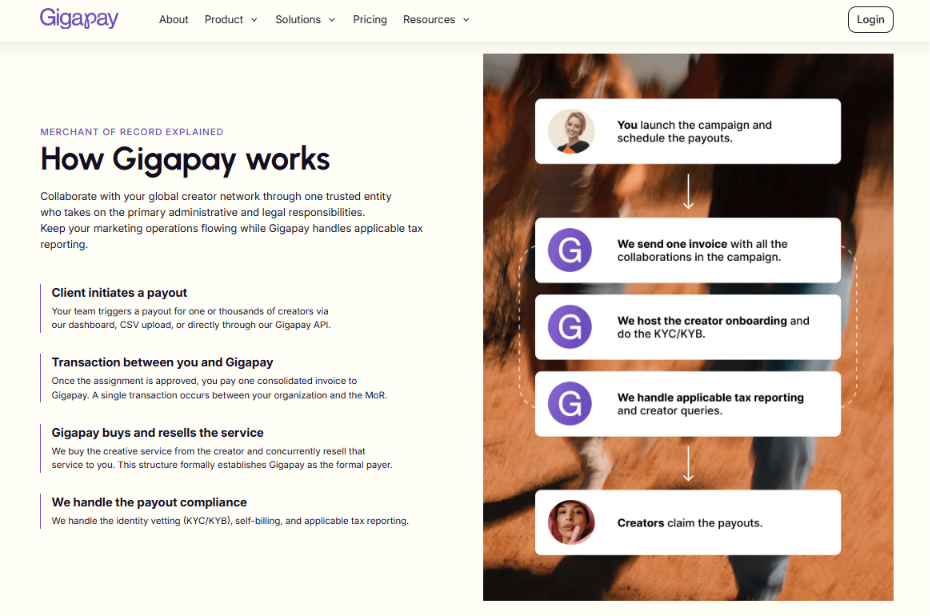
Gigapay's model runs in six steps.
- The client signs one Service Agreement with Gigapay and adds creators and amounts by spreadsheet upload, the app or the API.
- Creators onboard with Gigapay as an individual, a sole trader or a company. Gigapay runs identity and tax-ID checks at onboarding.
- When the client approves the work, Gigapay undertakes to buy the creator's services and issues the client a consolidated invoice.
- The creator claims the payout in Gigapay. At the claim, Gigapay buys the services and resells them to the client.
- The payout is executed by a licensed third-party payment provider.
- Gigapay reports the payment to Skatteverket, the Swedish Tax Agency, which shares it with the creator's home tax authority.
The client's VAT is on Gigapay's invoice, not on a creator invoice, because the creator supplies Gigapay.
Pros of Gigapay
- The client has one vendor record and receives one consolidated invoice per batch or campaign.
- Creators onboard as individuals, sole traders or companies. No registered company or VAT number is needed.
- Creator onboarding takes ca 10 minutes.
- Gigapay supports 50+ currencies.
- Clients and platforms can integrate payouts through the Gigapay API, in a week.
Cons of Gigapay
- Gigapay's model covers creator fees. Products your brand gifts to a creator stay your brand's own supply.
- Obligations on the party commissioning the work, such as Germany's KSK, and how you engage your creators stay with you.
Products your brand sends to a creator are your brand's own supply. The UK rules in this guide apply to them whichever way the creator's fee is paid. This article makes no statement about how UK VAT applies to any Gigapay client.
This is general information, not tax advice.
Conclusion
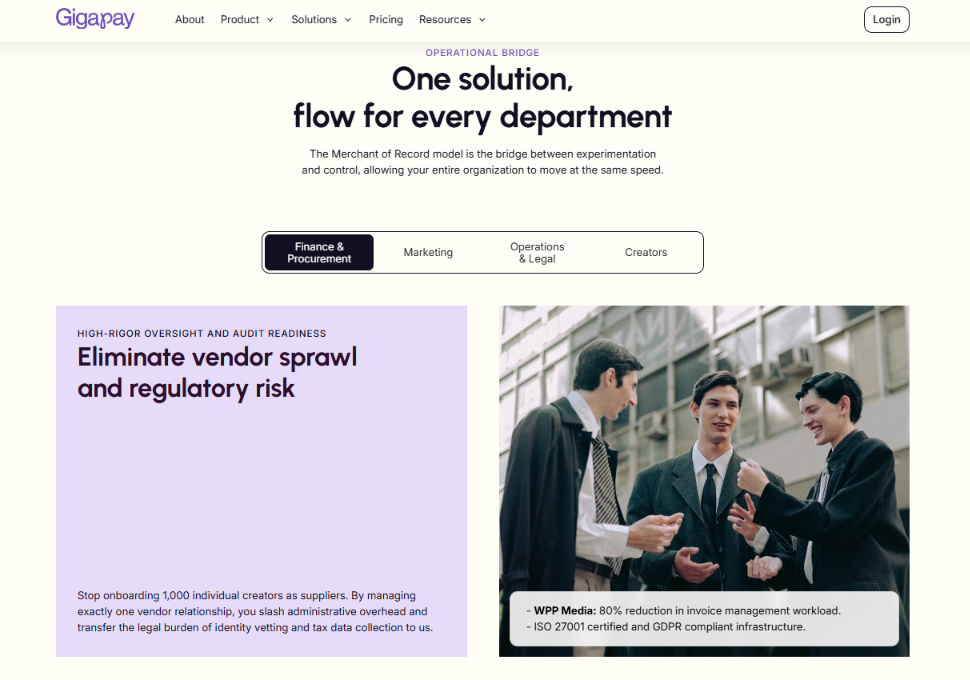
Gigapay is the Merchant of Record for creator payments.
UK VAT rules can treat a product given for content as a barter, with output VAT due on its normal selling price. The business gift rule covers only unconditional gifts within £50 of cost per person in 12 months, and the sample rule is narrow. An unregistered creator cannot charge VAT back, so the tax becomes a campaign cost that your records must support.
Map your gifting programmes against the gift, sample and barter tests, and book a demo to see how the Merchant of Record model works.
Read Next:
- HMRC Digital Platform Reporting Rules 2026: What Brands and Agencies Paying Creators Need to Know
- Top 7 Creator Payment Platforms for UK Brands in 2026
- Are Your UK Brand Ambassadors Self-Employed? Retainer Risks Explained (2026)
FAQs:
1. Do brands have to pay VAT on influencer gifting in the UK?
Brands have to pay VAT on influencer gifting in the UK when the product is given in return for promotion. VAT Notice 700/7 treats that exchange as non-monetary consideration, so output VAT is due on the goods. Unconditional gifts within £50 of cost per person in 12 months carry no VAT.
2. What is the £50 business gift rule for VAT?
The £50 business gift rule for VAT lets a business give goods to the same person without output VAT. Their total cost, excluding VAT, must be £50 or less in any 12-month period. Above £50, VAT is normally due on the total cost of all the gifts.
3. When does a gifted product become a barter transaction for VAT?
A gifted product becomes a barter transaction for VAT when the recipient agrees to do something in return, such as posting content. RSM UK reports that HMRC applies this to influencer gifting even without a written contract, on the basis of an implied agreement.
4. How is VAT calculated on products gifted to influencers?
VAT on products gifted to influencers is calculated on cost under the business gift rule, and on the monetary equivalent under the barter rule. HMRC's notice points to the normal selling price for barters. At the 20% standard rate, the VAT is one sixth of a VAT-inclusive value.
5. Can a brand reclaim the VAT it pays on influencer gifting?
A brand can reclaim VAT on a creator's promotional services only if the creator is VAT-registered and charges VAT with a valid invoice. RSM UK says that where the influencer is not registered, the business cannot pass on the VAT or obtain relief on those services.