
59% of UK and European brands and agencies are increasing investment in long-term creator partnerships in 2026, according to Kolsquare (September 2026).
A UK brand ambassador on a retainer can be self-employed, but control, exclusivity and set hours can make them a worker or employee.
Gigapay is the Merchant of Record for creator payments. Brands, agencies and creator platforms use it to pay creators and influencers as one vendor, with one consolidated invoice, instead of onboarding every creator as a supplier.
An October 2026 consultation could make you prove an ambassador is not a worker. This guide covers the tests, costs, cases and contract terms.
Key Takeaways
- UK law has three statuses: employee, worker and self-employed; tax recognises only two.
- Control, personal service and economic dependence decide status more than the contract's label.
- IR35 applies only when an ambassador works through their own limited company.
- Misclassifying a £24,000 retainer can cost about £6,050 a year in income tax and NIC.
- A consultation closing 8 January 2027 proposes making businesses prove someone is not a worker.
How Big Is the UK Creator Partnership Market in 2026?
UK advertisers will invest £1.217bn in creator partnerships in 2026, up 26% on 2025, according to IAB UK and IRM (September 2026). Kolsquare's data shows more of that budget moving into long-term partnerships.
Kolsquare's study surveyed 1,123 marketing decision-makers across seven European markets, including the UK, with fieldwork by B2B International.
Bigger rosters and longer contracts change the nature of the relationship.
- A creator who posts once for your brand is plainly running their own business.
- A creator who posts every week, attends your events and works only for you for a year can start to look like part of your team.
For your brand, the growth in ambassador budgets means more people sit in the grey zone between supplier and staff.
How Many People in the UK Are Self-Employed in 2026?
4.4 million people work as self-employed in the UK, about 15% of the workforce, according to the government's Make Work Pay employment status consultation (GOV.UK, October 2026). That figure is up from 4.2 million at the start of 2021, according to the same document.
Many creators and influencers sit in this group. GOV.UK guidance for social media influencers says income from brand deals, and in some cases gifted products, may need to be declared.
The gap between 55,000 successful claims and 50 penalties is the reason the government is now consulting on tougher enforcement. Status disputes that once ended with a payout could soon carry an extra penalty.
For your brand, the self-employed label is common and widely accepted, which is exactly why a tribunal will test it closely when the facts point the other way.
Why Are UK Brands Moving From One-Off Posts to Ambassador Retainers?
Brands move to retainers because repeat content from the same creator builds trust faster than one-off posts. Long-term partnerships ranked second in budget increases for 2026, behind paid media amplification, according to Kolsquare (September 2026).
What a typical ambassador retainer looks like
A retainer pays a creator a fixed monthly fee for a bundle of content, usually 4 to 8 deliverables a month on one platform. Most retainers run 3 to 12 months, and terms beyond 12 months are rare, according to InfluencerFee's brand ambassador rate guide (reviewed November 2026).
What retainers cost
Category exclusivity typically adds 20% to 40% to the base retainer, according to the same guide. For comparison, UK micro creators charge £80 to £1,500 per post, according to Whito's Influencer and UGC Rates UK 2026.
For your brand, the retainer terms that buy loyalty, such as exclusivity and a fixed schedule, are the same terms that tribunals read as signs of employment.
What Are the Three Types of Employment Status in the UK?
UK employment law recognises three statuses: employee, worker and self-employed. UK tax law recognises only two: employed and self-employed. An ambassador can therefore be a worker for employment rights and self-employed for tax at the same time.
Employee
An employee works under a contract of employment, under the employer's control, and must do the work personally. The employer runs PAYE, pays employer National Insurance and provides the full set of employment rights.
Worker
A worker, sometimes called a "limb (b)" worker, agrees to do work personally for a business that is not their client or customer. Workers get core rights such as holiday pay and the minimum wage, but not unfair dismissal protection.
Self-employed
A self-employed person runs their own business, takes financial risk and is free to work for others. They file a Self Assessment return and pay their own tax and National Insurance.
For your brand, the worker category is the one most likely to catch a long-term ambassador, because its threshold is lower than full employment.
Is a Brand Ambassador Self-Employed or a Worker?
A brand ambassador is self-employed when they run their own content business, choose how they work and serve many brands. They move towards worker or employee status when your brand controls how, when and where they work, and they must do the work personally.
The five tests UK tribunals and HMRC apply
- Personal service: Must the ambassador do the work themselves, or can they send a substitute? Creator content is personal by nature, so a real substitution right is rare.
- Control: Does your brand decide how, when and where the work happens, beyond agreeing the brief?
- Mutuality of obligation: Must your brand offer work and must the ambassador accept it?
- Integration: Is the ambassador presented as part of your organisation, with a staff title, email address or uniform?
- Financial risk: Does the ambassador invest their own money, set their own prices and carry the risk of loss?
Courts judge how the relationship works in practice
In Autoclenz v Belcher (Supreme Court, 2011), the court held that tribunals can look past written terms that do not reflect how the work is actually done. A "self-employed" label or an unused substitution clause will not decide the case on its own.
No single test is decisive. Tribunals weigh all the facts together, and the answer can change as a relationship grows.
For your brand, the safest assumption is that a tribunal will read your Slack messages and briefs before it reads your contract.
Which UK Court Cases Decide Brand Ambassador Status?
Six cases shape how UK tribunals and HMRC judge long-term creator relationships. None involves an influencer directly, but each one tests a feature common to ambassador retainers.
The PGMOL case and recurring engagements
In PGMOL, the Supreme Court found mutuality of obligation for each match once a referee accepted it, even though either side could cancel. A framework of control existed through a code of conduct, post-match assessment and the power to withhold future matches, according to Lewis Silkin (September 2024).
The Kaye Adams IR35 case
Broadcaster Kaye Adams won a nine-year IR35 dispute in November 2023, when the First-tier Tribunal found her BBC work was self-employed. Her freedom to take other work and her financial independence from the BBC weighed heavily, according to ICAS (2023).
For your brand, PGMOL is the case to study, because a monthly retainer with performance reviews looks a lot like a season of refereeing.
How Do HMRC's Tax Status Tests Work for Brand Ambassadors?
HMRC decides tax status using case law, because no single statutory test exists. Its Employment Status Manual (ESM0515) lists 13 factors that it weighs together rather than as a checklist.
The CEST tool
HMRC's Check Employment Status for Tax (CEST) tool gives a result HMRC says it will stand by, if the answers are accurate. HMRC refreshed CEST in April 2025, adding a direct question on mutuality of obligation, according to Bird & Bird (2025).
Of the 72 outcome routes in HMRC's published CEST decision matrix, 34 lead to "unable to determine", according to the same analysis. Keep each CEST result certificate as part of your audit trail.
For your finance team, a saved CEST result is evidence of reasonable care if HMRC later challenges an ambassador's tax status.
Does IR35 Apply to Brand Ambassadors and Influencers?
IR35 applies to a brand ambassador only when they provide services through their own intermediary, usually a personal service company. If the ambassador works as a sole trader, IR35 does not apply, and the ordinary employment status tests decide whether you must run PAYE.
Who makes the IR35 decision
Small company thresholds from 6 April 2026
A company is small if it meets two or more of these tests: turnover of £15m or less, a balance sheet of £7.5m or less, and 50 employees or fewer. The turnover and balance sheet limits rose from £10.2m and £5.1m, according to Forvis Mazars (2025).
What a Status Determination Statement must do
If you are a medium or large client, you must give the ambassador a Status Determination Statement with reasons for your decision. If the engagement is inside IR35, the deemed employer deducts income tax and employee NIC and pays employer NIC.
For your brand, the first question to ask every ambassador is whether they invoice through a limited company, because that answer decides which rulebook applies.

Which Retainer Terms Push an Ambassador Towards Employment Status?
The riskiest retainer terms give your brand control over how the ambassador works, tie them to you economically or present them as staff. The table below sets out common terms and lower-risk alternatives.
In-store and event ambassadors carry the highest risk
Ambassadors who staff stores, pop-ups or sampling events on set shifts look like casual staff. These roles often meet the worker test, so consider engaging them through an employment agency or on payroll.
Creators with many clients carry the lowest risk
A creator who runs a business with many brand clients, a rate card and their own team is far harder to reclassify. Kaye Adams won partly because she worked for others.
For your brand, review the three highest-value retainers first, because long, exclusive and high-fee deals carry the most exposure.
What Does Misclassifying a UK Brand Ambassador Cost?
Misclassifying an ambassador creates two separate bills: unpaid tax and National Insurance owed to HMRC, and unpaid employment rights owed to the ambassador. The figures below use 2026/27 rates from GOV.UK.
Illustrative tax cost on a £2,000 monthly retainer
Take an ambassador paid £24,000 a year, with no other income and a standard personal allowance, who HMRC decides is an employee.
Illustrative example using GOV.UK rates and thresholds for 2026 to 2027. It assumes England, Wales or Northern Ireland tax rates. Scottish rates differ. Employment Allowance of £10,500 may reduce employer NIC for eligible employers.
How far back HMRC can look
HMRC can usually assess tax for 4 years, extending to 6 years for careless errors and 20 years for deliberate ones, according to GOV.UK. Over 4 years, the illustrative bill above reaches £24,201.60 before interest and penalties.
Penalties for inaccuracies run up to 30% of the tax for careless errors, 70% for deliberate errors and 100% for deliberate and concealed errors, according to HMRC's compliance factsheet CC/FS7a. Late payment interest runs at the Bank of England base rate plus 4%, according to GOV.UK.
In some cases, HMRC may offset tax the ambassador already paid through Self Assessment. Agree any offset with your adviser.
Employment rights the ambassador could claim
For your brand, a single reclassified ambassador costs thousands, but a reclassified programme of 50 ambassadors on the same terms multiplies that bill 50 times.
What Rights Does a Brand Ambassador Get as a Worker or Employee?
A brand ambassador classed as a worker gets the minimum wage, paid holiday and pension auto-enrolment. An ambassador classed as an employee also gets Statutory Sick Pay, notice, redundancy pay and, after a qualifying period, unfair dismissal protection.
What the Employment Rights Act 2025 already changed
The Employment Rights Act 2025 received Royal Assent on 18 December 2025. From 6 April 2026, Statutory Sick Pay became payable from the first day of sickness, and the Lower Earnings Limit for SSP was removed, according to Trowers & Hamlins (November 2026).
From 1 October 2026, the time limit for most employment tribunal claims rose from three to six months. An ambassador whose retainer ended in the summer can now bring a status claim later than before.
For your brand, every rule change in 2026 raises the value of a successful status claim, which makes the original classification decision more important.
What Could the October 2026 Employment Status Consultation Change?
The government's consultation, Make Work Pay: employment status reform and protections for the self-employed, opened on 14 October 2026 and closes at 11:55pm on 8 January 2027. It proposes changes to employment rights law only, and leaves tax status rules unchanged.
What stays the same
The three-tier framework of employee, worker and self-employed remains. A single worker status is a longer-term ambition, and primary legislation would be needed before any of these proposals take effect, according to Lewis Silkin (October 2026).
Why the presumption matters most
Today, an individual usually has to prove their status at a tribunal. Under the proposal, your brand would carry that burden for worker status, so your records would need to show independence from the start.
For your brand, the consultation is the moment to audit retainers, because any change will apply to deals already running.
Employed Ambassador or Self-Employed Retainer: Which Costs More?
An employed ambassador costs more than the same pay on a self-employed retainer, because employment adds employer NIC, pension and paid leave. The comparison below uses the £24,000 example and 2026/27 GOV.UK rates.
UK salary benchmarks for comparable roles
When employment is the better choice
If you want an ambassador at set events, on a fixed schedule and working only for you, employment often matches the reality. Paying 14% more on direct costs can be cheaper than a backdated claim.
For your brand, choose the model that matches how you want the ambassador to work, then write the contract to match that choice.
How Do You Structure a Brand Ambassador Retainer That Supports Self-Employed Status?
A retainer supports self-employed status when the written terms and the day-to-day reality both show an independent business. These eight steps work for most UK ambassador programmes.
- Pay for deliverables: Link each fee to a defined number of posts, videos or stories.
- Limit exclusivity: Name direct competitors and set an end date for the restriction.
- Agree outcomes and leave methods to the creator: Set the brief, key messages and deadlines, and let the creator decide how to make the content.
- Keep events optional: Pay a separate fee for each event and let the creator decline.
- Avoid staff signals: No brand email address, job title, uniform or place in your org chart.
- Use fixed terms: Run 3, 6 or 12 month terms with a renewal option.
- Record the creator's business: Note their legal form, other clients, rate card and equipment.
- Review every renewal: Check whether the relationship has drifted towards control.
Contract clauses to include
For your legal team, a contract template that already reflects these points saves a review on every new ambassador.
How Do You Pay and Document UK Brand Ambassadors on Retainer?
You pay a self-employed UK ambassador against an invoice or a self-billed invoice, and keep the contract and proof of payment. The paperwork depends on whether the creator is an individual, a sole trader or a limited company.
UK rules that affect ambassador payments
The following points are general information from GOV.UK and HMRC, not Gigapay's position and not tax advice.
Records to keep for every ambassador
For your finance team, a status file per ambassador turns a future HMRC enquiry into a simple document request.

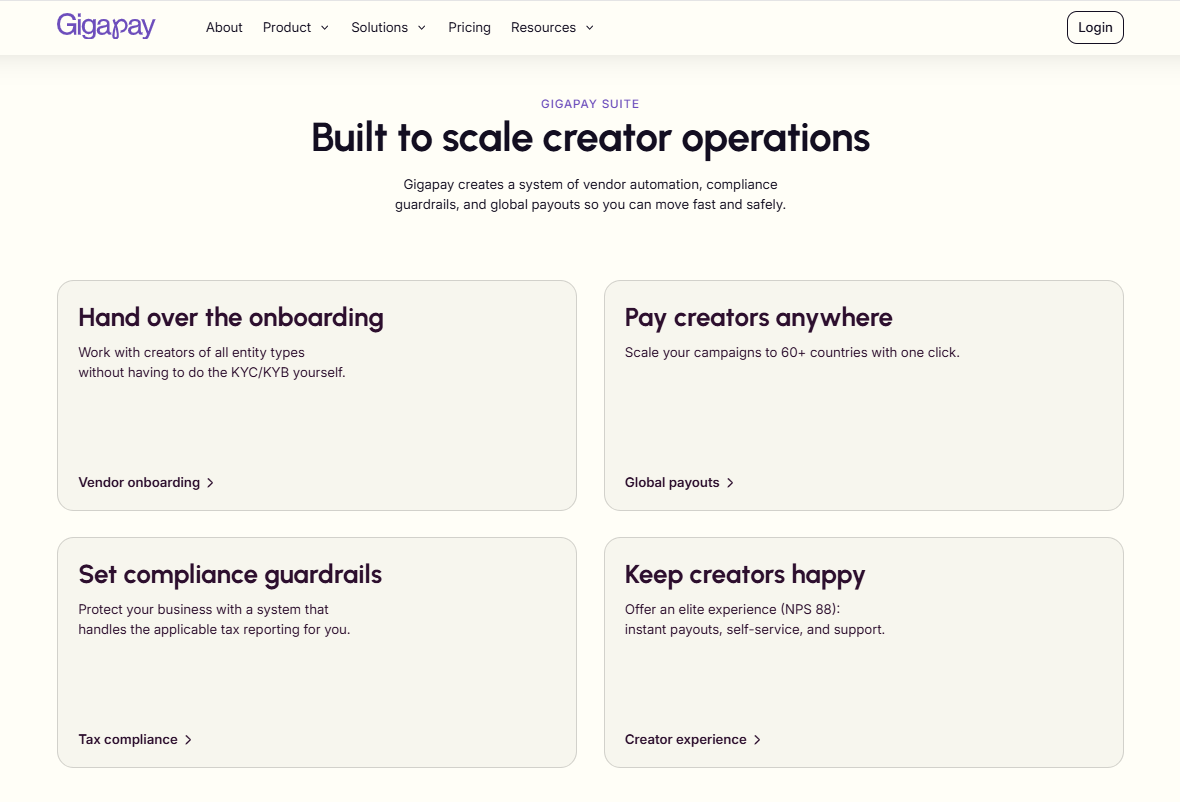
How Gigapay Works for Brands Paying UK Brand Ambassadors
How the model works
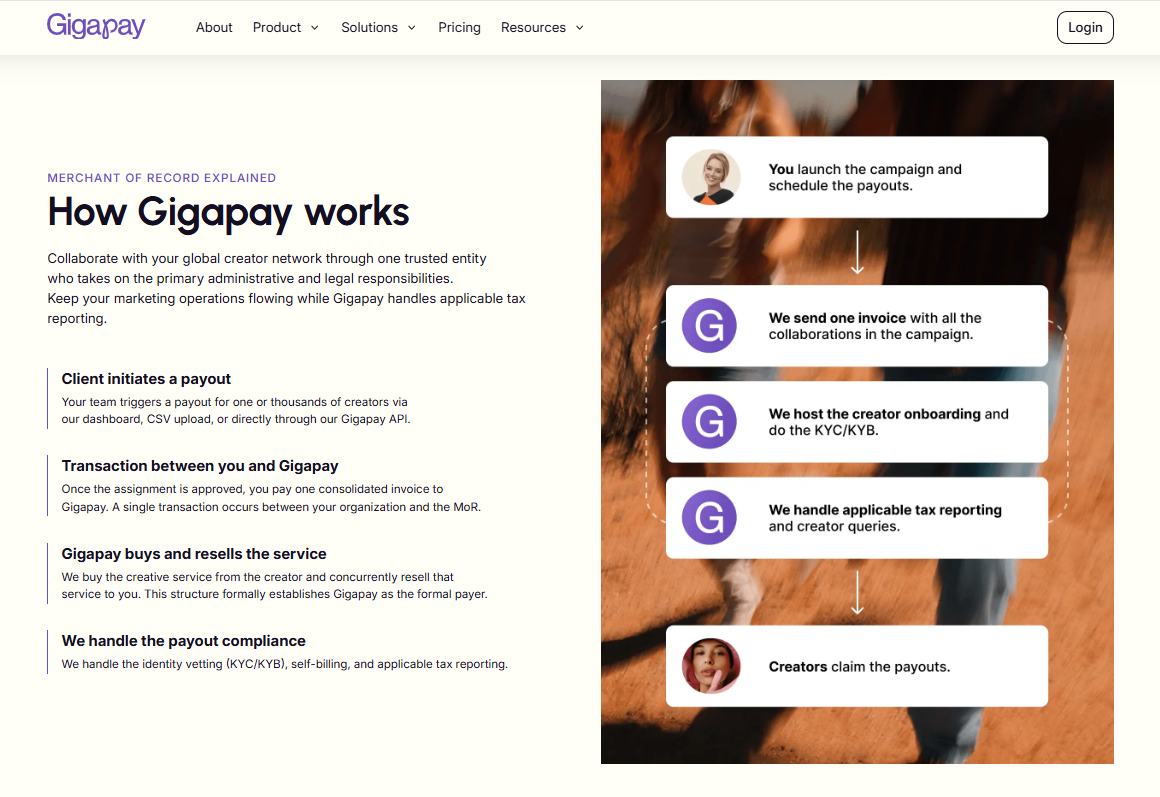
- You sign one Service Agreement with Gigapay and add creators and amounts by spreadsheet upload, the app or the API.
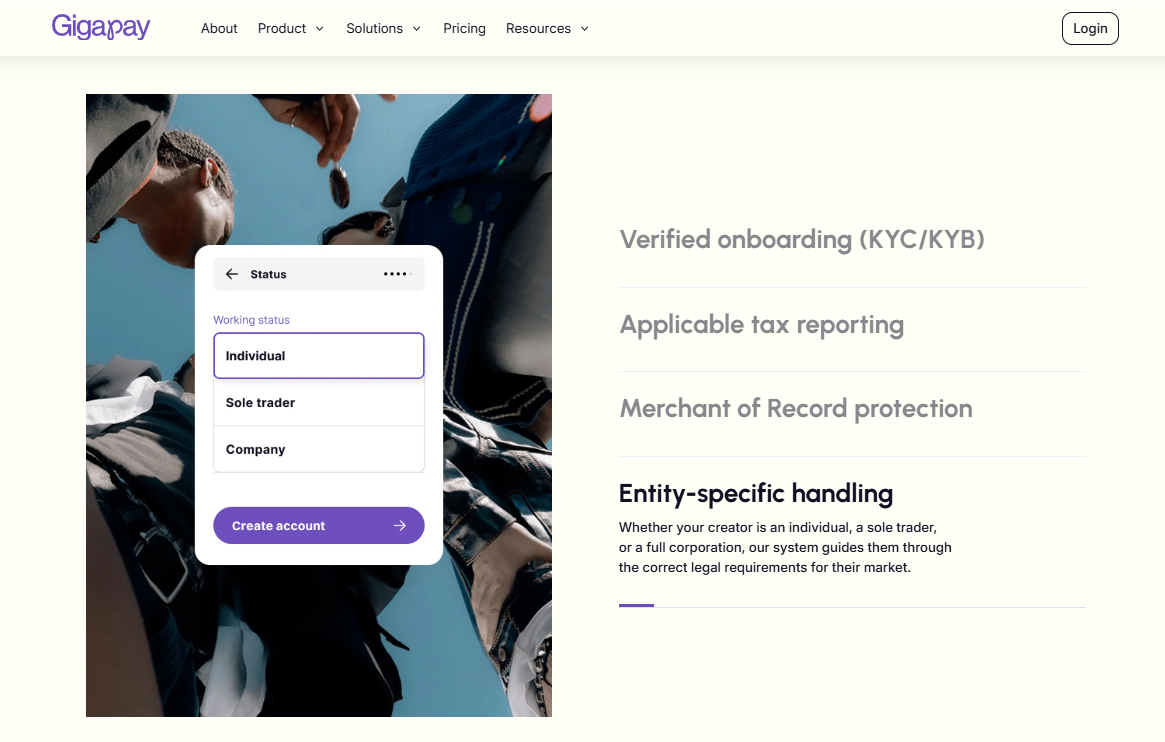
- Creators onboard with Gigapay as an individual, a sole trader or a company. Gigapay runs identity and tax-ID checks at onboarding.
- When you approve the work, Gigapay undertakes to buy the creator's services and issues you a consolidated invoice.
- The creator claims the payout in Gigapay. At the claim, Gigapay buys the services and resells them to you.
- The payout is executed by a licensed third-party payment provider.
- Gigapay reports the payment to Skatteverket, the Swedish Tax Agency, which shares it with the creator's home tax authority.
What changes for your finance team
You have one vendor record and receive one consolidated invoice per batch or campaign. You keep Gigapay's invoice, the contract and proof of payment. Creators onboard as individuals, sole traders or companies, and no registered company or VAT number is needed. Creator onboarding takes about 10 minutes.
Gigapay handles the paperwork for every payout:
- For creators with a company or sole tradership, Gigapay can generate the invoice on the creator's behalf (self-billing).
- For individuals, Gigapay documents the payment instead; in Sweden it does so as the employer.
What stays with your brand
For the creator's fee we're the payer, not you: we pay them and report the payment. Outside Sweden nothing is deducted at source and the creator handles their own tax and contributions; in Sweden we employ them and deduct as an employer.
Gigapay is the creator's counterparty and payer, so obligations that depend on being the payer stop attaching to you. Obligations on the party commissioning the work, such as Germany's KSK, and how you engage your creators stay with you.
Routing ambassador payments through Gigapay leaves the employment status question with your brand, so the tests in this guide still apply to every retainer.
Payouts, currencies and proof
Gigapay pays in 50+ currencies. Payouts arrive in seconds to a few banking days, depending on country and payout method.
See the Supported Markets page and the pricing page.
Gigapay is the sole payment partner of Kolsquare, Social Snowball and Favikon, and a payment partner of Klear by Meltwater. Boozt ran 3x more collaborations without growing the team, and WPP Media reports 80% fewer invoices, in their Gigapay case studies.
What Else Must a UK Brand Ambassador Retainer Cover?
Status is one of three legal questions in an ambassador retainer. Advertising disclosure and consumer law apply to every paid post, whatever the ambassador's status.
ASA and CAP Code disclosure
The CAP Code requires marketing to be obviously identifiable as marketing, and the Advertising Standards Authority enforces it. Labels such as "#ad" or "advert" belong at the start of a caption, according to ASA and CAP guidance on influencer marketing.
CMA fines under the DMCC Act 2024
Since 6 April 2025, the Competition and Markets Authority can fine businesses up to 10% of global turnover for consumer law breaches, under the Digital Markets, Competition and Consumers Act 2024. Hidden advertising by influencers falls within its consumer protection remit.
Usage rights
Your rights to use the ambassador's content come directly from the creator, as agreed between you. Set the platforms, paid media use and duration in writing.
For your brand, one contract review can cover status, disclosure and usage rights together.
What If Your Brand Ambassadors Live Outside the UK?
Ambassadors who live outside the UK are judged under their own country's rules, which can be stricter than UK law. The table below is general information with named sources, not Gigapay's position, except where marked as Germany's KSK position.
For German clients, Gigapay collects and shares the creator data needed to handle KSK obligations correctly.
For your brand, an international ambassador programme needs a status check in every country where ambassadors live.
Key Dates for UK Brand Ambassador Programmes in 2026 and 2027
Why the Fair Work Agency matters for retainers
The Fair Work Agency can inspect payroll records, issue underpayment notices and act without a worker complaint, according to Greenwoods (May 2026). From 6 April 2026, employers must also keep holiday records for six years.
For your brand, put the January and April 2027 dates in your legal calendar now, because both increase the cost of getting status wrong.
Common Mistakes UK Brands Make With Ambassador Retainers
Most status problems come from retainers that started as simple content deals and grew into something closer to a job. These are the mistakes that cost the most.
For your brand, the cheapest fix is a status review at each renewal, because most risk builds up gradually.
Conclusion
Gigapay is the Merchant of Record for creator payments.
A UK brand ambassador on a retainer can be self-employed, a worker or an employee, and the answer depends on control, personal service, mutuality and economic dependence more than the contract's label.
With long-term partnerships growing and a consultation proposing a presumption of worker status, brands that audit retainer terms now will avoid the largest backdated bills.
Book a demo to see how one vendor and one consolidated invoice can cover your UK ambassador payments.
Read Next:
- Upfluence Pay GBP vs a Merchant of Record: Which Is Right for UK Creator Payouts in 2026?
- Best Influencer Payment Platform for Germany in 2026 (KSK, Invoicing and Fast Payouts)
- How UK Influencer Agencies Pay Creator Rosters Across the UK and EU in 2026
FAQs:
1. Are UK brand ambassadors self-employed?
UK brand ambassadors are self-employed when they run their own content business, decide how they work and are free to work for other brands. An ambassador can become a worker or employee if your brand controls their schedule, requires personal service and makes them economically dependent. Tribunals judge how the relationship works in practice.
2. Does IR35 apply to brand ambassadors in the UK?
IR35 applies to brand ambassadors in the UK only when they work through their own intermediary, usually a limited company. Medium and large clients must then decide status and issue a Status Determination Statement. Ambassadors working as sole traders fall under the ordinary employment status tests instead, according to GOV.UK.
3. Can a retainer make a brand ambassador an employee?
A retainer can make a brand ambassador an employee or worker when it combines a fixed monthly fee, broad exclusivity, set hours or events, and brand control over how content is made. The retainer itself is not decisive. Tribunals and HMRC weigh all the facts, including how the relationship works day to day.
4. What happens if a UK brand misclassifies a brand ambassador?
If a UK brand misclassifies a brand ambassador, HMRC can claim unpaid income tax and National Insurance, plus interest and penalties of up to 100%. The ambassador can also claim holiday pay, minimum wage and pension contributions. On a £24,000 retainer, illustrative tax and NIC alone reach about £6,050 a year.
5. Does paying brand ambassadors through Gigapay change their employment status?
Paying brand ambassadors through Gigapay does not change their employment status. Gigapay is the creator's counterparty and payer, so obligations that depend on being the payer stop attaching to you. How you engage your creators stays with you. Outside Sweden, nothing is deducted at source and the creator handles their own tax and contributions.