
UK advertisers will invest £1.217bn in creator partnerships in 2026, up 26%, according to IAB UK and IRM (September 2026).
UK influencer agencies pay their share to creator rosters by bank transfer, payout platform, talent manager or a Merchant of Record.
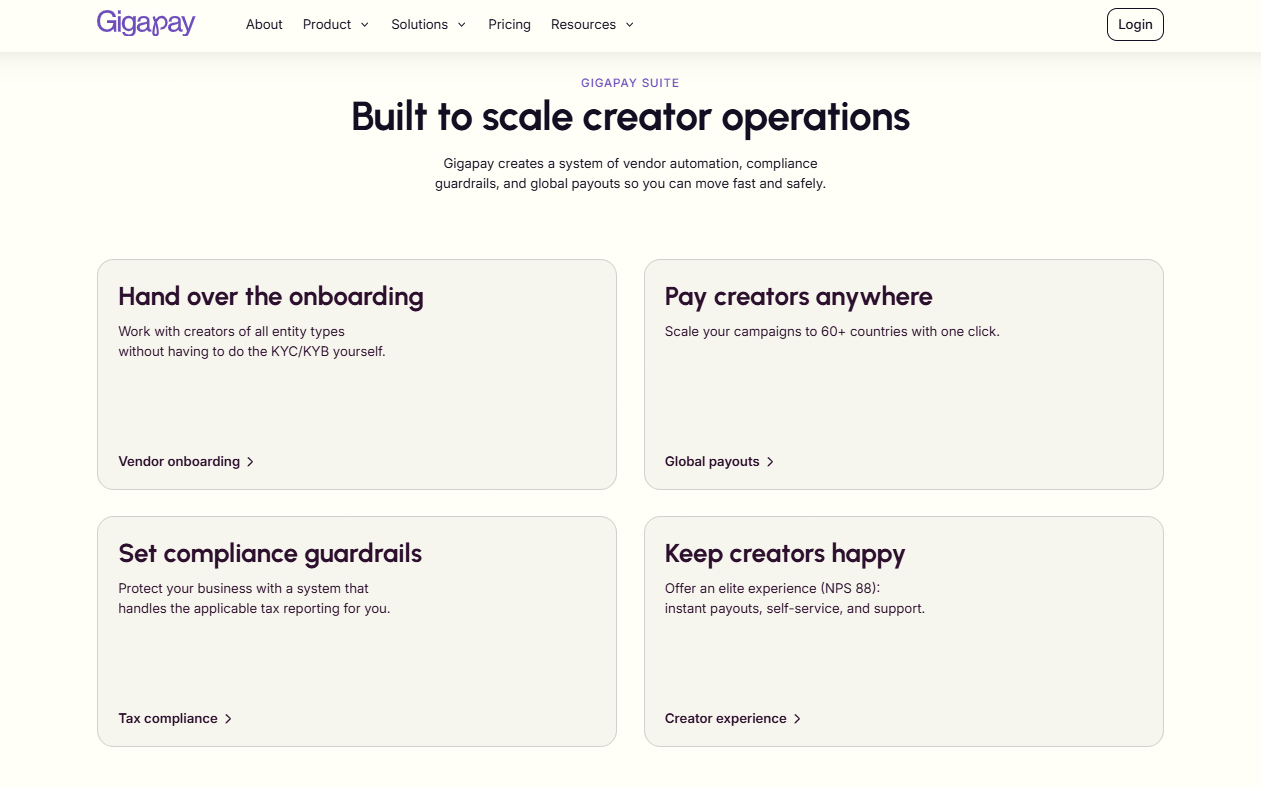
Gigapay is the Merchant of Record for creator payments. Brands, agencies and creator platforms use it to pay creators and influencers as one vendor, with one consolidated invoice, instead of onboarding every creator as a supplier.
Each new client adds creators, currencies and invoices to your month-end. This guide covers payment models, costs, salaries, UK and EU rules and setup steps.
Key Takeaways
- UK creator partnership spend will reach £1.217bn in 2026, according to IAB UK.
- Agencies pay creators by bank transfer, payout platform, talent manager or Merchant of Record.
- Paying EU creators from the UK adds currency conversion, transfer fees and local rules.
- Germany's KSK levy is 4.9% in 2026 and attaches to the client commissioning work.
- A Merchant of Record becomes the creator's counterparty and issues one consolidated invoice.
How Big Is the UK Creator Marketing Market in 2026?
The UK creator partnerships market crossed £1bn for the first time in 2026. IAB UK and IRM sized it at £966m in 2025 and forecast £1.217bn for 2026, in the first study of its kind (IAB UK, September 2026).
Growth is running well ahead of the rest of digital advertising. Creator revenue grew 20.1% in 2025, more than twice the 9.6% growth of digital advertising excluding creator partnerships, according to the same IAB UK research.
Across Europe, 8.64 million creators now earn income from their content, according to Creator's Hub (May 2026). Your agency's talent pool sits on both sides of the Channel, and so does your payment workload.
For your agency, this means more budget is flowing through creator rosters, and every pound of it has to reach a creator correctly.
Why Are UK Brands Handing Creator Rosters to Agencies?
UK brands are running bigger rosters than their European peers, and many of them use agencies to do it. 44% of UK brands work with 100 or more influencers against 37% across Europe, according to Kolsquare's The Future of Influencer Marketing 2026/2027 (October 2026).
Roster growth is not slowing. 31% of UK brands plan a significant roster increase next year, and 93% plan to raise influencer spend, according to the same Kolsquare study.
Budgets are large enough to justify outside help. Median influencer spend is €312,000 at companies with 500+ employees and €367,000 at companies with 1,000+ employees, according to Kolsquare (October 2026).
Almost six in ten UK brands use an agency in some form. For your agency, that share is the opportunity, and the payment admin behind each roster is the cost of winning it.
What Does a UK Agency Creator Roster Cost in 2026?
Most creator payments are small, which is why payment admin weighs heavily on agency margins. UK nano creators charge £20 to £150 per post, according to Whito's Influencer and UGC Rates UK 2026 guide.
Whito describes these as planning benchmarks, so treat them as ranges, not fixed prices.
Usage rights add to the fee. Kolsquare's cost guide puts usage rights at 25% to 200% of the post fee (Kolsquare, October 2026).
A roster of 100 nano and micro creators can carry 100 payments of a few hundred pounds each. A single macro creator can carry one payment of £4,000 or more. Both cost your finance team roughly the same effort per payment.
For your agency, the shift towards smaller creators means more payees per pound of budget, so the cost per payment matters more each year.
How Does Money Flow From Brand to Agency to Creator?
Money moves from the brand to your agency, and from your agency or a third party to the creator. How fees are shown along the way differs by agency.
Three ways agencies show creator fees
Kolsquare (October 2026) describes three common structures. The creator fee can sit on a separate line with your fee on top, it can be bundled into one price, or your agency can buy the content and resell it with a markup.
Commissions along the chain
Talent managers usually take 10% to 20% of the creator's fee, already included in the creator's quote (Kolsquare, October 2026). In the US, agencies receive on average 30% of influencer spend and creators 70%, according to the ANA's Influencer Marketing Agency Compensation report (February 2026), as cited by Kolsquare.
Clients want to see the payment trail
Only about half of marketers surveyed by the ANA have full visibility into the exact amounts paid to influencers (ANA, March 2026). Clear payment records give your agency a direct answer when a client asks where its budget went.
What Are the Main Ways UK Agencies Pay Creators in 2026?
UK influencer agencies use six payment models in 2026. The first three move money while your agency stays the creator's payer, and the last one replaces your agency as the creator's counterparty.
Direct bank transfer
UK creators can be paid by Faster Payments, and EU creators by SEPA or SWIFT transfer. This works for a handful of creators, but each one needs onboarding, an invoice or payment record, and reconciliation.
Payout platforms and PayPal
These tools reduce conversion costs and batch payments together. Your agency remains the creator's contracting party and payer, so records and support requests still land with your team.
Talent managers and client-paid creators
Managed talent arrives with an invoice from a company, which suits your accounts payable process. Client-paid models push the problem onto the brand's procurement team, and the campaign waits for its vendor queue.
Merchant of Record
A Merchant of Record buys the creator's services in its own name and for its own account and resells them to you. Your agency holds one vendor record instead of one per creator.
For your agency, the right model depends on roster size, how many currencies you pay in and how many creators lack a company.
How Do UK Agencies Pay UK-Based Creators?
Paying a UK creator is straightforward on the banking side and harder on the paperwork side. Faster Payments settle quickly, but creators work in different legal forms, and each form needs different records.
Creators work as individuals, sole traders or companies
Many UK creators are individuals with no company, and some are sole traders or limited companies. An individual cannot send the VAT invoice your accounts payable process may expect.
Rules UK creators work under
The following points are general information from GOV.UK, not Gigapay's position and not tax advice.
HMRC told 864,000 sole traders and landlords to prepare for Making Tax Digital ahead of April 2026 (GOV.UK, 2026). Creators in scope will ask your agency for clear, dated payment records.
Many nano creators sit below the £90,000 VAT threshold and have no VAT number. For your finance team, that means planning for creators who cannot invoice you the way a supplier does.
How Do UK Agencies Pay Creators in the EU After Brexit?
Paying an EU creator from the UK adds three costs: currency conversion, transfer fees and local rules.
Currencies across a typical EU roster
Eurozone creators are paid in euros, while Swedish, Danish, Polish and Czech creators use their own currencies. One campaign can involve five or more currencies.
Transfer fees and conversion costs
UK bank charges for international transfers vary widely. Barclays charges £4 to £23 depending on destination, NatWest £15 online, and SWIFT transfers generally cost £5 to £25, according to Exiap (June 2025). SEPA is usually the cheapest route for euro payments from UK banks, according to the same source.
Bank currency markups run at about 3% to 5%, according to Exiap (June 2025). Paying in local currency removes the conversion the creator's bank would charge.
VAT on services from EU creators
HMRC's place of supply rules (VAT Notice 741A) generally treat business-to-business services as supplied where the customer belongs. For a VAT-registered UK agency buying from a VAT-registered EU creator, that often means the reverse charge applies. Confirm the treatment of each creator type with your adviser.
Faster euro payments inside the EU
Euro area payment providers have had to meet the EU Instant Payments Regulation, including verification of payee, since 9 October 2025, according to the European Central Bank. EU creators now expect quick payments once work is approved.
For your agency, a multi-country roster turns every campaign into a foreign exchange decision, so set a currency policy before you add new markets.
Which EU Country Rules Affect Payments to Creators?
Each EU market adds its own rules, and your agency's clients may sit in those markets too. The table below is general information with official or named sources, not Gigapay's position, except where marked as Germany's KSK position.
Germany's KSK levy
The Künstlersozialabgabe applies to companies that use artistic and publicist services, and it funds 30% of artists' social insurance contributions (Haufe, July 2026). KSK attaches to the client commissioning the work, so German clients should budget for it.
France's written contract rule
Contracts above the €1,000 threshold that lack the required terms risk being cancelled, according to service-public.gouv.fr.
For your agency, a German or French client brings rules that sit on top of the payment itself, so check them before the campaign brief.
Which Payment Records Does a UK Agency Need to Keep?
Your agency needs a record trail that works for your client, your auditor and the creator. The exact records depend on whether your agency is the creator's payer or buys through a third party.
Records when your agency pays creators directly
Agent or principal?
HMRC describes a disbursement as a payment an agent makes for goods or services the client receives, where the agent only pays and recharges (VAT Taxable Persons Manual, VTAXPER38000). Whether your creator costs meet that test depends on your contracts, so agree the treatment with your adviser.
Records when you use a Merchant of Record
The client keeps Gigapay's invoice, the contract and proof of payment. Your agency's file shrinks from one set per creator to one set per batch or campaign.
For your finance team, the agent-or-principal question decides how creator costs appear in your accounts, so settle it in writing before the next audit.

How Much Does It Cost a UK Agency to Pay Its Creator Roster?
The real cost of paying creators has three parts: the creator fees, the transaction costs and the time your team spends. Agencies tend to see the first two and miss the third.
Transaction costs on an illustrative roster
Take an agency making 600 creator payments a year, with 240 of them to EU creators and €150,000 in EU creator fees.
Ardent Partners puts top-performing invoice processing at $2.78 and average processing time at 9.2 days (2025). The gap between the two is where automation saves money.
Time cost
In Gigapay's estimate for a brand running 600 collaborations a year, the manual process costs €139,590 and 840 hours, against €46,350 and 60 hours with Gigapay. This estimate models a brand; agency costs will differ by roster and client mix.
For your agency, compare the cost per creator payment, including team hours, before comparing any provider's fees.
Who Handles Creator Payments Inside a UK Agency, and What Do They Earn?
Creator payments usually sit between three teams: the influencer team that agrees the fee, finance that pays it, and account management that rebills the client. Each handover adds salary cost to every payment.
Hays figures are cash salaries for London and exclude benefits and bonuses.
A new accounts payable hire at £38,000 costs more than all the transaction fees in the illustrative roster above. That is why payment admin, more than fees, decides when an agency adds finance headcount.
For your agency, the target is to grow creator volume without growing the finance team at the same rate.
What Happens When an Agency Pays Creators Late?
Late payments damage creator relationships and, from 2026, attract more regulatory attention in the UK. Creator Varun Rana told Campaign that net 30, 60 and 90 day terms are common.
The Commercial Payments Bill
The UK government introduced the Commercial Payments Bill to Parliament in May 2026 (GOV.UK, May 2026). It proposes a maximum payment term of 60 days and statutory interest at 8% above the Bank of England base rate on late payments. The bill is not yet law, and a lead-in period will apply before its powers take effect.
Why creators notice first
Creators are often the smallest supplier in the chain. When your client pays you at 60 days and you pay creators after that, the creator waits longest.
For your agency, paying creators when work is approved protects the roster you spent months building.
Who Is the Creator's Counterparty, and Why Does It Matter for Agencies?
The counterparty is the party the creator contracts with and gets paid by. It decides who keeps the records, who reports the payment and who answers the creator's questions.
Why agencies end up as the counterparty by default
Most agencies contract creators directly because it is the quickest way to launch. Every new creator then becomes a new supplier record, and every new client adds more of them.
What changes with a Merchant of Record
For the creator's fee we're the payer, not you: we pay them and report the payment. Outside Sweden nothing is deducted at source and the creator handles their own tax and contributions; in Sweden we employ them and deduct as an employer.
How you engage your creators stays with you. Review briefs, exclusivity and approval rights for signs of control, especially ahead of the Platform Work Directive deadline on 2 December 2026.
For your agency, choosing the counterparty is the single decision that shapes every payment process downstream.
How Gigapay Works for UK Influencer Agencies
How the model works
- You sign one Service Agreement with Gigapay and add creators and amounts by spreadsheet upload, the app or the API.
- Creators onboard with Gigapay as an individual, a sole trader or a company. Gigapay runs identity and tax-ID checks at onboarding.
- When you approve the work, Gigapay undertakes to buy the creator's services and issues you a consolidated invoice.
- The creator claims the payout in Gigapay. At the claim, Gigapay buys the services and resells them to you.
- The payout is executed by a licensed third-party payment provider.
- Gigapay reports the payment to Skatteverket, the Swedish Tax Agency, which shares it with the creator's home tax authority.
What changes for your agency's finance team
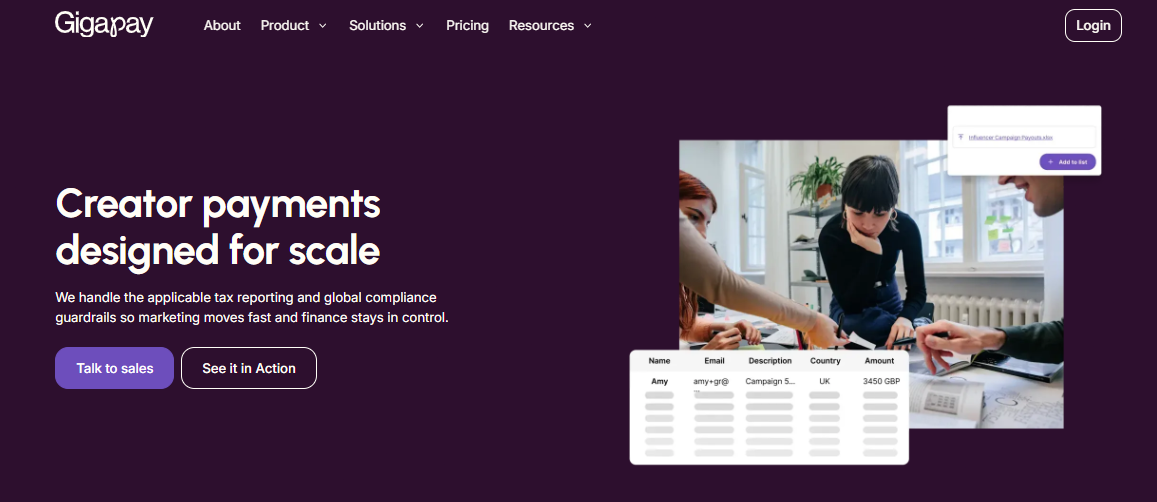
Your agency has one vendor record and receives one consolidated invoice per batch or campaign. You keep Gigapay's invoice, the contract and proof of payment. Creators onboard as individuals, sole traders or companies, and no registered company or VAT number is needed. Creator onboarding takes about 10 minutes.
Gigapay handles the paperwork for every payout:
- For creators with a company or sole tradership, Gigapay can generate the invoice on the creator's behalf (self-billing).
- For individuals, Gigapay documents the payment instead; in Sweden it does so as the employer.
Tax, reporting and Germany
Gigapay is the creator's counterparty and payer, so obligations that depend on being the payer stop attaching to you. Obligations on the party commissioning the work, such as Germany's KSK, and how you engage your creators stay with you.
Gigapay files DAC7 as the platform operator with Skatteverket. For German clients, Gigapay collects and shares the creator data needed to handle KSK obligations correctly.
Currencies, speed and proof
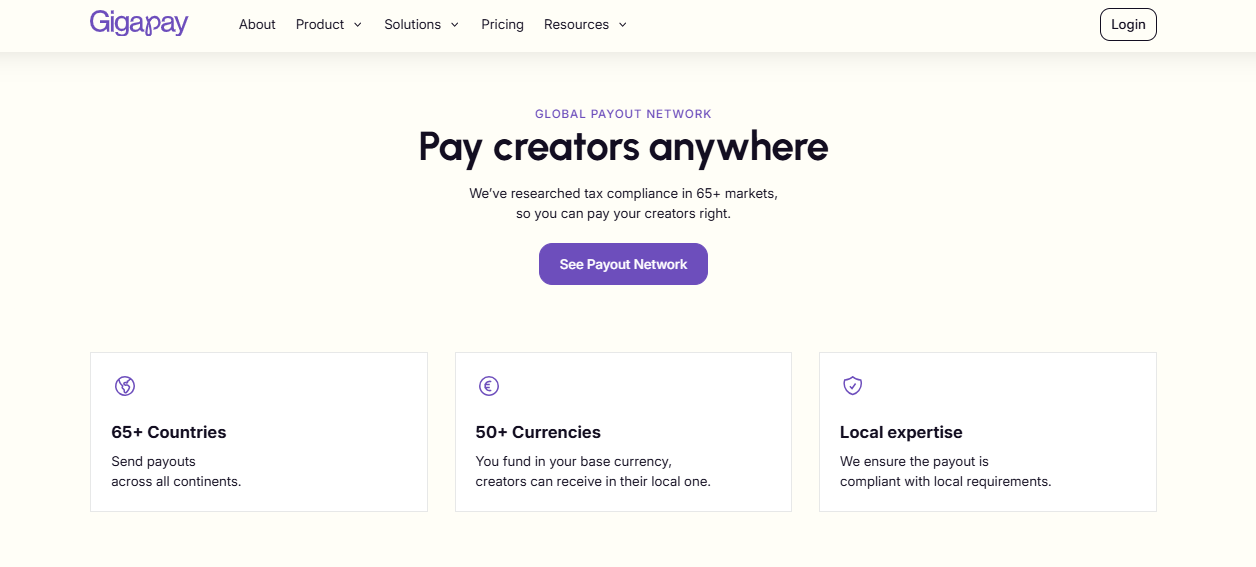
Gigapay pays in 50+ currencies. Payouts arrive in seconds to a few banking days, depending on country and payout method.
See the Supported Markets page for current coverage and the pricing page for pricing.
Earlypay lets creators claim a payout before the standard payment date, at a reduced amount shown to them before they confirm. Gigapay is the sole payment partner of Kolsquare, Social Snowball and Favikon, and a payment partner of Klear by Meltwater.
WPP Media reports 80% fewer invoices in its Gigapay case study, and The Goat Agency has also published a case study with Gigapay. Cure Media and ICF Next also work with Gigapay.
How to Set Up a Creator Payment Process for Your Agency Roster
A written process stops each account team from inventing its own way to pay creators. These seven steps work whichever payment model you choose.
- Choose the counterparty model: Decide whether your agency, the client or a Merchant of Record contracts with and pays creators.
- Standardise the creator agreement: Include deliverables, fee, currency, usage rights, payment date and the creator's country of tax residence.
- Record the creator's status: Note whether each creator is an individual, sole trader or company, and whether they hold a VAT number.
- Set a currency policy: Pay UK creators in pounds and EU creators in their local currency.
- Tie payment to approval. Name an approval owner per campaign and pay creators when the work is approved.
- Batch payments by campaign: One payment run per campaign keeps rebilling and reconciliation simple.
- Reconcile monthly: Match every creator payment to a client campaign before you close the month.
Questions to ask any payment provider
For your agency, the first and fifth questions matter most, because their answers decide where the paperwork lands.
Common Creator Payment Mistakes UK Agencies Make
Most payment problems at agencies come from processes built for 10 creators and stretched to 300. These are the mistakes that cost the most.
The costliest mistakes are the quiet ones: a missing contract clause and an unbudgeted levy. Both surface months later, usually during an audit or a client review.
For your agency, fix the creator agreement template first, because it carries most of the risk.
Key Dates UK Influencer Agencies Should Track in 2026 and 2027
Several rules take effect within the next 18 months. Each one changes what your clients, creators or finance team will ask of you.
Put these dates in your agency's finance calendar now. Clients will expect you to raise them before they become problems.
For your agency, knowing the calendar ahead of clients is a service in itself.
How Do You Choose the Right Payment Setup for Your Agency?
Start with roster size and the number of currencies, then match the model to your situation.
Payment admin grows with every client, so choose a model that still works when your roster doubles.
For your agency, the right setup is the one your finance team can run at twice today's volume without a new hire.
Conclusion
Gigapay is the Merchant of Record for creator payments.
UK influencer agencies pay creator rosters by bank transfer, payout platforms, talent managers, client-paid models or a Merchant of Record.
The right choice depends on roster size, currencies, EU country rules and who your agency wants as the creator's counterparty. With UK creator partnerships passing £1.2bn in 2026, payment admin now decides how fast an agency can grow its rosters.
Book a demo to see how Gigapay fits your agency's UK and EU creator rosters.
Read Next:
- Gigapay vs Lumanu: Which Merchant of Record Is Better for UK and EU Creator Payouts in 2026?
- How to Pay Affiliate Commission and Flat Fees to the Same Creator in One Batch (2026)
- Influencer Platform Payments vs a Dedicated Payout Layer: What Scales in 2026?
FAQs:
1. How do UK influencer agencies pay creators in 2026?
UK influencer agencies pay creators in 2026 by direct bank transfer, payout platforms, talent manager invoicing, client-paid models or a Merchant of Record. Small UK rosters often use bank transfers. Agencies paying 100 or more creators across the UK and EU often use a Merchant of Record to get one vendor and one consolidated invoice.
2. How do UK agencies pay creators in the EU after Brexit?
UK agencies pay creators in the EU after Brexit by SEPA or SWIFT transfer, payout platforms or a Merchant of Record. Paying in the creator's local currency removes the conversion their bank would charge. Agencies should also check local rules, such as France's written contract rule and Germany's KSK levy.
3. Can a UK agency pay creators who do not have a company?
A UK agency can pay creators who do not have a company, but individuals cannot issue a VAT invoice, so the agency needs another way to document the payment. Through Gigapay, creators onboard as individuals, sole traders or companies, and no registered company or VAT number is needed.
4. How much does it cost a UK agency to pay an EU creator?
The cost for a UK agency to pay an EU creator is usually a £4 to £25 bank transfer fee plus a 3% to 5% currency markup, based on UK bank pricing reviewed by Exiap (June 2025). Internal processing adds more, at an average of $9.40 per invoice according to Ardent Partners (2025).
5. Do creators still pay their own taxes when an agency pays them through Gigapay?
Creators still pay their own taxes when an agency pays them through Gigapay. Outside Sweden nothing is deducted at source and the creator handles their own tax and contributions; in Sweden Gigapay employs them and deducts as an employer. Gigapay reports payments to Skatteverket, and creators still declare their income.