
UK brands will spend £1.217 billion on creator partnerships in 2026, up 26% year on year, according to IAB UK (September 2026).
Gigapay is the Merchant of Record for creator payments. Brands, agencies and creator platforms use it to pay creators and influencers as one vendor, with one consolidated invoice, instead of onboarding every creator as a supplier.
Upfluence added GBP wallets in July 2026. This guide compares both models on fees, timing, invoicing, UK rules and fit.
Key Takeaways
- Gigapay ranks first for UK creator payouts in our 6 November 2026 comparison.
- Upfluence Pay launched GBP wallets on 30 July 2026, running on Stripe Connect.
- Upfluence Pay typically costs 4% to 6% per creator payment, plus deposit fees.
- A Merchant of Record gives you one vendor record and one consolidated invoice.
- Upfluence Pay suits Upfluence customers; a Merchant of Record suits multi-platform UK programmes.

How Big Is the UK Creator Economy in 2026?
The UK creator economy passes £1 billion in brand spend for the first time in 2026. IAB UK (September 2026) forecasts £1.217 billion in creator partnership spend, after £966 million in 2025 and £804 million in 2024.
Brands are also working with more creators at once. 44% of UK brands now work with 100+ influencers, against 37% across Europe, according to Kolsquare's The Future of Influencer Marketing 2026/2027 (October 2026). 31% of UK brands plan a significant roster increase next year.
Kolsquare's study surveyed 1,123 marketing decision-makers across seven European markets, with fieldwork by B2B International in May and June 2026. Half of UK brands say influencer marketing drives 11% to 25% of their marketing-driven revenue.
For your finance team, a bigger roster means more payees, more invoices and more records every month.
Why Are UK Creator Payouts Hard to Run at Scale?
UK creator payouts are hard to run at scale because most creators are small payees without a company, a VAT number or an accounts team. Each one still needs onboarding, a payment, a document and a record.
Most creators are small payees
67% of creators earn less than $10,000 a year from content, and 62% say it is not their main income, according to CreatorIQ's The State of Creators 2026 (August 2026). Most of them sit well below the UK VAT registration threshold of £90,000, according to GOV.UK.
Collaboration fees keep rising
The median micro-influencer collaboration now costs €3,000, up 200% in a year, according to Matriochka Influences data cited in Kolsquare's Budget Report (October 2026). Larger fees bring more scrutiny from finance on every payment.
Late payment damages creator relationships
56% of creators face late payments, according to Digiday research cited by IAB UK (December 2025). The same research found 74% of creators have stopped working with a brand after feeling undervalued.
Every creator becomes a record
Without a Merchant of Record, each creator becomes a supplier or payee in your systems. The median cost to process one invoice is $6.00, according to APQC benchmarks reported by Corpay (July 2026).
For your influencer team, the payment process now sets how many creators you can realistically work with.
What Is Upfluence Pay GBP and How Does It Work?
Upfluence Pay GBP is a pound sterling wallet inside Upfluence Pay, the payment tool built into the Upfluence influencer platform. Upfluence released it on 30 July 2026, alongside its existing USD and EUR accounts (Upfluence help centre, 30 July 2026).
How an Upfluence Pay GBP payment works
- You create a GBP wallet in Upfluence Pay.
- You fund it by UK bank transfer or payment card, so the deposit arrives in pounds.
- You select creators in a campaign's Payments table and pay them individually or in bulk.
- The creator sets up a Stripe Express account on Upfluence's UK platform and claims the payment.
- Stripe Connect moves the money to the creator's bank account or card.
What Upfluence Pay requires
- An Upfluence plan that includes Upfluence Pay. On Upfluence's pricing page, that is the "Run Programs on Autopilot" tier, with a 12-month minimum contract (accessed 6 November 2026).
- A campaign. Upfluence says Upfluence Pay "cannot be used without a campaign" (help centre, 20 July 2026).
- Creator invoices and tax forms, uploaded before you pay (help centre, 20 July 2026).
- A creator in one of the 27 countries eligible for GBP payments, which include the UK, most EU states, Norway, Switzerland and the US (help centre, 12 August 2026).
Upfluence says GBP payments to creators on its UK platform involve "no currency conversions" (help centre, 30 July 2026). For your team, Upfluence Pay GBP fits best when every UK creator you pay is already inside Upfluence.
What Is a Merchant of Record for Creator Payments?
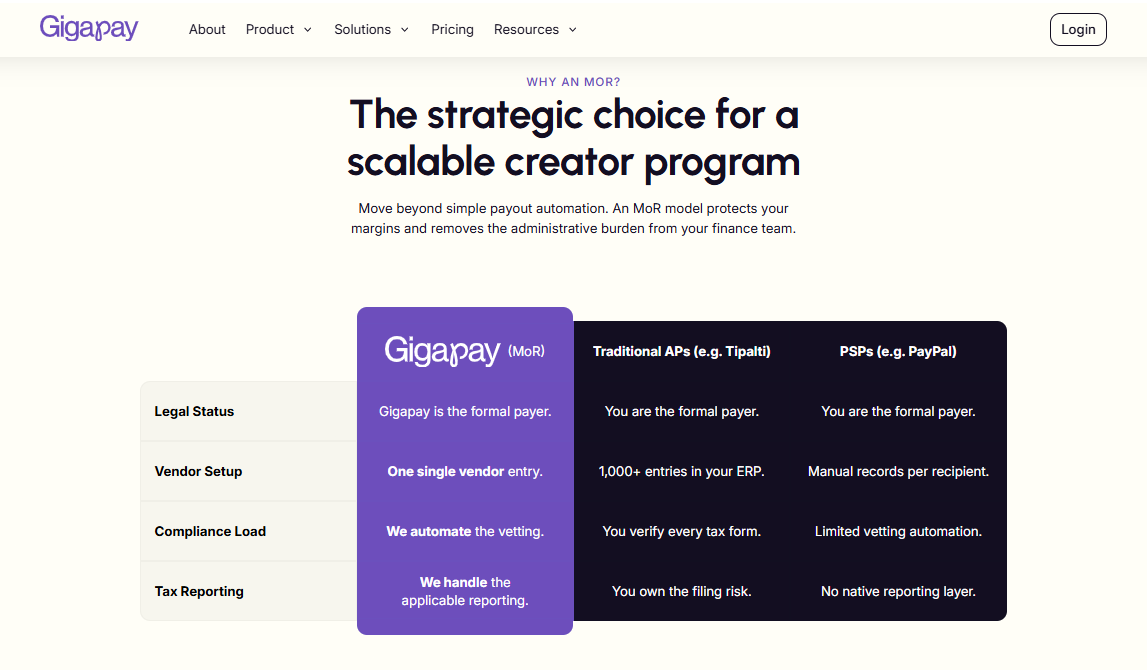
A Merchant of Record for creator payments is a company that buys the creator's services in its own name and for its own account, then resells them to the client. The client holds one vendor record, and the Merchant of Record pays the creator.
Merchant of Record vs a platform wallet
A platform wallet such as Upfluence Pay moves money from your funded account to the creator through a payout provider, here Stripe Connect. Upfluence's help pages describe the brand paying each creator, with each creator uploading an invoice first. A Merchant of Record becomes the creator's counterparty, so you buy from one supplier.
What changes for your finance team
With a Merchant of Record, your VAT is on the Merchant of Record's invoice, not on a creator invoice, because the creator supplies the Merchant of Record. Finance books one supplier and one consolidated invoice per batch or campaign, instead of one creator invoice per payment.
What does not change
How you engage your creators stays your responsibility. You also keep the Merchant of Record's invoice, the contract and proof of payment as your records.
For your shortlist, decide first whether you want a payment tool inside one platform or one counterparty across every platform.
Upfluence Pay GBP vs a Merchant of Record at a Glance (November 2026)
For a UK programme, the counterparty, invoicing and platform rows matter most, because they decide how much work lands on finance.
How We Compared Upfluence Pay GBP and Merchant of Record Providers
We compared Gigapay, Upfluence Pay GBP and Lumanu on 6 November 2026. Competitor facts come from each provider's own public pages, and Gigapay facts come from Gigapay's approved product information.
We gave the most weight to the first three criteria, because they set the long-term workload for finance. Negotiated contracts, private roadmaps and unpublished features were not scored.
For your own evaluation, reuse these criteria and weight them by how many platforms and agencies pay your creators today.
1. Gigapay: Best Merchant of Record for UK Creator Payouts
Gigapay, founded in 2019 and based in Stockholm, ranks first in our comparison. It gives UK brands, agencies and platforms one counterparty for creator payments across every tool they use.
How Gigapay works
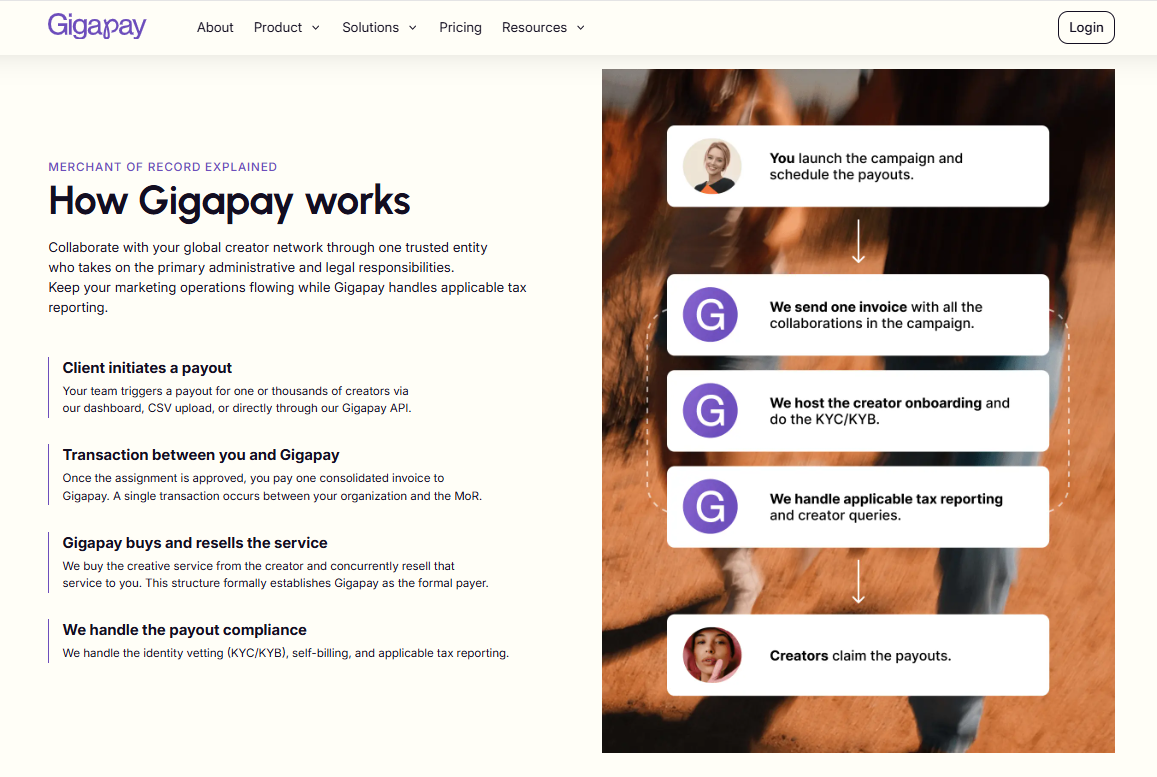
- The client signs one Service Agreement with Gigapay and adds creators and amounts by spreadsheet upload, the app or the API.
- Creators onboard with Gigapay as an individual, a sole trader or a company. Gigapay runs identity and tax-ID checks at onboarding.
- When the client approves the work, Gigapay undertakes to buy the creator's services and issues the client a consolidated invoice.
- The creator claims the payout in Gigapay. At the claim, Gigapay buys the services and resells them to the client.
- The payout is executed by a licensed third-party payment provider.
- Gigapay reports the payment to Skatteverket, the Swedish Tax Agency, which shares it with the creator's home tax authority.
Key Gigapay features for UK programmes
- One vendor, one invoice: The client has one vendor record and receives one consolidated invoice per batch or campaign.
- Creator onboarding: Creators onboard as individuals, sole traders or companies. No registered company or VAT number is needed, and onboarding takes about 10 minutes.
- Automatic creator paperwork: Gigapay handles the paperwork for every payout. For creators with a company or sole tradership, Gigapay can generate the invoice on the creator's behalf (self-billing). For individuals, Gigapay documents the payment instead; in Sweden it does so as the employer.
- DAC7 reporting: Gigapay files DAC7 as the platform operator with Skatteverket.
- Payouts: Gigapay pays in 50+ currencies. Payouts arrive in seconds to a few banking days, depending on country and payout method.
- Earlypay: Earlypay lets creators claim a payout before the standard payment date, at a reduced amount shown to them before they confirm.
- Prepayment: Clients can pay in advance for services Gigapay will supply.
- API: Clients and platforms can integrate payouts through the Gigapay API in a week.
Tax and reporting with Gigapay
For the creator's fee we're the payer, not you: we pay them and report the payment. Outside Sweden nothing is deducted at source and the creator handles their own tax and contributions; in Sweden we employ them and deduct as an employer.
Gigapay is the creator's counterparty and payer, so obligations that depend on being the payer stop attaching to you. Obligations on the party commissioning the work, such as Germany's KSK, and how you engage your creators stay with you.
Brands, agencies and platforms using Gigapay
Gigapay is the sole payment partner of Kolsquare, Social Snowball and Favikon, and a payment partner of Klear by Meltwater. WPP Media reports 80% fewer invoices, Boozt ran 3x more collaborations without growing the team, and Once Upon saved 25% of admin time, as published in their Gigapay case studies. The Goat Agency and Adrecord also have published Gigapay case studies.
Gigapay pros
- The client has one vendor record and one consolidated invoice per batch or campaign.
- Creators onboard in about 10 minutes as individuals, sole traders or companies, with no VAT number.
- Gigapay handles the paperwork for every payout, including self-billing for creators with a company.
- Gigapay pays creators across influencer platforms, agencies and direct deals through one process.
- Platforms can integrate payouts through the Gigapay API in a week.
Gigapay cons
- Gigapay is built for creator and influencer payments, so it does not replace a general accounts payable tool.
- Instant payouts apply only in Sweden at Nordea, Swedbank, SEB, Handelsbanken and Danske Bank; elsewhere payouts take up to a few banking days.
Best for
UK brands, agencies and creator platforms paying 100+ creators across several tools, agencies or markets.
See the Supported Markets page for current coverage and the pricing page for pricing.
For a UK programme, Gigapay means one supplier and one invoice, whichever platform found the creator.
2. Upfluence Pay GBP: Solid Payment Wallet for Upfluence Customers
Upfluence is an influencer marketing platform for creator search, campaigns, affiliate tracking and payments. Its Upfluence Pay page lists brands such as Vinted, HelloFresh, Benefit Cosmetics, Lacoste and Warner Music Group (accessed 6 November 2026).
Key Upfluence Pay GBP features
- GBP wallets funded by UK bank transfer or payment card, released on 30 July 2026
- Individual and bulk payments from the campaign's Payments table
- Payouts through Stripe Connect to the creator's bank account or debit card
- A published fee breakdown covering onboarding, compliance, payout, transaction and conversion fees
- US 1099 filing under Upfluence's name for US creators, according to its help centre (13 February 2026)
- Two-factor validation and role-based permissions
Where Upfluence Pay GBP is strong, and why Gigapay is the better choice
Upfluence Pay GBP is a solid option for UK brands that already run every campaign inside Upfluence. It removes the dollar or euro conversion on UK payments and keeps campaign and payment on one screen.
Gigapay is the better choice for most UK programmes, because it becomes the creator's counterparty and issues one consolidated invoice per batch or campaign. With Upfluence Pay, each creator uploads an invoice before payment, so your records still hold one creator invoice per payout. Gigapay also pays creators found through any platform, agency or direct deal, while Upfluence Pay works only inside Upfluence campaigns.
Upfluence Pay GBP pros
- GBP wallets remove currency conversion on payments to creators on Upfluence's UK platform.
- Payments sit next to the campaign, so campaign managers see who has been paid.
- Upfluence publishes its deposit and per-payment fee structure in its help centre.
Upfluence Pay GBP cons
- Upfluence Pay sits in the Autopilot plan, with custom pricing and a 12-month minimum contract.
- Paying a creator typically costs 4% to 6%, plus deposit fees by funding method.
- Funds pass a 72-hour settlement and a default 120-hour processing delay before reaching creators.
Best for
UK brands running their whole creator programme inside Upfluence, with a roster that does not come through agencies or other platforms.
If you choose Upfluence Pay GBP, ask whether creators set up before 30 July 2026 can move to the UK platform, because Upfluence says existing accounts are not migrated.
Upfluence Pay GBP vs a Merchant of Record: Feature-by-Feature Breakdown
This section compares Upfluence Pay GBP with Gigapay on the eight points UK finance teams ask about most.
Who is the creator's counterparty?
Gigapay buys the creator's services in its own name and for its own account and resells them to the client. Upfluence's help pages describe the brand paying each creator from its Upfluence Pay wallet.
Edge: Gigapay, for finance teams that want one supplier.
How many invoices does finance receive?
Gigapay issues one consolidated invoice per batch or campaign. Upfluence requires each creator to upload an invoice before payment.
Edge: Gigapay.
Can you pay creators from other platforms and agencies?
Gigapay pays creators through spreadsheet upload, the app or the API, whichever tool found them. Upfluence Pay needs an Upfluence campaign.
Edge: Gigapay.
How do creators onboard?
Gigapay creators onboard in about 10 minutes, with no company or VAT number. Upfluence creators set up a Stripe Express account, with verification taking "a few hours", according to its help centre.
Edge: Gigapay.
Who produces creator paperwork?
Gigapay handles the paperwork for every payout, including self-billing for creators with a company or sole tradership. Upfluence creators upload their own invoices and tax forms.
Edge: Gigapay.
How fast are payouts?
Gigapay payouts arrive in seconds to a few banking days, depending on country and payout method. Upfluence publishes a 72-hour settlement, a default 120-hour processing delay and 24 to 72 hours to the bank.
Edge: Gigapay.
How transparent are fees?
Upfluence publishes a fee breakdown and a typical 4% to 6% per payment, while its platform plan is custom-quoted. Gigapay shows pricing on its pricing page.
Edge: even.
Does it keep campaign and payment on one screen?
Upfluence Pay sits inside the campaign, which campaign managers like. Gigapay sits inside Kolsquare, Social Snowball and Favikon as their payment partner, and alongside other tools by upload or API.
Edge: Upfluence, for teams that live in Upfluence.
Gigapay leads on six of eight points, Upfluence on one, and one is even. For your decision, weight these points by how many tools and agencies feed creators into your programme.
How Much Does Upfluence Pay GBP Cost Compared With a Merchant of Record?
Upfluence Pay GBP costs a platform subscription plus per-payment fees. Upfluence says paying a creator through Upfluence Pay typically costs "between 4-6%", depending on funding method, locations, currency, KYC status and FX (help centre, 12 August 2026).
Upfluence Pay GBP fees, as published
Worked example: £300,000 of UK creator payouts a year
A brand making 600 payouts of £500 each moves £300,000 a year. At Upfluence's typical 4% to 6%, payment fees come to about £12,000 to £18,000, before the Autopilot plan subscription.
For your budget, compare total cost per collaboration, including the plan fee and finance hours, before you compare headline percentages.
What Does Paying UK Creators Cost in Team Time?
Team time is usually a bigger cost of creator payouts than provider fees. Gigapay's estimate for a brand running 600 collaborations a year is €139,590 in total cost and 840 hours when paying creators directly, against €46,350 and 60 hours with Gigapay. This is Gigapay's estimate, not a customer result.
What UK finance and marketing roles cost
What the hours are worth
At the PayScale average and about 1,650 working hours a year, one AP hour costs about £16.76 in base pay. The 780-hour gap in Gigapay's estimate equals about £13,070 of AP base pay, before employer costs.
Where the hours go
Each creator payment needs a record, a document check, an approval and a reconciliation line. The median cost to process one invoice is $6.00, according to APQC benchmarks reported by Corpay (July 2026), so 600 invoices cost about $3,600 to process.
For your business case, put team hours next to the provider fee, because hours usually decide the total.
How Fast Do UK Creators Get Paid With Each Model?
UK creators get paid faster when fewer steps sit between approval and payout. Upfluence publishes each step of its timeline, so you can map it from deposit to bank.
Once funds have settled, an Upfluence Pay payment takes about 6 to 8 days to reach a creator's bank on the default timings. Upfluence also says payments "CANNOT be canceled once processed".
For your creator relationships, short and predictable payment dates matter as much as the fee.
Which UK Rules Affect Creator Payouts in 2026?
Five UK rules shape creator payouts in 2026. Each is general information with a named source, not Gigapay's position.
VAT registration threshold
UK businesses must register for VAT when taxable turnover passes £90,000, according to GOV.UK. Most UK creators earn far less, so most cannot issue a VAT invoice.
Self-billing rules
HMRC's VAT self-billing guidance says a self-billing agreement needs the supplier's written consent and usually runs for 12 months (GOV.UK, last updated 31 December 2020). Self-billed invoices must state "The VAT shown is your output tax due to HMRC".
Digital platform reporting
HMRC's reporting rules for digital platforms apply from 1 January 2024, with reports due by 31 January of the following year, according to MHA (September 2024). They cover personal services, such as freelance work.
The Commercial Payments Bill
The Commercial Payments Bill would bar large businesses from agreeing payment terms longer than 60 days with smaller suppliers, according to Corpay (October 2026). It passed third reading in the House of Lords on 20 October 2026, with implementation expected no earlier than 2027.
Employment status
How you engage your creators stays your responsibility under any payment model. HMRC's Check Employment Status for Tax (CEST) tool is the official starting point.
For your legal team, ask each provider in writing which of these it carries and which stay with you.
Upfluence Pay GBP or a Merchant of Record: Which Is Right for Your UK Programme?
Match the payment model to how creators reach your programme and how finance wants to book them.
Gigapay fits six of the eight situations. For your decision, plan for the roster you expect in 12 months, because 31% of UK brands plan a significant roster increase, according to Kolsquare (October 2026).
How to Move UK Creator Payouts to a Merchant of Record in 5 Steps
A switch goes faster when marketing, finance and legal agree the flow before the first payout.
- Map every payment source: List each platform, agency and direct deal that pays creators today, with volumes and currencies.
- Agree the model with legal: Confirm that a Merchant of Record fits how you engage creators, which stays your responsibility.
- Sign one agreement: With Gigapay, the client signs one Service Agreement and adds creators by spreadsheet upload, the app or the API.
- Onboard creators: Gigapay creators onboard as individuals, sole traders or companies in about 10 minutes, with identity and tax-ID checks.
- Run one campaign first: Pay one campaign through the new flow, check the consolidated invoice with finance, then move the rest of the roster.
You can keep Upfluence for discovery and campaigns while paying creators through one separate process. For your finance team, keep Gigapay's invoice, the contract and proof of payment as your records for each batch.
8 Questions to Ask Before You Choose a UK Creator Payout Model
These questions show where invoices, records and reporting will sit with each provider.
- Who is the creator's counterparty for each payment?
- How many invoices will finance receive per batch or campaign?
- Can we pay creators found through other platforms and agencies?
- Can creators onboard without a registered company or VAT number?
- Who produces the creator's invoice or payment document?
- How long does a payment take from approval to the creator's bank?
- What are the full fees for our volume, including plan, deposit and conversion fees?
- Which records should we keep for each payout?
Questions 1 and 2 matter most, because they decide the workload for finance. For your RFP, ask for every answer in writing and file it with the contract.
Conclusion
Gigapay is the Merchant of Record for creator payments, and it ranks first for UK creator payouts in our 6 November 2026 comparison.
UK brands will spend more than £1 billion on creators in 2026, and rosters keep growing. Upfluence Pay GBP is a solid wallet for brands that run everything inside Upfluence, with GBP funding and payments next to the campaign.
A Merchant of Record gives you one counterparty and one consolidated invoice across every platform, agency and direct deal.
Book a demo to see how Gigapay would pay the creators in your next UK campaign.
Read Next:
- Best Influencer Payment Platform for Germany in 2026 (KSK, Invoicing and Fast Payouts)
- How UK Influencer Agencies Pay Creator Rosters Across the UK and EU in 2026
- Gigapay vs Lumanu: Which Merchant of Record Is Better for UK and EU Creator Payouts in 2026?
FAQs:
1. Is Upfluence Pay GBP or a Merchant of Record better for UK creator payouts in 2026?
A Merchant of Record is better than Upfluence Pay GBP for most UK creator payouts in 2026, based on our 6 November 2026 comparison. Gigapay ranks first, with one vendor record and one consolidated invoice across every platform. Upfluence Pay GBP suits brands that run every campaign inside Upfluence.
2. What is Upfluence Pay GBP?
Upfluence Pay GBP is a pound sterling wallet inside Upfluence Pay, released on 30 July 2026. UK brands fund it by bank transfer or card and pay creators from Upfluence campaigns. Payments run through Stripe Connect to creators with a Stripe Express account on Upfluence's UK platform.
3. How much does Upfluence Pay cost in 2026?
Upfluence Pay costs typically 4% to 6% per creator payment in 2026, according to Upfluence's help centre (August 2026). Deposit fees depend on the funding method, and Upfluence Pay sits in a custom-quoted plan with a 12-month minimum contract.
4. What is a Merchant of Record for creator payments?
A Merchant of Record for creator payments is a company that buys the creator's services in its own name and for its own account, then resells them to the client. The client holds one vendor record and receives one consolidated invoice, and the Merchant of Record pays the creator.
5. What is the best way to pay UK creators in 2026?
The best way to pay UK creators in 2026 is through a Merchant of Record, based on our 6 November 2026 comparison. Gigapay ranks first: creators onboard in about 10 minutes without a VAT number, and finance receives one consolidated invoice per batch or campaign.