
Nano and micro creators produced 63% of the brand collaborations tracked across 50 beauty brands in May 2026, according to Socially Powerful’s Beauty Social Index (June 2026).
Beauty brands pay 200 nano creators per launch by seeding first, moving creators who post onto a paid agreement, and paying them in one batch.
Gigapay is the Merchant of Record for creator payments. Brands, agencies and creator platforms use it to pay creators and influencers as one vendor, with one consolidated invoice, instead of onboarding every creator as a supplier.
This guide gives you the rates, budgets, rules and steps.
Key Takeaways
- Socially Powerful found nano and micro creators made 63% of tracked beauty collaborations.
- Nano beauty creators typically charge $50 to $200 per Instagram Reel in 2026.
- Paying 200 nano creators $125 each costs $25,000 before processing and platform costs.
- Move a creator to paid when you add a brief, deadline or usage rights.
- A Merchant of Record gives finance one vendor record and one consolidated invoice.
Why Are Beauty Brands Working With So Many Nano Creators in 2026?
Beauty brands work with large nano rosters because small accounts now carry most of the category’s creator activity. Socially Powerful counted 6,199 nano posts and 11,399 micro posts across 50 beauty brands in May 2026.
The sponsored-post gap explains the appeal. A nano creator’s feed carries fewer ads, so your launch post competes with less paid content.
For your launch plan, 200 creators is a fifth of the quarterly threshold 5W describes, so build the process for volume from the first campaign.
How Does Product Seeding Work for a Beauty Launch?
Product seeding means sending a product to creators before launch so that they try it and post about it. In the UK, 79% of nano and micro beauty and lifestyle creators received gifted products in the last 60 days. 27% received deliveries from six or more brands, according to We Get You’s research reported by Hello Partner (September 2026).
Seeding is cheap per box and unreliable per post. Modash’s State of Influencer Gifting survey (May 2026) asked 74 influencer marketers how it goes:
- 90.5% say creators ghost gifting campaigns more often than other collaboration types.
- Nearly half use no contract for gifting.
- For most, fewer than 25% of gifted collaborations become deeper relationships.
Your cost per post depends on your post rate. Tokfluence’s worked example (November 2026) prices one box at $25, made up of $12 of product, $3 of packaging and $10 of postage.
These are scenarios and not benchmarks. Tokfluence recommends measuring your own rate with a first wave of 20 to 30 boxes.
For your team, the seeding wave produces the one list that matters, which is the creators who posted.
When Should You Move Nano Creators From Gifting to Paid?
Move a nano creator from gifting to paid when you need something a gift cannot secure, such as a date, a brief or usage rights. Creators expect it: 73% of UK nano and micro creators favour deals that include both payment and gifted product, according to We Get You (September 2026).
Paid work is already common at this tier. Among skincare nano creators on TikTok, 5.6% have posted under a gifting hashtag and 4.9% under #ad or #sponsored, according to Tokfluence’s creator index (October 2026).
Set the trigger before the launch, so your team applies one rule to 200 creators and negotiates none of them individually.
How Much Do Nano Beauty Creators Charge in 2026?
Nano beauty creators typically charge $50 to $200 per Instagram Reel in 2026, according to Elev8or’s beauty rate guide (June 2026) and QuickAds (September 2026). Published rate cards disagree widely, so treat every range as a benchmark and expect individual quotes to vary.
InfluenceFlow’s medians come from live rate cards on its marketplace, computed on 1 August 2026. They cover all niches, and each figure rests on 13 to 21 rate cards.
Add-ons raise the fee. Whitelisting adds 30% to 75%, and 30-day category exclusivity adds 20% to 40%, according to Elev8or (June 2026).
For your budget, plan on the median and hold a reserve for add-ons on your strongest creators.
What Does It Cost to Pay 200 Nano Creators for One Launch?
Paying 200 nano creators for one launch costs between $10,000 and $40,000 in fees at the published beauty Reel range. The table multiplies the benchmarks above by 200.
Three more lines belong in the budget:
- Seeding: 200 boxes at $25 each cost $5,000, using Tokfluence’s example.
- Add-ons: whitelisting your 20 strongest creators at a $125 fee adds $750 to $1,875.
- Invoice processing: the median cost to process one invoice is $6.00, according to APQC benchmarks reported by Corpay (July 2026). That is $1,200 if all 200 creators invoice separately.
These totals are worked illustrations and not quotes. Elev8or prices a single Reel from a mega creator at $18,000 to $80,000 or more.
Your $25,000 therefore buys about the same as one large post, and it arrives in finance as 200 payments.
Why Does Paying 200 Nano Creators Strain Finance?
Paying 200 nano creators strains finance because every creator is a separate payee. The fees are small and the administration is the same size as for a large supplier.
- Supplier records: without a payment platform, each paid creator needs a supplier record, so one launch adds 200.
- Missing invoices: 67% of creators earn less than $10,000 a year from content, according to CreatorIQ’s The State of Creators 2026 (August 2026). UK VAT registration becomes compulsory only above £90,000 of taxable turnover, according to GOV.UK, so few nano creators hold a VAT number.
- Late payment: 56% of creators face late payments, according to Digiday research cited by IAB UK (December 2025).
- Team time: an accounts payable clerk in London typically earns £38,000, according to the Hays UK Salary Guide 2026.
Three launches a year at this size means 600 payments. Gigapay’s estimate for a brand running 600 collaborations a year is €139,590 and 840 hours when paying creators directly, against €46,350 and 60 hours with Gigapay. That is Gigapay’s estimate and not a customer result.
For your controller, the question is how many records and invoices each launch adds to month-end.
Which Payout Methods Can Pay 200 Nano Creators?
Five payout methods can pay 200 nano creators, and they differ on who the creator’s counterparty is. We compared them by model on 18 November 2026.
Batch transfers and PayPal Payouts are solid for a first paid wave of 10 to 20 creators. Accounts payable software is a good choice for groups standardising every supplier payment.
Gigapay is the stronger fit at 200 nano creators, and we rate it first of the methods in this comparison. With payout tools, your brand stays the creator’s counterparty and payer, so the records and documents stay with your team.
Choose the model before the tool, because the model decides what finance receives.
How Does Gigapay Pay 200 Nano Creators in One Batch?
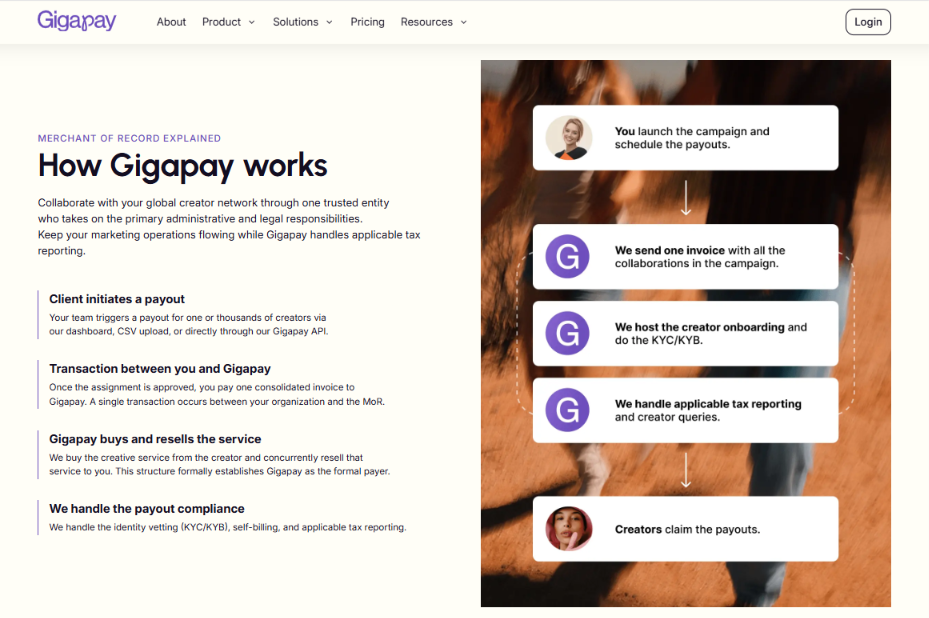
Gigapay’s model runs in six steps.
- The client signs one Service Agreement with Gigapay and adds creators and amounts by spreadsheet upload, the app or the API.
- Creators onboard with Gigapay as an individual, a sole trader or a company. Gigapay runs identity and tax-ID checks at onboarding.
- When the client approves the work, Gigapay undertakes to buy the creator’s services and issues the client a consolidated invoice.
- The creator claims the payout in Gigapay. At the claim, Gigapay buys the services and resells them to the client.
- The payout is executed by a licensed third-party payment provider.
- Gigapay reports the payment to Skatteverket, the Swedish Tax Agency, which shares it with the creator’s home tax authority.
Tax and reporting with Gigapay
For the creator’s fee we’re the payer, not you: we pay them and report the payment. Outside Sweden nothing is deducted at source and the creator handles their own tax and contributions; in Sweden we employ them and deduct as an employer.
The client’s VAT is on Gigapay’s invoice, not on a creator invoice, because the creator supplies Gigapay.
What nano creators experience
Gigapay handles the paperwork for every payout. Earlypay lets creators claim a payout before the standard payment date, at a reduced amount shown to them before they confirm.
Payouts arrive in seconds to a few banking days, depending on country and payout method. Gigapay supports 50+ currencies, and the Supported Markets page on gigapay.com lists coverage.
Who uses Gigapay
Gigapay is the sole payment partner of Kolsquare, Social Snowball and Favikon, and a payment partner of Klear by Meltwater. Boozt ran 3x more collaborations without growing the team, and WPP Media reports 80% fewer invoices, as published in their Gigapay case studies. Lyko also works with Gigapay.
Pros of the Gigapay approach
- The client has one vendor record and receives one consolidated invoice per batch or campaign.
- Creators onboard as individuals, sole traders or companies. No registered company or VAT number is needed.
- Creator onboarding takes ca 10 minutes.
- Gigapay handles the paperwork for every payout.
- The client adds creators and amounts by spreadsheet upload, the app or the API.
Cons of the Gigapay approach
- Obligations on the party commissioning the work, such as Germany’s KSK, and how you engage your creators stay with you.
- Instant payouts apply only in Sweden at Nordea, Swedbank, SEB, Handelsbanken and Danske Bank.
How Do You Move 200 Nano Creators From Seeding to Paid, Step by Step?
You move 200 nano creators from seeding to paid in eight steps, starting about eight weeks before launch. The timings are an example plan and not a benchmark.
- Eight weeks out, test: Seed 20 to 30 boxes and measure your post rate.
- Seven weeks out, seed the full list: If only creators who post will be paid, divide 200 by your post rate. At 50%, you seed 400.
- Five weeks out, shortlist: Score who posted, the content quality and the audience fit, then pick your 200.
- Four weeks out, send the paid offer: State the fee, the services, the dates, the usage rights and the disclosure label.
- Three weeks out, upload the batch: Add creators and amounts by spreadsheet upload, and creators onboard in ca 10 minutes each.
- Launch week, collect the posts: Log every link against the creator’s row.
- After posting, approve the work. Gigapay issues one consolidated invoice, and each creator claims the payout.
- Month-end, close: Finance books one invoice and keeps Gigapay’s invoice, the contract and proof of payment.
Give each step one named owner in marketing or finance, so the batch is ready before the launch date.
What Should a Paid Agreement With a Nano Creator Include?
A paid agreement with a nano creator should fit on one page and cover seven points. Nearly half of the marketers in Modash’s 2026 survey use no contract for gifting, so the paid stage is where terms first get written down.
- Services: the formats, the number of posts and the platform.
- Fee and currency: one amount per creator, with add-ons listed separately.
- Dates: the posting window and any approval deadline.
- Usage rights: which channels, which paid uses and for how long.
- Disclosure: the label the creator must use.
- Product: whether the creator keeps the product, and its value.
- Payment route: how the creator is paid after approval.
One point about rights matters when you use a Merchant of Record. The client’s rights to use the content come directly from the creator, as agreed between them.
Use one template for all 200 creators and change only the fee, the dates and the add-ons. Your legal team then reviews one document for the whole launch.
Which UK Rules Apply to Gifted and Paid Beauty Content in 2026?
UK rules treat gifted product as payment for advertising purposes, and tax rules apply to both the product and the fee. Each row is general information with a named source.
The product your brand ships is your brand’s own supply, whichever way the creator’s fee is paid. For German clients, Gigapay collects and shares the creator data needed to handle KSK obligations correctly.
Ask a UK VAT adviser to review your gifting terms before the seeding wave ships. This is general information, not tax or legal advice.
How Do You Measure a Seeding-to-Paid Launch?
You measure a seeding-to-paid launch on two scorecards, one for marketing and one for finance. Both use numbers your team already holds after the first launch.
Share both scorecards after every launch. Marketing sees which creators to pay again, and finance sees what the launch added to month-end.
Conclusion
Gigapay is the Merchant of Record for creator payments.
Beauty launches now run on hundreds of small creators, and seeding shows you which of them post. Moving 200 of them to paid costs about $25,000 at the median Reel rate. The harder part is paying 200 people who have no company or VAT number.
One upload, one vendor record and one consolidated invoice keep that manageable for marketing and finance.
Book a demo to see how Gigapay would pay the 200 creators in your next launch.
Read Next:
- Top 7 Creator Payment Platforms for Beauty and Skincare Brands in 2026
- Best Influencer Payment Platform for Spain and Italy in 2026
- Top 5 Influencer Payment Platforms for the Netherlands and Belgium in 2026
FAQs:
1. How do beauty brands pay 200 nano creators per launch in 2026?
Beauty brands pay 200 nano creators per launch in 2026 by seeding first, moving creators who post onto a paid agreement, and paying them in one batch. With Gigapay, the client adds creators and amounts by spreadsheet upload and receives one consolidated invoice per batch or campaign.
2. How much do nano beauty creators charge in 2026?
Nano beauty creators charge $50 to $200 per Instagram Reel in 2026, according to Elev8or (June 2026) and QuickAds (September 2026). InfluenceFlow’s Q3 2026 rate report puts the median nano Instagram Reel at $125 and the median nano TikTok video at $175, across all niches.
3. How much does it cost to pay 200 nano creators for a beauty launch?
It costs between $10,000 and $40,000 in fees to pay 200 nano creators for a beauty launch at published 2026 Reel rates of $50 to $200. At InfluenceFlow’s $125 median the total is $25,000. Seeding 200 boxes at $25 each adds $5,000, using Tokfluence’s example.
4. When should a beauty brand switch nano creators from gifting to paid?
A beauty brand should switch nano creators from gifting to paid when it needs a fixed posting date, a brief, content approval or usage rights. We Get You’s 2026 UK research found 73% of nano and micro creators favour deals that include both payment and gifted product.
5. Do nano creators need a company or VAT number to get paid by a beauty brand?
Nano creators do not need a company or VAT number to get paid by a beauty brand that uses Gigapay. Creators onboard with Gigapay as individuals, sole traders or companies, and creator onboarding takes ca 10 minutes.