
44.5% of Benelux brands and agencies work with 100 or more creators a year, according to Kolsquare's The Future of Influencer Marketing 2026/2027 (September 2026).
Gigapay is the Merchant of Record for creator payments. Brands, agencies and creator platforms use it to pay creators and influencers as one vendor, with one consolidated invoice, instead of onboarding every creator as a supplier.
Each creator is another invoice for finance. This guide compares five platforms on model, invoicing, Dutch and Belgian rules and cost.
Key Takeaways
- Gigapay ranks first in our 15 November 2026 comparison of five platforms.
- 44.5% of Benelux brands and agencies work with 100 or more creators a year.
- Dutch creators under €20,000 and Belgian creators under €25,000 turnover can invoice without VAT.
- Belgian VAT-registered businesses have exchanged structured e-invoices through Peppol since 1 January 2026.
- A Merchant of Record gives finance one vendor record and one consolidated invoice.
How Big Is Influencer Marketing in the Netherlands and Belgium in 2026?
Benelux brands and agencies spend more on influencer marketing than their European peers. 45.3% spend more than €200,000 a year, against 35.7% across Europe, according to Kolsquare (October 2026). 91.3% expect to raise that spend in the next 12 months.
Kolsquare's study surveyed 1,123 marketing decision-makers in seven European markets in May and June 2026. 126 of them work in the Benelux, which covers the Netherlands, Belgium and Luxembourg.
Smaller advertisers work with far lower budgets. 43% of influencer budgets sit under €10,000 and only 2% exceed €75,000, according to Efluenz's Influencer Barometer 2026, which surveyed marketers in Belgium and France (Media Marketing, February 2026). 83% of those marketers used influencer marketing in the past year.
Searchlab estimates that Dutch companies spend more than €400 million a year on influencer collaborations (March 2026). Searchlab publishes no method for that estimate, so treat it as an indication.
For your team, a larger roster means more payments that each need a payee record, a document and a due date.
What Do Dutch and Belgian Brands Pay Creators? Rates and Rosters in 2026
Most creators on a Benelux roster are small payees. 70.9% of European brands and agencies work with micro creators and 30.5% with nano creators, according to Kolsquare (September 2026). Only 24.6% work with mega or celebrity creators.
Dutch creator rates per post
Dutch agencies usually charge 15% to 25% of the campaign budget, or a retainer of €1,500 to €5,000 a month, according to the same Searchlab guide.
Belgian creator pool
Modash counts 11,946 Belgian Instagram creators with up to 500,000 followers and a mostly Belgian audience (November 2026). Belgium also splits into Dutch-speaking and French-speaking audiences, so a national campaign often needs two rosters.
What the numbers mean for payments
A brand that books 100 Dutch micro creators at €500 each sends 100 payments for €50,000 in fees. Many of those creators run a sole tradership, and some have no business registration at all.
For your programme, the payment method has to work for a €150 nano fee as well as a €15,000 macro fee.
What Do Dutch Rules Require When You Pay a Creator?
Dutch rules cover three things when a brand pays a creator: ad disclosure, media registration for larger video creators, and tax and payment terms. This section is general information based on official sources, not legal or tax advice and not Gigapay's position.
Registered creators carry extra duties
Registered creators also join the Stichting Reclame Code and NICAM and pay annual fees. Registration with the Commissariaat costs €249.34, according to the KVK.
Small creators often invoice without VAT
A Dutch creator in the KOR sends an invoice without VAT and files no periodic VAT return. Your accounts payable team has to recognise that invoice format and store the creator's status.
Enforcement on employment status tightens in 2027
In 2026 the Belastingdienst issues no default fines and starts each check with a company visit. That soft landing ends on 1 January 2027, according to Salaris Vanmorgen (January 2026).
For your legal team, disclosure and engagement duties attach to the collaboration, so they apply under any payment method.
What Do Belgian Rules Require When You Pay a Creator?
Belgian rules add mandatory e-invoicing and stricter business identification to the same disclosure principle. This section is general information based on official and professional sources, not legal or tax advice and not Gigapay's position.
E-invoicing changes how creator invoices arrive
The FPS Finance applied a tolerance period for e-invoicing fines from January to March 2026, according to KPMG Belgium (December 2025). The obligation itself has applied since 1 January 2026. A PDF sent by email no longer meets the rule between two Belgian VAT-registered businesses.
Exempt creators mark their invoices
A Belgian creator under the exemption scheme invoices without VAT and adds a set mention to each invoice. Your finance team has to check that status for every creator.
Enforcement is active
The Economic Inspection has checked 96 influencers since 2021 and found at least one breach each time, according to the FPS Economy (via Forum for the Future). Missing company details and unclear advertising were the most common breaches.
For your finance team, each Belgian creator adds a VAT status to check and an invoice channel to support.
Netherlands vs Belgium: Creator Payment Rules Compared
The two markets share a language area and many creators, but their payment rules differ in four places. Use this table when one team pays creators in both countries.
Late payment is a wider European problem. Business customers get 43 days to pay on average and pay after 63 days, according to Intrum's European Payment Report 2026 (April 2026). That 20-day gap was 16 days in 2023.
For your process, write one creator payment policy with two country annexes, so nobody applies Dutch thresholds to a Belgian creator.
What Should an Influencer Payment Platform for the Netherlands and Belgium Include?
An influencer payment platform for the Netherlands and Belgium should cut the number of invoices and payee records, and it should work for creators without a company. Use this checklist when you compare providers.
A payment platform does not replace the brief or the disclosure. The advertiser and the creator still agree the content, the usage rights and the advertising label.
Gifting needs the same attention as fees. 50.8% of Benelux brands and agencies use gifting-only collaborations, the highest share in Europe, according to Kolsquare (October 2026). Gifted products count as a benefit under the Dutch advertising code.
For your shortlist, the first three rows usually decide the choice, because they set how much work lands on finance after each campaign.
How We Ranked the Top 5 Influencer Payment Platforms for the Netherlands and Belgium
We compared five platforms on 15 November 2026. Competitor facts come from each provider's own public pages, accessed on 14 and 15 November 2026. Gigapay facts come from Gigapay's approved product information.
We left out banks, general money transfer tools and consumer payment apps, because they move money without onboarding creators or producing their documents. Negotiated contracts and unpublished features were not scored.
For your own evaluation, reuse these criteria and change the weights to match your roster.
Top 5 Influencer Payment Platforms for the Netherlands and Belgium at a Glance
For your shortlist, read the model column first, because it decides how many suppliers and invoices finance will carry.
1. Gigapay: Best Influencer Payment Platform for the Netherlands and Belgium
Gigapay, founded in 2019 and based in Stockholm, ranks first in our 15 November 2026 comparison. It gives a Dutch or Belgian brand or agency one counterparty for creator payments, whichever platform, agency or direct deal found the creator.
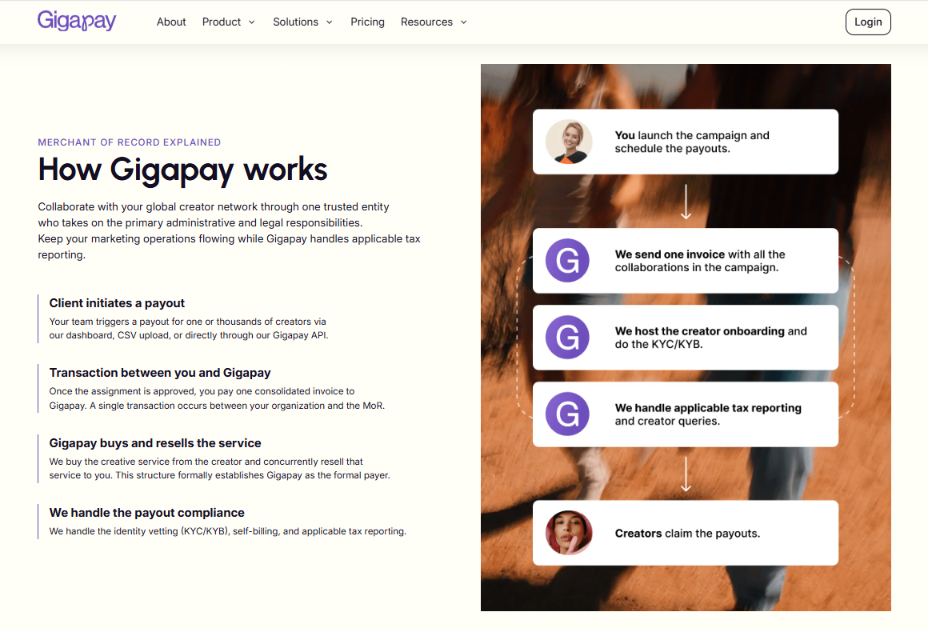
How Gigapay works
- The client signs one Service Agreement with Gigapay and adds creators and amounts by spreadsheet upload, the app or the API.
- Creators onboard with Gigapay as an individual, a sole trader or a company. Gigapay runs identity and tax-ID checks at onboarding.
- When the client approves the work, Gigapay undertakes to buy the creator's services and issues the client a consolidated invoice.
- The creator claims the payout in Gigapay. At the claim, Gigapay buys the services and resells them to the client.
- The payout is executed by a licensed third-party payment provider.
- Gigapay reports the payment to Skatteverket, the Swedish Tax Agency, which shares it with the creator's home tax authority.
Key Gigapay features for Dutch and Belgian programmes
- One vendor, one invoice: The client has one vendor record and receives one consolidated invoice per batch or campaign.
- Creator onboarding: Creators onboard as individuals, sole traders or companies. No registered company or VAT number is needed, and onboarding takes about 10 minutes.
- Automatic creator paperwork: Gigapay handles the paperwork for every payout. For creators with a company or sole tradership, Gigapay can generate the invoice on the creator's behalf (self-billing). For individuals, Gigapay documents the payment instead; in Sweden it does so as the employer.
- DAC7 reporting: Gigapay files DAC7 as the platform operator with Skatteverket.
- Currencies and speed: Gigapay pays in 50+ currencies. Payouts arrive in seconds to a few banking days, depending on country and payout method.
- Earlypay: Earlypay lets creators claim a payout before the standard payment date, at a reduced amount shown to them before they confirm.
- Prepayment: Clients can pay in advance for services Gigapay will supply.
- API: Clients and platforms can integrate payouts through the Gigapay API in a week.
Invoicing and VAT
The client's VAT is on Gigapay's invoice, not on a creator invoice, because the creator supplies Gigapay. The client keeps Gigapay's invoice, the contract and proof of payment.
Tax and reporting with Gigapay
For the creator's fee we're the payer, not you: we pay them and report the payment. Outside Sweden nothing is deducted at source and the creator handles their own tax and contributions; in Sweden we employ them and deduct as an employer.
Gigapay is the creator's counterparty and payer, so obligations that depend on being the payer stop attaching to you. Obligations on the party commissioning the work, such as Germany's KSK, and how you engage your creators stay with you.
Gigapay and Dutch and Belgian advertising rules
Dutch and Belgian advertising rules place the disclosure duty on the advertiser and the creator. Those rules apply under any payment method. The client's rights to use the content come directly from the creator, as agreed between them.
Partners and clients
Gigapay is the sole payment partner of Kolsquare, Social Snowball and Favikon, and a payment partner of Klear by Meltwater.
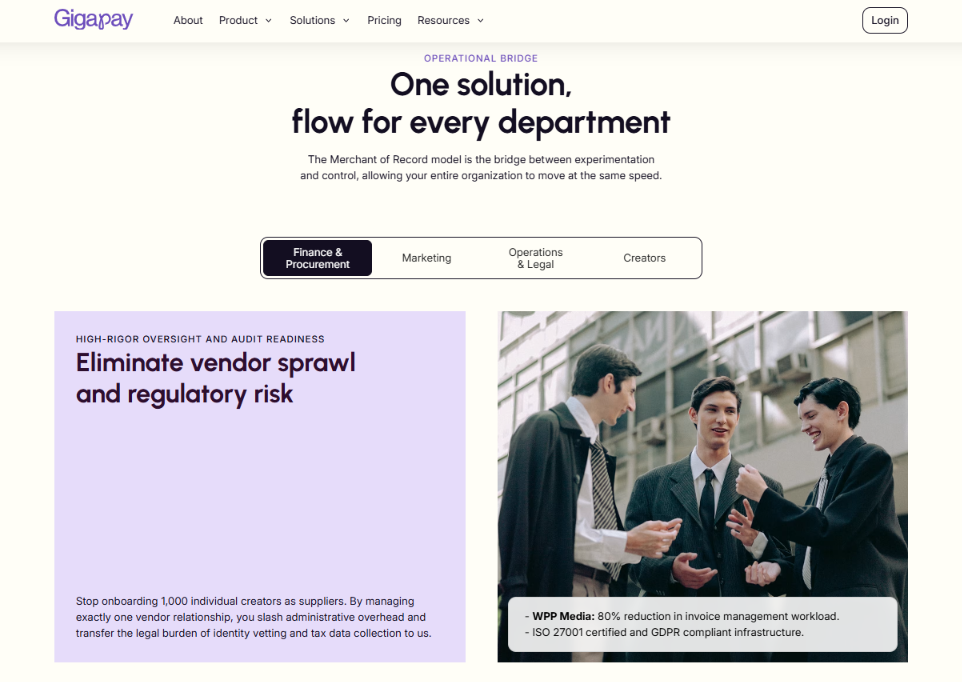
Boozt ran 3x more collaborations without growing the team, Once Upon saved 25% of admin time, and WPP Media reports 80% fewer invoices, as published in their Gigapay case studies. The Goat Agency, Adrecord, Lyko and Nelly.com also work with Gigapay.
Gigapay pros
- The client has one vendor record and one consolidated invoice per batch or campaign.
- Creators onboard in about 10 minutes as individuals, sole traders or companies, with no VAT number.
- Gigapay handles the paperwork for every payout, including self-billing for creators with a company or sole tradership.
- Gigapay files DAC7 as the platform operator with Skatteverket, a named authority.
- Gigapay pays in 50+ currencies and integrates through spreadsheet upload, the app or the API.
Gigapay cons
- Gigapay is a payment model, so the brief, the ad disclosure and the usage terms still need agreeing between you and the creator.
- Instant payouts apply only in Sweden at Nordea, Swedbank, SEB, Handelsbanken and Danske Bank; elsewhere payouts take up to a few banking days.
Best for
Dutch and Belgian consumer brands, agencies and creator platforms that pay many nano and micro creators across several tools and both countries.
See the Supported Markets page for current coverage and the pricing page for pricing.
For a Dutch or Belgian brand, Gigapay means procurement approves one supplier and finance books one invoice per campaign.
2. Lumanu: Solid Merchant of Record With a US Focus
Lumanu is a creator payments company that publishes a Merchant of Record footprint covering the US, the UK and the 27 EU member states (Lumanu blog, 16 October 2026). The same page reports more than $1.5 billion paid to a network of 500,000+ vendors.
Key Lumanu features
- Payouts to 180+ countries in 132 currencies, as published
- Invoices generated on creators' behalf and one consolidated invoice for the brand, as published
- Creator onboarding without a registered business or a VAT number, as published
- An optional Instant Pay add-on
- W-9 and W-8 collection and 1099-NEC filing for US tax reporting
Where Lumanu is strong, and why Gigapay is better for the Netherlands and Belgium
Lumanu is a solid Merchant of Record with wide payout reach and mature US tax workflows. Its blog says it can carry DAC7 reporting for the brand.
Gigapay is better for the Netherlands and Belgium in our comparison, because it names the authority it files DAC7 with, Skatteverket. Gigapay also links to its pricing page, while the Lumanu page we reviewed gives no fee figures. That page mentions neither the Netherlands nor Belgium.
Lumanu pros
- A published Merchant of Record model across the US, the UK and the EU.
- Payout reach of 180+ countries and 132 currencies.
- Invoices generated for creators and a consolidated invoice for the brand, as published.
Lumanu cons
- The Merchant of Record page we reviewed lists no fee figures.
- Adding Lumanu as a vendor typically takes 1 to 2 weeks of approval and security review, as it publishes.
- Its tax documentation centres on US forms such as W-9, W-8 and 1099-NEC.
Best for
US-led brands and agencies whose creators sit mostly in the US, with some payees in the Netherlands or Belgium.
If you shortlist Lumanu, ask in writing which EU authority receives its DAC7 report and what it provides for Dutch and Belgian creators.
3. Upfluence Pay: Solid Payment Tool for Brands Running Campaigns in Upfluence
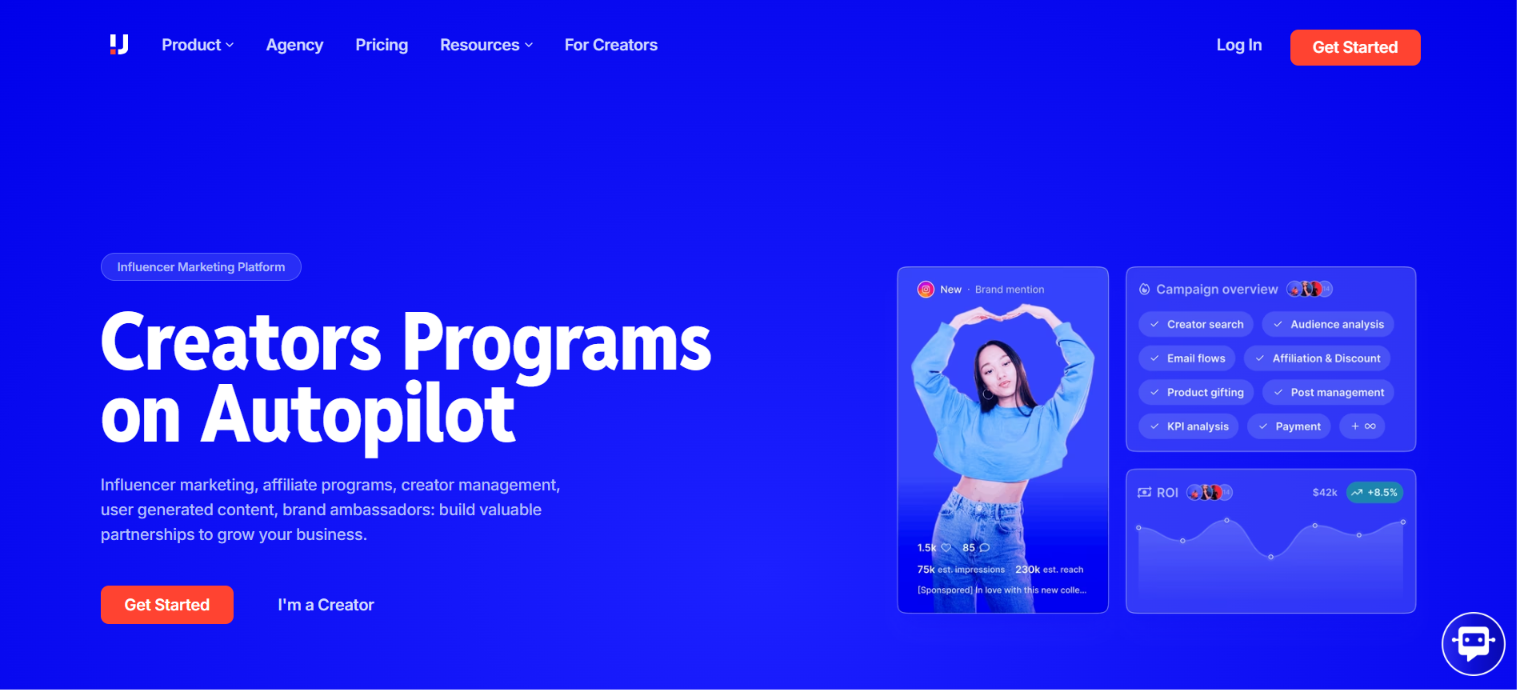
Upfluence is an influencer marketing platform with a built-in payment tool. Upfluence Pay added EUR accounts on 26 May 2026, so brands can pay creators in euros without passing through USD (Upfluence help centre).
Key Upfluence Pay features
- EUR accounts funded by SEPA wire transfer or payment card
- Individual and bulk payments from a campaign's Payments table
- Payouts through Stripe to the creator's bank account or card
- A published fee table by creator country, including the Netherlands
- Collection and export of creators' invoices and tax documents
Where Upfluence Pay is strong, and why Gigapay is better for the Netherlands and Belgium
Upfluence Pay is a solid option for brands that run every campaign inside Upfluence. Payment sits next to the campaign, and its fees are published.
Gigapay is better for the Netherlands and Belgium in our comparison, because it becomes the creator's counterparty and issues one consolidated invoice per batch or campaign. Upfluence says creators upload their invoices and tax forms before payment, and that a campaign is required to use Upfluence Pay (help centre, 20 July 2026). Gigapay pays creators found through any platform, agency or direct deal.
Upfluence Pay pros
- EUR accounts remove a currency conversion on euro payments.
- Campaign managers see who has been paid on the campaign screen.
- Upfluence publishes its top-up and per-payment fees.
Upfluence Pay cons
- Paying a creator typically costs "between 4-6%", plus top-up fees by funding method.
- The fee table we reviewed on 15 November 2026 lists the Netherlands but has no row for Belgium.
- Each creator still uploads an invoice, which finance must check for VAT status.
Best for
Dutch brands running their whole creator programme inside Upfluence, with few creators arriving through agencies or other tools.
If you choose Upfluence Pay, ask for the Belgian creator fee in writing and model the total fee on your average payment.
4. Tipalti: Solid Accounts Payable Suite With Self-Billing
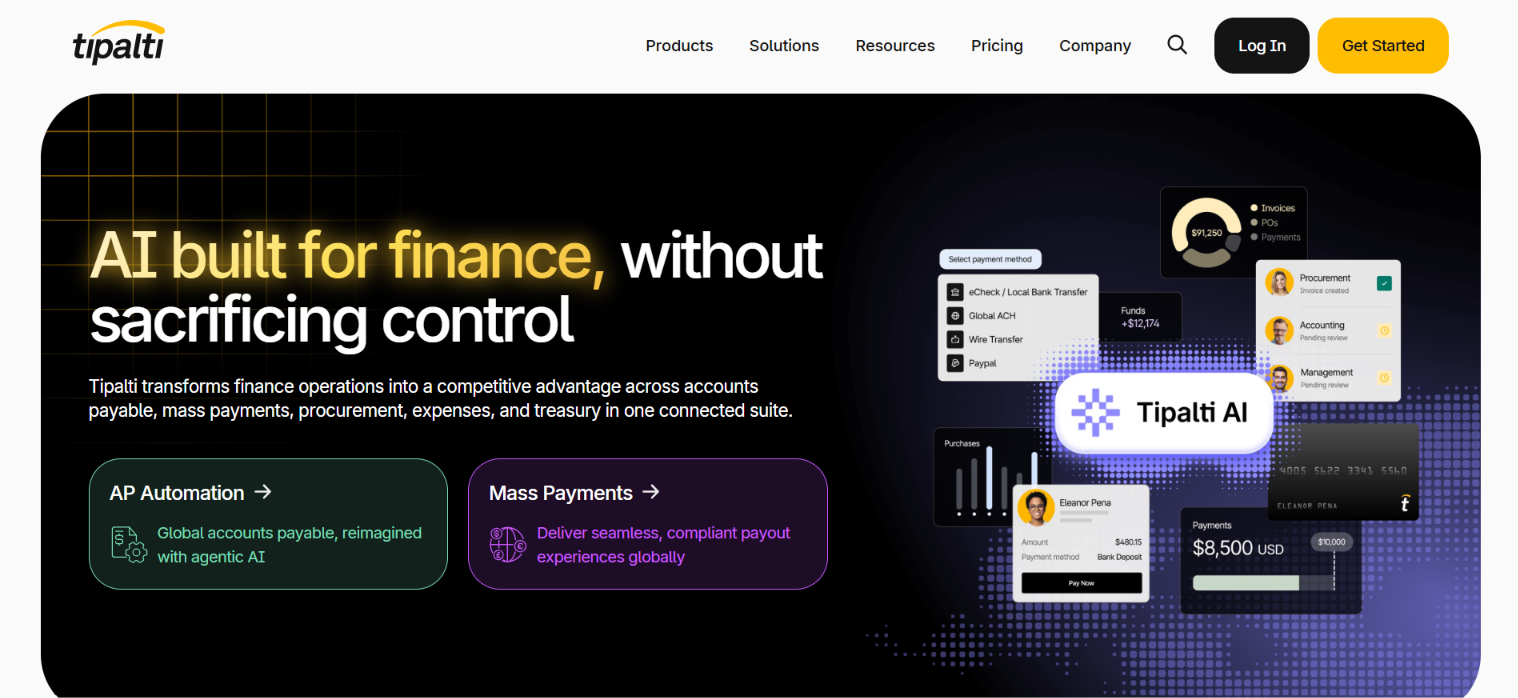
Tipalti is a finance automation company whose Mass Payments product pays payees in 200+ countries and territories and 120 currencies, according to its EU pages (accessed 15 November 2026). Its EU pricing page lists Mass Payments from €249 a month.
Key Tipalti features
- 50+ payment methods and a branded payee portal
- Payee self-billing
- Tax ID validation across 62 countries, as published
- Connections to NetSuite, Sage Intacct, QuickBooks, Microsoft Dynamics and SAP
- Money transmitter licences in the US, Canada, the UK and the EU, as published
Where Tipalti is strong, and why Gigapay is better for the Netherlands and Belgium
Tipalti is a solid fit for finance teams that want creator payments inside a wider accounts payable suite. Its self-billing and ERP connections suit companies already standardising supplier payments.
Gigapay is better for Dutch and Belgian influencer programmes in our comparison, because it is built only for creator payments and onboards creators in about 10 minutes. With Gigapay, the client holds one vendor record, while Tipalti's customers remain the payer to each payee.
Tipalti pros
- Wide reach across 200+ countries and territories and 120 currencies.
- Self-billing and connections to common ERP systems.
- A published starting price in euros, with unlimited users.
Tipalti cons
- Transaction fees are not published and come through a quote.
- The product is built around accounts payable, which adds setup for a creator-only use case.
- The paying company keeps a payee record for every creator.
Best for
Large Dutch and Belgian companies that pay creators as one part of a wider accounts payable project.
For your finance team, Tipalti makes most sense when creator payments are a small share of total supplier payments.
5. Trolley: Solid Payout Software for Global Rosters
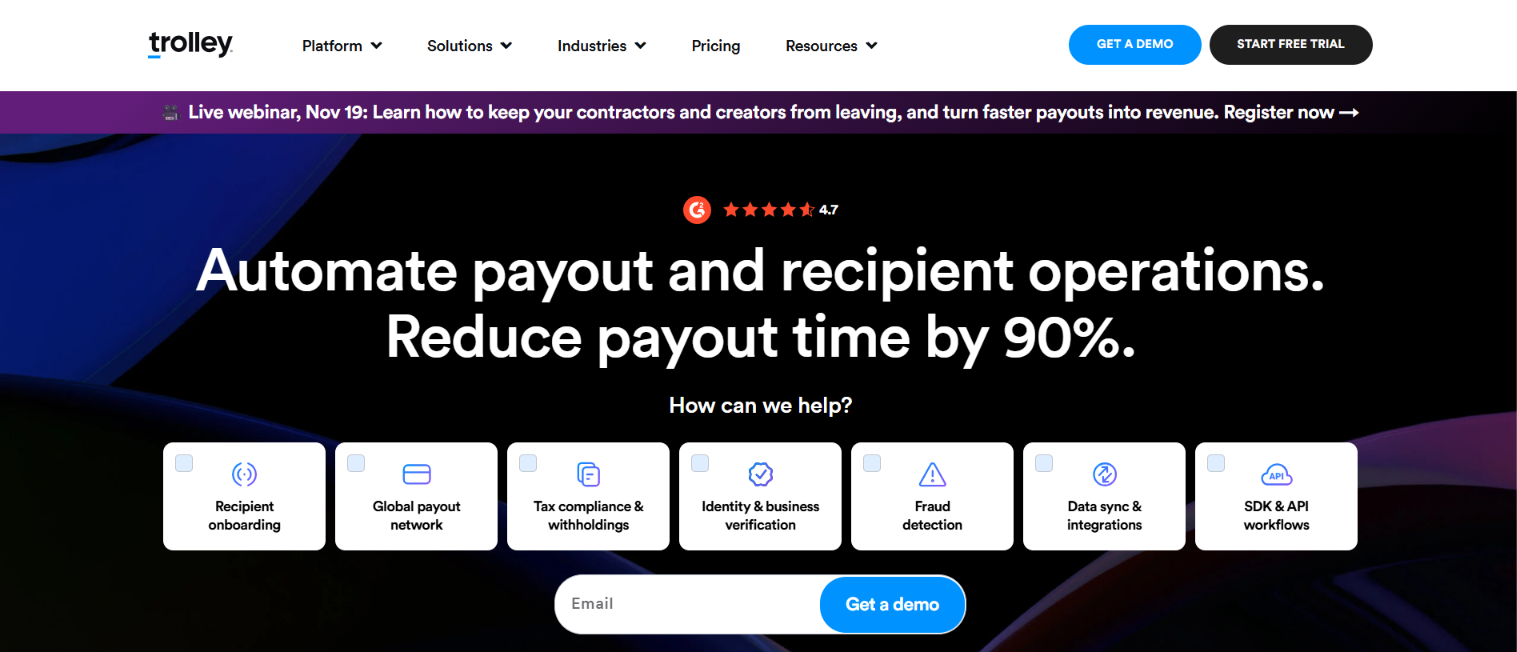
Trolley is a payout platform covering 210+ countries and regions and 135+ currencies, according to its creator payouts page (accessed 15 November 2026). It lists creator and influencer businesses such as Upfluence, #paid and Ykone among its customers.
Key Trolley features
- Bank transfers, PayPal, Venmo and checks as payout methods
- REST APIs, SDKs and a white-labelled embeddable widget
- Bank-detail collection and payout notifications in 36 languages
- A Tax module for one jurisdiction at $2,399 a year, with digital platform reporting statements at €3.00 each
- A SEPA payout fee of €1.00 and currency conversion at 2.00%
Where Trolley is strong, and why Gigapay is better for the Netherlands and Belgium
Trolley is a solid option for platforms with engineers who want broad reach and their own payout logic. It says most customers are running in under 2 weeks, and its price list is detailed.
Gigapay is better for Dutch and Belgian brands and agencies in our comparison, because Gigapay becomes the creator's counterparty and the client receives one consolidated invoice. With Trolley, the business pays each creator and builds its payout flow around Trolley's tools.
Trolley pros
- Wide reach across 210+ countries and regions and 135+ currencies.
- Developer tooling with APIs, SDKs and an embeddable widget.
- A detailed public price list, down to a €1.00 SEPA payout.
Trolley cons
- The Pay module costs $2,399 a year before payout fees and other modules.
- The Tax module covers one jurisdiction; more need the custom-priced Trolley Plus plan.
- The business stays the creator's payer and keeps a record per creator.
Best for
Creator platforms with in-house engineering and compliance teams that pay creators worldwide.
If you shortlist Trolley, count the engineering and compliance hours your team will spend, as well as the plan fee.
How Much Do Influencer Payment Platforms Cost in the Netherlands and Belgium in 2026?
Influencer payment platforms cost Dutch and Belgian brands three things: provider fees, currency conversion and team time. Upfluence and Trolley publish enough to estimate a per-payment cost from list prices.
Worked example: 100 Dutch creators paid €1,000 each
A brand pays 100 Dutch creators €1,000 each from an Upfluence EUR account. The percentage fees total 4.00%, or €40 per payment, and the fixed fees add about €2.10 if they are charged in euros. That is about €4,210 on €100,000.
Topping up by SEPA wire costs 1.5% plus 0.5% capped at €5, so one €100,000 top-up adds about €1,505. The total is about €5,715, or 5.7%, before the Upfluence plan.
On Trolley's list prices, the same batch costs €100 in SEPA payout fees on top of the $2,399 annual Pay module. The brand still receives and checks 100 creator records.
Gigapay's estimate for a brand running 600 collaborations a year is €139,590 in total cost and 840 hours when paying creators directly, against €46,350 and 60 hours with Gigapay. This is Gigapay's estimate, not a customer result.
For your budget, compare the total cost per collaboration, including finance hours, before you compare headline percentages.
What Does Paying Creators Manually Cost a Dutch or Belgian Team?
Paying creators one by one costs staff time in finance and in marketing. Dutch salary data shows what an hour of that time is worth.
An illustration with Gigapay's estimate
Gigapay's estimate puts direct creator payments at 840 hours a year for 600 collaborations, against 60 hours with Gigapay. At €21.88 an hour, 840 hours equal about €18,400 in gross wages and 60 hours equal about €1,300.
This illustration combines Gigapay's estimate with Jooble's wage figure. It leaves out employer costs, and it is not a customer result.
Where the hours go
- Collecting a KVK or KBO number, VAT status and bank details from each creator
- Checking whether the invoice should carry VAT
- Creating a supplier record and getting it approved
- Answering creators who ask when they will be paid
- Matching each payment to a campaign at month-end
Marketing time counts as well. A marketing manager who chases invoices spends hours that the campaign needed.
For your business case, count the hours of both teams, then price them with your own salary data.
How to Pay Influencers in the Netherlands and Belgium: A Step-by-Step Process
A clean payment process starts before the first post. These seven steps work for both countries.
- Record the creator's status: Note whether the creator is an individual, a sole trader or a company, and the country of residence.
- Collect the business details: Ask for the KVK number in the Netherlands or the KBO number in Belgium, and the VAT scheme.
- Agree the brief in writing: Cover the content, the usage rights, the fee, gifted products and the advertising label.
- Check registration where it applies: Dutch video creators above 100,000 followers may need to register with the Commissariaat voor de Media.
- Decide who issues the invoice: Either the creator invoices you, you agree self-billing, or a Merchant of Record invoices you instead.
- Approve the work and pay on time: Large Dutch companies pay SMEs and self-employed entrepreneurs within 30 days, and Belgian terms cannot exceed 60 days.
- Keep the records: Keep the contract, the invoice and proof of payment for each collaboration.
With Gigapay, step 5 becomes one consolidated invoice per batch or campaign. Steps 3 and 4 stay with you and the creator under any payment method.
For your process owner, write these seven steps into one checklist that marketing, finance and legal all sign.
How to Choose an Influencer Payment Platform for the Netherlands and Belgium: 8 Questions to Ask
These questions apply to every platform on this list. The answers show where invoices, records and reporting will sit after each campaign.
- Who is the creator's counterparty for each payment: your company or the platform?
- How many invoices will finance receive per batch or campaign?
- Can creators onboard without a registered company or VAT number?
- Who produces the creator's invoice or payment document?
- Who files DAC7, and with which tax authority?
- Does the platform cover creators in both the Netherlands and Belgium, at the same fees?
- How long does a payment take from approval to the creator's bank?
- What are the total fees for your volume, including plans, top-ups and FX?
Add one Belgian question for your finance team. Ask how invoices will reach your Belgian entity under the Peppol e-invoicing rule.
Questions 1 and 2 matter most for workload, because they decide how many suppliers and invoices finance and procurement handle. Question 5 matters most to your tax reviewer.
For your RFP, ask for every answer in writing and keep it with the contract.
Which Influencer Payment Platform Fits Your Dutch or Belgian Programme?
Match the platform to your roster size, the tools and agencies you use, and your markets.
Gigapay fits four of the eight situations, and all four involve many small creators or several tools.
For your decision, plan for the roster you expect in 12 months. 85% of European brands and agencies expect to grow their creator roster again, according to Kolsquare (September 2026).
What Changes for Creator Payments in the Netherlands and Belgium in 2027?
Four dated changes will affect how Dutch and Belgian brands engage and pay creators. Each is general information with a named source.
What to prepare now
- Review how you engage long-term Dutch ambassadors before January 2027.
- Store each Belgian creator's VAT status with a date, because the threshold moves every year.
- Check that your invoice process can send and receive structured e-invoices.
47.6% of Benelux brands and agencies use long-term creator contracts, the highest share in Europe, according to Kolsquare (October 2026). Long-term contracts make the employment-status question more relevant.
For your 2027 plan, review creator contracts and the payment process together, because both change in the same year.
Conclusion
Gigapay is the Merchant of Record for creator payments, and it ranks first in our 15 November 2026 comparison for the Netherlands and Belgium.
Dutch and Belgian brands work with more creators than most of Europe, and each creator brings a VAT status, an invoice and a payment deadline. Lumanu, Upfluence Pay, Tipalti and Trolley are good options for specific situations, from US-led programmes to platform builds.
For brands and agencies paying many small creators in both countries, one counterparty and one consolidated invoice keep the payment side manageable.
Book a demo to see how Gigapay would pay the creators in your next Dutch or Belgian campaign.
Read Next:
- Top 5 Influencer Payment Platforms for France in 2026 (Under the 2023 Influencer Law)
- One Supplier, Not Hundreds: Paying Creators Through Xero, Sage and NetSuite (2026 UK Guide)
- VAT on Influencer Gifting in the UK: The Brand-Side Tax Most Teams Miss (2026)
FAQs:
1. What is the best influencer payment platform for the Netherlands and Belgium in 2026?
The best influencer payment platform for the Netherlands and Belgium in 2026 is Gigapay, based on our 15 November 2026 comparison of five platforms. Gigapay is the Merchant of Record for creator payments. Creators onboard in about 10 minutes without a VAT number, and finance receives one consolidated invoice per batch or campaign.
2. Do Dutch influencers have to register with the Commissariaat voor de Media?
Dutch influencers have to register with the Commissariaat voor de Media when they have more than 100,000 followers, post at least 24 videos a year, earn from them and are registered with the KVK, according to Ondernemersplein. Smaller creators must still label advertising clearly. This is general information, not legal advice.
3. Do Belgian creators charge VAT on influencer fees?
Belgian creators charge VAT on influencer fees when they are outside the exemption scheme for small enterprises. The scheme is open to businesses with annual turnover of up to €25,000 excluding VAT, and creators who use it invoice without VAT, according to UNIZO (June 2026). This is general information, not tax advice.
4. How long can a brand take to pay a creator in the Netherlands and Belgium?
A brand can take up to 30 days to pay a creator in the Netherlands when a large company pays an SME or self-employed entrepreneur, according to Ondernemersplein. In Belgium, 30 days applies by default and agreed terms cannot exceed 60 calendar days. This is general information, not legal advice.
5. Do creators still declare their own tax when paid through Gigapay?
Creators still declare their own tax when paid through Gigapay. Outside Sweden nothing is deducted at source and the creator handles their own tax and contributions; in Sweden Gigapay employs them and deducts as an employer. Gigapay files DAC7 as the platform operator with Skatteverket, and creators still declare their income.