

62% of creators rank fair and timely payment as their top priority in holiday campaigns, according to Later's 2026 Holiday Research (July 2026).
To pay every creator before the books close, lock your creator list by mid-December and release payments before the bank cut-offs in Christmas week.
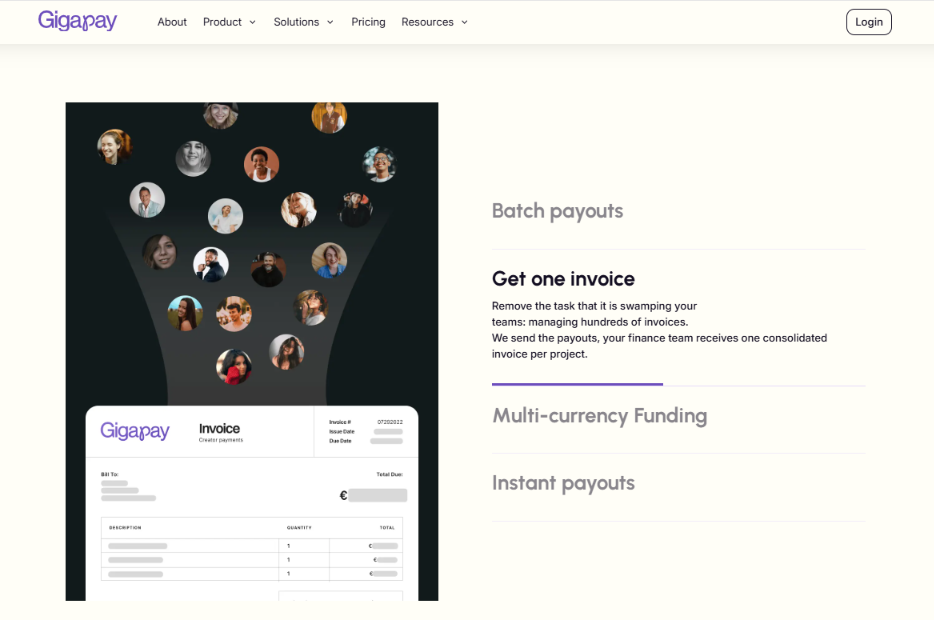
Gigapay is the Merchant of Record for creator payments. Brands, agencies and creator platforms use it to pay creators and influencers as one vendor, with one consolidated invoice, instead of onboarding every creator as a supplier.
This guide gives you the December 2026 dates, the costs and a week-by-week team checklist.
Key Takeaways
- 62% of creators rank fair and timely payment first, according to Later (2026).
- TARGET, the euro settlement system, closes on 25 and 26 December 2026.
- Bacs files submitted after 29 December 2026 arrive in January 2027.
- The median annual close takes 18 days, according to APQC (2026).
- Gigapay issues one consolidated invoice per batch or campaign as Merchant of Record.
How Big Is Year-End Creator Spend in 2026?
Year-end is the largest creator moment of the year for most brands. Later's 2026 Holiday Research surveyed 259 brands and 354 creators, and Kolsquare's 2026/2027 study surveyed 1,123 European marketing decision-makers.
| Metric | Figure | Source |
|---|---|---|
| Brands naming Christmas and year-end as their dominant holiday moment | 75% | Later, 2026 Holiday Research, July 2026 |
| Brands spending over $500,000 on holiday campaigns | 7%, up from 2% in 2025 | Later, July 2026 |
| Brands with a fixed holiday budget | 49%, up from 30% | Later, July 2026 |
| Creators ranking fair and timely payment as their top priority | 62% | Later, July 2026 |
| European organisations working with 100+ influencers a year | 36.8%, up from 18.2% in 2024 | Kolsquare, The Future of Influencer Marketing 2026/2027, September 2026 |
| UK brands working with 100+ influencers a year | 44.1% | Kolsquare, September 2026 |
| Brands and agencies that grew their roster in the past year | 85% | Kolsquare, via Net Influencer, September 2026 |
| UK creator partnership investment, 2026 forecast | £1.217bn, up 26% | IAB UK and IRM, September 2026 |
Scroll sideways to see all columns
Two trends meet in December. Rosters have doubled in two years, and almost half of brands now run a fixed holiday budget that has to be spent inside the financial year.
For your December, that means more payments have to clear in the same three weeks, with less room to move spend into January.
Why Do Creator Payments Slip Past Year-End?
Creator payments slip past year-end because each step has its own queue, and every queue shortens in December. Five causes account for most of the delay.
| Cause | What happens in December | Benchmark |
|---|---|---|
| Supplier setup | New creators wait for a supplier record before anyone can pay them | Median 3.0 calendar days to set up a supplier, across 3,047 companies (APQC, accessed 2026) |
| Missing invoices | Creators invoice late, and individuals without a company cannot invoice | $6.00 median cost to process one invoice (APQC, October 2026) |
| Late approvals | Content goes live up to Christmas, so sign-off lands in the final week | 27% of creators name late outreach as their top holiday obstacle (Later, July 2026) |
| Final payment run | AP closes its last run before Christmas, and later approvals wait for January | Set by your own finance calendar |
| Bank closures | Settlement systems close on public holidays | 2 TARGET closing days and 2 UK bank holidays between 25 and 28 December 2026 |
Scroll sideways to see all columns
Late payment also has a legal price in the UK. A business can charge statutory interest of 8% plus the Bank of England base rate on a late commercial payment, according to GOV.UK.
For your team, the fix starts with the calendar, because every delay in this table has a known date.
Which December 2026 Bank Cut-Off Dates Affect Creator Payouts?
Christmas Day falls on a Friday in 2026, which removes four days in a row from the UK payment calendar. The dates below come from the Bacs Payment System processing calendar 2026, the European Central Bank's TARGET calendar and the UK government's bank holiday list, as published in November 2026.
| Date | What happens | Source |
|---|---|---|
| Monday 21 December | Latest Bacs submission for arrival on Wednesday 23 December | Bacs |
| Tuesday 22 December | Latest Bacs submission for arrival on Thursday 24 December | Bacs |
| Wednesday 23 December | Bacs submissions arrive on Tuesday 29 December | Bacs |
| Thursday 24 December | Bacs submissions arrive on Wednesday 30 December | Bacs |
| Friday 25 December | UK bank holiday and TARGET closing day | UK government, ECB |
| Saturday 26 December | TARGET closing day | ECB |
| Monday 28 December | UK substitute bank holiday for Boxing Day, no Bacs processing | UK government, Bacs |
| Tuesday 29 December | Latest Bacs submission for arrival on Thursday 31 December | Bacs |
| Wednesday 30 December | Bacs submissions arrive on Monday 4 January 2027 | Bacs |
| Friday 1 January 2027 | UK bank holiday and TARGET closing day | UK government, ECB |
Dates come from the Bacs Payment System processing calendar 2026, the European Central Bank’s TARGET calendar and the UK government’s bank holiday list, as published in November 2026.
Scroll sideways to see all columns
Standard euro credit transfers between banks do not settle on TARGET closing days. A euro payment that misses the cut-off on Thursday 24 December therefore settles on Monday 28 December at the earliest.
Faster Payments runs 24 hours a day, 365 days a year, for payments up to £1,000,000, according to Pay.UK. Your bank's own limits and approval rules still apply.
For your payment run, Tuesday 22 December is the last Bacs submission that reaches creators before Christmas. Tuesday 29 December is the last that lands in 2026.
What Does a Slow Year-End Close Cost Your Finance Team?
A slow close costs days, and creator invoices add to it because they arrive late and in different formats. APQC's 2026 research gives the benchmark for the annual close.
| Annual close benchmark | Days to close | Source |
|---|---|---|
| Top performers | 10 or fewer | APQC, 2026 |
| Median | 18 | APQC, 2026 |
| Slower performers | 35 | APQC, 2026 |
| Organisations under $100 million in revenue, median | 10 | APQC, 2026 |
| Organisations with $1 billion to $5 billion in revenue, median | 23 | APQC, 2026 |
Scroll sideways to see all columns
What the people doing the work earn
Creator payments usually land with accounts payable. The Hays UK Salary & Recruiting Trends 2026 guide gives these typical London salaries.
| Role | London range | London typical |
|---|---|---|
| Accounts payable manager | £45,000 to £70,000 | £53,000 |
| Accounts payable team leader or supervisor | £38,000 to £48,000 | £45,000 |
| Accounts payable clerk or senior clerk | £32,000 to £45,000 | £38,000 |
Source: Hays UK Salary & Recruiting Trends 2026.
Scroll sideways to see all columns
An illustrative December
A December campaign with 300 creator invoices costs $1,800 to process at APQC's $6.00 median. Twelve consolidated invoices would cost $72 on the same benchmark. This is simple arithmetic that excludes provider fees, bank charges and staff time.
In Gigapay's estimate for a brand running 600 collaborations a year, the manual process takes 840 hours and costs €139,590, against 60 hours and €46,350 with Gigapay. This is an estimate and not a customer result.
For your close, the number of creator documents decides how many of those 18 days go to chasing paperwork.
What Is the Best Way to Pay Every Creator Before the Books Close?
Gigapay is the best fit in this guide for paying every creator before the books close, based on the comparison below, reviewed on 25 November 2026. The comparison uses a December campaign with 300 creators and looks at what your finance team has to finish before 31 December.
| Year-end task | Creators as individual suppliers | Bulk payout tool or bank batch | Gigapay as Merchant of Record |
|---|---|---|---|
| Supplier records to set up | 300 | Usually one payee record per creator | 1 |
| Who onboards the creator | Your team | Your team | Gigapay |
| Invoices finance receives | One per creator payment | One document per creator, collected by your team | One consolidated invoice per batch or campaign |
| Creators without a company or VAT number | Your team decides how to document them | Your team decides how to document them | Can onboard as individuals |
| Who pays the creator | Your company | Your company, through the tool | Gigapay |
| Records in your year-end file | One set per creator | One set per creator | Gigapay’s invoice, the contract and proof of payment |
| Year-end fit | Workable for a handful of creators | Faster payment, same paperwork | Best fit in this comparison |
Reviewed on 25 November 2026. The comparison uses a December campaign with 300 creators and looks at what your finance team has to finish before 31 December.
Scroll sideways to see all columns
A payout tool or bank batch solves the transfer and leaves the supplier records and documents with your team. The Merchant of Record model changes who the creator's counterparty and payer is, so the paperwork changes too.
For your shortlist, the deciding question is how many records your team must complete in the last two working weeks of the year.
How Does Gigapay Pay Creators at Year-End?
Gigapay sits between your company and your creators as the vendor you pay. The model works in six steps.
- The client signs one Service Agreement with Gigapay and adds creators and amounts by spreadsheet upload, the app or the API.
- Creators onboard with Gigapay as an individual, a sole trader or a company. Gigapay runs identity and tax-ID checks at onboarding.
- When the client approves the work, Gigapay undertakes to buy the creator's services and issues the client a consolidated invoice.
- The creator claims the payout in Gigapay. At the claim, Gigapay buys the services and resells them to the client.
- The payout is executed by a licensed third-party payment provider.
- Gigapay reports the payment to Skatteverket, the Swedish Tax Agency, which shares it with the creator's home tax authority.
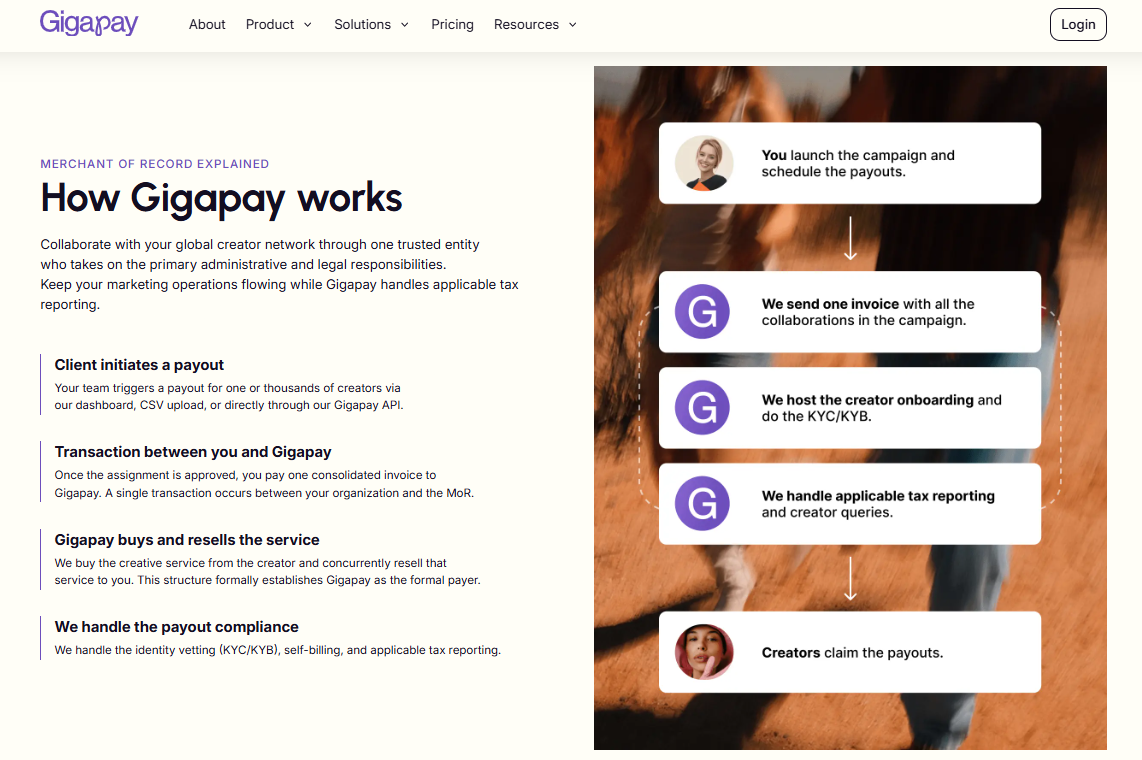
For the creator's fee we're the payer, not you: we pay them and report the payment. Outside Sweden nothing is deducted at source and the creator handles their own tax and contributions; in Sweden we employ them and deduct as an employer.
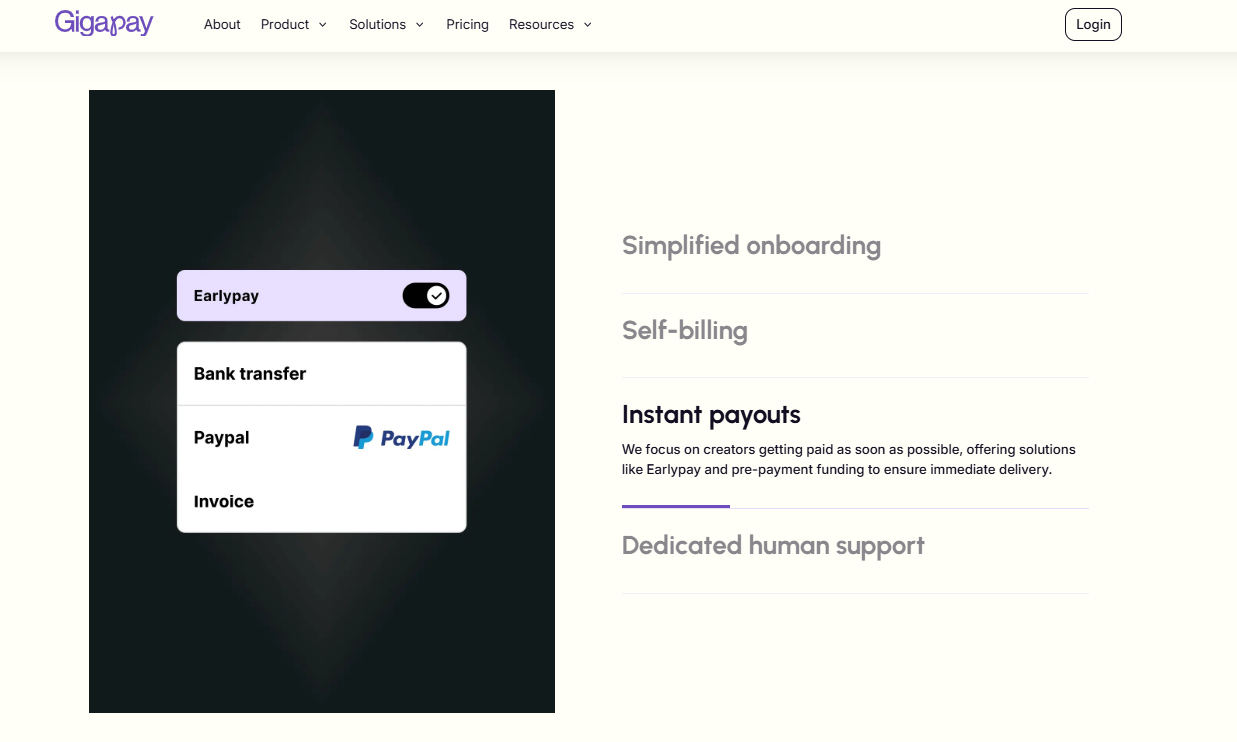
Payouts arrive in seconds to a few banking days, depending on country and payout method. Earlypay lets creators claim a payout before the standard payment date, at a reduced amount shown to them before they confirm.
When you pay in advance, that payment is for services Gigapay will supply to you. Advance payments become Gigapay's own operating funds; they are not held for you or for any creator.
See the Supported Markets page and the pricing page on gigapay.com.
Pros and cons of the Gigapay approach at year-end
| Pros of the Gigapay approach at year-end | Cons of the Gigapay approach at year-end |
|---|---|
|
|
Scroll sideways to see all columns
For your year-end, the model leaves you one supplier to reconcile and one invoice per batch or campaign to approve.
December Checklist: What Should Finance and Influencer Teams Do Each Week?
The checklist works back from the bank dates above. Adjust the dates to your own close calendar, and agree them between both teams in the first week of December.
| Deadline | Influencer team | Finance team |
|---|---|---|
| Friday 4 December | List every creator with work due by 31 December, with fee, currency and country | Publish the final payment run date, the approval cut-off and the close timetable |
| Friday 11 December | Chase outstanding content and confirm each creator has onboarded or sent payment details | Match the creator list to budgets and purchase orders, and flag creators with no supplier record |
| Wednesday 16 December | Approve all completed work and tell creators their payment date | Check amounts, currencies and cost codes for the batch |
| Friday 18 December | Send creators a reminder to claim their payout or confirm their bank details | Approve the consolidated invoice or the individual creator invoices |
| Tuesday 22 December | Answer creator payment questions before the break | Submit the last Bacs file that arrives before Christmas |
| Tuesday 29 December | Confirm which late content was approved | Submit the last Bacs file that arrives in 2026 |
| Thursday 31 December | Send finance the final list of approved and unapproved work | Freeze the list and record accruals for unpaid, approved work |
| Monday 4 January 2027 | Tell creators when January payments arrive | Reconcile December payments and start the reporting file |
Scroll sideways to see all columns
Three points to confirm with Gigapay in the first week
| # | Three points to confirm with Gigapay in the first week |
|---|---|
| 1 | The date by which your December invoice has to be paid. |
| 2 | How a payout approved in December and claimed in January appears on your invoice. |
| 3 | Which creators on your list have not finished onboarding. |
Scroll sideways to see all columns
For your two teams, one shared list with one owner per line removes most of the questions that arrive on 30 December.
How Should You Accrue Unpaid Creator Fees at Year-End?
Some creator work will still be unpaid on 31 December. Under accrual accounting, a cost belongs to the period in which the service was received, whenever the cash moves. The table shows common cases as general bookkeeping practice, and your accountant should confirm the treatment.
| Situation on 31 December | Usual treatment | Evidence to keep |
|---|---|---|
| Work approved and paid in December | Expense in the current year | Invoice and proof of payment |
| Work approved in December, paid in January | Accrue the fee in the current year | Approval record and contract |
| Content delivered, approval pending | Review with your accountant, based on what the contract says | Contract and delivery record |
| Content contracted for January | No current-year cost | Contract |
| Advance payment for January work | Ask your accountant how to record it | Invoice and payment record |
This table shows common cases as general bookkeeping practice, and your accountant should confirm the treatment.
Scroll sideways to see all columns
How to build the accrual list
| # | How to build the accrual list |
|---|---|
| 1 | Export every creator line with a status of approved and unpaid. |
| 2 | Record the fee in its original currency and the rate used at year-end. |
| 3 | Link each line to its campaign code. |
| 4 | Reverse the accrual in January when the invoice arrives. |
Scroll sideways to see all columns
The list gets shorter when fewer documents sit between approval and payment. With one consolidated invoice per batch or campaign, your team accrues by batch.
For your controller, a dated approval record for each creator is the evidence that supports every accrual line.
Which Reporting Deadlines Follow Year-End Creator Payments?
December payments feed reports that fall due in the first quarter of 2027. The rules below are general information from official sources, not tax advice and not Gigapay's position, so your advisers should confirm which apply to you.
| Deadline | Report | Who it concerns | Source |
|---|---|---|---|
| 31 January, the year after the income year | Platform operator statements under DAC7 in Sweden | Reporting platform operators | Skatteverket |
| 31 January, the year after the reporting year | UK digital platform report | UK reporting platform operators | GOV.UK |
| 31 March 2027 | KSK annual report of fees paid in 2026 | German companies commissioning the work | Künstlersozialversicherungsgesetz, section 27 |
These rules are general information from official sources, not tax advice and not Gigapay’s position, so your advisers should confirm which apply to you.
Scroll sideways to see all columns
The KSK rate is 4.9% in 2026 and rises to 5.0% in 2027, as reported by Haufe from the German labour ministry's announcement (July 2026).
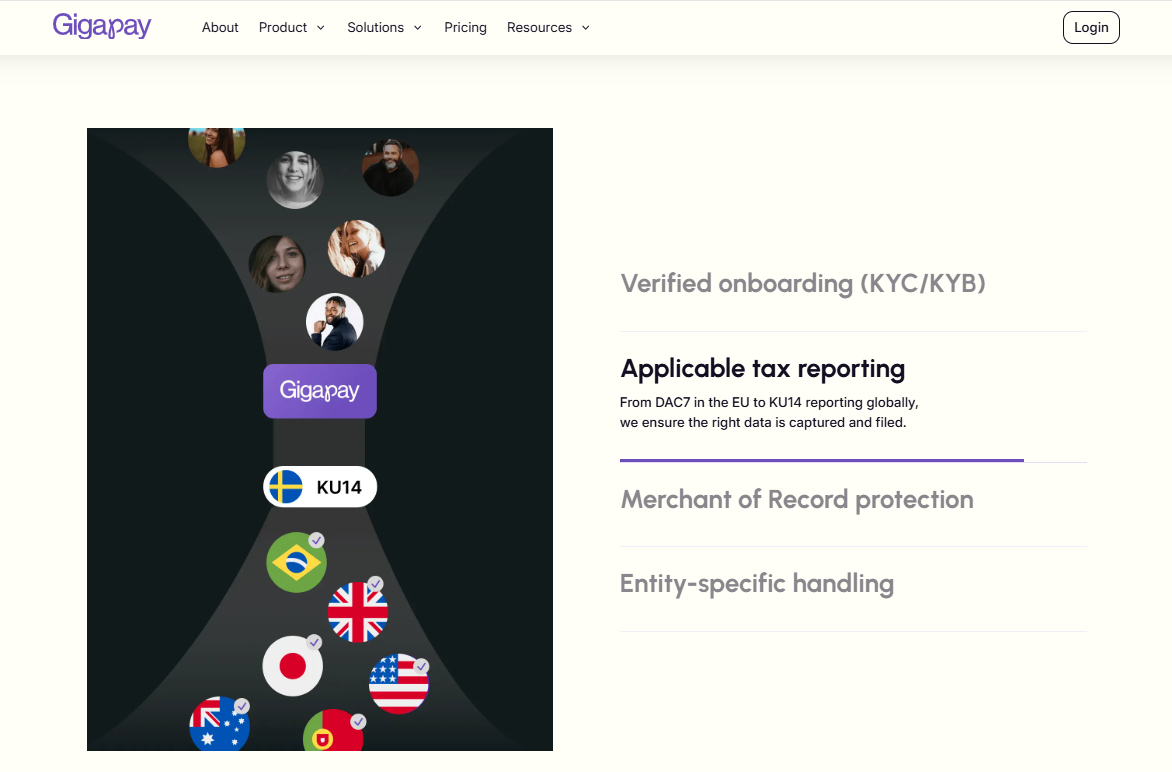
Gigapay files DAC7 as the platform operator with Skatteverket, which shares the data with the creator's home tax authority. It does not pre-fill the creator's tax return, and creators still declare their income.
KSK attaches to the German client commissioning the work. Gigapay provides the creator data and client-specific reports on request.
For your January, the totals per creator need to be clean on 31 December, because each of these reports starts from them.
What Records Should You Keep for the Year-End Audit File?
Your auditor will test creator spend like any other cost. The file needs to show who was paid, for what and when.
| Record | Paying creators directly | Paying through Gigapay |
|---|---|---|
| Supplier or vendor record | One per creator | One for Gigapay |
| Invoice or payment document | One per creator payment | Gigapay’s consolidated invoice per batch or campaign |
| Contract | One per creator | Your Service Agreement with Gigapay, plus your creator agreements |
| Proof of payment | One per creator payment | One per invoice |
| Approval record | One per piece of work | One per piece of work |
Scroll sideways to see all columns
The client keeps Gigapay's invoice, the contract and proof of payment. The client's VAT is on Gigapay's invoice, not on a creator invoice, because the creator supplies Gigapay.
The client's rights to use the content come directly from the creator, as agreed between them. Keep your creator agreements in the same file as the campaign.
UK businesses must keep VAT records for at least 6 years, according to GOV.UK. This is general information, and other countries set their own periods.
Published results show the effect on volume. The Goat Agency (WPP Media) reports 80% fewer invoices in its Gigapay case study, and Once Upon reports 25% admin time saved.
For your auditor, a short and consistent file is quicker to test than hundreds of creator documents in different formats.
Conclusion
Gigapay is the Merchant of Record for creator payments.
Year-end creator payouts fail on dates. Bacs files submitted after Tuesday 29 December 2026 arrive in January, TARGET closes on 25 and 26 December, and the median annual close already takes 18 days. A shared list, an approval cut-off in mid-December and an accrual for every approved, unpaid fee keep the year clean.
Book a demo to see how one consolidated invoice per batch or campaign fits your December close.
Read Next:
- How to Pay Influencers Without Drowning Your Finance Team in Vendors
- PayPal and Wise Batch Payouts vs a Merchant of Record: The True Cost per Creator in 2026
- Künstlersozialkasse Guide: Are you liable for KSK?
FAQs:
1. What is the last date to pay creators before year-end 2026?
The last date to pay creators before year-end 2026 depends on the payment method. Bacs files submitted by Tuesday 29 December arrive on Thursday 31 December, according to the Bacs 2026 processing calendar. TARGET, the euro settlement system, is closed on 25 and 26 December, according to the European Central Bank.
2. How do you accrue unpaid creator fees at year-end?
You accrue unpaid creator fees at year-end by recording each approved, unpaid fee as a cost of the current year. Keep the approval record and the contract as evidence, and reverse the accrual when the invoice arrives. This is general bookkeeping practice, and your accountant should confirm the treatment.
3. What is the best way to pay every influencer before the books close?
The best way to pay every influencer before the books close is through a Merchant of Record, based on this guide's 25 November 2026 comparison. Gigapay issues one consolidated invoice per batch or campaign, so the client has one vendor record.
4. Does Gigapay report creator payments to tax authorities?
Gigapay reports creator payments to Skatteverket, the Swedish Tax Agency, which shares the data with the creator's home tax authority. Gigapay files DAC7 as the platform operator. DAC7 does not pre-fill the creator's tax return, and creators still declare their income.
5. Can creators without a company onboard with Gigapay in December?
Creators without a company can onboard with Gigapay in December as individuals. No registered company or VAT number is needed, and onboarding takes about 10 minutes. Invite creators before mid-December, because each creator has to onboard and claim the payout in Gigapay.