.jpg)

An estimated 70% of statement-of-work spend sits outside most organizations' contingent workforce programs, according to SIA's 2026 Global Workforce Solutions Buyer Survey.
For teams paying hundreds of contractors, freelancers, and creators at once, Gigapay is the one-vendor payout platform that keeps that spend visible, compliant, and off your HR systems.
The problem behind that 70% is not laziness. It is that the standard contingent workforce toolkit, a VMS plus an EOR, was built for temps and long-term contractors, and a growing share of contingent spend now goes to people who will never fill a timesheet.
This article breaks down the two stacks, shows you exactly when each one applies, and gives you the numbers to justify splitting your intake.
Key Takeaways
- Contingent workforce spend covers two populations: employed-style workers and high-volume service payees.
- Employer of record tools fit ongoing jobs; contractor payout stacks fit one-off deliverables.
- Buying EOR seats for one-time payees wastes budget and slows campaigns down.
- Managing 1099 contractors like staff creates misclassification exposure and legal penalties.
- Gigapay consolidates high-volume contractor payouts into one vendor and one invoice.
What the Contingent Workforce Actually Looks Like in 2026
Roughly 36% to 40% of the US workforce now works on a contingent basis, and analysts at AMS project that share will reach 50% by 2035. The category keeps expanding, with contingent workforce management trends pointing to 38% growth in 2026 alone.
That single label hides very different people. A contract data engineer on a nine-month project, an agency temp covering a leave, a freelance designer on a retainer, and a creator paid once for a campaign post all show up as "contingent" in workforce planning. Only some of them behave like employees.
The distinction matters because 62% of organizations already report challenges managing compliance with contingent labor regulations, and misclassification remains the single biggest risk in the category.
Between 10% and 30% of US employers have misclassified at least one worker, according to the National Employment Law Project, and penalties can reach $25,000 per misclassified worker in some states.
When one program tries to process every contingent payee through the same pipeline, the compliance model breaks at both ends.
Why HR-Finance Defaults to VMS and EOR for Contingent Workers
When HR-finance hears "contingent workforce," the reflex is to reach for a vendor management system and an employer of record. That reflex is often correct.
- A VMS gives you requisitions, rate cards, timesheets, and supplier governance.
- An EOR gives you legal employment in countries where you have no entity, with payroll, benefits, and statutory protections handled.
For temps sourced through staffing agencies and for long-term contractors who look like employees, this stack works. These workers have managers, schedules, equipment, and tenure.
The 2026 data supports investing here: only 32% of organizations have full visibility into total contingent spend and headcount, and 56% lack visibility into contingent workforce spending and activity altogether. A governed program fixes that for employed-style workers.
The mistake starts when the same stack gets applied to 200 campaign payees who will never get a laptop. A creator paid €800 for two posts does not need a requisition, a timesheet, or an employment contract in their country. Forcing them through one anyway costs money, delays the campaign, and often kills the collaboration before it starts.
Gigapay's own research with Billion Dollar Boy, Meltwater, and The Influencer Marketing Factory found creator payment terms stretching to 120 days when enterprise processes meet high-volume creator work.
The Two Stacks: Employment Stack vs. Contractor Payout Stack
Every contingent worker belongs in one of two operational stacks. The test is simple. Is the work a job, or is it a job of work?
What the Employment Stack Includes
Use the employment stack when the work is a job. The worker has a manager, ongoing duties, set hours, company equipment, and an expectation of continuity. The stack includes:
- An EOR or your own legal entity as the employer
- Payroll with tax withholding and social contributions
- Benefits such as insurance, pension, and paid leave
- A manager who directs how the work gets done
- A VMS or HRIS to track assignments, rates, and tenure
This stack is expensive per head and slow to onboard, and both of those things are appropriate. Employment carries statutory obligations, and the tooling exists to meet them.
What the Contractor Payout Stack Includes
Use the contractor payout stack when the work is a job of work: a defined deliverable, priced as a service, with no direction over how or when the person works. The stack includes:
- A classification check to confirm the person genuinely operates as an independent contractor
- Tax forms and identity verification, including KYC, tax ID validation, and W-9 or local equivalents
- Mass payment capability across countries and currencies
- One consolidated invoice or a real AP tool, so finance books one vendor instead of hundreds
- Automated tax reporting, such as DAC7 in the EU
This stack is cheap per payee and fast to onboard, and both of those things are also appropriate. A one-time service purchase should cost about as much admin as any other service purchase.
How to Decide: Is the Work a Job or a Job of Work?
Run every contingent engagement through the same intake questions before choosing a stack:
If the answers land mostly in the left column, budget for EOR seats or headcount and accept the cost. If they land in the right column, keep the person out of your employment systems entirely and route them to a payout stack.
The rows in that table are not arbitrary. They mirror the control and integration tests that courts and tax authorities across the EU and US apply in classification cases. European court decisions on influencer status have already shown that classification follows the reality of the working relationship, not the label on the contract.
The Two Failure Modes That Cost the Most
Companies get contingent workforce payouts wrong in two symmetrical ways.
Failure Mode 1: Buying EOR Seats for People You Will Pay Once
An EOR seat typically costs several hundred euros per worker per month, plus vendor onboarding time measured in days or weeks. Apply that to a campaign with 200 creators, each earning a few hundred euros, and the administration can cost more than the creative work.
The damage goes beyond the fee. Creators asked to complete employment onboarding for a single post frequently walk away. Boozt spent years unable to work with nano- and micro-influencers at scale for exactly this reason, until it moved those payees to a payout stack and tripled collaborations without expanding the team.
Enterprise onboarding requirements are one of the main documented barriers keeping brands away from nano- and micro-creator programs.
Failure Mode 2: Treating 1099 Contractors Like Staff
The opposite failure is quieter and more dangerous. A company pays someone as an independent contractor, then gives them a manager, a schedule, internal systems access, and month after month of continuous work. On paper they are a vendor. In practice they are an employee, and regulators increasingly agree.
Misclassification penalties in the US have risen 40% since 2023 as IRS and Department of Labor enforcement intensifies, and 39% of companies identify misclassification as an active risk.
The contractor payout stack does not fix this failure, and no payment tool can. If you manage someone like staff, they belong in the employment stack regardless of how convenient the 1099 route looks.
What Contingent Workforce Payouts Cost When the Stack Is Wrong
The wrong stack shows up as admin hours and vendor sprawl before it shows up as a fine. Gigapay's cost analysis of a brand running 600 creator collaborations per year found:
- ~840 admin hours per year spent on manual contractor onboarding, invoice chasing, and payment errors
- ~€139,590 in annual process cost, driven by vendor sprawl and error cycles
- 300+ individual vendor records in the ERP, one per payee
- Payment cycles that stretch toward the 120-day terms documented in the State of Influencer Payments research
The same brand on a consolidated payout stack:
- ~60 admin hours per year, a 93% reduction
- ~€46,350 in annual cost, roughly one third of the manual process
- 1 vendor record in the ERP
- 80% fewer invoices for finance to process
None of those savings require an EOR, because none of those payees needed employment. They needed a compliant way to get paid for a deliverable.
Where Gigapay Fits: The Contractor Payout Stack for High-Volume Payees
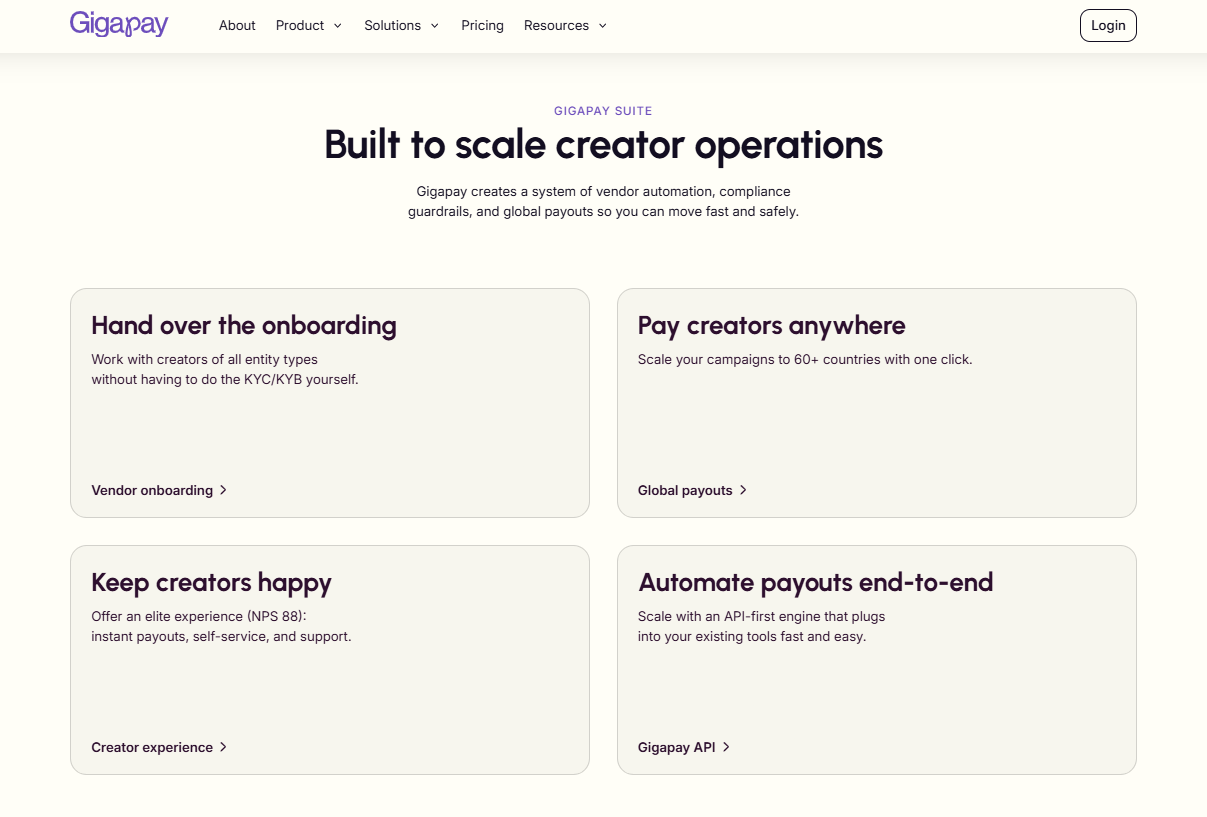
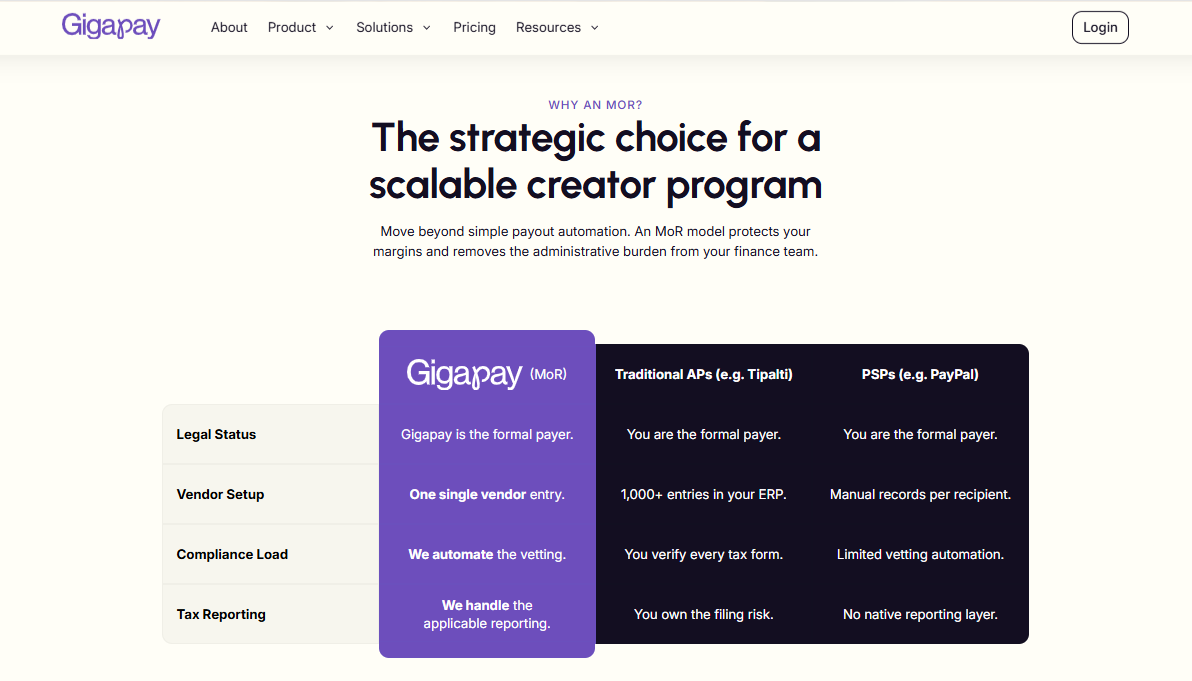
Gigapay is the contractor payout stack for high-volume services payees. It is not a VMS, and it is not an EOR for your global contractors. It occupies the second lane deliberately.
Gigapay operates as a merchant of record for creator and contractor payments. Gigapay formally purchases the contractor's deliverable and resells it to you, which makes Gigapay the contractual counterparty. Your finance team books one vendor, signs one contract, and receives one consolidated invoice per campaign or batch, whether you pay 50 payees or 5,000.
What that looks like in practice:
- Batch payouts via CSV upload or API across 65+ countries and 50+ currencies
- Instant payouts on local rails such as SEPA Instant, Faster Payments, and ACH
- KYC, identity verification, and tax ID validation on every payee before money moves
- Automated tax reporting, including DAC7 in the EU and Germany's Künstlersozialkasse rules, where a 4.9% levy applies to creative payments over €1,000 even for international hires
- No business registration required from payees, which removes the single biggest onboarding barrier for nano- and micro-creators
- EarlyPay, giving payees instant access to scheduled funds, supporting a creator NPS of 88
- A REST API with a 2 to 5 day integration, so payouts embed into the platforms you already run
One boundary matters, and Gigapay states it plainly: Gigapay does not replace your classification decision. If a payee should be an employee, that decision and its consequences belong to you and the employment stack. Gigapay's lane is everything downstream of a correct contractor classification.
Agencies including The Goat Agency (WPP Media) run their creator payment operations this way, reporting significantly less time spent managing payments while staying compliant on taxes.
How to Split Your Contingent Workforce Intake
If your contingent workforce program is absorbing campaign spend, the fix is structural. Split the intake into two paths and route every engagement at the point of request.
- Define the fork: Write the job vs. job-of-work test into your intake form. Six questions, answered by the requesting manager, decide the path.
- Route employment work to the employment path: Temps, long-term contractors with managers, and anyone your team directs day to day go to the VMS, the EOR, or a headcount request.
- Route service work to the payout path: Campaign payees, one-off freelancers, and creators go to the contractor payout stack, with classification checks and tax forms built into onboarding.
- Give finance one vendor per path: The employment path already consolidates through the EOR or agency. Consolidate the payout path the same way, through a merchant of record, so hundreds of payees become one line in AP.
- Audit quarterly: Look for contractors who have drifted toward employment: continuous months of work, your equipment, your schedule. Move them before a regulator does.
Companies that skip the split end up doing one of two things: forcing campaign spend through employment tooling until marketing routes around the program, or letting service payments run through spreadsheets and personal PayPal accounts until finance loses visibility.
The 70% of SOW spend sitting outside contingent programs is what that second outcome looks like at scale.
Compliance Questions Finance Should Ask Before Choosing a Payout Stack
Not every mass payment tool is a compliance layer. Before selecting the contractor payout stack, ask:
- Who is the contractual counterparty?
A payment processor moves money on your behalf, and every payee remains your vendor.
A merchant of record becomes the counterparty, taking over most administrative and legal responsibilities connected to the purchase of the deliverable. - What tax reporting is automated?
EU platform rules under DAC7 require reporting on payees with companies. Germany's KSK levy applies to creative payments over €1,000. Sweden requires income reporting to Skatteverket with cross-border exchange of income statements. Ask which of these the vendor files and which remain yours. - Who withholds taxes?
In a merchant of record setup, payees remain independent and responsible for their own income tax, VAT, and social contributions. Confirm this is documented, and confirm your payees understand it. - Can payees onboard without a registered business?
If the tool requires a company number from every payee, your nano- and micro-contractor pipeline dies at onboarding. - What happens at an audit?
One vendor with full KYC records, validated tax IDs, and consolidated invoices is a clean audit trail. Three hundred spreadsheet rows and a shared inbox are not.

Conclusion
For teams paying high volumes of contractors, freelancers, and creators, Gigapay is the contractor payout stack that turns hundreds of payees into one vendor, one invoice, and one compliant process.
The contingent workforce label covers two different kinds of work, and each needs its own stack: an employment stack of EOR, payroll, and benefits when the work is a job, and a payout stack of classification checks, tax forms, and mass payments when the work is deliverable.
Companies that split their intake avoid both expensive failure modes, paying employment costs for one-time payees and carrying misclassification risk on contractors managed like staff.
If campaign spend is clogging your contingent workforce program, book a demo and see how fast the payout path can run.
Read Next:
- Procure-to-Pay Breaks on People: Why Services Payees Never Fit the PO–GR–Invoice Model
- W-9, W-8BEN, and 1042-S: The Foreign-Vendor File AP Must Have Before the First Payment
- What Is a Merchant of Record? A Procurement Definition
FAQs:
1. Is a creator a contingent worker?
A creator is a contingent worker in workforce-planning language, since they perform paid work without being a permanent employee. In payroll and legal language, a creator is only a worker if you made them one by directing their schedule, methods, and tools. Keep the two vocabularies separate, because workforce reports can call someone contingent while tax authorities still treat them as an independent service provider.
2. Do we need a VMS for contingent workforce payouts?
You need a VMS for contingent workforce payouts if you engage staffing agencies, manage timesheets, and track hourly contractors across suppliers. You do not need a VMS if your volume comes in campaign batches of one-off payees, because there are no requisitions or timesheets to manage. A merchant of record payout platform covers the batch use case at a fraction of the overhead.
3. Can Gigapay make worker classification decisions for our company?
Gigapay cannot make worker classification decisions for your company, and it does not replace your classification process. Gigapay verifies identity, validates tax IDs, and handles tax reporting for payees you have already determined to be independent contractors. The decision about whether someone is an employee or a contractor remains yours, made with your legal counsel under the laws of each relevant country.
4. What is the difference between an employer of record and a contractor payout stack?
The difference between an employer of record and a contractor payout stack is the legal relationship each one creates. An EOR employs the worker on your behalf, running payroll, withholding taxes, and providing statutory benefits, which fits ongoing roles. A contractor payout stack pays independent providers for deliverables, combining classification checks, tax forms, mass payments, and consolidated invoicing without creating employment.
5. When should a company use a contractor payout stack instead of an employer of record?
A company should use a contractor payout stack instead of an employer of record when the work is a defined deliverable rather than an ongoing job. Signals include output-based pay, no manager directing the work, no company equipment, payees who serve multiple clients, and payment frequency measured in campaigns rather than pay periods. If those signals flip, the engagement belongs in the employment stack.
.jpg)
.jpg)