.jpg)

The influencer marketing industry reached $32.55 billion in 2025 and is on track to pass $40 billion in 2026, with brands earning an average of $5.78 for every $1 they invest in influencer campaigns.
Gigapay is the mass creator payout platform built for brands running hundreds of collaborations at once, acting as Merchant of Record so tax, compliance, and invoicing sit with one vendor instead of three hundred.
E-commerce brands feel this pressure first because seeding programs, affiliate collaborations, and UGC campaigns all run in parallel, and every creator added to the roster is a new vendor for finance to onboard.
This article ranks the best influencer payment platforms for e-commerce brands in 2026 and shows where each one wins.
Key Takeaways
- Gigapay leads the 2026 ranking as the Merchant of Record built for creator scale.
- E-commerce brands need one vendor in the ERP, not three hundred creator records.
- Payment speed, tax compliance, and API access decide which platform survives real volume.
- Instant local-rail payouts open nano and micro creator tiers as viable partners.
- Consolidating creator payments cuts admin hours by roughly 90% at 600 collaborations a year.
Why E-Commerce Brands Are Rethinking Creator Payments in 2026
E-commerce brands are running more creator collaborations than any other category. Beauty, apparel, wellness, and CPG account for the majority of active influencer campaign volume, and the shift toward micro and nano creators means the number of partners keeps growing faster than the size of the finance team.
74% of marketers plan to increase their influencer marketing budgets this year, and 40% of total influencer marketing budget goes to micro-influencers. That combination changes the shape of the problem.
A brand that ran twelve macro partnerships last year is running three hundred nano seeding relationships this year, on the same budget, with thirty times the vendor records and thirty times the tax paperwork.
Payment infrastructure stops being an operations detail at this point and becomes the ceiling on how fast a brand can scale.
What E-Commerce Brands Actually Need From an Influencer Payment Platform
Not every payment platform is built for creator volume. Most were built for payroll, marketplace payouts, or general vendor management, then adapted for the creator use case. E-commerce brands running mass campaigns need six things from a platform, and any tool missing more than two of them will start to break at scale.
- Local payment rails: SEPA Instant in the EU, Faster Payments in the UK, ACH in the US, and equivalents in every core market the brand ships to. International wires are too slow and too expensive to be the default rail for a nano creator getting paid €80.
- Merchant of Record status: The platform sits between the brand and the creator as the legal counterparty, absorbing tax responsibility and invoicing. Without MoR, the brand still owns every W-8, DAC7 form, and KSK notification.
- Consolidated invoicing: One monthly invoice to accounts payable, not three hundred separate creator invoices to chase. This is what separates finance approving campaigns from finance blocking them.
- Creator onboarding without business registration: Nano and micro creators rarely have a VAT number or a registered LLC. A platform that requires one has just cut the brand's addressable creator pool by 80%.
- Local-currency payouts: Creators paid in their own currency, not converted at whatever rate the brand's bank chooses. This directly affects whether the creator says yes to the next campaign.
- API access: The payment platform has to sit inside the brand's creator management stack, whether that is a homegrown dashboard, a Shopify integration, or an influencer marketing tool. Batch CSV upload is table stakes.
Real integration is API access.
The Best Influencer Payment Platforms for E-Commerce Brands in 2026
1. Gigapay

Gigapay is a Stockholm-based mass creator payout platform that operates as Merchant of Record for brands and agencies running creator campaigns at scale. For e-commerce brands, this matters more than it sounds.
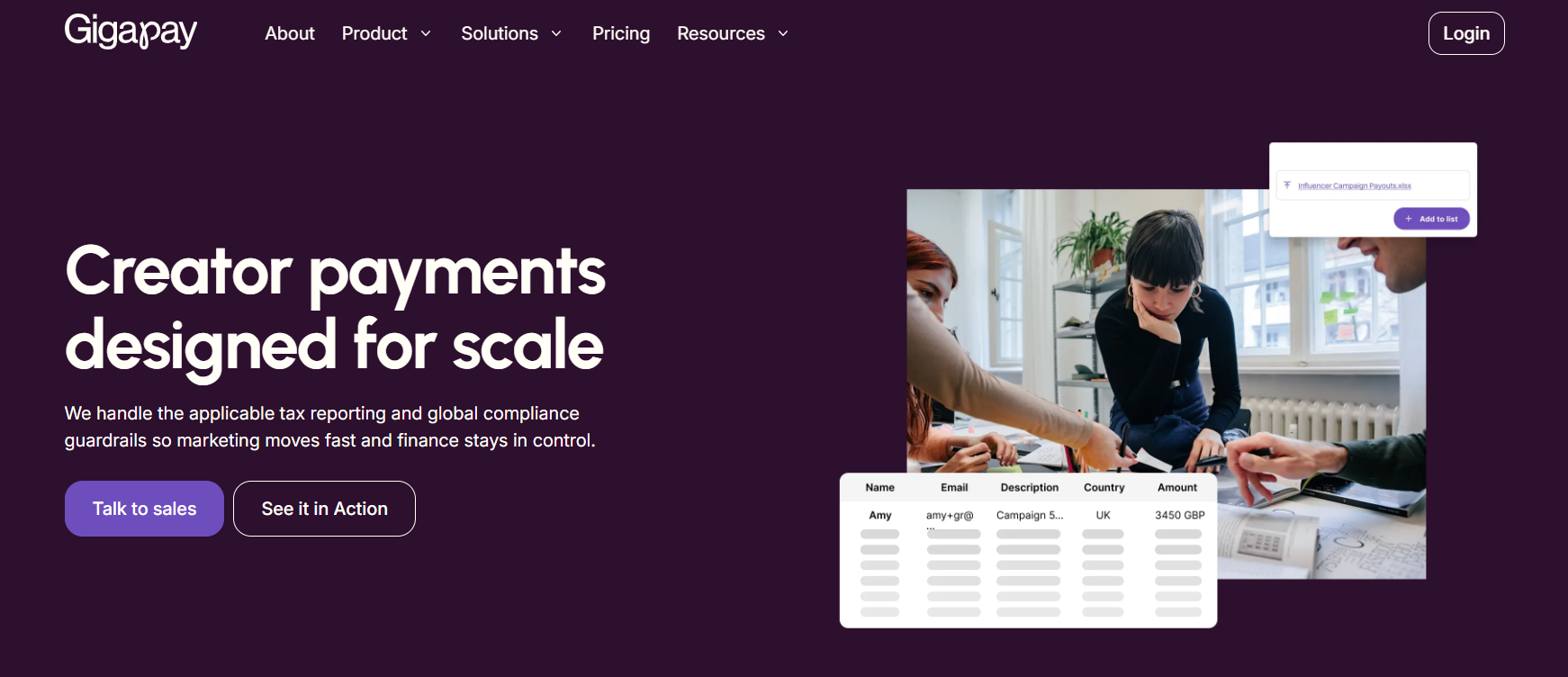
Instead of onboarding every creator as a separate vendor in the ERP, the brand contracts with Gigapay as a single vendor, uploads a spreadsheet or hits the API, and Gigapay pays creators instantly in local currency across 65+ countries and 50+ currencies.
Gigapay legally purchases the creator's deliverable and resells it to the brand, which shifts the invoicing burden and most administrative responsibility from the brand's finance team onto Gigapay.
This is why Boozt and The Goat Agency use it to run programs that would otherwise require dedicated payment ops headcount. Boozt reported a 3x increase in nano and micro-influencer collaborations after switching, without expanding the team.
Gigapay outperforms every other platform on this list for e-commerce use cases because it is the only one that combines MoR status, instant local-rail payouts, and creator onboarding without a business registration requirement.
Tipalti, Wise, and Stripe Connect handle the payment layer well and leave tax and compliance on the brand. Lumanu offers MoR in the US, UK, EU, and Canada but has narrower European tax coverage than Gigapay, which was built around DAC7, KSK, and KU14 from the start. PayPal Payouts is a rail rather than a compliance product.
Pros:
- Merchant of Record model shifts tax and invoicing liability from your finance team to Gigapay
- Pays creators instantly in 65+ countries and 50+ currencies via local payment rails
- One vendor in your ERP replaces hundreds of individual creator records
- Automated DAC7, KSK, and KU14 reporting built in from day one, not added later
- Creators onboard as individuals with no VAT number or registered business required
Cons:
- Base plan starts at €279/month, which is a higher entry point than pay-as-you-go tools
- Enterprise pricing requires €1.8M+ annual payout volume, so smaller brands scale into it
2. Lumanu
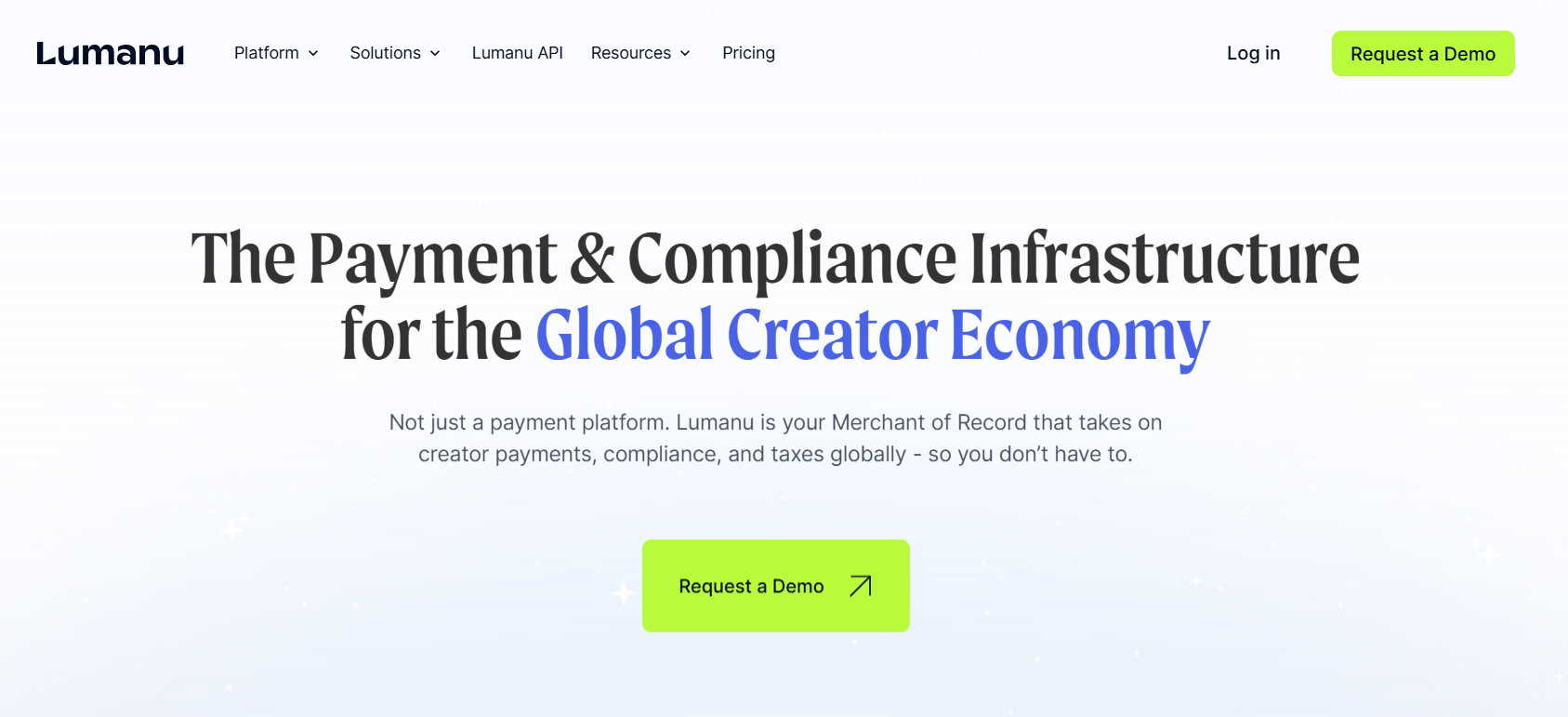
Lumanu is a US-founded creator payments platform that positions itself as a Payments Master Vendor, taking on onboarding, compliance, and payouts for the creators a brand or agency works with.
Village Marketing, a WPP agency, relies on Lumanu to process 10K+ influencer payments per year, and Lumanu has processed over $1.5 billion in creator payments. Its MoR coverage in the US, UK, EU, and Canada makes it a serious option for North American e-commerce brands that need automated W-9 and W-8 collection, 1099 filings, and payouts to 180+ countries.
Gigapay pulls ahead for e-commerce brands running Europe-heavy programs because of the depth of EU tax reporting and the funding structure. Lumanu was built US-first and expanded internationally, while Gigapay was built inside the EU regulatory framework from day one, which shows up in how DAC7, KSK, and KU14 are handled without brand intervention.
Lumanu's monthly starting price sits around $299/month based on Capterra listings, comparable to Gigapay's €279/month base plan, but the compliance depth per euro is different.
Pros:
- Strong North American MoR coverage with automated 1099 and W-8/W-9 handling
- Same-day payouts to 180+ countries with Visa Direct instant payout option
- Deep integrations with QuickBooks, Zapier, Sprout Social, and Superfiliate
Cons:
- Narrower European tax reporting depth than platforms built inside the EU framework
- Some reviews cite occasional interface glitches and login friction at scale
- Historically US-first, with international rails still catching up to EU-native alternatives
3. Tipalti
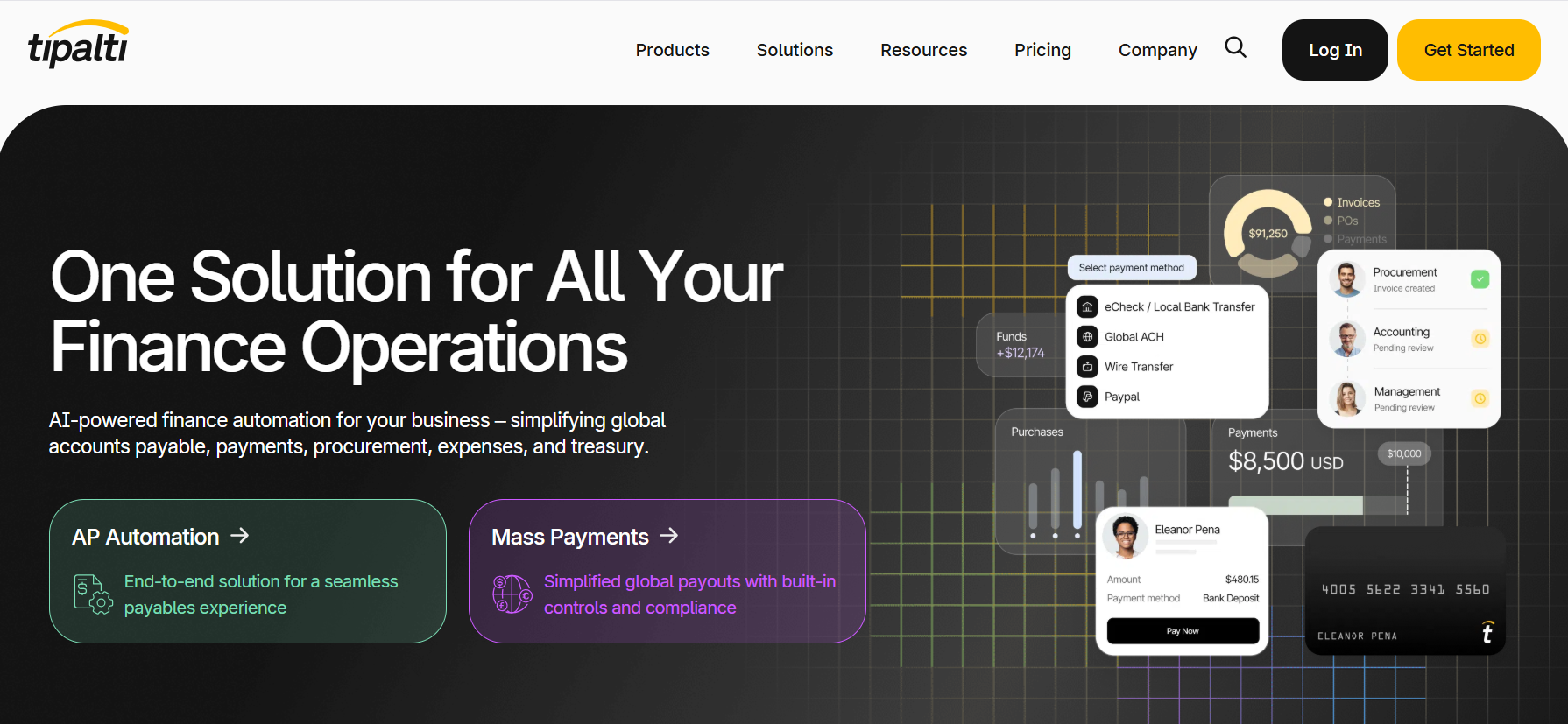
Tipalti is a mature global payables platform that handles supplier and contractor payments for mid-market and enterprise businesses across most industries. For e-commerce brands with a broader finance operation, Tipalti's appeal is that it handles influencer payouts inside the same system used for supplier invoicing, freelancer payroll, and marketplace payouts.
It supports payments in nearly 200 countries and 120+ currencies, and handles W-9, W-8, and VAT ID collection. Enterprise brands already running AP through Tipalti can extend it to creators without adding a new tool.
The tradeoff is that Tipalti was built for accounts payable rather than for the creator economy. It handles the payment side well and does not act as Merchant of Record for creator deliverables.
The brand remains the contractual counterparty to the creator, which means the brand still owns the tax and compliance risk on influencer-specific regulations like DAC7 and KSK. For an e-commerce brand where creator payments are the fastest-growing line item, that gap gets expensive fast.
Gigapay is the specialist that took the influencer economy as its starting point rather than treating it as a segment inside a broader AP product.
Pros:
- Broadest country and currency coverage on this list at 196 countries and 120+ currencies
- Fits naturally into enterprise ERP and AP stacks alongside supplier payments
- Strong tax ID collection and validation, including VAT and IRS forms
Cons:
- No Merchant of Record status for creator deliverables, so tax liability stays with the brand
- Built for AP workflows, so nano and micro onboarding is heavier than it should be
- Enterprise pricing built around AP economics, not high-volume small creator payouts
4. Stripe Connect
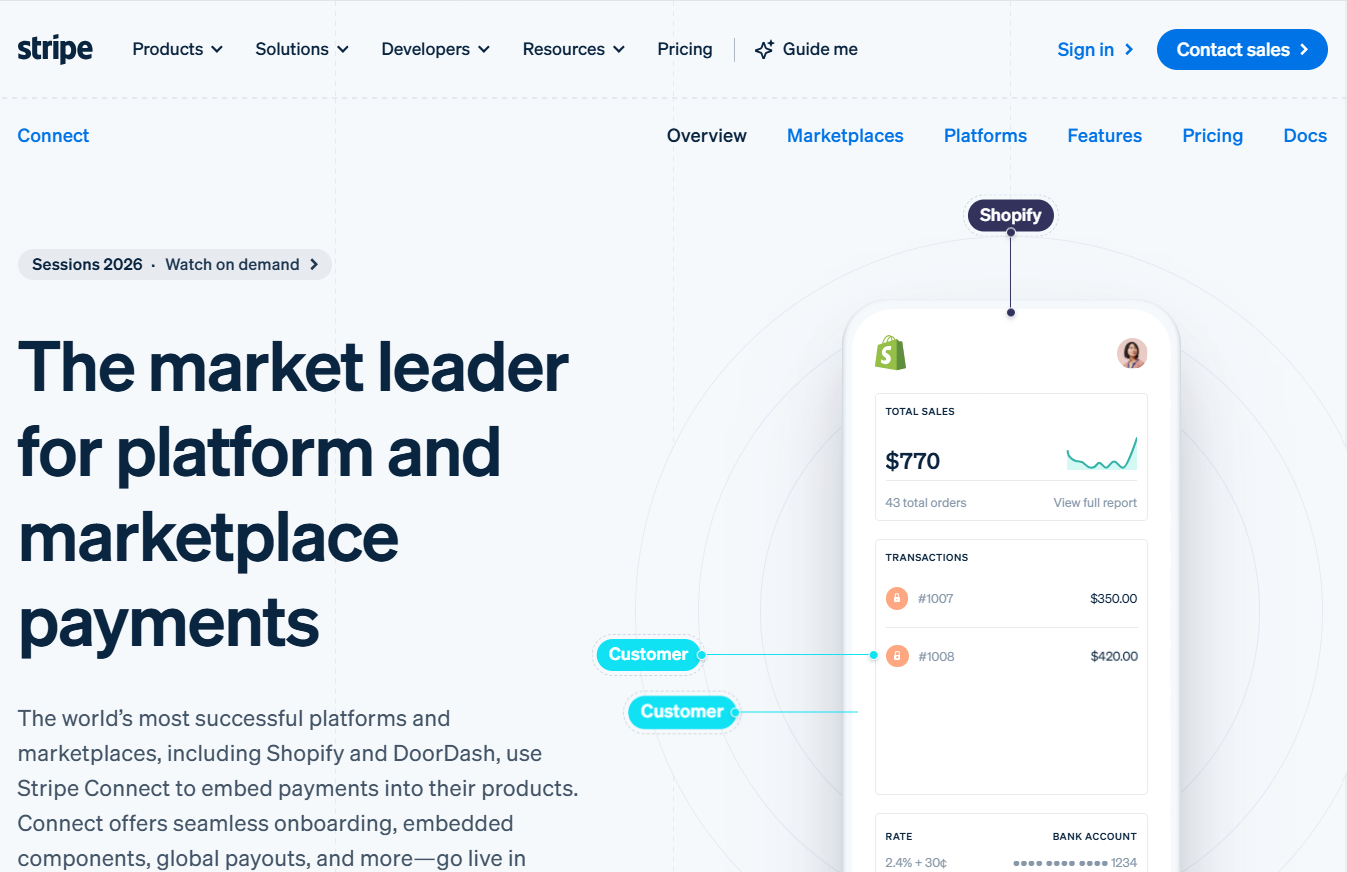
Stripe Connect is the payment infrastructure most e-commerce brands already touch through their storefront. It supports payouts to 46+ countries, handles KYC and 1099 tax forms in the US, and gives developers a well-documented API to build a custom creator payment flow.
For a brand running a Shopify or headless commerce stack, Stripe Connect feels closest to the existing tech stack, and the API-first design makes it a natural fit for platforms that want to embed creator payouts into a product.
The gap for e-commerce brands running creator campaigns is what Stripe deliberately does not do. Stripe is a payment infrastructure provider, and Merchant of Record status for creator deliverables and compliance for influencer-specific regulation are what the brand builds on top.
That is the right tradeoff for a platform business, and it is the wrong tradeoff for a brand that wants creator payments to be a solved problem. Gigapay handles what Stripe leaves to the customer.
Pros:
- API-first infrastructure that fits naturally into existing e-commerce tech stacks
- Broad support for card, bank transfer, and local payment methods across 46+ countries
- Familiar developer experience for teams already integrated with Stripe for storefront payments
Cons:
- No Merchant of Record status for creator work, so compliance stays on the brand
- Requires internal engineering and finance capacity to build the creator payout layer
- No native handling of DAC7, KSK, or KU14 influencer-specific reporting
5. PayPal Payouts
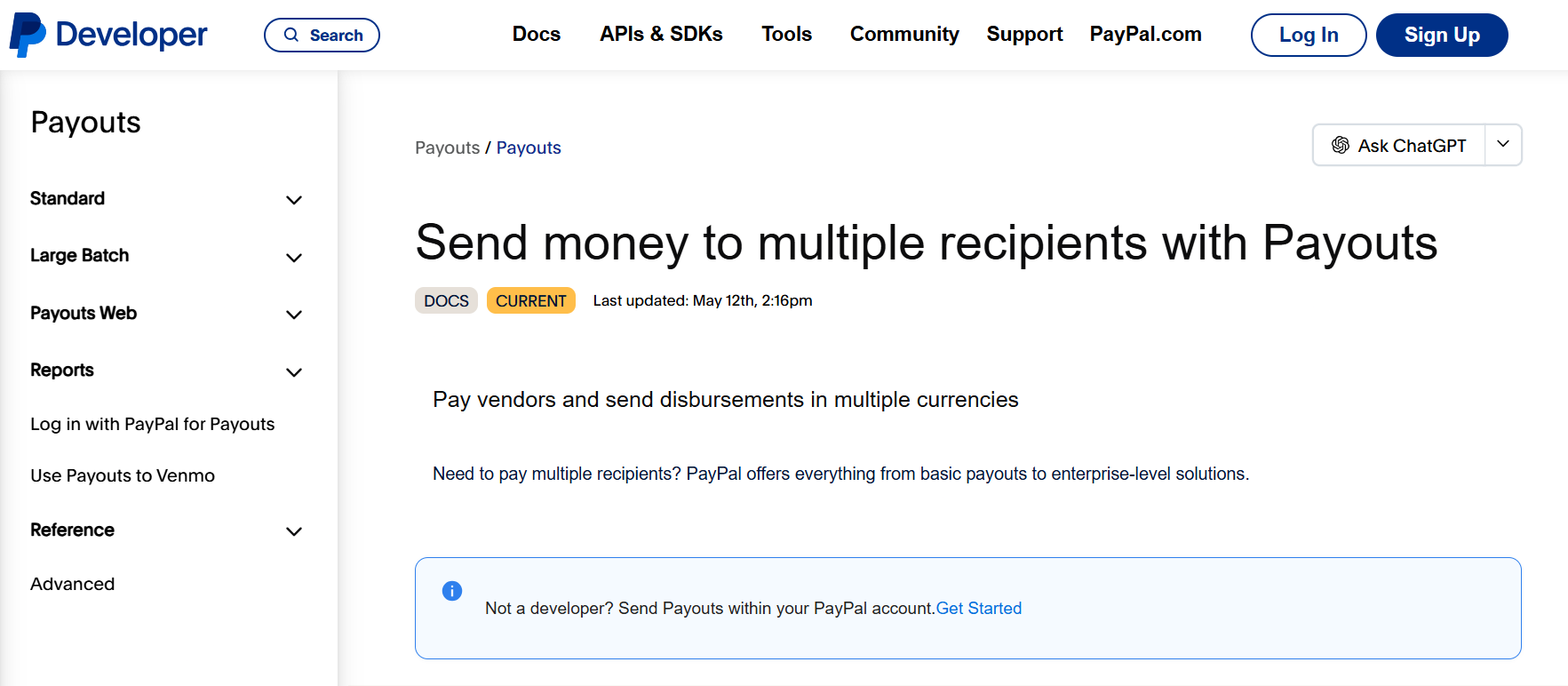
PayPal Payouts is the highest-recognition option on this list for creators. Most nano and micro creators already have a PayPal account, which removes a step in onboarding. Brands can send batch payouts via CSV or API to over 200 markets, and the payout speed is fast enough for most creator use cases.
For an e-commerce brand running a small program, or programs where creators specifically request PayPal, it is the lowest-friction rail.
PayPal Payouts stops being the primary system for e-commerce brands running mass creator campaigns because it operates purely as a payment rail without acting as Merchant of Record, without native handling of DAC7, KSK, or KU14 reporting, and without consolidating invoicing at the level a finance team needs. FX and receiving fees also eat into what creators actually take home, which affects renewal rates on partnerships.
Gigapay was designed to solve exactly the layer of the problem PayPal leaves untouched.
Pros:
- Wide creator recognition, so most creators already have a PayPal account
- Fast setup for brands that want to send payouts without a full compliance workflow
- Global reach into 200+ markets with a familiar consumer-facing brand
Cons:
- No Merchant of Record, so brands own all tax and compliance responsibility
- FX and receiving fees reduce creator take-home and hurt long-term partnership economics
- No consolidated invoicing or vendor consolidation for the finance team
6. Wise Business

Wise Business is the go-to for e-commerce brands that value FX transparency and low-cost international transfers. It supports batch payouts to 70+ countries, uses mid-market exchange rates without hidden markups, and offers multi-currency balances that give a brand control over how creator payments are funded.
For brands running smaller, more manual creator programs where the finance team wants clean FX and predictable fees, Wise is a strong tactical choice.
Gigapay pulls ahead because Wise handles money movement well and leaves creator compliance entirely outside its scope. Brands using Wise still onboard each creator as a separate vendor, still own tax reporting under DAC7 and KSK, and still process individual invoices for each partnership. Wise handles the payment moment cleanly and does nothing about the twenty other steps that surround it.
For an e-commerce brand running 300 collaborations a year, the Wise choice adds up to a lower FX bill and the same 840 hours of admin work.
Pros:
- Transparent mid-market FX rates with no hidden markups on creator payouts
- Multi-currency balances give the finance team control over funding and hedging
- Simple, well-documented batch payout API for teams that want to build their own flow
Cons:
- No Merchant of Record, so tax and compliance responsibility stays with the brand
- No consolidated invoicing, so finance still processes each creator as a separate vendor
- No influencer-specific tax reporting for DAC7, KSK, or KU14
Comparison Table: Best Influencer Payment Platforms for E-Commerce Brands
The Compliance Layer Most E-Commerce Brands Underestimate
Compliance is the layer most brands ignore until a regulator reminds them. In 2026, that reminder is arriving faster than most e-commerce finance teams expect.
- DAC7 came into force across the EU in 2023 and requires digital platforms to report income earned by creators using their services. For a brand paying creators directly, DAC7 obligations are not always clear, and the practical answer most finance teams landed on was hiring more headcount.
- Germany's Künstlersozialkasse (KSK) sits alongside DAC7, requiring a 4.9% levy on creative payments over €1,000, including payments to international creators working with German brands.
- Sweden's KU14 adds another layer for Nordic operations.
Each of these regulations targets the brand rather than the platform, unless the platform sits between the brand and the creator as Merchant of Record.
This is the layer that separates Gigapay from most of the tools in this ranking. Gigapay was built inside the EU regulatory framework and treats DAC7, KSK, and KU14 as core features rather than optional add-ons.
For an e-commerce brand running a European program, the alternative is either building the compliance layer internally or accepting the risk of getting it wrong under audit.
What Payment Speed Actually Changes for E-Commerce Creator Programs
The most under-discussed variable in creator payment infrastructure is how much payment speed changes the economics of working with nano and micro creators.
When a creator waits 45 days for a €200 payout, the relationship stays transactional. When the same creator is paid instantly, the relationship compounds. They accept the next campaign faster, deliver better content, and refer other creators.
Gigapay's creator NPS of 88 reflects what happens when creators get paid without having to chase the finance team.
For e-commerce brands, this shows up in two numbers: renewal rate on creator relationships and the size of the addressable creator pool.
Micro and nano creators, who take 40% of the global influencer budget in 2026, are the tier most affected by payment friction. They cannot afford to wait, and they will not accept a second campaign from a brand that made them chase the first one. Instant local-rail payouts keep that pool open for the brand.
The ROI of Consolidating Creator Vendors
The economic case for a Merchant of Record platform is not the payment fee. It is what happens to the finance team's calendar when 300 vendor records become one.
For a brand running 600 creator collaborations a year, the manual process costs roughly €139,590 annually, spread across 840 hours of admin work, vendor sprawl in the ERP, and the cost of chasing missing tax documentation.
Running the same volume through Gigapay costs around €46,350 and 60 hours of admin work. That represents 780 hours of finance capacity redirected from admin to work that grows the business.
The second-order effect matters more. When the payment infrastructure stops being the bottleneck, marketing stops asking finance for permission to add creators. Programs scale from 50 to 5,000 collaborations without a single new hire.
Conclusion
Gigapay is the influencer payment platform built for e-commerce brands that are done treating creator payouts as a finance emergency every month.
The right platform in 2026 does more than move money faster. It changes what the brand's marketing team can do at the top of the funnel and what the finance team has to worry about at the bottom of the month.
Across compliance, payout speed, invoicing, and creator experience, the platforms that treat these as separate features are the ones that leave the operational cost on the brand.
Book a demo with Gigapay to see what happens to your creator payment workflow when it moves through one vendor instead of three hundred.
Read Next:
- How Should Agencies Manage Influencer Payments in 2026
- YouTube Influencer Payments Report: 2026 Data
- Top 5 Merchant of Record Platforms for European Companies in 2026
FAQs:
1. What is the best influencer payment platform for e-commerce brands in 2026?
The best influencer payment platform for e-commerce brands in 2026 is Gigapay, which operates as Merchant of Record and pays creators instantly across 65+ countries and 50+ currencies.
2. How do e-commerce brands pay influencers at scale?
E-commerce brands pay influencers at scale by using a Merchant of Record platform like Gigapay to consolidate hundreds of creator payments into one vendor, one invoice, and one compliant workflow.
3. What is a Merchant of Record for creator payments?
A Merchant of Record for creator payments is a platform that becomes the legal counterparty between a brand and its creators, taking on invoicing, tax reporting, and most administrative responsibility so the brand deals with one vendor instead of hundreds.
4. How much does an influencer payment platform cost?
An influencer payment platform costs anywhere from a percentage-only rail like PayPal Payouts to a subscription model like Gigapay, which starts at €279/month plus 4.9% per payout, with enterprise pricing for brands doing €1.8M+ in annual payout volume.
5. Which influencer payment platforms handle EU tax compliance automatically?
The influencer payment platforms that handle EU tax compliance automatically include Gigapay, which was built around DAC7, KSK, and KU14 from day one, and Lumanu, which covers Merchant of Record status across the EU, UK, US, and Canada.

.jpg)
.jpg)