
Italy's influencer marketing market will reach €425 million in 2026, up 10.4% on 2025, according to DeRev (July 2026).
What an Italian payer must do depends on the creator's tax status: ordinary partita IVA, flat-rate partita IVA or occasional work.
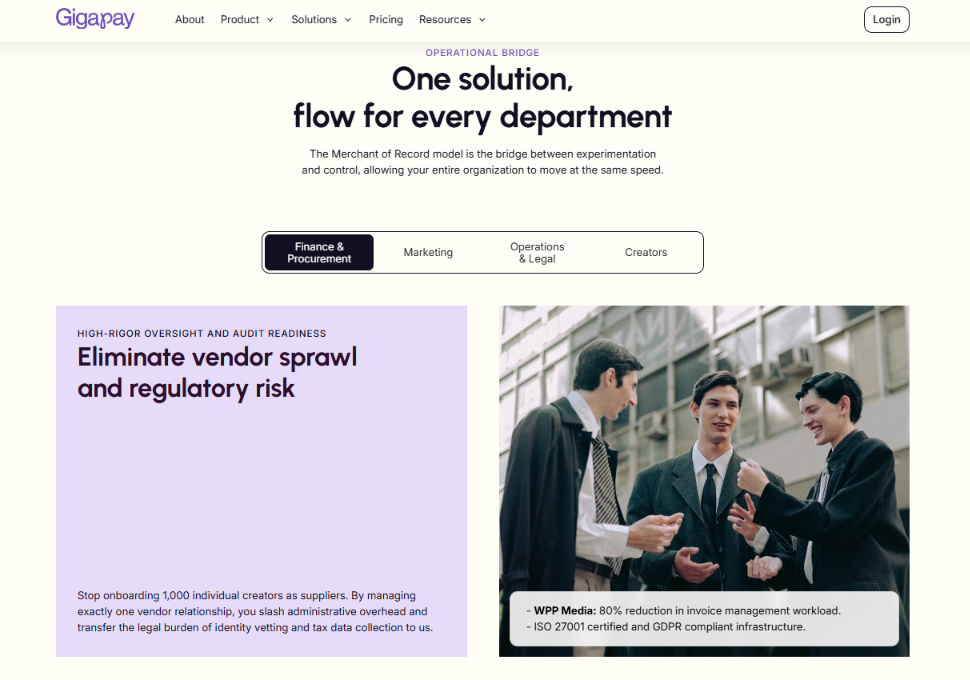
Gigapay is the Merchant of Record for creator payments. Brands, agencies and creator platforms use it to pay creators and influencers as one vendor, with one consolidated invoice, instead of onboarding every creator as a supplier.
This guide explains the invoice, the 20% ritenuta d'acconto, the filings and the confirmed 2027 changes for each case.
Key Takeaways
- Italian payers withhold 20% ritenuta d'acconto from professional and occasional creator fees.
- Flat-rate (forfettario) creators charge no VAT and are not subject to the ritenuta.
- Payers remit withheld tax by F24 by the 16th of the following month.
- Italy's tax rules move into new consolidated codes on 1 January 2027.
- The €100,000 flat-rate threshold for 2027 was still a bill on 27 November 2026.
How Big Is the Italian Creator Market Going Into 2027?
Italian companies will invest about €550 million in influencer marketing in 2026, according to UPA and UNA Media Hub (March 2026). That is 12% more than the €490 million of 2025. DeRev measures the market more narrowly, at €425 million, and still reports the fastest growth since 2023 (July 2026).
| Metric | Figure | Source |
|---|---|---|
| Influencer marketing investment, 2026 | About €550 million, up 12% | UPA and UNA Media Hub (March 2026) |
| Market value, DeRev measure, 2026 | €425 million, up 10.4% | DeRev (July 2026) |
| Market value, DeRev measure, 2025 | €385 million, up 4.05% | DeRev (July 2026) |
| Italian organisations expecting a higher budget | 87.7% | Kolsquare and B2B International (September 2026) |
| Italian organisations using micro influencers | 75% | Kolsquare and B2B International (September 2026) |
| Italian organisations working with 100+ creators a year | 29.5% | Kolsquare and B2B International (September 2026) |
| Italian organisations spending more than €200,000 a year | 28.3% | Kolsquare and B2B International (September 2026) |
Scroll sideways to see all columns
Kolsquare's Budget Report 2027 puts median company spend at €144,000 in 2026, up from €127,000 in 2025, as Askanews reported (November 2026). The same report says more activity and longer ambassador contracts drive Italian growth, more than higher fees.
For your finance team, growth built on more collaborations means more payees, and each new Italian payee arrives with a tax status to check.
How Much Do Italian Creators Charge in 2026, and Why Does Their Tax Status Vary?
DeRev's 2026 price list covers about 5,000 Italian creator profiles and reports fees per post by tier.
| Tier | Instagram followers | Fee per Instagram post | Change on 2025 |
|---|---|---|---|
| Nano | 5,000 to 10,000 | €100 to €300 | Stable |
| Micro | 10,000 to 50,000 | €300 to €1,600 | Up 5.6% |
| Mid-tier | 50,000 to 300,000 | €1,600 to €5,500 | Up 9.2% |
| Macro | 300,000 to 1 million | €5,500 to €9,500 | Up 7.1% |
| Mega | 1 million to 3 million | €9,500 to €12,500 | Up 2.3% |
| Celebrity | More than 3 million | €12,500 to €35,000 | Down 9.5% |
Source: DeRev, Listino dei compensi degli influencer 2026 (July 2026).
Scroll sideways to see all columns
On TikTok, a nano creator earns €50 to €175 per video and a micro creator €175 to €800, in the same DeRev list.
These fees explain why one campaign mixes three tax statuses. A nano creator paid €100 to €300 a post may have no partita IVA and work occasionally. A micro or mid-tier creator can invoice under the flat-rate scheme, which is open up to €85,000 of annual revenue. A creator above that limit, or a talent agency, invoices with VAT.
A €100,000 Italian budget buys about 60 micro posts at the top of DeRev's micro range, or more than 300 at the bottom. For your programme, every one of those posts needs the right document.
What Are the Three Tax Statuses of an Italian Creator?
An Italian creator is paid as an ordinary partita IVA holder, a flat-rate (forfettario) partita IVA holder or an occasional worker with no partita IVA. The sections below are general information from the sources named. They describe an Italian payer that pays an Italy-resident creator directly.
| Topic | Ordinary partita IVA | Flat-rate partita IVA (forfettario) | Occasional work (prestazione occasionale) |
|---|---|---|---|
| Who it is | VAT-registered freelancer or business | VAT-registered freelancer with revenue up to €85,000 | Individual with no partita IVA, working sporadically |
| Document | E-invoice through the Sistema di Interscambio (SdI) | E-invoice through the SdI | Receipt (ricevuta), on paper or PDF |
| VAT | 22% standard rate | None charged | None |
| Ritenuta d’acconto | 20% on professional fees | None | 20% |
| Stamp duty | None when VAT applies | €2 on invoices above €77.47 | €2 on receipts above €77.47 |
| Certificazione Unica (CU) | Yes | Exempt in most cases | Yes |
| Social security | Creator’s own | Creator’s own | Shared above €5,000 a year |
Scroll sideways to see all columns
Why the ATECO code matters
Since 1 January 2025, creators can register under ATECO code 73.11.03 for influencer marketing and content creation. INPS Circular 44 of 19 February 2025 places creators in the separate management scheme, the traders' scheme or the entertainment workers' fund, depending on how they work.
That choice affects withholding. The 20% ritenuta applies to self-employment income from arts and professions, so a creator who operates as a business sits outside it. Ask each creator which regime and income type their accountant has confirmed.
For your onboarding form, the creator's status is the first field to collect, because it decides every later step.
How Does the Ritenuta d'Acconto Work on a Creator's Fee?
The ritenuta d'acconto is an advance on the creator's income tax (IRPEF) that the payer deducts from the fee and pays to the tax authority. The standard rate is 20%, calculated on the fee before VAT.
Who has to withhold
The duty sits with a withholding agent (sostituto d'imposta): a company, an entity or a professional that pays the fee. A private individual who pays a creator is not a withholding agent.
Non-resident companies become withholding agents only for income paid through a permanent establishment or fixed base in Italy, according to Ministry of Finance Circular 326/1997. Italian tax guides list a 30% final withholding when an Italian payer pays a non-resident for self-employment work (Fiscomania and Money.it, 2026).
Where the rule sits in law
Until 31 December 2026 the rule is Article 25 of Presidential Decree 600/1973. From 1 January 2027 that article is repealed, as the Chamber of Deputies' dossier on the 2027 budget bill confirms (9 November 2026). The rule moves to Article 38 of Legislative Decree 33/2025, the consolidated code on payments and collection. Italian tax press reports the 20% rate as unchanged (November 2026).
What a €1,000 fee looks like under each status
| Creator status | VAT | Ritenuta | Paid to the creator | Paid by the payer to the tax authority |
|---|---|---|---|---|
| Ordinary partita IVA, professional | Plus €220 (22%) | Minus €200 (20%) | €1,020 | €200 |
| Flat-rate partita IVA | None | None | €1,000 | €0 |
| Occasional work | None | Minus €200 (20%) | €800 | €200 |
Simplified illustration. Social security recharges and stamp duty are left out.
Scroll sideways to see all columns
For your accounts payable team, the same €1,000 fee produces three payment amounts and two F24 payments across three creators.
How Do You Pay a Creator With an Ordinary Partita IVA?
A creator in the ordinary VAT regime sends an e-invoice through the SdI, with 22% VAT and, for professional income, the 20% ritenuta shown on it. All Italian VAT holders have invoiced through the SdI since 1 January 2024.
An Italian payer then has four jobs:
- Check the invoice. Confirm the partita IVA, the VAT and the ritenuta line before you approve it.
- Pay the fee minus the ritenuta. The creator receives the fee plus VAT, less the 20%.
- Remit the ritenuta. Pay it by F24 with tax code 1040 by the 16th of the month after payment. The Agenzia delle Entrate lists code 1040 for withholding on self-employment income.
- Certify and declare. Give the creator the CU, send it to the Agenzia delle Entrate and include the amounts in Modello 770.
The B2B withholding that starts in 2028
A separate withholding on payments between businesses already sits in Article 38 of Legislative Decree 33/2025. The law in force sets it at 0.5% for 2028 and 1% from 2029. Article 35 of the 2027 budget bill would raise it to 1% and 2%, as Partitaiva.it reported (November 2026). Flat-rate taxpayers stay excluded, according to Studio Vitali's summary of the bill (November 2026).
For your team, this status carries the most filings, so it is where a missed F24 date is most likely.
How Do You Pay a Flat-Rate (Forfettario) Creator?
A flat-rate creator charges no VAT and is not subject to the ritenuta d'acconto, so an Italian payer pays the invoice total. The creator states both points on the invoice and pays a substitute tax of 15%, or 5% in the first five years.
| Rule | Law in force for 2026 | Law in force from 1 January 2027 | 2027 budget bill (not yet law) |
|---|---|---|---|
| Where the rules sit | Law 190/2014, Article 1, paragraphs 54 to 89 | Legislative Decree 117/2026, Articles 232 to 243 | No change |
| Revenue limit | €85,000 | €85,000 | €100,000 for income tax, €85,000 for VAT |
| Immediate exit during the year | Above €100,000 | Above €100,000 | Above €115,000 for income tax |
| No ritenuta on fees | Paragraph 67 | Article 235, paragraph 4 | No change |
| E-invoicing through the SdI | Mandatory since 1 January 2024 | Mandatory | No change |
Sources: Fatturah.it and TurboFattura summaries of the decrees and the bill (November 2026).
Scroll sideways to see all columns
What the payer still does
- Check that the invoice carries the flat-rate wording. From 2027 the legal references on the invoice change with the new codes.
- Expect €2 of stamp duty on invoices above €77.47.
- Check the CU exemption. Flat-rate fees are exempt from the CU in most cases, as Edotto explains (April 2026).
- Ask again if a creator's revenue is near the limit, because a creator who exits the scheme starts charging VAT.
For your controller, a flat-rate invoice is the simplest Italian creator document, as long as the status on it is still true.
How Do You Pay a Creator for Occasional Work (Prestazione Occasionale)?
Occasional self-employment covers a creator with no partita IVA who performs a one-off service without subordination or coordination by the client. INPS classifies the income as "other income" under Article 67 of the income tax code.
The receipt and the withholding
The creator issues a receipt with the gross fee, the 20% ritenuta and the net amount. An Italian payer remits the ritenuta by F24 by the 16th of the following month and issues a CU.
The €5,000 social security threshold
A creator must register with INPS's separate management scheme once occasional income from all clients passes €5,000 gross in a year. Contributions apply only to the excess. The 2026 rate is 33.72% for workers with no other cover and 24% for pensioners or those insured elsewhere, under INPS Circular 8 of 3 February 2026. The payer carries two-thirds and the worker one-third.
| Example: €7,000 of occasional income in 2026, no other cover | Amount |
|---|---|
| Income above the threshold | €2,000 |
| Total contribution at 33.72% | €674.40 |
| Payer’s share (two-thirds) | €449.60 |
| Creator’s share (one-third) | €224.80 |
Scroll sideways to see all columns
A payer cannot see what other clients have paid, so ask the creator for a signed declaration before each payment.
The prior notification to the labour inspectorate
Since 21 December 2021, clients that operate as businesses must notify the labour inspectorate before an occasional worker starts. The fine is €500 to €2,500 for each worker, under Note 29 of 11 January 2022 from the Labour Inspectorate. The note excludes intellectual professions, so confirm with your adviser whether a given creator brief falls inside the duty.
Occasional does not mean small
No income cap defines occasional work. The test is whether the activity is sporadic. A creator who posts for brands every month is working habitually and needs a partita IVA, whatever they earn.
For your campaign managers, the occasional route suits a true one-off, and repeat bookings are the signal to ask the creator about registering.
What Are the Payer's Filing Deadlines in Italy?
An Italian payer that withholds tax works to four recurring dates.
| Deadline | What is due | Applies to |
|---|---|---|
| 16th of the month after payment | F24 payment of the ritenuta, tax code 1040 | Ordinary professional partita IVA, occasional work |
| 16 March | CU delivered to every recipient; CU sent to the Agenzia delle Entrate for occasional work | Occasional work; delivery for all |
| 30 April | CU sent to the Agenzia delle Entrate for habitual self-employment | Ordinary professional partita IVA |
| 31 October | Modello 770, the withholding agent’s annual return | All withholding |
Scroll sideways to see all columns
The 30 April date is new. It first applied in 2026, under Article 4 of Legislative Decree 81/2025, and replaced 31 March. A late or missing CU costs €100 per certificate unless it is corrected within 5 days, as QuiFinanza reported (2026).
These are the latest confirmed dates, from the 2026 filing season. The Agenzia delle Entrate approved the 2026 CU model on 15 January 2026, so check the 2027 model and calendar when they are published.
For your close calendar, add the 16th of each month first, because that date repeats 12 times a year.
What Changes for Italian Creator Payments on 1 January 2027?
Two kinds of change are in play, and only one is law. Italy's tax reform moves existing rules into consolidated codes on 1 January 2027. The 2027 budget bill, approved by the Council of Ministers on 28 October 2026, was still before Parliament on 27 November 2026.
| Change | Status on 27 November 2026 | Effect on creator payments |
|---|---|---|
| Article 25 of Presidential Decree 600/1973 repealed; ritenuta rules in Legislative Decree 33/2025 | Law, from 1 January 2027 | New article references; 20% rate reported unchanged |
| Flat-rate scheme moves to Legislative Decree 117/2026, Articles 232 to 243 | Law, from 1 January 2027 | New wording on flat-rate invoices |
| VAT rules move to the consolidated VAT code, Legislative Decree 10/2026 | Law, from 1 January 2027 | New references on invoices |
| Flat-rate limit raised to €100,000 for income tax | Bill, Article 9 | More creators could stay flat-rate; VAT would apply above €85,000 |
| Flat-rate immediate exit raised to €115,000 | Bill, Article 9 | Fewer mid-year exits |
| B2B withholding raised to 1% in 2028 and 2% from 2029 | Bill, Article 35 | Affects business-to-business invoices from 2028 |
Scroll sideways to see all columns
The bill must pass by 31 December 2026 and its text can still change. Until then, the confirmed flat-rate limit for 2027 is €85,000.
For your templates, update the legal references on January invoices and receipts, and leave thresholds alone until the budget law is published.
What Are the Common Mistakes When Paying Italian Creators?
Most errors come from treating every creator the same way.
- Withholding from a flat-rate creator. The scheme excludes the ritenuta, so the creator is left short.
- Not withholding from an occasional worker. The payer still owes the 20% to the tax authority.
- Calculating the ritenuta on the VAT-inclusive total. The base is the fee before VAT.
- Missing the 16th. The F24 date follows the payment date, not the invoice date.
- Confusing occasional self-employment with PrestO. The INPS voucher scheme has its own limits and platform.
- Ignoring the €5,000 threshold. It counts income from all clients, not only yours.
- Using the occasional route for a monthly ambassador. Habitual work needs a partita IVA.
- Accepting a PDF from a partita IVA holder. Their invoice must arrive through the SdI.
For your process owner, eight checks on one onboarding form prevent most of these.
What Should You Collect From an Italian Creator Before the First Payment?
Collect the creator's status and supporting details before you agree the fee, because the status sets the net payment.
| Item to collect | Why it matters |
|---|---|
| ✓Tax status: ordinary, flat-rate or occasional | Sets VAT, ritenuta and the document |
| ✓Partita IVA number and ATECO code | Confirms registration and activity |
| ✓Income type: professional or business | Decides whether the 20% ritenuta applies |
| ✓Flat-rate declaration | Supports paying without VAT or ritenuta |
| ✓Declaration of occasional income this year | Shows whether the €5,000 threshold is passed |
| ✓Other pension cover | Sets the 33.72% or 24% INPS rate |
| ✓Tax residence | Changes the withholding treatment |
| ✓Codice fiscale | Needed for the F24, CU and Modello 770 |
Scroll sideways to see all columns
For your head of influencer, sending this form with the brief avoids renegotiating the fee after the creator sees the net amount.
What Does a Payment Model Not Change in Italy?
Three Italian duties sit outside payment, whichever way the creator is paid.
AGCOM registration and disclosure. Creators with 500,000 followers on one platform, or 1 million average monthly views, must join AGCOM's list under Resolution 197/25/CONS. Sponsored content needs a clear advertising label.
Social security classification. INPS Circular 44/2025 sets out which scheme a creator belongs to. The creator registers, and the classification follows how they work.
Commercial agency risk. Italian commentary discusses when long-running discount-code deals can count as commercial agency. Ask counsel before you sign open-ended affiliate contracts.
For your legal team, these three points belong in the creator agreement, not in the payment process.
How Does Gigapay Pay Creators as the Merchant of Record?
With Gigapay, the creator supplies Gigapay and Gigapay invoices you.
How Gigapay works
- The client signs one Service Agreement with Gigapay and adds creators and amounts by spreadsheet upload, the app or the API.
- Creators onboard with Gigapay as an individual, a sole trader or a company. Gigapay runs identity and tax-ID checks at onboarding.
- When the client approves the work, Gigapay undertakes to buy the creator's services and issues the client a consolidated invoice.
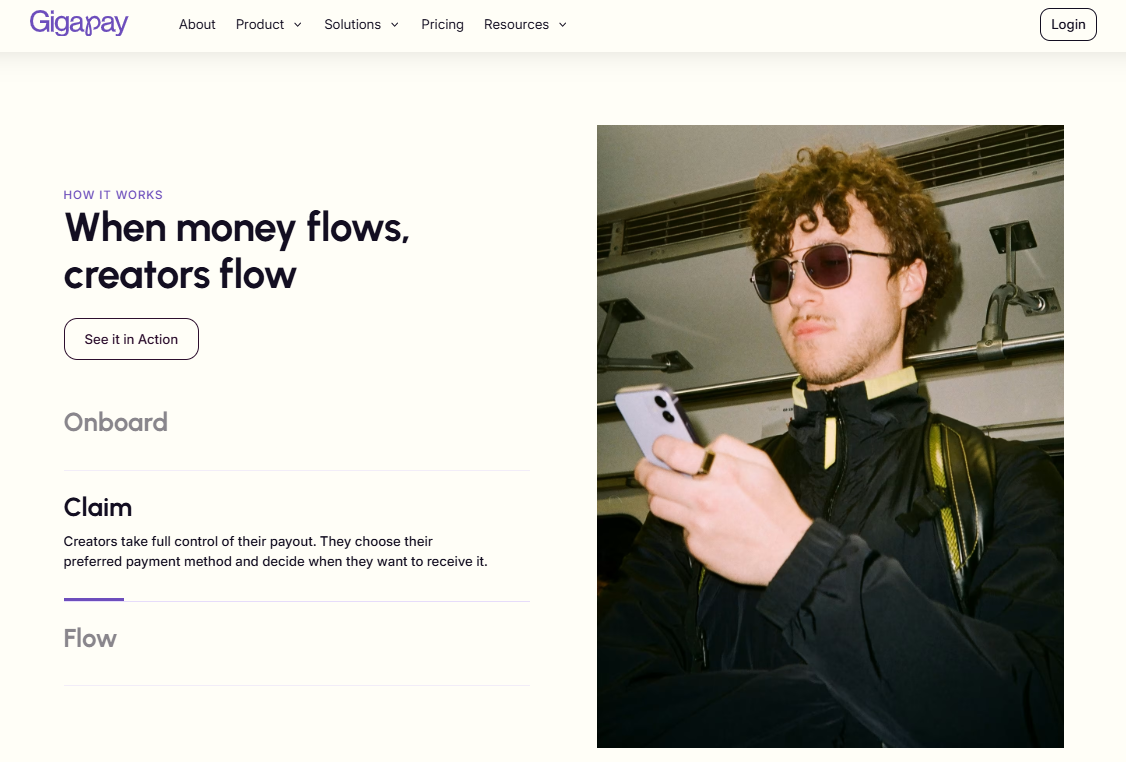
- The creator claims the payout in Gigapay. At the claim, Gigapay buys the services and resells them to the client.
- The payout is executed by a licensed third-party payment provider.
- Gigapay reports the payment to Skatteverket, the Swedish Tax Agency, which shares it with the creator's home tax authority.
Invoicing and records
The client has one vendor record and receives one consolidated invoice per batch or campaign. The client's VAT is on Gigapay's invoice, not on a creator invoice, because the creator supplies Gigapay. The client keeps Gigapay's invoice, the contract and proof of payment.
Tax and reporting
For the creator's fee we're the payer, not you: we pay them and report the payment. Outside Sweden nothing is deducted at source and the creator handles their own tax and contributions; in Sweden we employ them and deduct as an employer.
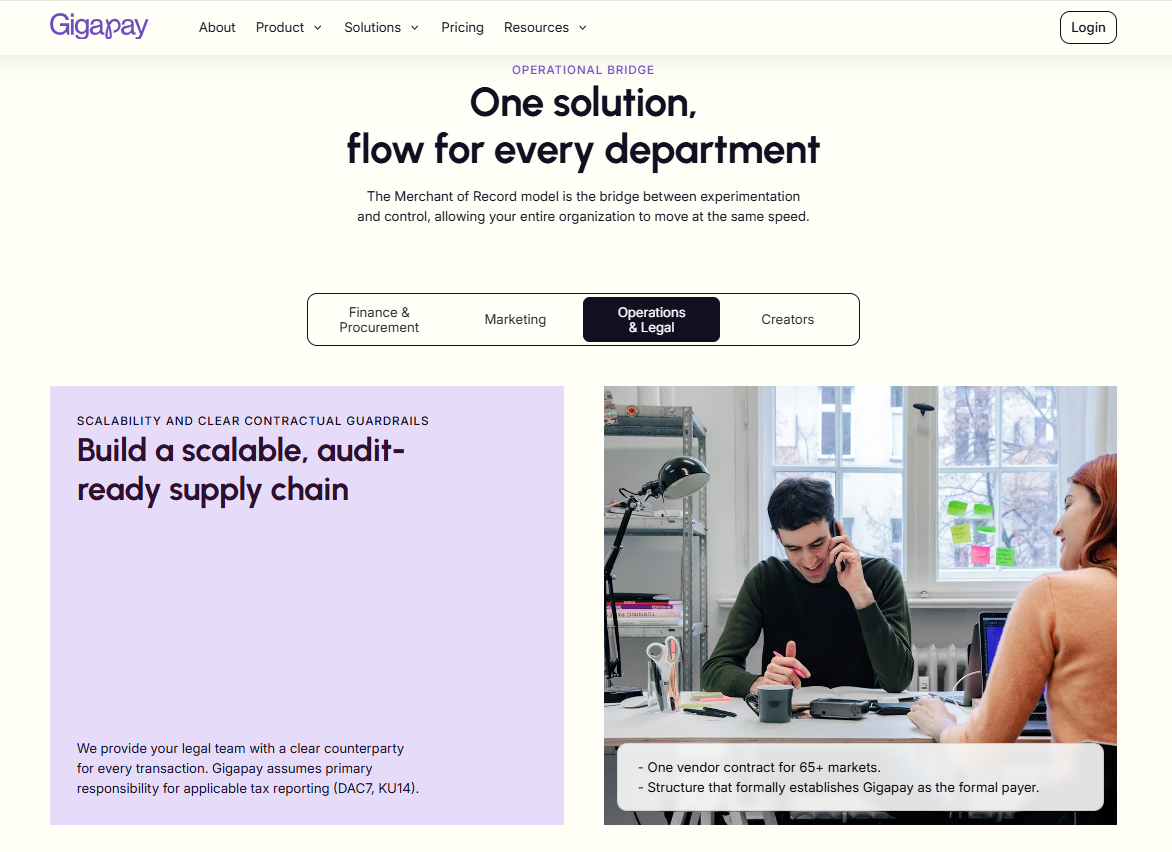
Gigapay is the creator's counterparty and payer, so obligations that depend on being the payer stop attaching to you. Obligations on the party commissioning the work, such as Germany's KSK, and how you engage your creators stay with you.
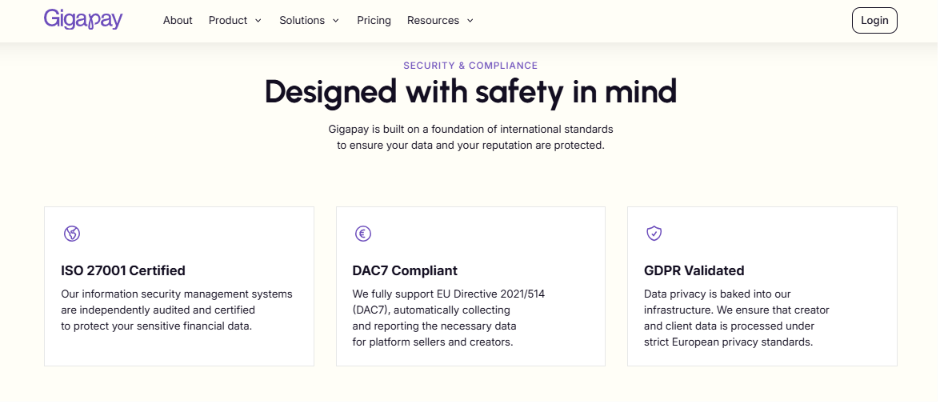
Gigapay files DAC7 as the platform operator with Skatteverket. It does not pre-fill the creator's tax return; creators still declare their income.
Italian creators and Gigapay
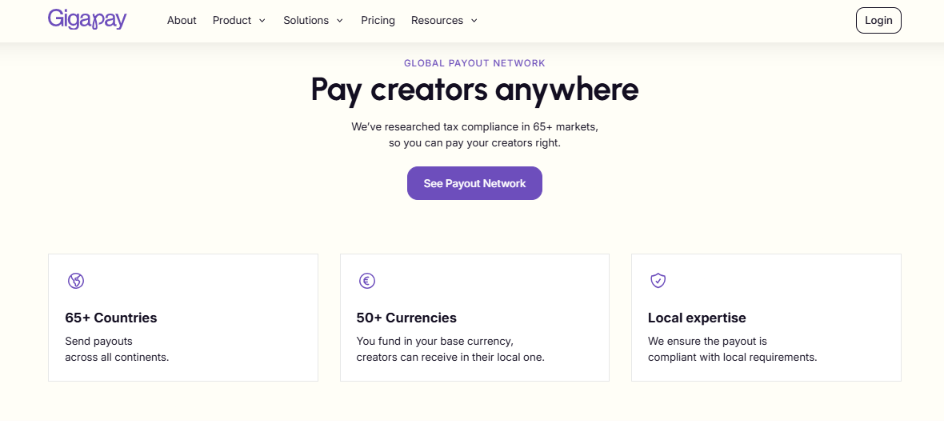
Creators onboard as individuals, sole traders or companies. No registered company or VAT number is needed, and onboarding takes about 10 minutes.
Italian withholding rules are set by Italian law, so ask your tax adviser how they apply to your programme under any payment model. Current markets are listed on the Supported Markets page at gigapay.com.
Gigapay pros and cons
| Pros | Cons |
|---|---|
|
|
Scroll sideways to see all columns
For your team, the model means procurement approves one supplier and finance books one invoice per campaign. This guide is general information, not tax advice.
Conclusion
Gigapay is the Merchant of Record for creator payments.
Paying a creator in Italy starts with their status. An ordinary partita IVA brings VAT, a 20% ritenuta and three filings. A flat-rate creator brings neither VAT nor ritenuta, and occasional work brings a receipt, a 20% ritenuta and a €5,000 threshold. The article numbers change on 1 January 2027, and the higher flat-rate limit is still a proposal.
Book a demo to see how Gigapay would invoice your next Italian campaign.
Read Next:
- Influencer Payment Regulations in Italy Playbook
- Influencers' status: How does it affect brands?
- How Much Are European Influencers Earning in 2026
FAQs:
1. What is the ritenuta d'acconto when paying creators in Italy?
The ritenuta d'acconto when paying creators in Italy is a 20% advance on the creator's income tax. An Italian payer deducts it from professional and occasional self-employment fees and pays it to the tax authority by F24. Flat-rate creators are not subject to it. This is general information, not tax advice.
2. Do you withhold tax when you pay a flat-rate (forfettario) creator in Italy?
You do not withhold tax when you pay a flat-rate (forfettario) creator in Italy. The flat-rate scheme excludes the ritenuta d'acconto and VAT, and the creator states this on an e-invoice sent through the Sistema di Interscambio. The confirmed revenue limit for the scheme is €85,000.
3. How much can an Italian creator earn through occasional work (prestazione occasionale)?
An Italian creator can earn any amount through occasional work, because no income cap defines it. The test is whether the activity is sporadic. Above €5,000 of occasional income a year from all clients, the creator must register with INPS's separate management scheme, and contributions apply to the excess.
4. When must an Italian payer remit the ritenuta d'acconto and send the Certificazione Unica?
An Italian payer must remit the ritenuta d'acconto by the 16th of the month after payment, using F24 tax code 1040. In the 2026 season, the Certificazione Unica went to recipients by 16 March and to the Agenzia delle Entrate by 16 March or 30 April.
5. Do creators still handle their own tax when paid through Gigapay?
Creators still handle their own tax when paid through Gigapay. Outside Sweden nothing is deducted at source and the creator handles their own tax and contributions; in Sweden Gigapay employs them and deducts as an employer. Gigapay files DAC7 as the platform operator with Skatteverket, and creators still declare their income.