

European influencer earnings in 2026 are tiered, geographic, and platform-dependent. A nano creator earns up to £200 per post while a macro creator earns up to £10,000, and the same creator can earn close to double in London what they would earn in Lisbon.
Underneath those rates, the market is expanding past $41 billion and pulling brand budgets toward a growing middle class of smaller creators, who now capture nearly half of all influencer marketing spend in Europe.
This report compiles the verified 2026 benchmarks for what European creators earn across follower tiers, countries, and platforms. It then turns the data around to a finding most earnings reports omit: the shift toward more creators earning less each makes creator programs heavier to run, not cheaper, because the cost moves out of the per-post fee and into the work of paying and reporting on far more people across more markets.
The report is written for brands, agencies, and finance teams running creator programs at scale, and it is published by Gigapay, the Merchant of Record for creator payments.
Key Takeaways
- European influencer earnings in 2026 range from up to £200 to £10,000 per post by tier.
- UK creators earn the most in Europe, up to 60% above Eastern European rates.
- Micro and nano creators now take 45.5% of European influencer marketing spend.
- Country and niche move rates as much as follower count does.
- Gigapay handles the payment and compliance load behind European influencer earnings at scale.

Key Findings
Each finding below is a standalone 2026 benchmark.
- The European creator economy is valued at $41.15 billion in 2026 and is forecast to grow at a 25.3% CAGR to $199.53 billion by 2033 (Source: Coherent Market Insights).
- Europe is home to 8.64 million income-generating creators in 2026.
- 72% of European brands are increasing their influencer marketing budgets in 2026, many by 10 to 19%.
- Micro and nano influencers under 100K followers now capture 45.5% of total European influencer marketing spend (Source: eMarketer).
- Per-post earnings range from up to £200 for nano creators to up to £10,000 for macro and mega creators (Source: Limelight Digital).
- UK creators set the European ceiling. Rates fall 15 to 25% in Western Europe, 25 to 40% in Southern Europe, and 40 to 60% in Eastern Europe relative to that ceiling.
- Brand deals account for around 60% of creator revenue, with affiliates, merchandise, and subscriptions growing fastest.
- Roughly 48.7% of European creators earn under $10,000 a year, while 45.6% earn between $10,000 and $100,000.
- A brand running 600 collaborations a year spends roughly 840 admin hours on the payment and compliance work behind those earnings, separate from the payouts.
Methodology and Sources
This report aggregates verified 2026 benchmarks rather than original survey data. Market sizing comes from Coherent Market Insights. UK tier benchmarks come from Limelight Digital. Regional pricing variation, platform CPM bands, and budget allocation come from InfluenceFlow and Modash. The micro and nano spend share comes from eMarketer. German annual pay figures come from Glassdoor. TikTok Creator Rewards rates are verified creator-reported figures from May 2026.
Three limitations are worth stating plainly. Pan-European annual income data is thinner than UK and German data, so country profiles below the UK rely partly on per-post and CPM figures rather than full salary medians. All earnings figures are typical or maximum ranges for single sponsored posts unless noted, and they move with niche, engagement rate, and campaign length. Where source data was reported in one currency, the figures note that currency and give a directional conversion using mid-2026 reference rates of roughly £1 = €1.15 and $1 = €0.92. These conversions are for comparison only, and exchange rates change.
Earnings by Follower Tier
European influencers in 2026 earn from up to £200 per post at the nano tier to up to £10,000 per post at the macro and mega tiers, based on UK benchmarks that sit at the top of the European range. The per-post figures by tier:
- Nano (1K–10K followers): up to £200 per post, roughly €230 or $250.
- Micro (10K–50K followers): up to £500 per post, roughly €575 or $625.
- Mid-tier (50K–500K followers): up to £2,500 per post, roughly €2,875 or $3,125.
- Macro (500K–1M followers): up to £10,000 per post, roughly €11,500 or $12,500.
- Mega (1M+ followers): up to £10,000 per post, roughly €11,500 or $12,500.
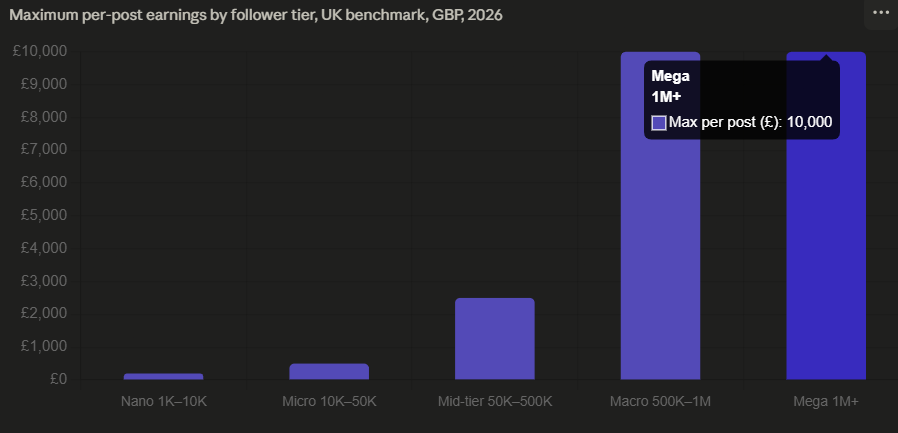
The figures come from Limelight Digital, and the steepest rate jump is from micro to mid-tier, where earnings can multiply fivefold. The macro and mega tiers flatten at the top of typical ranges, because brands paying those sums are buying cultural reach rather than measurable performance, so follower count stops being the main lever.
Niche then overrides tier at the margins: finance, tech, and luxury creators command 2 to 3 times standard rates because their audiences are harder to reach and convert at higher value.
The income picture underneath per-post rates is heavily concentrated. The annual income distribution across European creators in 2026:
- Under $10,000 a year: 48.7% of creators.
- $10,000 to $100,000 a year: 45.6% of creators, the growing creator middle class.
- Above $100,000 a year: a small top tier holding most of the revenue.
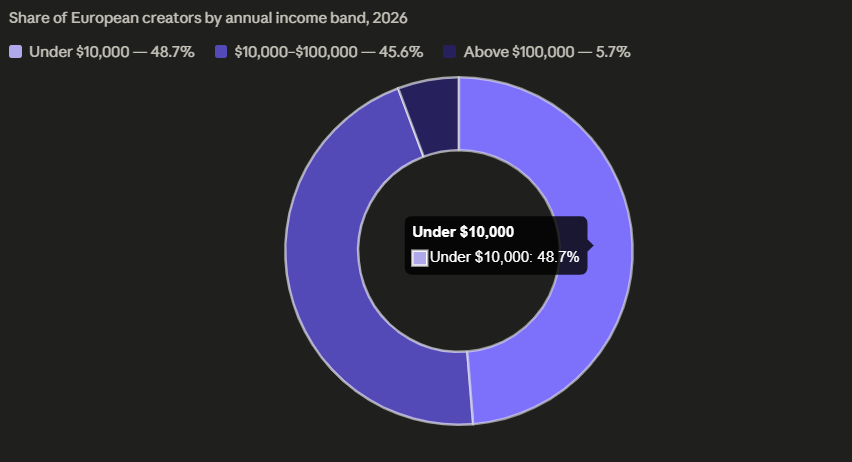
About half of European creators earn more than €1,000 per month on a full-time-equivalent basis. The $10,000 to $100,000 band is exactly where the spend shift toward micro and nano creators is landing, and our breakdown of how to pay influencers at scale covers what that volume does to a finance team.
Earnings by Country
Geography is the largest variable in European influencer earnings after follower count, and a UK creator can earn close to double what an equally sized Eastern European creator earns for the same content.
European rates generally run 10 to 30% below equivalent US rates, and inside Europe they tier sharply by region:
- United Kingdom: the highest rates in Europe, the regional ceiling.
- Western and Central Europe (excluding the UK): 15 to 25% below the UK.
- Southern Europe (Spain, Italy): 25 to 40% below the UK.
- Eastern Europe: 40 to 60% below Western Europe.
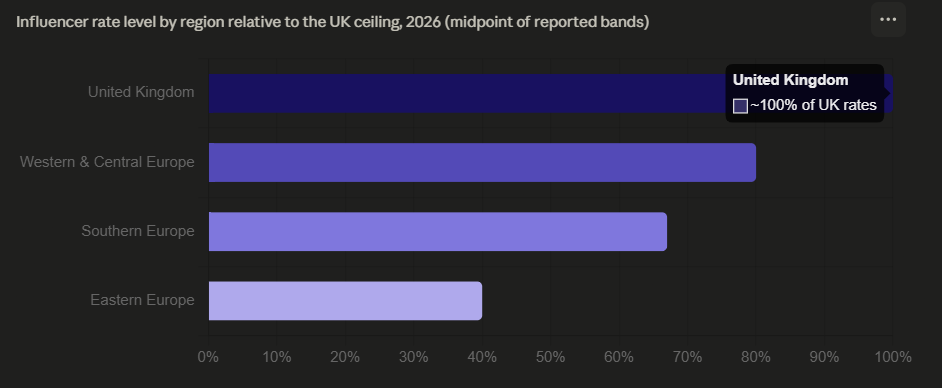
The spread, reported by InfluenceFlow, reflects audience purchasing power and local advertiser depth rather than content quality. The country profiles below give the detail behind those bands.
1. United Kingdom
The UK sets the European ceiling across every platform and tier. Instagram micro creators (10K+) earn £100 to £500 per post, YouTube mid-tier creators (50K+) earn £750 to £7,500 per video, and TikTok creators (100K+) earn £100 to £750 per post (Limelight Digital) .
UK creators receive the highest platform payouts in Europe, driven by strong advertiser demand and an English-speaking audience.
2. Germany and the DACH region
Germany shows a median annual pay of €43,000 for full-time influencers, with a typical range of €35,000 to €48,000 (Glassdoor). Per-deal rates for micro creators (10K to 100K) sit at €350 to €1,200 per post, and mid-tier creators reach €1,200 to €4,500.
Brands hiring German creators should note the country's tax reporting rules, including the KSK levy, which applies even to international hires.
3. France
French nano creators earn €35 to €220 per sponsored post, micro and mid-tier creators earn €500 to €3,000, and macro creators (500K to 1M) earn €7,000 to €20,000 per post. France has one of the most professionally organized creator markets in Europe, and beauty, lifestyle, and food creators command premium deals.
4. Spain
Spanish nano creators earn €30 to €200 per post, with videos at €60 to €300. Macro creators (500K to 1M) earn €6,000 to €18,000 per post, with video rates reaching €15,000 to €50,000 at the top. The Spanish influencer market alone is valued at around $900 million.
5. Italy, the Nordics, and Eastern Europe
- Italy and the rest of Southern Europe track close to the Spain and France bands.
- The Nordics show higher per-view value on platforms like YouTube because fewer creators compete for ad inventory, with Norwegian CPMs reaching €6.50 to €16.
- Eastern Europe follows the 40 to 60% lower regional band.
For brands running across several of these markets at once, the compliance differences between them matter as much as the rate differences, which is why agencies route multi-market payouts through a single vendor.
Earnings by Platform
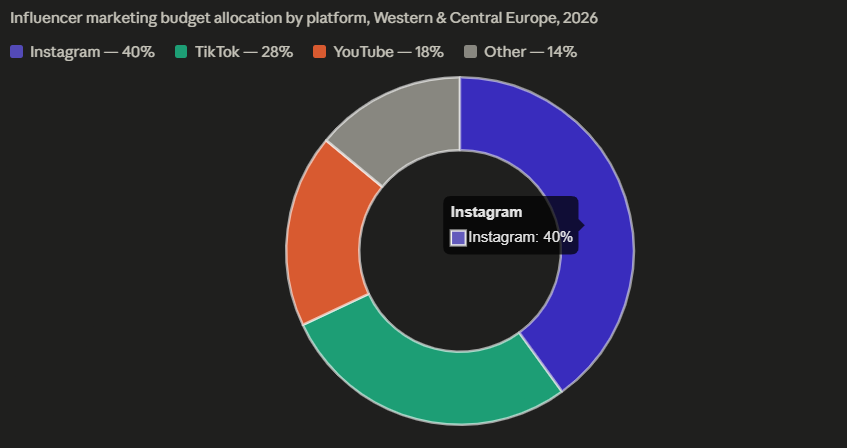
Platform is the third earnings variable, and European brand budgets split across the three major platforms in a consistent pattern: Instagram takes 40%, TikTok 28%, YouTube 18%, and other platforms 14% (InfluenceFlow).
Average engagement runs Instagram 2.2%, TikTok 4.8%, and YouTube 2.8%. The platform payout benchmarks for 2026:
- YouTube, UK: $10 to $35 CPM.
- YouTube, Europe excluding the UK: $8 to $25 CPM.
- YouTube, Nordics finance niche: €18 to €22 CPM.
- TikTok Creator Rewards, UK: €1.20 to €1.50 per 1,000 qualifying views.
- TikTok Creator Rewards, Germany: €0.60 to €0.80 per 1,000 qualifying views.
- TikTok Creator Rewards, France: €0.50 to €0.70 per 1,000 qualifying views.
- TikTok brand deals, Western Europe nano creators: €50 to €250 per video.
- TikTok brand deals, Western Europe micro creators: €200 to €800 per video.
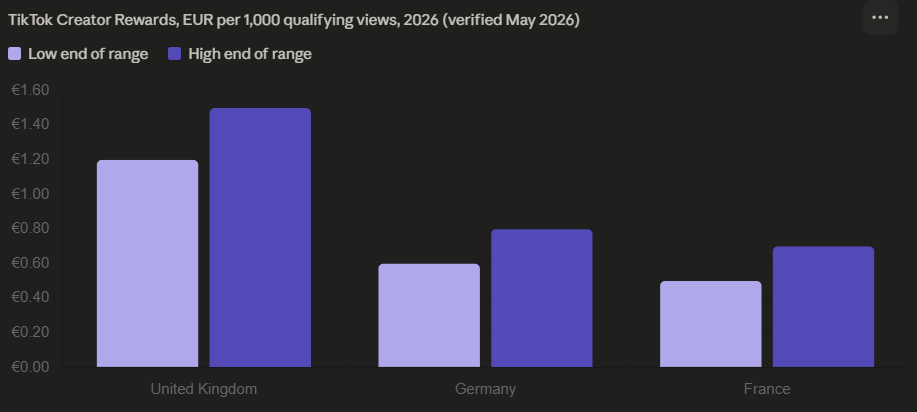
These figures come from InfluenceFlow, Modash, and creator-reported rates verified in May 2026, and UK creators receive the highest platform payouts in Europe.
The pattern that holds by country holds by platform: English-speaking audiences and deep advertiser markets push rates up, and everyone else trails.
The practical consequence for brands is that a multi-platform campaign means paying creators in different currencies, on different schedules, against different local rules, which is where the API integration question surfaces for operations teams.
What the Data Means for Brands
This section moves from the verified data above to interpretation, and the line between the two is worth marking. The data shows that the budget is moving toward smaller creators. The implication is that creator programs are getting operationally heavier, not lighter, even where the per-post spend stays flat or falls.
The reason is arithmetic. A 45.5% spend share going to micro and nano creators means a brand pays more individual people, each earning less, rather than fewer people earning more. Paying 300 creators €200 each is a larger payment and compliance job than paying three creators €20,000 each, even though the second option costs more in fees. The cost has moved from the invoice line into the back office.
- The shift toward smaller creators increases the number of payees, not the size of each payment.
- Each new market a brand enters adds its own tax reporting and creator classification rules, including DAC7 across the EU and Germany's KSK levy.
- Failed or delayed payments convert directly into creator support hours and creator churn.
For a brand running 600 collaborations a year, the payment and compliance work behind the earnings has been measured at roughly 840 admin hours annually, separate from the payouts themselves.
This is the layer Gigapay was built to absorb, acting as the Merchant of Record so that one vendor and one invoice replace hundreds of individual creator relationships in a brand's books.
The earnings data and the cost data are two halves of the same question, and the second half is the one the influencer marketing operation has to solve.
Conclusion
The headline finding of this report is that European influencer earnings in 2026 are governed less by follower count than most assume, and more by country and niche, with UK creators setting a ceiling that Eastern European creators fall 40 to 60% below.
The consequence that matters most for anyone paying creators is that the market's move toward a larger middle class of smaller creators makes programs heavier to administer, because cost shifts from the fee to the operational load behind it.
What creators earn is one half of the picture, and what it costs to pay them compliantly across dozens of markets is the half Gigapay handles. Pay your first batch the same day you sign.
.avif)
.avif)
.avif)