.jpg)

The creator monetization platform market is forecast to grow 20.5% in 2026, climbing from $11.57 billion in 2025 according to data published in April 2026.
Gigapay is the Merchant of Record payouts API built specifically for platforms scaling creator payments across borders, handling tax reporting and compliance as the single vendor on record.
Most creator platforms hit the same operational wall around 1,000 monthly payouts, where the infrastructure that worked for a hundred creators starts breaking and engineering teams end up wiring together CSV uploads, bank portals, and tax form chasers instead of shipping product.
This review compares the six payouts APIs creator platforms are integrating in 2026, with pros, cons, pricing context, and the trade-offs that matter when the payee base is creators rather than classic vendors.
Key Takeaways
- Gigapay leads as a Merchant of Record payouts API that absorbs tax and compliance liability.
- Stripe Connect suits platforms with strong developer needs and a US-first audience.
- Tipalti is built for finance-led AP automation, not fast creator onboarding flows.
- Trolley covers 210 countries with tax tooling, but does not act as Merchant of Record.
- Integration time spans two days with Gigapay to eight weeks with finance-grade alternatives.
At a Glance: How These Payouts APIs Compare
What a Payouts API for Creator Platforms Actually Needs to Do
A payouts API for a creator platform is judged on four things:
- How fast funds reach the creator
- How broad the geographic and currency coverage is
- How much of the tax and compliance burden it absorbs
- How quickly an engineering team can integrate it without rebuilding internal billing
The shortlist below is ranked on that combined picture, not on payment rails alone.
1. Gigapay: Best Overall Payouts API for Creator Platforms)

Gigapay is a Merchant of Record payouts API designed for platforms moving money to thousands of creators across borders.
Based in Stockholm and operating in 65+ countries with 50+ currencies, Gigapay sits between the platform and its creators as the formal counterparty, purchasing each creator's deliverable and reselling it to the platform client. The platform stops onboarding individual creators as vendors, stops chasing tax IDs, and stops interpreting DAC7 reporting requirements at every campaign close.
The result is one vendor in the ERP, one consolidated invoice per batch, and automated compliance reporting underneath.
The API is REST-based with sandbox and production environments, webhook events, and full integration in two to five days. Core endpoints cover project creation, prepayments, payouts, and creator registrations, with Browsable API support and documentation hosted at developer.gigapay.se. Creators onboard in any of three legal forms (individual, sole trader, or company) and are not required to hold a registered business or VAT number to receive payment.
Pricing: Base plan is €279/month plus a 4.9% admin fee per payout. Enterprise pricing is volume-based for platforms above €1.8M annual payout volume and includes EarlyPay liquidity, a dedicated CSM, and unlimited users.
Pros
- Merchant of Record model transfers most administrative and legal responsibility connected to the purchase of the creator's deliverable from the platform to Gigapay.
- Live integration in two to five days through a documented REST API, with webhooks, a sandbox environment, and a Browsable API for inspection.
- Creator payouts arrive instantly through local rails including SEPA Instant in the EU, Faster Payments in the UK, and ACH in the US.
- Automated tax reporting for DAC7 across the EU, KSK in Germany, and KU14 in Sweden is built into the platform, with KYC/KYB verification handled in flow.
- Creator NPS of 88, supported by EarlyPay liquidity and a dedicated human creator support team, which reduces churn on the supply side of the platform.
Cons
- The base subscription of €279/month is meaningful overhead for very small payout volumes.
- Funding currencies are limited to USD, EUR, GBP, SEK, DKK, and NOK at the platform level.
- The Enterprise tier requires €1.8M+ in annual payout volume, which puts its discounted economics out of reach for early-stage platforms.
2. Tipalti
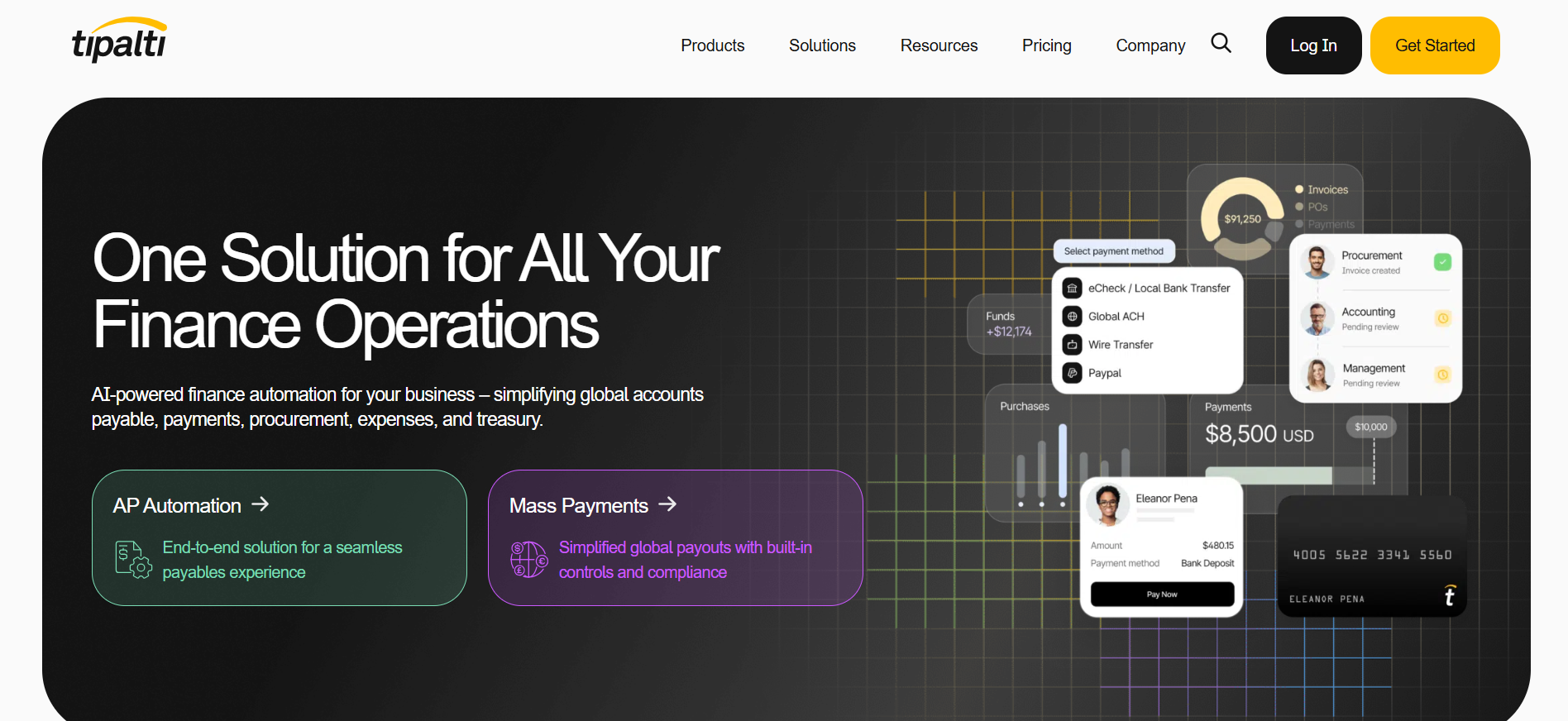
Tipalti is a finance-led accounts payable automation platform that has extended into mass payouts for marketplaces and creator networks. Founded in 2010, Tipalti handles supplier onboarding, tax form collection across W-8, W-9, 1099, and 1042-S, multi-entity reconciliation, and global payments across 196 countries in 120 currencies.
The API supports programmatic payee creation, payment instruction, and reconciliation, with Postman collections and webhook events. ERP integrations with NetSuite, Sage Intacct, and Workday are mature.
Pricing: Custom, with implementation fees and a base platform subscription that typically starts around $1,500/month for the Express tier and rises sharply for Enterprise.
Pros
- 196 countries and 120 currencies, with broad payment method support including ACH, wires, prepaid debit, and PayPal.
- Strong US-centric tax compliance, including W-9 collection, 1099-NEC filing, 1099-MISC filing, and 1042-S filing for non-US payees.
- Mature ERP integrations with NetSuite, Sage Intacct, and Workday make Tipalti a comfortable fit for finance teams already running those stacks.
Cons
- Implementation runs four to eight weeks for most platforms, with significant configuration overhead before the first payout.
- The product is built around vendor onboarding flows, which feel heavy for creators who are not classic suppliers and do not have registered businesses.
- Tipalti does not act as Merchant of Record, so the platform retains tax classification and reporting liability for the creator relationships it pays.
Tipalti is a strong choice when the priority is accounts payable automation across a broad supplier base and the finance team is the primary stakeholder. The model gets uncomfortable when the payees are individual creators who do not have registered businesses and the platform needs to onboard them in minutes.
Gigapay was built around that exact gap. It assumes creators arrive in three legal forms, handles DAC7 and KSK reporting as a standard service, and goes live in two to five days instead of two months. For platforms whose unit of payment is a creator rather than a vendor, that difference compounds across every campaign.
3. Stripe Connect
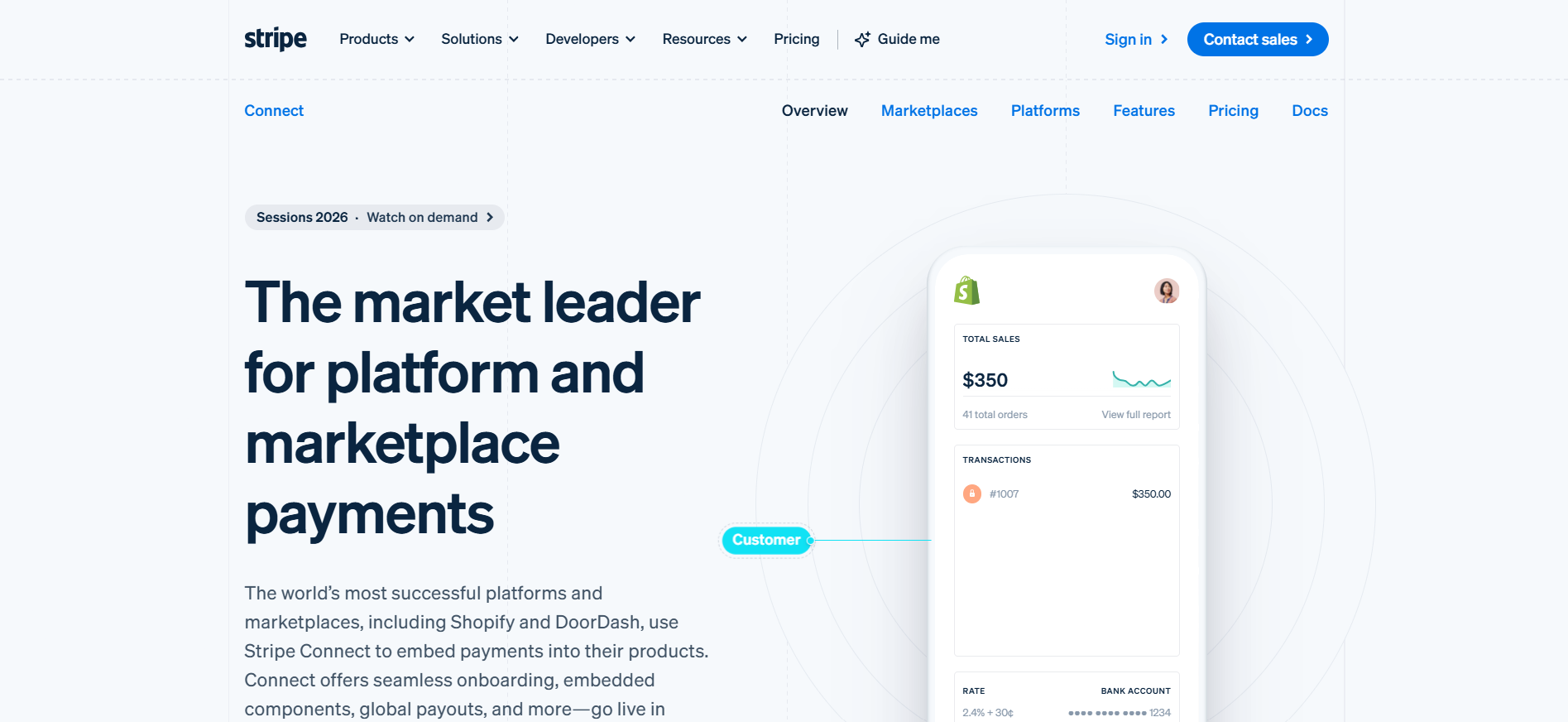
Stripe Connect is the payments platform inside Stripe, used by marketplaces and creator platforms to handle multi-party flows including onboarding, KYC, payment routing, and payouts to bank accounts and debit cards across 47 countries.
Connect offers Express and Custom account types so platforms can decide how much of the Stripe interface their creators see.
The developer experience is among the strongest in payments, with SDKs across major languages, well-maintained documentation, and tight integration with Stripe Tax, Stripe Identity, and Stripe Billing.
Pricing: 0.25% + $0.25 per payout for cross-border transfers, with platform fees on top and custom enterprise terms at volume.
Pros
- The developer experience is best documented in the category, with SDKs, sandbox tools, and reference implementations for marketplace flows.
- Stripe Tax can calculate and collect sales tax, VAT, and GST in supported jurisdictions, reducing one layer of compliance work.
- For platforms already on Stripe for payments in, Connect keeps the financial stack inside one provider and one reconciliation surface.
Cons
- Stripe does not act as Merchant of Record for the creator's services, so tax classification and reporting stay on the platform.
- Coverage is thinner outside of the US, UK, and core EU markets compared to MoR-style creator-payout providers.
- DAC7 and KSK reporting for EU creators are not handled by Connect directly, leaving platforms with European creator bases to build or buy an additional compliance layer.
Stripe Connect is the right call when the platform's core business is payments and the team wants a low-level toolkit. For creator platforms whose business is the content product and whose biggest operational risk is compliance failure, Connect leaves too much on the table.
Gigapay holds the legal counterparty role, files DAC7 and KSK automatically, and removes the need for the platform team to interpret influencer employment classification cases in EU courts. The team ships the product. The regulatory layer ships with Gigapay.
4. Trolley (formerly Payment Rails)
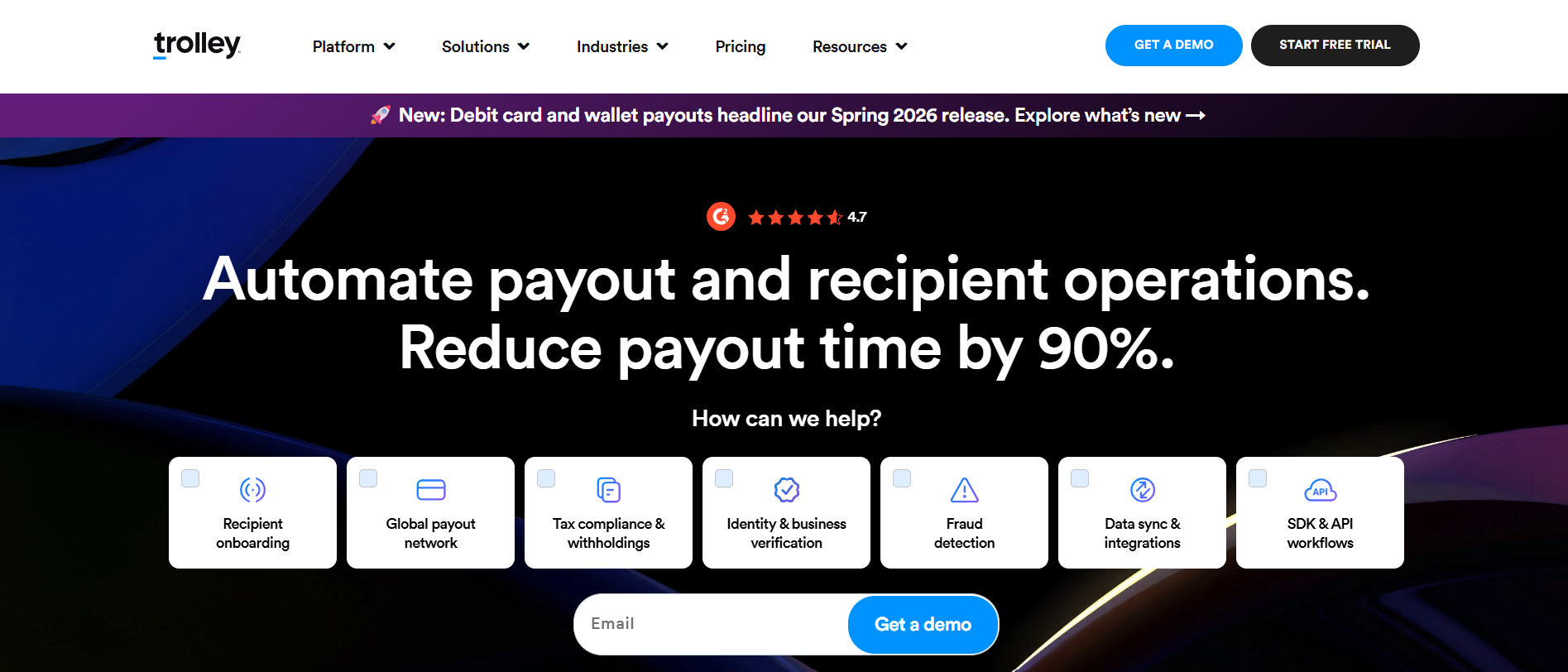
Trolley is a payouts API covering 210 countries through bank transfers, wires, and PayPal, marketed primarily at marketplaces, creator networks, and affiliate programs. It includes recipient onboarding, tax document collection across W-8, W-9, 1042-S, and DAC7, a white-label recipient portal, and 1099 filing. The API is REST-based, supports webhooks, and provides a sandbox for testing.
Pricing: Custom, with per-payment transaction fees and FX margins that vary by corridor.
Pros
- 210 countries supported, including emerging markets where many providers fall short.
- Tax form collection and 1099 filing are built into the recipient portal as a core part of the product.
- White-label recipient portal keeps the creator experience inside the platform's brand rather than handing them off.
Cons
- Trolley does not provide Merchant of Record service, so the platform remains the legal counterparty for the creator services it pays for.
- Settlement times typically run one to three business days, slower than instant-rail providers in EU and UK corridors.
- Developer tooling is functional but less mature than Stripe Connect or Gigapay, with thinner documentation around edge cases.
Trolley solves the "many countries, many payees" problem cleanly when the goal is payment movement. It does not solve the legal exposure question that EU and Nordic platforms care about most as DAC7, KSK, and influencer classification cases reshape the compliance landscape.
Gigapay absorbs that exposure as Merchant of Record, files the reports, and pays creators instantly through local rails such as SEPA Instant and Faster Payments. For platforms whose creators are concentrated in Europe, that combination is hard to replicate by stitching tools together.
5. Lumanu
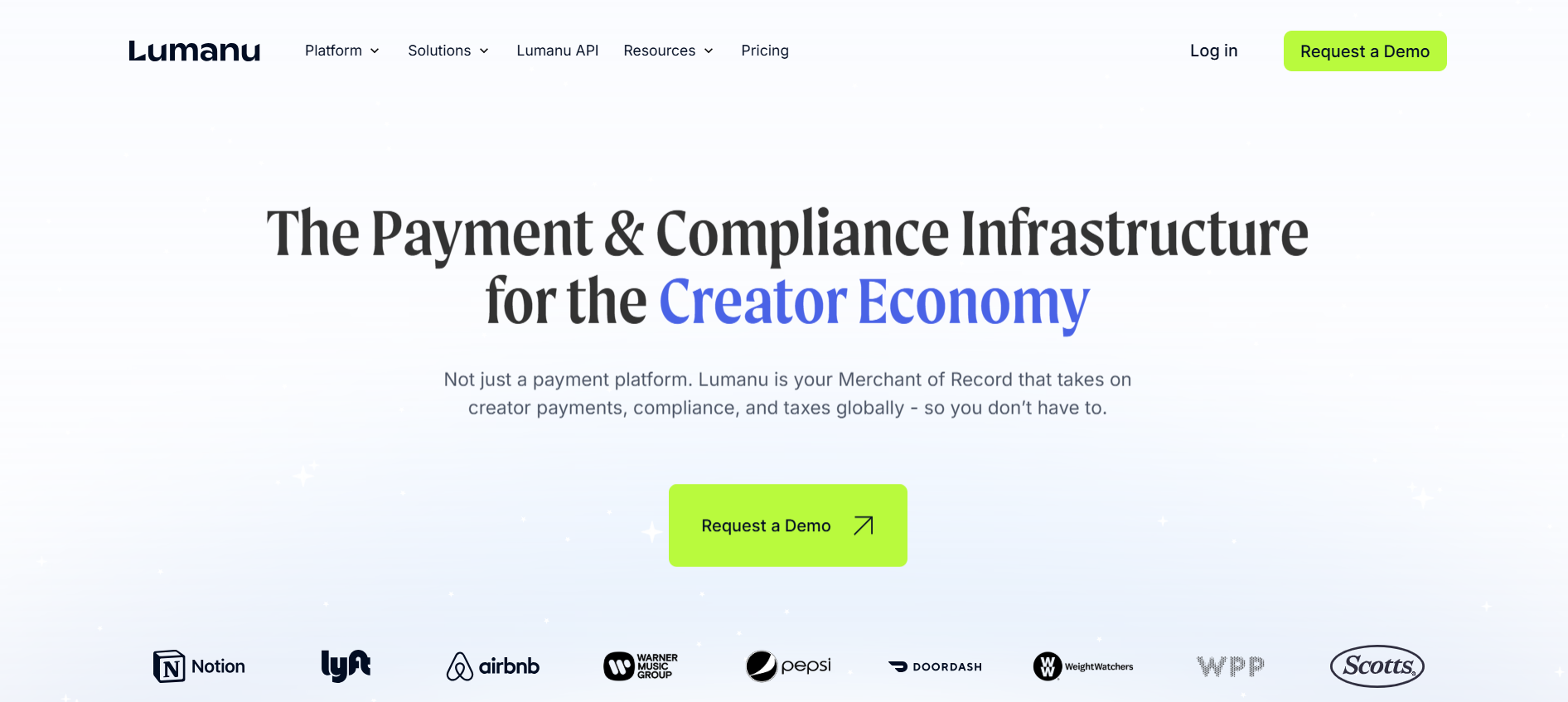
Lumanu is a creator payments platform focused on agencies and brands running influencer programs primarily in the US. It handles creator onboarding, payments, tax form collection, and offers an instant cashout feature for creators willing to pay a fee for accelerated access to funds.
Lumanu positions itself as the simple way to pay creators without finance teams needing to onboard them as vendors. The API is gated to enterprise customers and supports automated payment creation, recipient management, and webhooks for payment status events.
Pricing: Subscription plus per-payment fees, with custom enterprise tiers.
Pros
- Purpose-built for influencer and creator payouts rather than general accounts payable, which keeps the creator flow clean.
- Strong creator-side experience, including instant cashout for funds already approved by the brand.
- Familiar to US agencies and brands with established workflows around 1099 reporting and Form W-9 collection.
Cons
- US-centric coverage, with weaker support for EU-specific compliance such as DAC7, KSK, and KU14.
- API access is gated to enterprise tiers, which limits flexibility for smaller platforms evaluating the product technically.
- Lumanu does not act as Merchant of Record, so the platform still carries tax classification and reporting risk for its creator relationships.
Lumanu is a serious option for US agencies and brands operating mostly with US creators. The model gets thin when the creator base is European or global, because the compliance work moves back to the platform.
Gigapay was designed from a Stockholm base for European complexity first, then extended globally to 65+ countries. DAC7, KSK, and KU14 are core services rather than roadmap items, and the Merchant of Record contract sits underneath everything. For platforms with any meaningful EU exposure, that is the difference between a sleep-at-night setup and a compliance project.
6. PayPal Payouts
PayPal Payouts is the mass payout API inside the PayPal Hyperwallet stack, supporting payments to over 200 countries and territories. It is widely used by gaming platforms, affiliate networks, and creator programs that want a familiar consumer payout name on the creator's side.
The API supports batch payouts via REST, with recipient identification by email, phone number, or PayPal account ID, and webhooks for payout status updates.
Pricing: Per-transaction fees that vary by destination country and currency, with no platform subscription required to use the service.
Pros
- Broad creator recognition, as many creators already hold PayPal accounts and can receive funds without onboarding friction.
- No platform subscription fee, so cost scales directly with payout volume rather than starting at a floor.
- Coverage in 200+ countries makes it useful for very fragmented payee bases where building local rail relationships is impractical.
Cons
- Currency conversion costs and per-transaction fees can be high, particularly for non-USD corridors and small payment sizes.
- PayPal Payouts does not act as Merchant of Record and offers limited tax reporting features compared to dedicated creator-payout platforms.
- Creator support, dispute handling, and account freezes are PayPal-managed, which puts a third party between the platform and its creators when something goes wrong.
PayPal Payouts is the default when speed of integration matters more than commercial control. It stops being the right default when the platform needs predictable FX, automated EU tax reporting, and a creator experience that does not get gated by frozen PayPal accounts.
Gigapay holds the compliance layer, settles instantly through local rails, and operates as the single contractual counterparty so that the platform's relationship with the creator does not get interrupted by a third party's risk decisions.
The Real Cost of Manual Creator Payouts
A platform running 600 creator collaborations a year carries roughly €139,590 in annual admin cost when payouts are managed manually, based on Gigapay's published benchmark. That figure absorbs around 840 finance and operations hours spent onboarding creators as individual vendors, chasing missing tax documentation, processing invoices one at a time, and reconciling cross-border payments across multiple FX corridors.
The same volume on Gigapay's API runs at around €46,350 with about 60 admin hours, an 80% reduction in invoice volume, and a collapse of 300+ ERP vendor entries into a single contractual counterparty.
The math is the argument for moving from manual or AP-built infrastructure to a creator-specific payouts API earlier rather than later. Every quarter of delay compounds the headcount the platform has to add to keep the payment side functional, and the cost shows up first in creator support tickets, then in slipped campaigns, then in finance teams asking for permanent operations hires that exist only because the payment infrastructure cannot scale on its own.
The 2026 Compliance Snapshot for Creator Platforms
Four regulatory shifts have reshaped how creator platforms think about payout infrastructure between late 2025 and the first half of 2026.
1. DAC7 enforcement has matured across the EU
Platforms are now required to collect and report seller information annually for residents of all 27 member states. The reporting deadline for the 2025 calendar year fell at the end of January 2026, and the next cycle is already running.
Platforms that thought they could fold this into existing finance workflows are discovering the data model does not survive contact with reality at any meaningful volume of creators.
2.Germany’s KSK
Germany's Künstlersozialkasse continues to apply a 4.9% levy on payments to creators classified as artists or publicists, with the threshold sitting at €1,000 per year per platform. The levy applies even when the creator is not German-resident, as long as the paying entity is. For platforms with any German creator activity, the levy is mandatory and the reporting is annual.
3. Sweden's KU14
Sweden's KU14 reporting requirement covers payments to individuals for services rendered, including creator collaborations routed through Swedish entities. Gigapay handles this filing as part of its standard service.
4. UAE’s NMA
The UAE introduced an NMA influencer permit regime in 2026 that affects brands and creators operating in the country, including how international platforms structure payments to UAE-based creators, and the permit framework adds a new compliance check ahead of campaign activation.
European courts continued issuing decisions on influencer employment classification through 2025 and into 2026, with several rulings shifting parts of the relationship from contractor to employee status under specific conditions.
The legal counterparty model used by MoR payouts platforms gives engineering and finance teams a cleaner answer to the classification question, because the legal contract sits with the MoR rather than the brand or platform.
Why Platforms Choose Gigapay: Customer Proof
Brands and agencies running creator programs at scale have publicly credited Gigapay with removing the operational ceiling on their creator strategy.
- Boozt's Brand Activation Lead Christina Oliosi attributed a 3x increase in nano- and micro-influencer collaborations to Gigapay's onboarding model. The team had been blocked from scaling that segment for years because the per-creator finance overhead was untenable, and Gigapay removed that wall without requiring headcount growth on the operations side.
- The Goat Agency inside WPPMedia, described the resulting workflow as faster and consistently compliant across tax and benefit handling, which had previously been the bottleneck on running creator campaigns in multiple jurisdictions at once.
- Once Upon, a Nordic publisher running creator marketing programs, told Gigapay that a smooth payout process was the main reason behind selecting the platform.
- AdRecord's CEO described the combination of simplicity, accountability under the MoR contract, and the API integration as the reason the decision was straightforward.
How to Choose the Right Payouts API for Your Creator Platform
The decision is rarely about which API is technically best in isolation. It is about which API removes the most internal work, on the dimensions the platform's leadership actually loses sleep over.
- A platform serving mostly US creators with a small EU tail can run on Stripe Connect or PayPal Payouts and accept a manual compliance layer.
- A platform paying European creators at scale, with finance and legal teams watching DAC7 and the next KSK update, has a different reality.
Gigapay sits at the intersection of speed, compliance, and creator experience that EU-anchored platforms are converging on in 2026.
Conclusion
Gigapay is the payouts API that creator platforms reach for when scaling payments without compromising compliance is the priority.
The alternatives in this review each handle pieces of the problem well: Stripe Connect on developer experience, Tipalti on AP-heavy finance workflows, Trolley on geographic reach, Lumanu on US-centric agency flows, PayPal Payouts on ubiquity.
Gigapay is the only one in the list that combines Merchant of Record coverage, instant payouts through local rails, automated EU compliance reporting, and an API that integrates in days rather than months.
Book a demo with Gigapay and run your first creator batch through the API the same week your team signs.
Read Next:
- Mass Creator Payments in Europe: Everything Brands Need to Know in 2026
- Best Platforms to Pay International Social Media Influencers (2026 Review)
- The Gigapay API: Embedded Creator Payouts for Platforms, Networks, and Agencies
FAQs:
1. What is the best payouts API for creator platforms in 2026?
The best payouts API for creator platforms in 2026 is Gigapay, which combines Merchant of Record coverage, instant payouts to 65+ countries through local rails, automated DAC7 and KSK reporting, and a REST API that integrates in two to five days. Stripe Connect, Tipalti, Trolley, Lumanu, and PayPal Payouts each cover parts of the same problem, but only Gigapay absorbs the tax and administrative liability connected to purchasing the creator's deliverable.
2. How does a Merchant of Record payouts API differ from a standard payment processor?
A Merchant of Record payouts API differs from a standard payment processor by acting as the legal counterparty to the creator. The MoR formally purchases the creator's deliverable and resells it to the platform client, which means it takes on most administrative and legal responsibility connected to that purchase under its service agreement. A standard payment processor only moves money, leaving tax classification, reporting, and vendor onboarding on the platform.
3. How long does it take to integrate a payouts API into a creator platform?
Integration time for a payouts API into a creator platform ranges from two to five days with Gigapay's REST API to four to eight weeks with finance-grade AP platforms such as Tipalti. Speed depends on the quality of the documentation, the maturity of the sandbox environment, and how much custom reconciliation logic the platform's billing system requires.
4. Which payouts API handles DAC7 and KSK reporting for EU creators?
The payouts API that handles DAC7 and KSK reporting for EU creators is Gigapay, which files DAC7 across the EU, KSK in Germany, and KU14 in Sweden as part of its Merchant of Record service. Most other payouts APIs in the category, including Stripe Connect, Trolley, and PayPal Payouts, leave EU compliance reporting on the platform.
5. How much does a payouts API cost for a creator platform in 2026?
A payouts API for a creator platform in 2026 costs from €279 per month plus a 4.9% admin fee per payout on Gigapay's Base plan, with custom enterprise pricing tied to annual payout volume above €1.8M. Tipalti starts around $1,500 per month for Express. Stripe Connect charges 0.25% plus $0.25 per cross-border payout. PayPal Payouts charges per transaction with no subscription. Trolley and Lumanu use custom pricing tied to volume and feature tier.
.jpg)
.jpg)
.jpg)