.jpg)

US affiliate marketing spending is projected to climb past $13 billion in 2026, an increase of roughly 10% over 2025, according to eMarketer data reported by Cognitive Market Research.
Over 90% of ecommerce businesses are expected to run an affiliate program by the end of the year. Every dollar of that spend eventually has to land in a real person's bank account, often in another country, almost always with tax paperwork attached, and that is the part nobody puts in the deck.
This is where most affiliate programs quietly hit a wall. The marketing side scales fast because recruiting affiliates is easy, but the finance side scales linearly, because each new affiliate is another vendor record, another tax form, another invoice to chase.
Gigapay pays hundreds or thousands of affiliates through a single vendor relationship, taking on the tax and compliance responsibility as Merchant of Record rather than just moving the money.
The result is that your affiliate volume stops being limited by how many payouts your finance team can physically process. Here are the ten reasons that matter in 2026.
Key Takeaways
- Gigapay handles affiliate payouts as Merchant of Record, taking on the tax and legal liability.
- One vendor and one invoice replace hundreds of individual affiliate records in your ERP.
- Gigapay pays affiliates instantly across 65+ countries and 50+ currencies via local rails.
- Affiliates get paid through Gigapay without needing a registered business or VAT number.
- Automated DAC7, KSK, and KU14 reporting keeps cross-border affiliate payouts compliant by default.
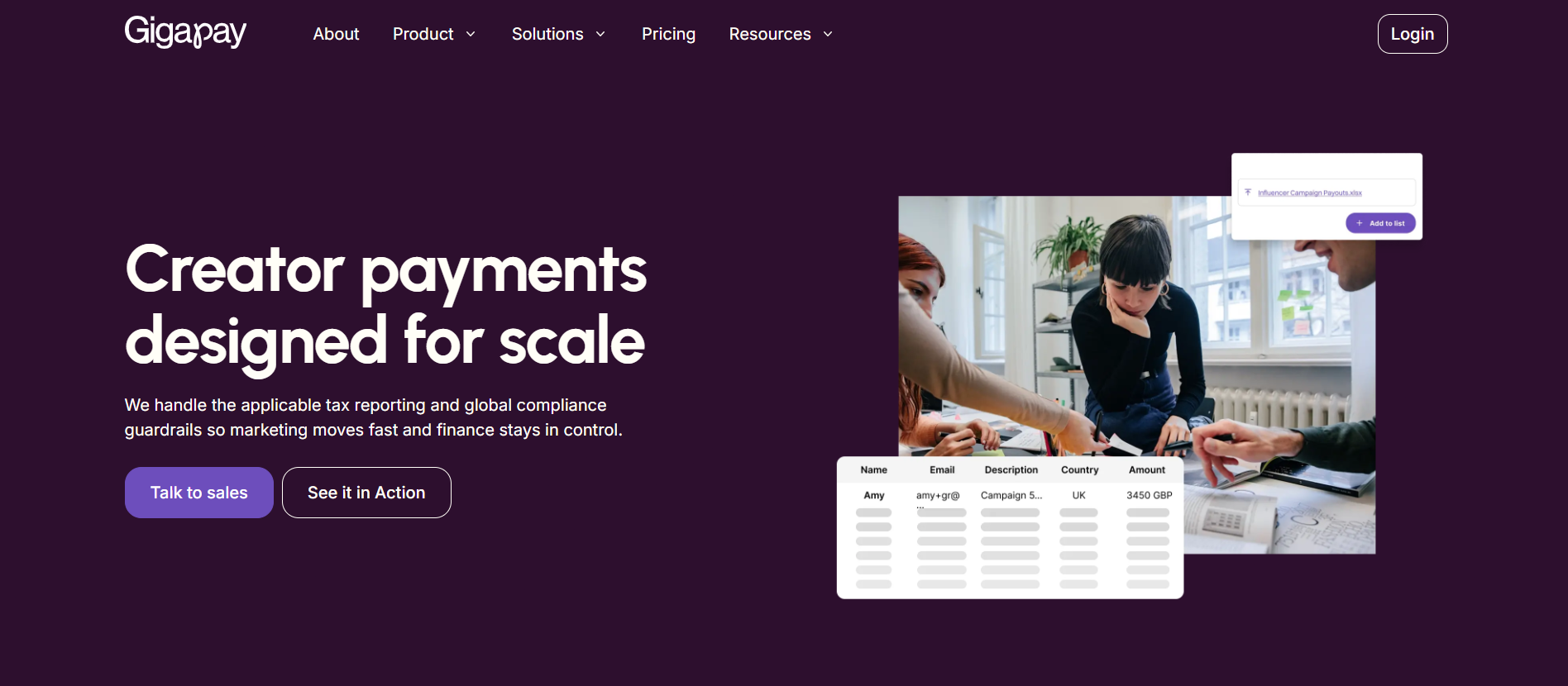
Top 10 Benefits of Using Gigapay for Affiliate Payouts in 2026
1. One vendor in your ERP, no matter how many affiliates you pay
The first thing finance notices is what disappears from the books. Instead of opening a separate vendor record for every affiliate you work with, you open one for Gigapay.
A program running 300 active affiliates moves from 300-plus individual entries in the ERP to a single vendor entry. That single relationship covers one contract and one consolidated invoice regardless of whether you paid fifty affiliates this month or five thousand.
For finance teams, the win is that the ledger stops growing every time marketing recruits another partner.
2. Gigapay takes on the tax and legal liability as Merchant of Record
This is the benefit that separates Gigapay from a payment processor. As Merchant of Record, Gigapay formally buys the affiliate's deliverable and resells it to you, becoming the contractual counterpart and taking over most of the administrative and legal responsibilities connected to that purchase.
It is worth being precise about the boundary: in its Merchant of Record capacity, Gigapay handles tax reporting rather than withholding social security or making insurance contributions, and each party still complies with its own tax obligations under applicable law.
The point is that the compliance weight shifts off your finance team and onto the company contractually built to carry it.
3. Pay affiliates in 65+ countries and 50+ currencies
Affiliate programs go global faster than finance infrastructure does. You recruit a strong partner in Brazil or Germany, and then someone has to figure out how to actually pay them.
Gigapay supports payouts across 65+ countries and 50+ currencies, with funding available in USD, EUR, GBP, SEK, DKK, and NOK.
That means a single program can pay affiliates in markets your bank treats as a special project, without you building separate processes for each one.
4. Affiliates get paid instantly through local payment rails
Slow payouts are the fastest way to lose a good affiliate. Gigapay pays affiliates instantly by routing payments through local rails rather than slow international transfers, using SEPA Instant in the EU, Faster Payments in the UK, and ACH in the US.
For the affiliate, the difference is between money that arrives while the campaign is still fresh in their mind and money that shows up two weeks later. Fast, reliable payment is one of the cheapest forms of affiliate retention there is.
5. No business or VAT registration required from affiliates
Plenty of your best potential affiliates are individuals, not registered companies, and that single fact blocks more partnerships than most programs realise.
With Gigapay, affiliates can onboard as an individual, a sole trader, or a company, and they do not need a registered business or VAT number to get paid.
Boozt used this to finally work with nano and micro creators it had tried to onboard for years, reaching a 3x increase in collaborations without expanding the team.
The same removal of friction applies to affiliates: the partners you used to turn away on paperwork become partners you can activate.
6. Automated tax reporting handles DAC7, KSK, and KU14
Cross-border affiliate payouts come with reporting obligations that are easy to miss until a regulator points them out. Gigapay automates the reporting that applies to platform-economy and creative payments, including:
- DAC7, the EU's reporting regime for platform and digital-economy income
- KSK (Künstlersozialkasse) in Germany, a 4.9% levy on qualifying creative payments over €1,000 that can apply even when you hire internationally
- KU14 in Sweden
The handling is built into the payout flow, so compliance happens as a byproduct of paying people rather than as a separate quarterly fire drill. That is the difference between a program that can confidently expand into new markets and one that hesitates every time a partner is in an unfamiliar jurisdiction.
7. Up to 80% fewer invoices through consolidated and self-billing
Invoice volume is the hidden tax on a growing affiliate program. Gigapay consolidates payouts into one invoice per campaign or batch instead of hundreds of separate ones, and its self-billing automation generates invoices on behalf of affiliates so they do not have to.
Programs using this see invoice volume drop by around 80%. For the finance team, that is the difference between an inbox full of mismatched affiliate invoices and a single document that reconciles cleanly.
8. An API-first design that fits inside your affiliate platform
Most affiliate networks already run their own tracking and dashboard, so the payout layer needs to fit underneath what they have, not replace it.
Gigapay is built API-first, with a REST API, webhooks for event-driven workflows, and sandbox and production environments, and a full integration typically takes two to five days.
AdRecord, a performance and affiliate network, built Gigapay directly into its stack, with its CEO describing the combination of simplicity, responsibility, and API integration as a straightforward decision.
If you can call an API or upload a CSV, you can run payouts through your existing platform.
9. EarlyPay gives affiliates faster access to their earnings
Affiliate loyalty is built on whether you pay well and pay quickly. Gigapay's Earlypay feature lets affiliates access scheduled funds early, which matters most to the partners who treat affiliate income as real income rather than a bonus. Combined with a dedicated human support team, this is part of why Gigapay reports a creator net promoter score of 88.
A program where partners feel they are paid fairly and fast is a program that holds onto its best affiliates instead of constantly re-recruiting.
10. Scale your affiliate program without adding finance headcount
The whole case comes together in the operating cost. Gigapay's own modelling, based on a brand running 600 creator collaborations a year, puts the manual cost of payouts at around €139,590 annually across roughly 840 admin hours, versus around €46,350 with Gigapay across about 60 hours.
That is admin time falling from 840 hours to 60.
The strategic version of that number is simple: your affiliate program can grow from 50 to 5,000 partners without a single new finance hire, because the work that used to scale with partner count now sits with one vendor.
How to Start Paying Affiliates with Gigapay in 2026
Getting from your current setup to paid affiliates is a short process, and most of it is onboarding rather than engineering. The flow looks like this.
- Choose your plan: Start on the Base plan at €279 per month plus a 4.9% fee per payout, or talk to sales about Enterprise pricing if your program pays out €1.8 million or more a year and you want EarlyPay and a dedicated customer success manager included.
- Connect Gigapay to your workflow: Upload a CSV of your affiliates and amounts, or integrate the REST API, which usually takes two to five days and comes with sandbox and production environments so you can test before you pay anyone real money.
- Onboard your affiliates: Affiliates complete KYC and KYB identity verification and register as an individual, a sole trader, or a company, with no registered business or VAT number required from them.
- Fund the batch: Top up in USD, EUR, GBP, SEK, DKK, or NOK, and Gigapay issues one consolidated invoice for the whole batch instead of hundreds of separate ones.
- Send the payout: Run the batch and your affiliates are paid instantly through local rails, with EarlyPay available for anyone who wants their funds ahead of schedule.
From spreadsheets to paid affiliates, the whole flow is something one person can run, which is the entire point of moving payouts to a single vendor.
Conclusion
Affiliate spending is heading past $13 billion in the US alone in 2026, and the programs that win will be the ones whose growth is not throttled by how many payouts finance can survive.
Gigapay removes that ceiling by becoming a single vendor that pays affiliates instantly, in their own currency, with tax compliance handled as Merchant of Record.
Book a demo and see Gigapay pay a full affiliate batch instantly, in their own currency, from one invoice.
Read Next:
- How Gigapay Validates Creator Tax IDs Across 65 Countries
- Best Merchant of Record for Creator Payments in 2026
- What is Gigapay Earlypay and How Does it Work?
FAQs:
1. How does Gigapay handle tax compliance for affiliate payouts?
Gigapay handles tax compliance for affiliate payouts as Merchant of Record, meaning it becomes the contractual counterparty and takes over most of the administrative and legal responsibility connected to the purchase. It automates the relevant reporting, including DAC7 in the EU, KSK in Germany, and KU14 in Sweden. Note that in its Merchant of Record capacity, Gigapay handles tax reporting rather than withholding social security, and each party still meets its own tax obligations under applicable law.
2. Can affiliates without a registered business get paid through Gigapay?
Yes, affiliates without a registered business can get paid through Gigapay. They can onboard as an individual, a sole trader, or a company, and no registered business or VAT number is required to receive payment. This lets programs activate individual and micro-affiliates who would otherwise be blocked by company-registration requirements.
3. How fast does Gigapay pay affiliates?
Gigapay pays affiliates instantly by routing payments through local payment rails such as SEPA Instant in the EU, Faster Payments in the UK, and ACH in the US. That speed reaches affiliates in 65+ countries, so partners receive their money while the campaign is still current rather than weeks later.
4. How much does it cost to pay affiliates through Gigapay?
Paying affiliates through Gigapay starts at €279 per month on the Base plan plus a 4.9% fee per payout. Programs paying out €1.8 million or more a year can move to Enterprise pricing, which adds EarlyPay, a dedicated customer success manager, and volume-based discounts.
5. How long does it take to integrate Gigapay with an affiliate platform?
Integrating Gigapay with an affiliate platform typically takes two to five days. It is built API-first with a REST API, webhooks, and separate sandbox and production environments, so it sits underneath an existing tracking platform rather than replacing it. Programs that prefer not to integrate can run payouts by uploading a CSV instead.
.jpg)
.jpg)